PUBLISHER: Mordor Intelligence | PRODUCT CODE: 2121636

PUBLISHER: Mordor Intelligence | PRODUCT CODE: 2121636
Middle East And Africa Paper Packaging - Market Share Analysis, Industry Trends & Statistics, Growth Forecasts (2026 - 2031)
According to Mordor Intelligence, Middle East and Africa paper packaging market size in 2026 is estimated at USD 26.83 billion, growing from 2025 value of USD 25.42 billion with 2031 projections showing USD 35.13 billion, growing at 5.54% CAGR over 2026-2031.
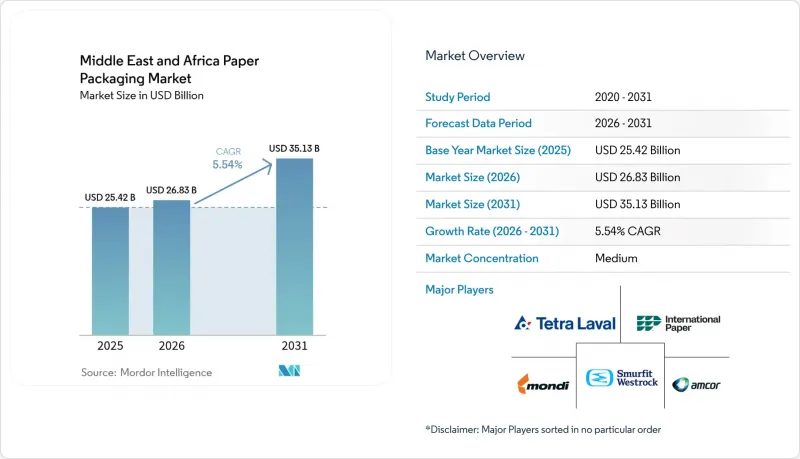
This report is Segmented by Material Type (Kraft Paper, Paperboard, and More), Product Type (Flexible, Rigid), Packaging Format (Primary, Secondary, Tertiary), End-Use Industry (Food, Beverage, Healthcare and Pharmaceuticals, and More), and Geography (Saudi Arabia, United Arab Emirates, Rest of Middle East, South Africa, Nigeria, Kenya, Rest of Africa). Market Forecasts are in Value (USD).
Middle East And Africa Paper Packaging Market Trends and Insights
Accelerating E-Commerce Fulfillment Volumes
Mobile-enabled shopping, same-day delivery promises, and digital marketplaces have driven parcel counts sharply higher in major consumer corridors since 2024. Every additional shipped box raises corrugated demand, but rising SKU complexity now favors converters that integrate hybrid digital-flexo print lines capable of on-demand graphics. Order cycles have shortened from weeks to days, compelling plants to adopt AI-based planning tools that squeeze idle time and release working capital. Brand owners are increasingly specifying box formats that eliminate void-fill plastics and utilize lightweight containerboard to meet carrier weight thresholds and Extended Producer Responsibility fees. Converters can maintain consistent flute profiles while running variable graphics and capturing above-market margins by reducing clients' inventory carry costs.
Government Plastic Phase-Out Regulations
Nigeria's 2024 single-use ban, Kenya's expanded restrictions, the UAE's degradability rules, and Ethiopia's Addis Ababa mandates have triggered a measurable shift to fiber solutions across food service and retail. Compliance accelerates the demand for dispersion-coated paper that withstands grease and moisture while remaining recyclable in existing mills. Enforcement inconsistencies create arbitrage opportunities: converters with ISO 14001 certifications secure public-sector tenders, whereas their non-certified peers face ad-hoc audits and contract penalties. Equipment upgrades to curtain-coating lines and inline barrier inspection systems are required investments; however, converters recover their costs through premium prices on certified mono-material formats. Regional chemical suppliers gain a pipeline of bio-based coating volumes that displace polyethylene laminations.
Frequent Cost Volatility in Recycled Fiber Import Feedstock
European export restrictions and Asian buying spikes drove recycled fiber prices to EUR 1,380 per metric ton in April 2024, inflating raw-material costs for Middle East and African mills that import more than 70% of their feedstock. Gross margin compression of 200-300 basis points followed as converters absorbed surges to preserve long-term contracts. Buyers began requesting quarterly price-adjustment clauses, but smaller converters lacked the leverage to counter these demands and risked losing orders. Vertically integrated players with captive OCC collection offset volatility and gained share, widening the cost gap versus spot purchasers. Working-capital pressure forced some independents to temporarily shutter their lines, underscoring the feedstock risk premium inherent in the Middle East and Africa paper packaging market.
Other drivers and restraints analyzed in the detailed report include:
- Rising Fresh Produce Exports Requiring Corrugated Solutions
- Rapid Expansion of Quick Service Restaurants
- Chronic Power Supply Instability in Sub-Saharan Manufacturing Hubs
For complete list of drivers and restraints, kindly check the Table Of Contents.
Segment Analysis
Corrugated board generated 55.01% of 2025 material revenue thanks to sturdy, low-cost secondary and tertiary transit roles across food and industrial supply chains. The Middle East and Africa paper packaging market size for corrugated paper is projected to trail paperboard through 2031, as carton demand in the QSR and personal care sectors outpaces bulk shipping volumes. Paperboard's 7.32% CAGR reflects lightweight substrates that support high-definition graphics, portion control, and shelf impact, enabling brand segregation in crowded retail aisles. Kraft paper continues to serve bakery wraps, yet faces substitution by coated paperboard, which delivers superior moisture barriers.
Converters installing inline coating and digital print stations on paperboard lines lock in higher margins by catering to premium cosmetic SKUs. MEPCO's SAR 1.78 billion fifth line will add 450,000 metric tons of recycled containerboard, reinforcing corrugated supply, while molded-pulp niches rise in electronics protection. Integrated mills that optimize furnish recipes between testliner and medium grades can flex their output around e-commerce spikes, thereby buffering the Middle East and Africa paper packaging market against pulp shocks.
Rigid formats accounted for 65.85% of 2025 revenue, primarily driven by folding cartons and corrugated cases. However, flexible paper pouches, bags, and wraps are expected to post a 6.63% CAGR through 2031, as regulators increasingly clamp down on multilayer plastics. The Middle East and Africa paper packaging market size for flexible grades remains smaller but benefits from bio-dispersion coatings that enable high-moisture foods to shift away from laminated films without sacrificing shelf life. Bakery and confectionery packs are already shifting to paper-based pouches, which reduce system costs, as Extended Producer Responsibility fees penalize plastics.
Huhtamaki's South African molded-fiber expansion signals demand for rigid trays that displace PET. Meanwhile, converters with gravure-coating towers introduce barrier wraps for frozen foods, adding premium throughput. Integrating digital presses on flexible lines enables suppliers to quickly batch-code promotions and language versions, which is vital in multi-lingual markets. Rigid corrugated will still dominate bulk transit, but flexible formats provide a double-digit margin opportunity where weight reduction, source reduction, and recyclability converge.
Complete Report Scope:
- By Material Type
- Kraft Paper
- Paperboard
- Corrugated Board
- Other Material Types
- By Product Type
- Flexible Paper Packaging
- Rigid Paper Packaging
- By Packaging Format
- Primary Packaging
- Secondary Packaging
- Tertiary / Transit Packaging
- By End-Use Industry
- Food
- Beverage
- Healthcare and Pharmaceuticals
- Personal Care and Cosmetics
- Industrial and Electronic
- Other End-Use Industries
- By Middle East and Africa
- By Middle East
- Saudi Arabia
- United Arab Emirates
- Rest of Middle East
- By Africa
- South Africa
- Nigeria
- Kenya
- Rest of Africa
- By Middle East
List of Companies Covered in this Report:
- Amcor Plc
- International Paper Company
- Mondi Plc
- Smurfit WestRock
- Tetra Laval International S.A.
- Sonoco Products Company
- Stora Enso Oyj
- Huhtamaki Oyj
- Nippon Paper Industries Co., Ltd.
- Oji Holdings Corporation
- Metsa Board Corporation
- Georgia-Pacific LLC
- Nampak Ltd
- Indevco Group
- Al Bayader International LLC
- Rotopak LLC
- Sealed Air Corporation
- Crown Paper Mill Ltd
Additional Benefits:
- The market estimate (ME) sheet in Excel format
- 3 months of analyst support
TABLE OF CONTENTS
1 INTRODUCTION
- 1.1 Study Assumptions and Market Definition
- 1.2 Scope of the Study
2 RESEARCH METHODOLOGY
3 EXECUTIVE SUMMARY
4 MARKET LANDSCAPE
- 4.1 Market Overview
- 4.2 Market Drivers
- 4.2.1 Accelerating E-Commerce Fulfillment Volumes
- 4.2.2 Government Plastic Phase-Out Regulations
- 4.2.3 Rising Fresh Produce Exports Requiring Corrugated Solutions
- 4.2.4 Rapid Expansion of Quick Service Restaurants (QSRs)
- 4.2.5 Growing Adoption of Smart Water-Barrier Coated Papers
- 4.2.6 On-Site Digital Printing on Corrugated for Brand Localization
- 4.3 Market Restraints
- 4.3.1 Frequent Cost Volatility in Recycled Fiber Import Feedstock
- 4.3.2 Chronic Power Supply Instability in Sub-Saharan Manufacturing Hubs
- 4.3.3 Limited Regional Forestry Resources Increasing Pulp Dependency
- 4.3.4 Inefficient Intermodal Logistics Raising Delivery Lead Times
- 4.4 Industry Value Chain Analysis
- 4.5 Regulatory Landscape
- 4.6 Technological Outlook
- 4.7 Porter's Five Forces Analysis
- 4.7.1 Bargaining Power of Suppliers
- 4.7.2 Bargaining Power of Buyers
- 4.7.3 Threat of New Entrants
- 4.7.4 Intensity of Competitive Rivalry
- 4.7.5 Threat of Substitutes
- 4.8 Impact of Macroeconomic Factors on the Market
5 MARKET SIZE AND GROWTH FORECASTS (VALUE)
- 5.1 By Material Type
- 5.1.1 Kraft Paper
- 5.1.2 Paperboard
- 5.1.3 Corrugated Board
- 5.1.4 Other Material Types
- 5.2 By Product Type
- 5.2.1 Flexible Paper Packaging
- 5.2.2 Rigid Paper Packaging
- 5.3 By Packaging Format
- 5.3.1 Primary Packaging
- 5.3.2 Secondary Packaging
- 5.3.3 Tertiary / Transit Packaging
- 5.4 By End-Use Industry
- 5.4.1 Food
- 5.4.2 Beverage
- 5.4.3 Healthcare and Pharmaceuticals
- 5.4.4 Personal Care and Cosmetics
- 5.4.5 Industrial and Electronic
- 5.4.6 Other End-Use Industries
- 5.5 By Middle East and Africa
- 5.5.1 By Middle East
- 5.5.1.1 Saudi Arabia
- 5.5.1.2 United Arab Emirates
- 5.5.1.3 Rest of Middle East
- 5.5.2 By Africa
- 5.5.2.1 South Africa
- 5.5.2.2 Nigeria
- 5.5.2.3 Kenya
- 5.5.2.4 Rest of Africa
- 5.5.1 By Middle East
6 COMPETITIVE LANDSCAPE
- 6.1 Market Concentration
- 6.2 Strategic Moves
- 6.3 Market Share Analysis
- 6.4 Company Profiles (includes Global Level Overview, Market Level Overview, Core Segments, Financials as available, Strategic Information, Market Rank/Share for Key Companies, Products and Services, and Recent Developments)
- 6.4.1 Amcor Plc
- 6.4.2 International Paper Company
- 6.4.3 Mondi Plc
- 6.4.4 Smurfit WestRock
- 6.4.5 Tetra Laval International S.A.
- 6.4.6 Sonoco Products Company
- 6.4.7 Stora Enso Oyj
- 6.4.8 Huhtamaki Oyj
- 6.4.9 Nippon Paper Industries Co., Ltd.
- 6.4.10 Oji Holdings Corporation
- 6.4.11 Metsa Board Corporation
- 6.4.12 Georgia-Pacific LLC
- 6.4.13 Nampak Ltd
- 6.4.14 Indevco Group
- 6.4.15 Al Bayader International LLC
- 6.4.16 Rotopak LLC
- 6.4.17 Sealed Air Corporation
- 6.4.18 Crown Paper Mill Ltd
7 MARKET OPPORTUNITIES AND FUTURE OUTLOOK
- 7.1 White-Space and Unmet-Need Assessment

