PUBLISHER: Mordor Intelligence | PRODUCT CODE: 2121638

PUBLISHER: Mordor Intelligence | PRODUCT CODE: 2121638
Portable Ultrasound Devices - Market Share Analysis, Industry Trends & Statistics, Growth Forecasts (2026 - 2031)
According to Mordor Intelligence, the portable ultrasound devices market size is expected to grow from USD 2.78 billion in 2025 to USD 2.89 billion in 2026 and is forecast to reach USD 3.57 billion by 2031 at 4.31% CAGR over 2026-2031.
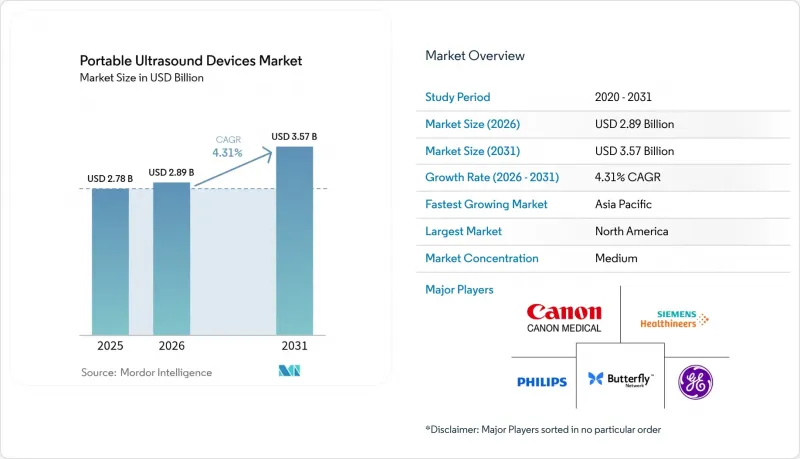
This report is Segmented by Device Type (Handheld, Mobile/Cart-based, Wearable & Tablet-Based), Technology (2D, 3D/4D, Doppler), Application (Obstetrics & Gynecology, Cardiovascular, Urology & Renal, Musculoskeletal, and More), End User (Hospitals, Ascs, Diagnostic Centers, Maternity Centers, Home Care & Telehealth), and Geography. Market Forecasts are in Value (USD).
Global Portable Ultrasound Devices Market Trends and Insights
Rising Demand for Point-of-Care Diagnostics in Emergency and Critical-Care Settings
Emergency departments now integrate handheld scanners into triage because bedside ultrasound reduces time to diagnosis for shock, pneumothorax, and cardiac arrest by 30-40% compared with conventional pathways. ACEP's 2024 statement classifies 11 core POCUS exams as mandatory competencies, making device access an accreditation requirement. Hospitals respond by equipping crash carts with pocket-sized probes that start imaging within seconds. Pilot EMS programs show that paramedics who received 8 hours of training achieved 85% sensitivity for detecting trauma-free fluid, foreshadowing broader prehospital use. Immediate revenue comes from emergency department capital budgets, while future growth hinges on alignment with EMS reimbursement.
Technological Miniaturization & AI-Enabled Imaging Improve Usability and Image Quality
Silicon-based CMUT arrays are now measuring under 2 mm thick, enabling patch and wrist-worn probes without compromising B-mode fidelity. Butterfly's iQ3 unites a single-chip CMUT with on-device AI, shortening novice exam times by 35%. Philips added AI Auto Measure to Lumify, delivering cardiac ejection fraction calculations that agree within 5% of expert readings. GE Healthcare's Caption Guidance overlays coaching prompts until anatomical landmarks align, lifting image quality among first-year residents. Hospitals typically refresh portable fleets every 3 to 4 years, so AI-enabled models will steadily replace legacy units over the medium term.
High Upfront Cost & Uneven Reimbursement Policies
Handhelds priced at USD 5,000-15,000 remain beyond the reach of rural clinics, where per-capita health spending is under USD 200. CMS reimburses CPT 76604, yet private insurers often impose prior authorization that delays payment 30-60 days. Germany pays for specific POCUS indications, whereas France limits outpatient reimbursement, illustrating European fragmentation. Subscription fees still overshoot budgets for many sub-Saharan posts. Price-sensitive buyers will postpone purchases until list prices drop below USD 3,000 or payers guarantee prompt reimbursement.
Other drivers and restraints analyzed in the detailed report include:
- Growing Burden of Chronic Diseases Necessitating Accessible Imaging Solutions
- 5G-Enabled Tele-Ultrasound Platforms Extending Reach to Rural & EMS Environments
- Shortage of Trained Operators; Lack of Standardized Frameworks
For complete list of drivers and restraints, kindly check the Table Of Contents.
Segment Analysis
Handheld units generated 57.12% of revenue in 2025 and were driven by imaging presets. That share will gradually cede ground as wearables and tablet-based scanners post a 7.06% CAGR to 2031. Hospitals still value cart platforms for complex Doppler and 3D tasks, yet handhelds now meet quality thresholds for most bedside exams, keeping the portable ultrasound devices market size weighted toward ultra-mobile form factors. Wearable bladder-monitoring patches under development promise 48-hour data streams without user intervention, extending reach into chronic-disease home monitoring. As chip-level CMUT integration lowers the bill of materials, vendors will differentiate less on hardware and more on AI workflows, subscription analytics, and interoperability.
Tablet-based offerings such as GE Vscan Air CL bridge screen real estate gaps, pairing wireless probes with consumer tablets for field trauma triage. They deliver enough processing to display dual-mode Doppler overlays while still fitting paramedic kits. The portable ultrasound devices market continues to price-segment by use case: handhelds for broad bedside adoption, tablets for transport teams, carts for high-throughput echo labs, and wearables for longitudinal disease management. Each slice grows, but wearables accelerate fastest as power-management miniaturization and soft-transducer research converge.
2D imaging maintained a 49.58% share in 2025, thanks to its longstanding roles in obstetrics, emergency care, and procedures. Yet GPU advances now on the horizon enable real-time volumetric rendering that was once workstation-exclusive; consequently, 3D/4D will grow at a 6.39% CAGR through 2031. Doppler modes still underpin cardiac and vascular care, representing roughly 30% of portable exams. AI now augments baseline 2D performance: Philips Auto Follicle cuts fertility clinic exam time by 40%, proving that software keeps 2D relevant. Residency programs have lagged in volumetric curricula only 18% covered 3D in 2024 slows adoption. Vendors counter with synchronized 2D-3D views that let clinicians validate new planes against familiar slices. Over time, portability will be defined less by transducer physics and more by the software toolchain deployed on edge devices.
Complete Report Scope:
- By Device Type
- Handheld
- Mobile/Cart-based
- Wearable & Tablet-based
- By Technology
- 2D Ultrasound
- 3D/4D Ultrasound
- Doppler Imaging
- By Application
- Obstetrics & Gynecology
- Cardiovascular
- Urology & Renal
- Musculoskeletal
- Anesthesiology & Critical Care
- Emergency Medicine & Trauma
- Abdominal & General Imaging
- By End User
- Hospitals
- Ambulatory Surgical Centers
- Diagnostic Imaging Centers
- Maternity Centers & Fertility Clinics
- Home Care & Telehealth
- By Geography
- North America
- United States
- Canada
- Mexico
- Europe
- Germany
- United Kingdom
- France
- Italy
- Spain
- Rest of Europe
- Asia-Pacific
- China
- Japan
- India
- Australia
- South Korea
- Rest of Asia-Pacific
- Middle East & Africa
- GCC
- South Africa
- Rest of Middle East & Africa
- South America
- Brazil
- Argentina
- Rest of South America
- North America
Geography Analysis
North America contributed 32.98% revenue in 2025 as CMS added CPT 76604 for tele-interpreted scans and FDA-cleared Butterfly iQ3, GE Vscan Air CL, and Philips Lumify within the same year. Canada's First Nations program reduced obstetric medevacs by 35% by equipping nurses with handheld probes. Mexico's social security fund ordered 2,500 handheld units for rural clinics, underscoring emerging-market appetite within the hemisphere. Market saturation in urban hospitals pushes vendors toward veterinary practices, home care suppliers, and critical-access facilities.
Asia-Pacific will expand at a 5.76% CAGR through 2031. China's township health center procurement, backed by NMPA approvals for Mindray, Sonoscape, and Edan, already exceeds 40% of the domestic market share. India cleared 18 new models in 2024, many priced below USD 3,000, enabling penetration into tier-3 cities. Japan embedded home-based cardiac ultrasound into long-term care insurance, and Australia's Royal Flying Doctor Service halved diagnostic delays in remote outback clinics. South Korea expanded insurance coverage for emergency POCUS, prompting upgrades at trauma centers.
- GE Healthcare
- Koninklijke Philips
- FUJIFILM
- Canon
- Siemens Healthineers
- Mindray
- Samsung Group
- Butterfly Network Inc.
- Clarius Mobile Health Corp.
- Esaote
- Terason Corporation
- Konica Minolta Healthcare
- Sonoscape Medical Corp.
- Fukuda Denshi Co., Ltd.
- VaveHealth
- Edan Instruments Inc.
- EchoNous Inc.
- Beijing Konted Medical Technology Co.
- Promed Technology Co., Ltd.
- EchoNous, Inc.
Additional Benefits:
- The market estimate (ME) sheet in Excel format
- 3 months of analyst support
TABLE OF CONTENTS
1 Introduction
- 1.1 Study Assumptions & Market Definition
- 1.2 Scope of the Study
2 Research Methodology
3 Executive Summary
4 Market Landscape
- 4.1 Market Overview
- 4.2 Market Drivers
- 4.2.1 Rising Demand for Point-Of-Care Diagnostics in Emergency and Critical-Care Settings
- 4.2.2 Technological Miniaturization & AI-Enabled Imaging Improve Usability and Image Quality
- 4.2.3 Growing Burden of Chronic Diseases Necessitating Accessible Imaging Solutions
- 4.2.4 5G-Enabled Tele-Ultrasound Platforms Extending Reach to Rural & EMS Environments
- 4.2.5 Subscription & Pay-Per-Use Models Lowering Capital Barriers for Smaller Providers
- 4.2.6 Increased Adoption in Home Healthcare Segments
- 4.3 Market Restraints
- 4.3.1 High Upfront Cost & Uneven Reimbursement Policies
- 4.3.2 Shortage of Trained Operators; Lack of Standardized Training Frameworks
- 4.3.3 Cyber-Security and Data-Privacy Risks with Wireless Handheld Devices
- 4.3.4 Regulatory Variability Affecting Global Market Entry
- 4.4 Regulatory Landscape
- 4.5 Technological Outlook
- 4.6 Porter's Five Forces Analysis
- 4.6.1 Threat of New Entrants
- 4.6.2 Bargaining Power of Buyers
- 4.6.3 Bargaining Power of Suppliers
- 4.6.4 Threat of Substitute Products
- 4.6.5 Intensity of Competitive Rivalry
5 Market Size & Growth Forecasts
- 5.1 By Device Type
- 5.1.1 Handheld
- 5.1.2 Mobile/Cart-based
- 5.1.3 Wearable & Tablet-based
- 5.2 By Technology
- 5.2.1 2D Ultrasound
- 5.2.2 3D/4D Ultrasound
- 5.2.3 Doppler Imaging
- 5.3 By Application
- 5.3.1 Obstetrics & Gynecology
- 5.3.2 Cardiovascular
- 5.3.3 Urology & Renal
- 5.3.4 Musculoskeletal
- 5.3.5 Anesthesiology & Critical Care
- 5.3.6 Emergency Medicine & Trauma
- 5.3.7 Abdominal & General Imaging
- 5.4 By End User
- 5.4.1 Hospitals
- 5.4.2 Ambulatory Surgical Centers
- 5.4.3 Diagnostic Imaging Centers
- 5.4.4 Maternity Centers & Fertility Clinics
- 5.4.5 Home Care & Telehealth
- 5.5 By Geography
- 5.5.1 North America
- 5.5.1.1 United States
- 5.5.1.2 Canada
- 5.5.1.3 Mexico
- 5.5.2 Europe
- 5.5.2.1 Germany
- 5.5.2.2 United Kingdom
- 5.5.2.3 France
- 5.5.2.4 Italy
- 5.5.2.5 Spain
- 5.5.2.6 Rest of Europe
- 5.5.3 Asia-Pacific
- 5.5.3.1 China
- 5.5.3.2 Japan
- 5.5.3.3 India
- 5.5.3.4 Australia
- 5.5.3.5 South Korea
- 5.5.3.6 Rest of Asia-Pacific
- 5.5.4 Middle East & Africa
- 5.5.4.1 GCC
- 5.5.4.2 South Africa
- 5.5.4.3 Rest of Middle East & Africa
- 5.5.5 South America
- 5.5.5.1 Brazil
- 5.5.5.2 Argentina
- 5.5.5.3 Rest of South America
- 5.5.1 North America
6 Competitive Landscape
- 6.1 Market Concentration
- 6.2 Market Share Analysis
- 6.3 Company Profiles (includes Global level Overview, Market level overview, Core Segments, Financials as available, Strategic Information, Market Rank/Share for key companies, Products & Services, and Recent Developments)
- 6.3.1 GE Healthcare
- 6.3.2 Koninklijke Philips N.V.
- 6.3.3 Fujifilm SonoSite Inc.
- 6.3.4 Canon Medical Systems Corp.
- 6.3.5 Siemens Healthineers
- 6.3.6 Shenzhen Mindray Bio-Medical Electronics Co., Ltd.
- 6.3.7 Samsung Medison Co., Ltd.
- 6.3.8 Butterfly Network Inc.
- 6.3.9 Clarius Mobile Health Corp.
- 6.3.10 Esaote SpA
- 6.3.11 Terason Corporation
- 6.3.12 Konica Minolta Healthcare
- 6.3.13 Sonoscape Medical Corp.
- 6.3.14 Fukuda Denshi Co., Ltd.
- 6.3.15 VaveHealth
- 6.3.16 Edan Instruments Inc.
- 6.3.17 EchoNous Inc.
- 6.3.18 Beijing Konted Medical Technology Co.
- 6.3.19 Promed Technology Co., Ltd.
- 6.3.20 EchoNous, Inc.
7 Market Opportunities & Future Outlook
- 7.1 White-space & Unmet-Need Assessment

