PUBLISHER: Mordor Intelligence | PRODUCT CODE: 2121641

PUBLISHER: Mordor Intelligence | PRODUCT CODE: 2121641
Polyolefin (PO) - Market Share Analysis, Industry Trends & Statistics, Growth Forecasts (2026 - 2031)
According to Mordor Intelligence, the polyolefin market size is expected to grow from USD 240.49 billion in 2025 to USD 257.61 billion in 2026 and is forecast to reach USD 363.39 billion by 2031 at 7.12% CAGR over 2026-2031.
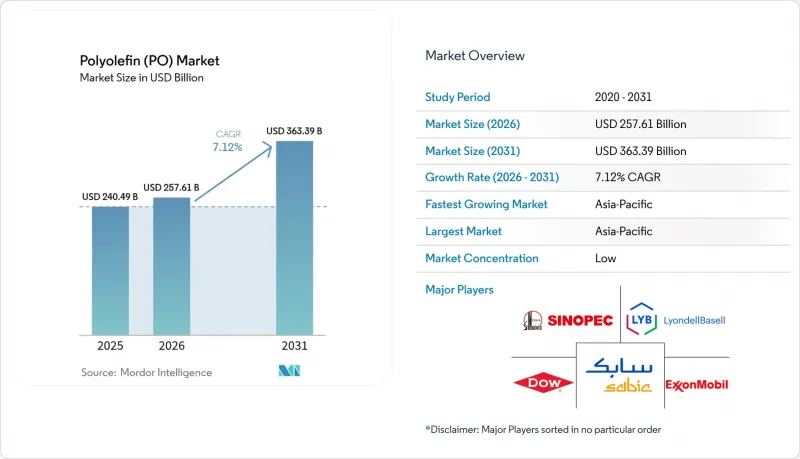
This report is Segmented by Material Type (Polyethylene (PE) and Polypropylene (PP)), Application (Films and Sheets, Injection Molding, Blow Molding, Extrusion Coating, and Fibers and Raffia), and Geography (Asia-Pacific, North America, Europe, South America, and Middle East and Africa). The Market Size and Forecasts are Provided in Terms of Value (USD) for all the Above Segments.
Global Polyolefin (PO) Market Trends and Insights
Shift from Rigid to Flexible Packaging
Brand owners migrate to lighter, flexible solutions that meet barrier targets while cutting logistics costs, a shift translating into larger film resin requirements across the polyolefin market. Flexible formats use up to 70% less material than legacy rigid containers, trimming freight emissions and warehouse space. Supply-chain disruptions in 2024 showed that mono-polyethylene pouches travel more efficiently than glass or metal options, ensuring on-shelf availability even during port congestion. Film converters now layer nano-barrier coatings on linear-low-density grades, matching shelf life once available only from multilayer laminates. EU-level design-for-recycling criteria due by 2028 favor these mono-material structures and will accelerate the replacement cycle.
Demand for Cost-efficient Interior and Consumer Goods
Middle-income households in India, Indonesia, and Vietnam increasingly opt for polypropylene furniture and appliance casings that deliver acceptable durability at one-third the cost of engineering plastics. OEMs reduce molding cycle time thanks to the polymer's broad processing window, cutting electricity consumption in factories strained by high power tariffs. Automotive suppliers are also swapping glass-fiber reinforced ABS parts with impact-modified polyolefin blends for door panels, shaving vehicle mass without expensive carbon composites. The development pipeline further includes talc-filled random-copolymer grades that withstand UV exposure, making them suitable for outdoor consumer goods.
Stricter Single-use-plastic and Carbon-tax Regulations
The EU bans lightweight produce bags under 1.5 kg beginning in 2030, eliminating a 0.8 million-tonne demand stream for polyethylene film. Simultaneously, carbon levies lift cash costs at European crackers by USD 75 per tonne ethylene equivalent, compressing netbacks relative to exporters from tax-lighter regions. Producers pivot to closed-loop packaging with 35% recycled content to retain retail shelves, yet volumes lost in banned skews take time to replace. Some film converters relocate slit-roll finishing to Turkey and Egypt to avoid levy exposure, altering trade flows within the Polyolefin market.
Other drivers and restraints analyzed in the detailed report include:
- Circular-economy Mandates Driving Chemical-recycling Grades
- Surging EV Lightweighting Needs for PP/POE Compounds
- Global Oversupply and Margin Pressure from Mega-crackers
For complete list of drivers and restraints, kindly check the Table Of Contents.
Segment Analysis
Polyethylene accounted for 55.02 of % Polyolefin market share in 2025, thanks to its entrenched role in packaging, construction, and agriculture. Yet polypropylene is forecast to post an 8.02% CAGR, meaning its slice of the polyolefin market size will expand meaningfully by 2031. Linear-low-density variants prosper as converters of down-gauge film, while high-density grades serve detergent bottles and corrosion-resistant pipes demanded by the water infrastructure boom across India. Low-density polyethylene faces design-for-recycling pressure, but maintains a foothold in extrusion-coating for liquid cartons.
Metallocene innovations enable ultra-thin cast films and high-stiffness polypropylene random copolymers that approach polycarbonate clarity. These grades unlock stretching and thermoforming latitude, helping brand owners migrate from polystyrene and PVC. Automakers specify long-glass polypropylene for front-end carriers, broadening revenue for compounders beyond traditional bumper fascia as chemical-recycling feedstock supply scales, polyethylene and polypropylene producers aim to certify grades with 50% circular content, reinforcing customer loyalty and protecting share in the polyolefin market.
Complete Report Scope:
- By Material Type
- Polyethylene (PE)
- High-Density PE (HDPE)
- Low-Density PE (LDPE)
- Linear Low-Density PE (LLDPE)
- Polypropylene (PP)
- Polyethylene (PE)
- By Application
- Films and Sheets
- Injection Molding
- Blow Molding
- Extrusion Coating
- Fibers and Raffia
- End-user Industry
- Packaging
- Automotive and Transportation
- Electrical and Electronics
- Building and Construction
- Other End-user Industries
- Geography
- Asia-Pacific
- China
- India
- Japan
- South Korea
- Rest of Asia-Pacific
- North America
- United States
- Canada
- Mexico
- Europe
- Germany
- United Kingdom
- France
- Italy
- Rest of Europe
- South America
- Brazil
- Argentina
- Rest of South America
- Middle East and Africa
- Saudi Arabia
- South Africa
- Rest of Middle East and Africa
- Asia-Pacific
Geography Analysis
Asia-Pacific commanded 51.22% polyolefin market share in 2025 and is tracking an 8.21% CAGR through 2031. China's modernization of logistics packaging, India's infrastructure push, and ASEAN's consumer boom all funnel incremental demand. Integrated refining-to-chemicals sites grant low conversion cost, but sustainability measures-such as China's 2026 cap on virgin-plastic consumption-will influence future capacity choices.
North America is the second-largest slice because of abundant shale-based ethane that yields cost-advantaged polyethylene. Regional demand rose 7% for polyethylene and 4% for polypropylene in 2024 due to e-commerce fulfillment and recovering durable goods orders. Resin exports from the Gulf Coast cushion producers during domestic slowdowns, though Panama Canal congestion reroutes cargo via U.S. East Coast ports, stretching transit times.
Europe wrestles with energy costs triple those in the U.S. following gas market upheaval. Nonetheless, early adoption of chemical-recycling technology positions the bloc at the forefront of circular polymer commerce. Producers pivot toward higher-margin specialty grades and service contracts with brand owners seeking traceable recycled content. The Middle East leverages a 15% rise in gas output since 2020 to supply competitively priced resin into Asia and Africa, while South America's import reliance keeps local prices high, incentivizing Brazilian investments in new steam crackers.
- Arkema
- BASF
- Borealis GmbH
- Braskem
- Chevron Phillips Chemical Company LLC
- PetroChina Company Limited
- China Petrochemical Corporation
- Daelim Co., Ltd.
- Dow
- Exxon Mobil Corporation
- Formosa Plastics Corporation
- INEOS
- Japan Polypropylene Corporation
- LG Chem
- LyondellBasell Industries Holdings B.V.
- Mitsubishi Chemical Group Corporation
- Mitsui Chemicals India Pvt. Ltd.
- NOVA Chemicals
- PetroChina Co. Ltd.
- Reliance Industries Limited
- SABIC
- Sasol Ltd.
- Tosoh Corporation
- TotalEnergies
Additional Benefits:
- The market estimate (ME) sheet in Excel format
- 3 months of analyst support
TABLE OF CONTENTS
1 Introduction
- 1.1 Study Assumptions and Market Definition
- 1.2 Scope of the Study
2 Research Methodology
3 Executive Summary
4 Market Landscape
- 4.1 Market Overview
- 4.2 Market Drivers
- 4.2.1 Shift from Rigid to Flexible Packaging
- 4.2.2 Demand for Cost-efficient Interior and Consumer Goods
- 4.2.3 Circular-economy Mandates Driving Chemical-recycling Grades
- 4.2.4 Surging EV Lightweighting Needs for PP/POE Compounds
- 4.2.5 Metallocene-catalyst Boom Enabling Specialty PE/PP Grades
- 4.3 Market Restraints
- 4.3.1 Stricter Single-use-plastic and Carbon-tax Regulations
- 4.3.2 Global Oversupply and Margin Pressure from Mega-crackers
- 4.3.3 Volatility in Naphtha/propane Feedstock Prices
- 4.4 Value Chain Analysis
- 4.5 Porter's Five Forces
- 4.5.1 Bargaining Power of Suppliers
- 4.5.2 Bargaining Power of Buyers
- 4.5.3 Threat of New Entrants
- 4.5.4 Threat of Substitutes
- 4.5.5 Degree of Competition
5 Market Size and Growth Forecasts (Value)
- 5.1 By Material Type
- 5.1.1 Polyethylene (PE)
- 5.1.1.1 High-Density PE (HDPE)
- 5.1.1.2 Low-Density PE (LDPE)
- 5.1.1.3 Linear Low-Density PE (LLDPE)
- 5.1.2 Polypropylene (PP)
- 5.1.1 Polyethylene (PE)
- 5.2 By Application
- 5.2.1 Films and Sheets
- 5.2.2 Injection Molding
- 5.2.3 Blow Molding
- 5.2.4 Extrusion Coating
- 5.2.5 Fibers and Raffia
- 5.3 End-user Industry
- 5.3.1 Packaging
- 5.3.2 Automotive and Transportation
- 5.3.3 Electrical and Electronics
- 5.3.4 Building and Construction
- 5.3.5 Other End-user Industries
- 5.4 Geography
- 5.4.1 Asia-Pacific
- 5.4.1.1 China
- 5.4.1.2 India
- 5.4.1.3 Japan
- 5.4.1.4 South Korea
- 5.4.1.5 Rest of Asia-Pacific
- 5.4.2 North America
- 5.4.2.1 United States
- 5.4.2.2 Canada
- 5.4.2.3 Mexico
- 5.4.3 Europe
- 5.4.3.1 Germany
- 5.4.3.2 United Kingdom
- 5.4.3.3 France
- 5.4.3.4 Italy
- 5.4.3.5 Rest of Europe
- 5.4.4 South America
- 5.4.4.1 Brazil
- 5.4.4.2 Argentina
- 5.4.4.3 Rest of South America
- 5.4.5 Middle East and Africa
- 5.4.5.1 Saudi Arabia
- 5.4.5.2 South Africa
- 5.4.5.3 Rest of Middle East and Africa
- 5.4.1 Asia-Pacific
6 Competitive Landscape
- 6.1 Market Concentration
- 6.2 Strategic Moves
- 6.3 Market Share (%)/Ranking Analysis
- 6.4 Company Profiles (includes Global level Overview, Market level overview, Core Segments, Financials as available, Strategic Information, Market Rank/Share, Products and Services, Recent Developments)
- 6.4.1 Arkema
- 6.4.2 BASF
- 6.4.3 Borealis GmbH
- 6.4.4 Braskem
- 6.4.5 Chevron Phillips Chemical Company LLC
- 6.4.6 PetroChina Company Limited
- 6.4.7 China Petrochemical Corporation
- 6.4.8 Daelim Co., Ltd.
- 6.4.9 Dow
- 6.4.10 Exxon Mobil Corporation
- 6.4.11 Formosa Plastics Corporation
- 6.4.12 INEOS
- 6.4.13 Japan Polypropylene Corporation
- 6.4.14 LG Chem
- 6.4.15 LyondellBasell Industries Holdings B.V.
- 6.4.16 Mitsubishi Chemical Group Corporation
- 6.4.17 Mitsui Chemicals India Pvt. Ltd.
- 6.4.18 NOVA Chemicals
- 6.4.19 PetroChina Co. Ltd.
- 6.4.20 Reliance Industries Limited
- 6.4.21 SABIC
- 6.4.22 Sasol Ltd.
- 6.4.23 Tosoh Corporation
- 6.4.24 TotalEnergies
7 Market Opportunities and Future Outlook
- 7.1 White-space and Unmet-Need Assessment

