PUBLISHER: Mordor Intelligence | PRODUCT CODE: 2121643

PUBLISHER: Mordor Intelligence | PRODUCT CODE: 2121643
Pipeline Security - Market Share Analysis, Industry Trends & Statistics, Growth Forecasts (2026 - 2031)
According to Mordor Intelligence, the pipeline security market size in 2026 is estimated at USD 11.3 billion, growing from 2025 value of USD 10.54 billion with 2031 projections showing USD 16.03 billion, growing at 7.23% CAGR over 2026-2031.
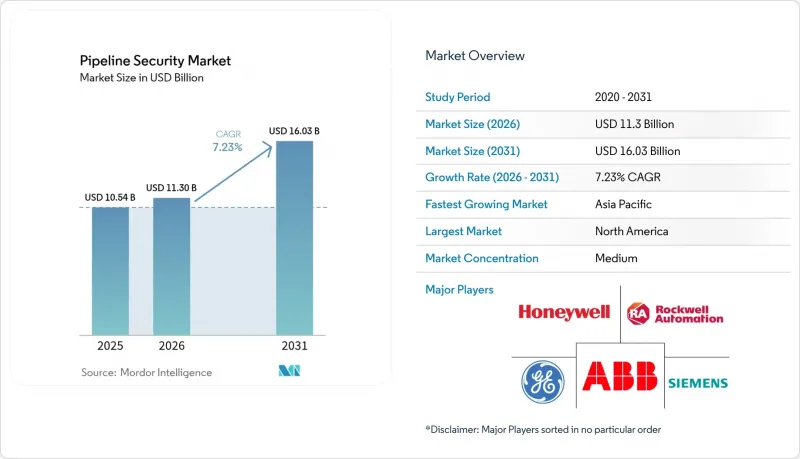
This report is Segmented by Product (Natural Gas, Crude Oil, Hazardous Liquid/Chemicals, and More), Technology and Solution (SCADA Systems, Perimeter Security, ICS Security, and More), Application (Onshore, Offshore, Gathering Networks, and Refined Products), Security Type (Physical, OT Cybersecurity, and Converged), and Geography. Market Forecasts are Provided in Terms of Value (USD).
Global Pipeline Security Market Trends and Insights
Expansion of Cross-Border Energy Trade Routes
Mega-projects such as the 5,600-kilometer Nigeria-Morocco line and Saudi Arabia's 4,000-kilometer Jafurah network illustrate how multinational corridors heighten security complexity by spanning jurisdictions with divergent enforcement standards. Operators must coordinate incident response protocols, satellite surveillance, and fiber-optic intrusion detection across multiple legal frameworks, driving per-kilometer security budgets higher than domestic averages
Stringent Environmental and Safety Regulations
The U.S. Pipeline and Hazardous Materials Safety Administration's 2024 rule requires leak-detection systems that spot 8% of maximum flow within 30 minutes, a threshold that effectively disqualifies legacy hydraulic models and pushes adoption of real-time acoustic sensing. Complementary EPA amendments extend risk-management audits to liquid pipelines near populated zones, adding third-party security reviews to compliance checklists. Similar pressure is mounting in Europe, where draft hydrogen network codes call for continuous embrittlement monitoring on repurposed lines
High Implementation and Maintenance Costs
Fiber-optic distributed acoustic sensing can exceed USD 10,000 per kilometer when installation, interrogator units, and SCADA integration are included, and annual software licenses add up to 20% of total life-cycle spending. Offshore pipelines bear even steeper costs: autonomous underwater vehicles, seabed arrays, and specialty corrosion sensors can push security budgets to 10% of total capex, challenging project economics for marginal fields
Other drivers and restraints analyzed in the detailed report include:
- Increasing Incidence of Sabotage and Terrorism Attacks
- Growing Adoption of AI-Powered Leak Detection Solutions
- Complex, Heterogeneous Legacy Infrastructure
For complete list of drivers and restraints, kindly check the Table Of Contents.
Segment Analysis
Hydrogen and CO2 pipelines are on track to expand at an 8.17% CAGR, the fastest pace among products, as governments underwrite green-hydrogen export corridors and carbon-capture value chain. This emerging network demands real-time strain sensing and embrittlement analytics that legacy natural-gas systems cannot deliver. Operators are piloting fiber-optic strain gauges to spot microfractures before rupture, a prerequisite for insurance underwriting in newbuild hydrogen corridors. In contrast, natural gas lines held a 45.40% share of the pipeline security market in 2025, sustained by LNG export buildouts in the United States, Qatar, and Australia.
Natural gas assets will continue to anchor revenue, but upside potential shifts toward hydrogen once demand visibility improves. Crude oil routes remain stable in security outlays owing to high spill liability, yet long-term growth is muted by electric-vehicle penetration. Hazardous-liquid and chemical pipelines funnel premium budgets into automated shutoff valves and multi-factor perimeter controls because any release can prompt class-action litigation within hours. Carbon dioxide networks for sequestration are at a formative stage, but forward-looking operators view the segment as a hedge against eventual emission-pricing regimes, keeping R&D pipelines active for CO2-specific sensor suites
Integrated end-to-end platforms are forecast to grow at 8.74% CAGR through 2031, reflecting operator preference for a single dashboard that unifies acoustic alerts, video feeds, GIS overlays, and cyber-threat telemetry. SCADA-only environments, though still 31.20% of 2025 revenue, are losing share as operators switch to edge-computing nodes that preprocess data locally, cutting latency and bandwidth commitments. Vulnerability disclosures affecting widely deployed SCADA vendors have hastened adoption of zero-trust architectures and micro-segmentation to isolate OT assets from enterprise IT.
Perimeter-security modules fencing, radar, and thermal cameras remain critical, but their market share slides as procurement officers bundle them into platform licenses instead of standalone buys. Computer-vision analytics now flag anomalous activity autonomously, freeing control-room staff for higher-order triage. Meanwhile, sensor innovation is shifting from hardware to firmware, with machine-learning edge nodes extracting leak-detection features directly from distributed acoustic sensing waveforms, improving accuracy while cutting false alarms by 30% compared to rule-based thresholds. These advances enlarge the addressable market among mid-tier operators once priced out of premium gear, broadening the revenue base for platform vendors
Complete Report Scope:
- By Product
- Natural Gas
- Crude Oil
- Hazardous Liquid / Chemicals
- Hydrogen and CO? Pipelines
- Other Products
- By Technology and Solution
- Supervisory Control and Data Acquisition (SCADA) Systems
- Perimeter Security and Intruder Detection Systems
- Industrial Control Systems Security
- Video Surveillance and GIS Mapping
- Pipeline Monitoring Sensors and Analytics
- Integrated End-to-End Security Platforms
- By Application
- Onshore Pipelines
- Offshore Pipelines
- Gathering and Distribution Networks
- Refined Products Pipelines
- By Security Type
- Physical Security
- Operational Technology (OT) Cybersecurity
- Physical-Cyber Converged Solutions
- By Geography
- North America
- United States
- Canada
- Mexico
- Europe
- United Kingdom
- Germany
- France
- Italy
- Rest of Europe
- Asia-Pacific
- China
- Japan
- India
- South Korea
- Rest of Asia
- Middle East
- Israel
- Saudi Arabia
- United Arab Emirates
- Turkey
- Rest of Middle East
- Africa
- South Africa
- Egypt
- Rest of Africa
- South America
- Brazil
- Argentina
- Rest of South America
- North America
Geography Analysis
North America remained the single largest contributor with 37.90% of 2025 revenue, thanks to the United States' 3 million-kilometer grid and Canada's export corridors linking western basins to coastal terminals. Compliance spending accelerated after PHMSA's 2024 leak-detection rule, prompting widespread retrofits of fiber-optic distributed acoustic sensing and linking of fault-isolation valves to real-time analytics. Meanwhile, cross-border projects moving Permian gas into Mexico face dual compliance audits from both U.S. and Mexican regulators, lifting consulting hours and driving platform upgrades that bridge language and protocol differences.
Asia-Pacific will outpace all regions at a 9.12% CAGR, fueled by 80% of global gas-pipeline kilometers now under construction across China, India, and Southeast Asia. China's Central-Asia. corridor overlays new surveillance gear on legacy lines that lacked basic telemetry, while India's city-gas push forces distributors to adopt low-cost acoustic sensors scalable to thousands of urban kilometers. Japan and South Korea add seismic monitoring layers around LNG import terminals, and Asia-Pacific members negotiate federated security clauses in the proposed Trans-Asia-PacificGas Pipeline, delaying tenders but raising future per-kilometer outlays.
Europe's market is shaped by dual imperatives: decarbonization and resilience following disrupted Russian flows. Draft hydrogen rules require real-time embrittlement monitoring on repurposed gas lines, a specification not yet available at commercial scale. Elsewhere, the Middle East bankrolls dual-use networks capable of carrying natural gas today and hydrogen tomorrow, with Saudi Aramco's Jafurah lines fitted with distributed acoustic sensing from inception. Africa's split market pairs North-African adoption of European-grade systems against Sub-Saharan budget constraints, while South America's growth centers on Vaca Muerta pipelines mandated to embed fiber-optic monitoring to meet environmental permits
- Honeywell International Inc.
- General Electric Company
- ABB Ltd.
- Rockwell Automation Inc.
- Siemens AG
- Schneider Electric SE
- OptaSense Ltd.
- Senstar Corporation
- Huawei Technologies Co. Ltd.
- Environmental Systems Research Institute Inc. (Esri)
- Thales S.A.
- BAE Systems plc
- Future Fibre Technologies Ltd.
- Elbit Systems Ltd.
- Inter Pipeline Ltd.
- Alstom SA
- Modcon Systems Ltd.
- Eye Trax Inc.
- Bandweaver Technologies Ltd.
- Magal Security Systems Ltd.
- Leidos Holdings Inc.
Additional Benefits:
- The market estimate (ME) sheet in Excel format
- 3 months of analyst support
TABLE OF CONTENTS
1 INTRODUCTION
- 1.1 Study Assumptions and Market Definition
- 1.2 Scope of the Study
2 RESEARCH METHODOLOGY
3 EXECUTIVE SUMMARY
4 MARKET LANDSCAPE
- 4.1 Market Overview
- 4.2 Value-Chain Analysis
- 4.3 Impact of Macroeconomic Factors on the Market
- 4.4 Market Drivers
- 4.4.1 Expansion of Cross-Border Energy Trade Routes
- 4.4.2 Stringent Environmental and Safety Regulations
- 4.4.3 Increasing Incidence of Sabotage and Terrorism Attacks
- 4.4.4 Growing Adoption of AI-Powered Leak Detection Solutions
- 4.4.5 Integration of Fiber Optic Sensing in Existing Networks
- 4.4.6 Proliferation of Remote, Unmanned Pipeline Operations
- 4.5 Market Restraints
- 4.5.1 High Implementation and Maintenance Costs
- 4.5.2 Complex, Heterogeneous Legacy Infrastructure
- 4.5.3 Shortage of Qualified OT-Cybersecurity Professionals
- 4.5.4 Limited Budget Allocation in Emerging Economies
- 4.6 Regulatory Landscape
- 4.7 Technological Outlook
- 4.8 Porter's Five Forces Analysis
- 4.8.1 Threat of New Entrants
- 4.8.2 Bargaining Power of Buyers
- 4.8.3 Bargaining Power of Suppliers
- 4.8.4 Threat of Substitute Products
- 4.8.5 Intensity of Competitive Rivalry
5 MARKET SIZE AND GROWTH FORECASTS (VALUE)
- 5.1 By Product
- 5.1.1 Natural Gas
- 5.1.2 Crude Oil
- 5.1.3 Hazardous Liquid / Chemicals
- 5.1.4 Hydrogen and CO? Pipelines
- 5.1.5 Other Products
- 5.2 By Technology and Solution
- 5.2.1 Supervisory Control and Data Acquisition (SCADA) Systems
- 5.2.2 Perimeter Security and Intruder Detection Systems
- 5.2.3 Industrial Control Systems Security
- 5.2.4 Video Surveillance and GIS Mapping
- 5.2.5 Pipeline Monitoring Sensors and Analytics
- 5.2.6 Integrated End-to-End Security Platforms
- 5.3 By Application
- 5.3.1 Onshore Pipelines
- 5.3.2 Offshore Pipelines
- 5.3.3 Gathering and Distribution Networks
- 5.3.4 Refined Products Pipelines
- 5.4 By Security Type
- 5.4.1 Physical Security
- 5.4.2 Operational Technology (OT) Cybersecurity
- 5.4.3 Physical-Cyber Converged Solutions
- 5.5 By Geography
- 5.5.1 North America
- 5.5.1.1 United States
- 5.5.1.2 Canada
- 5.5.1.3 Mexico
- 5.5.2 Europe
- 5.5.2.1 United Kingdom
- 5.5.2.2 Germany
- 5.5.2.3 France
- 5.5.2.4 Italy
- 5.5.2.5 Rest of Europe
- 5.5.3 Asia-Pacific
- 5.5.3.1 China
- 5.5.3.2 Japan
- 5.5.3.3 India
- 5.5.3.4 South Korea
- 5.5.3.5 Rest of Asia
- 5.5.4 Middle East
- 5.5.4.1 Israel
- 5.5.4.2 Saudi Arabia
- 5.5.4.3 United Arab Emirates
- 5.5.4.4 Turkey
- 5.5.4.5 Rest of Middle East
- 5.5.5 Africa
- 5.5.5.1 South Africa
- 5.5.5.2 Egypt
- 5.5.5.3 Rest of Africa
- 5.5.6 South America
- 5.5.6.1 Brazil
- 5.5.6.2 Argentina
- 5.5.6.3 Rest of South America
- 5.5.1 North America
6 COMPETITIVE LANDSCAPE
- 6.1 Market Concentration
- 6.2 Strategic Moves
- 6.3 Market Share Analysis
- 6.4 Company Profiles (includes Global Level Overview, Market Level Overview, Core Segments, Financials as available, Strategic Information, Market Rank/Share for Key Companies, Products and Services, and Recent Developments)
- 6.4.1 Honeywell International Inc.
- 6.4.2 General Electric Company
- 6.4.3 ABB Ltd.
- 6.4.4 Rockwell Automation Inc.
- 6.4.5 Siemens AG
- 6.4.6 Schneider Electric SE
- 6.4.7 OptaSense Ltd.
- 6.4.8 Senstar Corporation
- 6.4.9 Huawei Technologies Co. Ltd.
- 6.4.10 Environmental Systems Research Institute Inc. (Esri)
- 6.4.11 Thales S.A.
- 6.4.12 BAE Systems plc
- 6.4.13 Future Fibre Technologies Ltd.
- 6.4.14 Elbit Systems Ltd.
- 6.4.15 Inter Pipeline Ltd.
- 6.4.16 Alstom SA
- 6.4.17 Modcon Systems Ltd.
- 6.4.18 Eye Trax Inc.
- 6.4.19 Bandweaver Technologies Ltd.
- 6.4.20 Magal Security Systems Ltd.
- 6.4.21 Leidos Holdings Inc.
7 MARKET OPPORTUNITIES AND FUTURE OUTLOOK
- 7.1 White-Space and Unmet-Need Assessment

