PUBLISHER: Mordor Intelligence | PRODUCT CODE: 2121652

PUBLISHER: Mordor Intelligence | PRODUCT CODE: 2121652
Aluminum Foil Packaging - Market Share Analysis, Industry Trends & Statistics, Growth Forecasts (2026 - 2031)
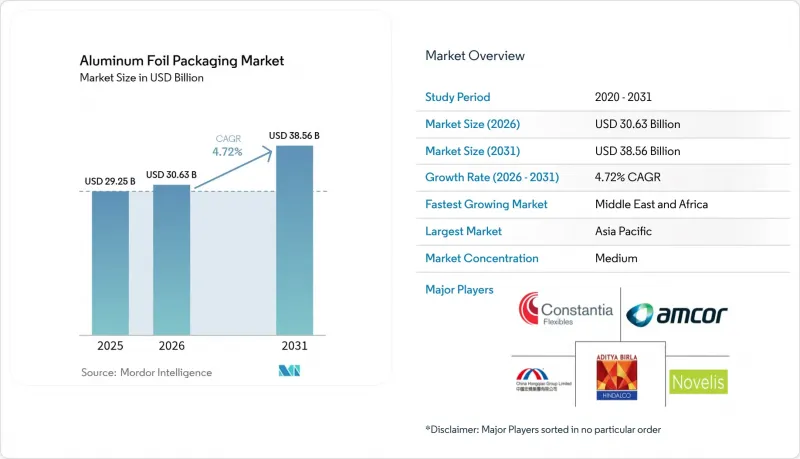
According to Mordor Intelligence, the aluminum foil packaging market size in 2026 is estimated at USD 30.63 billion, growing from 2025 value of USD 29.25 billion with 2031 projections showing USD 38.56 billion, growing at 4.72% CAGR over 2026-2031.
This report is Segmented by Type (Rolled Foil, Backed Foil, Embossed and Lacquered, and More), Application (Converter Foils, Container Foils, Household Foils, and More), Packaging Format (Wraps, Pouches and Sachets, and More), End User (Food, Beverage, Pharmaceutical, Cosmetics and Personal Care, and More), and Geography. The Market Forecasts are Provided in Terms of Value (USD).
Global Aluminum Foil Packaging Market Trends and Insights
Rising Demand for Ready-to-Eat and Convenience Foods
Convenience-oriented lifestyles elevate consumption of heat-and-eat meals, baked goods, and deli products. Aluminum foil's thermal conductivity enables uniform reheating up to 200 °C, adding value for foodservice trays, lidding films, and retort pouches. In Saudi Arabia, packaged food retail sales are projected to reach USD 34.2 billion by 2028, 38% above 2024 levels. Volume upticks translate directly into higher foil tonnage for trays and lidding. Major processors in North America and Asia-Pacific embed foil trays into chilled and frozen meal lines, reinforcing bulk procurement contracts that stabilize converter order books.
Growth in Pharmaceutical Blister Demand
Cold-form aluminum foil of 20-25 microns thickness offers unrivaled moisture and oxygen barriers, preserving drug potency across harsh climates. The U.S. FDA's emphasis on stability data propels the adoption of deeper-draw blister formats that require ductile, scratch-free foil grades. Emerging generics hubs in India and Indonesia commission new blister lines, raising call-off volumes for coated and laminated foil reels. Premium pricing in this segment cushions converters against metal price volatility.
Alternative Bio-Based Flexible Materials
Brands targeting eco-conscious consumers explore paper-foil hybrids and compostable barrier films. In snacks and confectionery, moderate oxygen protection suffices, allowing partial substitution. While bio-films cannot yet equal foil's full barrier profile, marketing narratives around renewability accelerate trials in Europe and North America. The threat intensifies once recycling legislation rewards renewable inputs through tax incentives or labeling advantages.
Other drivers and restraints analyzed in the detailed report include:
- Superior Barrier Properties and Shelf-Life Extension
- Induction Heat-Seal Liners for E-Commerce Liquids
- Raw Aluminum Price Volatility
For complete list of drivers and restraints, kindly check the Table Of Contents.
Segment Analysis
Rolled Foil captured 52.05% of 2025 revenue, anchoring the aluminum foil packaging market through its role as feedstock for printing, laminating, and forming lines. The output spectrum spans 6-micron household sheets to 200-micron industrial grades, letting suppliers tailor gauge to end-use. Strong converter demand keeps mills in China, India, and Germany running near 90% capacity utilization. The aluminum foil packaging market size attributed to Backed Foil is projected to widen at a 4.98% CAGR as pharmaceutical cold-form and premium coffee capsule demand reward laminate designs.
Embossed and Lacquered variants address decorative confectionery wraps and tamper-evident lidding, generating niche price premiums. Seasonal patterns, such as holiday-pattern foil launched by Reynolds Consumer Products in November 2024, illustrate how surface texture and color enhance shelf appeal. Other Types, including perforated ventilation foils and capacitor foils, remain small but technically stringent, reinforcing supplier specialization.
Converter Foils generated 41.01% of 2025 sales, confirming their place at the center of the aluminum foil packaging market. Laminators and printers transform master coils into rollstock for pouches, sachets, and cartons, driving consistent tonnage flow. Rising adoption of solvent-free adhesives and electron-beam curing elevates functional layering without sacrificing throughput. Container Foils, mainly for trays and semi-rigid dishes, are forecast at a 5.71% CAGR as ready-to-eat meals penetrate emerging middle-income urban zones.
Household Foil remains a legacy staple, held in 95% of U.S. kitchens per Reynolds Consumer Products' internal data. Volume is flat in mature markets but expands in Africa and South Asia, where consumer foil rolls still gain first-time buyers. Industrial and Insulation Foils link demand to building energy codes that specify reflective barriers in HVAC and roofing, a niche yet resilient outlet during construction cycles.
Complete Report Scope:
- By Type
- Rolled Foil
- Backed Foil
- Embossed and Lacquered Foil
- Other Types
- By Application
- Converter Foils
- Container Foils
- Household Foils
- Industrial/Insulation Foils
- By Packaging Format
- Wraps
- Pouches and Sachets
- Blisters and Lids
- Trays and Containers
- Other Packaging Fomrats
- By End User
- Food
- Beverage
- Pharmaceutical
- Cosmetics and Personal Care
- Tobacco
- Other End Users
- By Geography
- North America
- United States
- Canada
- Mexico
- South America
- Brazil
- Argentina
- Chile
- Rest of South America
- Europe
- United Kingdom
- Germany
- France
- Spain
- Italy
- Rest of Europe
- Asia-Pacific
- China
- India
- Japan
- Australia
- South Korea
- Vietnam
- Rest of Asia-Pacific
- Middle East and Africa
- Middle East
- Saudi Arabia
- United Arab Emirates
- Turkey
- Rest of Middle East
- Africa
- South Africa
- Nigeria
- Egypt
- Rest of Africa
- Middle East
- North America
Geography Analysis
Asia-Pacific contributed 39.88% of the 2025 value, driven by China's integrated smelter-converter clusters and India's USD 10 billion Hindalco capacity expansion aimed at battery foil lines. Lower freight costs and proximity to bauxite mines reinforce export competitiveness despite occasional power-price spikes. The aluminum foil packaging market size attached to the region is set for mid-single-digit growth, underpinned by processed food uptake and vaccine production localization.
North America remains technology-led, hosting advanced scrap-sorting plants that lift post-consumer foil recovery yields above 35%. U.S. consumption benefits from chilled-meal subscriptions and nutraceutical liquids shipped in induction-sealed jars. Canada's maple-products sector likewise shifts from glass to foil laminate pouches to trim freight weights.
Europe faces the tightest regulatory lens under the Packaging and Packaging Waste Regulation. Mandatory minimum recycled content targets spur investments in continuous pyrolysis and de-lacquering units that reclaim clean aluminum for remelt. While compliance costs strain small converters, multinational groups use closed-loop programs such as Austria's coffee-capsule recycling pilot that collected 5 million units in three months. The Middle East and Africa, expanding at 6.78% CAGR, leverages food-processing FDI and burgeoning pharmaceutical clusters in Saudi Arabia and Egypt that require high-barrier packs to suit hot-climate logistics.
- Amcor plc
- Constantia Flexibles Group GmbH
- Novelis Inc.
- Hindalco Industries Limited
- Alcoa Corporation
- Reynolds Consumer Products Inc.
- UACJ Corporation
- Hydro Aluminium AS
- United Company RUSAL Plc
- China Hongqiao Group Limited
- Laminazione Sottile S.p.A.
- Toyo Aluminium K.K.
- Carcano Antonio S.p.A.
- Hulamin Ltd.
- Henan Zhongfu Industrial Co., Ltd.
- Coppice Alupack Ltd.
- Ess Dee Aluminium Ltd.
- Penny Plate LLC
- Eurofoil S.A.
- Alufoil Products Pvt. Ltd.
- Zhangjiagang Goldshine Aluminium Foil Co., Ltd.
- Ningbo Times Aluminium Foil Tech Co., Ltd.
- Haomei Aluminium Co., Ltd.
- RCA Converters
Additional Benefits:
- The market estimate (ME) sheet in Excel format
- 3 months of analyst support
TABLE OF CONTENTS
1 INTRODUCTION
- 1.1 Study Assumptions and Market Definition
- 1.2 Scope of the Study
2 RESEARCH METHODOLOGY
3 EXECUTIVE SUMMARY
4 MARKET LANDSCAPE
- 4.1 Market Overview
- 4.2 Market Drivers
- 4.2.1 Rising demand for ready-to-eat and convenience foods
- 4.2.2 Growth in pharmaceutical blister demand
- 4.2.3 Superior barrier properties and shelf-life extension
- 4.2.4 Induction heat-seal liners for e-commerce liquids
- 4.2.5 EV battery pouch-foil adoption
- 4.2.6 Vertical-farming reflective foil demand
- 4.3 Market Restraints
- 4.3.1 Alternative bio-based flexible materials
- 4.3.2 Raw aluminum price volatility
- 4.3.3 Stricter EU recycling targets on foil scrap
- 4.3.4 ESG risks from energy-intensive smelting
- 4.4 Industry Value Chain Analysis
- 4.5 Regulatory Landscape
- 4.6 Technological Outlook
- 4.7 Porter's Five Forces Analysis
- 4.7.1 Bargaining Power of Suppliers
- 4.7.2 Bargaining Power of Buyers
- 4.7.3 Threat of New Entrants
- 4.7.4 Threat of Substitutes
- 4.7.5 Competitive Rivalry
- 4.8 The Impact of Macroeconomic Factors on the Market
5 MARKET SIZE AND GROWTH FORECASTS (VALUE)
- 5.1 By Type
- 5.1.1 Rolled Foil
- 5.1.2 Backed Foil
- 5.1.3 Embossed and Lacquered Foil
- 5.1.4 Other Types
- 5.2 By Application
- 5.2.1 Converter Foils
- 5.2.2 Container Foils
- 5.2.3 Household Foils
- 5.2.4 Industrial/Insulation Foils
- 5.3 By Packaging Format
- 5.3.1 Wraps
- 5.3.2 Pouches and Sachets
- 5.3.3 Blisters and Lids
- 5.3.4 Trays and Containers
- 5.3.5 Other Packaging Fomrats
- 5.4 By End User
- 5.4.1 Food
- 5.4.2 Beverage
- 5.4.3 Pharmaceutical
- 5.4.4 Cosmetics and Personal Care
- 5.4.5 Tobacco
- 5.4.6 Other End Users
- 5.5 By Geography
- 5.5.1 North America
- 5.5.1.1 United States
- 5.5.1.2 Canada
- 5.5.1.3 Mexico
- 5.5.2 South America
- 5.5.2.1 Brazil
- 5.5.2.2 Argentina
- 5.5.2.3 Chile
- 5.5.2.4 Rest of South America
- 5.5.3 Europe
- 5.5.3.1 United Kingdom
- 5.5.3.2 Germany
- 5.5.3.3 France
- 5.5.3.4 Spain
- 5.5.3.5 Italy
- 5.5.3.6 Rest of Europe
- 5.5.4 Asia-Pacific
- 5.5.4.1 China
- 5.5.4.2 India
- 5.5.4.3 Japan
- 5.5.4.4 Australia
- 5.5.4.5 South Korea
- 5.5.4.6 Vietnam
- 5.5.4.7 Rest of Asia-Pacific
- 5.5.5 Middle East and Africa
- 5.5.5.1 Middle East
- 5.5.5.1.1 Saudi Arabia
- 5.5.5.1.2 United Arab Emirates
- 5.5.5.1.3 Turkey
- 5.5.5.1.4 Rest of Middle East
- 5.5.5.2 Africa
- 5.5.5.2.1 South Africa
- 5.5.5.2.2 Nigeria
- 5.5.5.2.3 Egypt
- 5.5.5.2.4 Rest of Africa
- 5.5.5.1 Middle East
- 5.5.1 North America
6 COMPETITIVE LANDSCAPE
- 6.1 Market Concentration
- 6.2 Strategic Moves
- 6.3 Market Share Analysis
- 6.4 Company Profiles (includes Global level Overview, Market level overview, Core Segments, Financials as available, Strategic Information, Market Rank/Share for key companies, Products and Services, Recent Developments)
- 6.4.1 Amcor plc
- 6.4.2 Constantia Flexibles Group GmbH
- 6.4.3 Novelis Inc.
- 6.4.4 Hindalco Industries Limited
- 6.4.5 Alcoa Corporation
- 6.4.6 Reynolds Consumer Products Inc.
- 6.4.7 UACJ Corporation
- 6.4.8 Hydro Aluminium AS
- 6.4.9 United Company RUSAL Plc
- 6.4.10 China Hongqiao Group Limited
- 6.4.11 Laminazione Sottile S.p.A.
- 6.4.12 Toyo Aluminium K.K.
- 6.4.13 Carcano Antonio S.p.A.
- 6.4.14 Hulamin Ltd.
- 6.4.15 Henan Zhongfu Industrial Co., Ltd.
- 6.4.16 Coppice Alupack Ltd.
- 6.4.17 Ess Dee Aluminium Ltd.
- 6.4.18 Penny Plate LLC
- 6.4.19 Eurofoil S.A.
- 6.4.20 Alufoil Products Pvt. Ltd.
- 6.4.21 Zhangjiagang Goldshine Aluminium Foil Co., Ltd.
- 6.4.22 Ningbo Times Aluminium Foil Tech Co., Ltd.
- 6.4.23 Haomei Aluminium Co., Ltd.
- 6.4.24 RCA Converters
7 MARKET OPPORTUNITIES AND FUTURE OUTLOOK
- 7.1 White-space and Unmet-Need Assessment

