PUBLISHER: Mordor Intelligence | PRODUCT CODE: 2121664

PUBLISHER: Mordor Intelligence | PRODUCT CODE: 2121664
United States Endoscopy Devices - Market Share Analysis, Industry Trends & Statistics, Growth Forecasts (2026 - 2031)
According to Mordor Intelligence, the United States endoscopy devices market size is expected to increase from USD 12.89 billion in 2025 to USD 13.64 billion in 2026 and reach USD 18.56 billion by 2031, growing at a CAGR of 6.36% over 2026-2031.
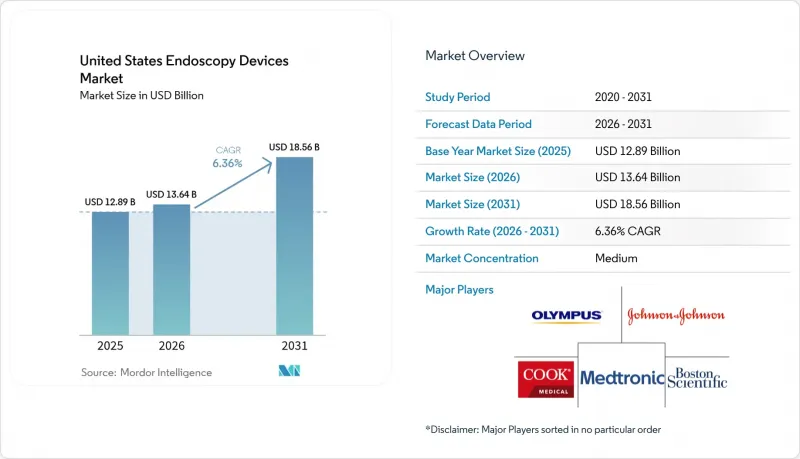
This report is Segmented by Device Type (Endoscopes [Rigid Endoscopes, and More], Endoscopic Operative Devices, and Visualization & Documentation Equipment), Application (Gastroenterology, Pulmonology, ENT Surgery, and More), Usability (Reusable and Single-Use), and End User (Hospitals, Ambulatory Surgical Centers, and More). The Market Forecasts are Provided in Terms of Value (USD).
United States Endoscopy Devices Market Trends and Insights
Rising Prevalence of GI & Colorectal Cancers
Colorectal cancer produced 147,931 new U.S. cases in 2022, and the screening age now begins at 45. The change expands eligibility by about 19 million adults. Evening and weekend colonoscopy sessions are therefore common, which pushes practices to purchase durable, flexible scopes and automated washers that process 8 to 10 cases a day. The National Cancer Institute dedicated USD 274 million to colorectal research in fiscal 2024, signaling bipartisan backing for early detection. These forces together lift demand across the endoscopy devices market.
Advances in HD & AI-Assisted Imaging Platforms
Fujifilm's CAD EYE joined three FDA-cleared AI modules in January 2024 and raised adenoma-detection rates by 8-12 percentage points. CMS added CPT 0596T in January 2025, which reimburses USD 175 per colonoscopy that incorporates AI, offsetting the typical software license fee. Pentax launched a 4K tower in March 2024, offering twice the pixel count of HD, enabling physicians to confirm lesion margins more quickly. Bundled 4K-plus-AI systems cost USD 150,000-180,000, but hospitals justify the premium with fewer missed lesions and higher throughput. These upgrades accelerate the replacement cycle and expand the endoscopy devices market.
High Capital Cost of Robotic / 4K Platforms
Intuitive Surgical's Ion robot lists at USD 500,000-1 million and reached only 382 U.S. installs by December 2024, representing roughly 6% hospital penetration. Medtronic's Hugo system cuts entry cost to USD 350,000 but still demands annual service near USD 80,000, raising five-year ownership above USD 750,000. Rural sites relying on cost-based Medicare payment rarely recover these sums, and 68% deferred new endoscopy purchases in 2024. High sticker prices, therefore, cap uptake and trim overall momentum in the endoscopy devices market.
Other drivers and restraints analyzed in the detailed report include:
- Outpatient Shift to Ambulatory Surgical Centers for Minimally Invasive Endoscopy
- Aging Population Driving Procedure Volumes
- Stringent FDA Re-Processing Compliance
For complete list of drivers and restraints, kindly check the Table Of Contents.
Segment Analysis
Endoscopes accounted for 53.27% of the 2025 revenue in the endoscopy devices market, anchored by flexible models that navigate tortuous GI and pulmonary anatomy and deliver high-definition video. Rigid scopes remain essential for laparoscopy and arthroscopy, but occupy a smaller share. Endoscopic operative devices are projected to rise at a 7.32% CAGR, outpacing the overall market, as surgeons adopt integrated insufflation and irrigation consoles that maintain stable pneumoperitoneum and shorten operative time. Capsule systems, such as Medtronic's PillCam Crohn's, address small-bowel imaging but still account for less than 3% of endoscopy device market share for this device type.
Visualization equipment is shifting from a one-time purchase to a lease model where providers pay a per-procedure fee that bundles 4K cameras and AI software updates. Standard-definition towers are being phased out, and major vendors now channel R&D into 4K and 8K prototypes. Accessories such as wound protectors show double-digit growth as single-incision techniques spread. Manual instruments remain profitable consumables; hospitals procure roughly 15-20 sets per suite each year to replace dull forceps and snares.
Gastrointestinal procedures commanded 44.73% of application revenue in 2025, supported by more than 15 million annual U.S. colonoscopies and robust upper GI surveillance, though growth moderates as screening compliance plateaus. Gynecology is the fastest-growing application, with a 7.69% CAGR, as office-based hysteroscopy expands for fibroid and polyp removal, backed by updated 2024 ACOG guidelines. Laparoscopic surgeries hold a mid-teens share, and adoption of robotic assistance continues to climb despite uncertain reimbursement parity.
Pulmonology benefits from lower lung-screen thresholds, with roughly 8% of low-dose CT findings requiring follow-up bronchoscopy. Urology advances as single-use ureteroscopes improve turnaround time, and Boston Scientific's LithoVue reached 22% market share by 2024. ENT, neurology, and orthopedics remain smaller niches, yet chip-on-tip cameras and fluorescence imaging are gradually broadening their procedural mix.
Complete Report Scope:
- By Device Type
- Endoscopes
- Rigid Endoscopes
- Flexible Endoscopes
- Capsule Endoscopes
- Robotic-assisted Endoscopes
- Endoscopic Operative Devices
- Irrigation / Suction Systems
- Access Devices
- Wound Protectors
- Insufflation Devices
- Manual Instruments
- Visualization Equipment
- Endoscopic Cameras
- SD Visualization Systems
- HD / 4K Visualization Systems
- Endoscopes
- By Application
- Gastrointestinal Endoscopy
- Laparoscopy
- Pulmonology / Bronchoscopy
- ENT / Otolaryngology
- Urology
- Gynecology
- Cardiology
- Neurology
- Orthopedics / Arthroscopy
- By Usability
- Reusable Devices
- Single-use / Disposable Devices
- By End-User
- Hospitals
- Ambulatory Surgical Centers
- Specialty Clinics
List of Companies Covered in this Report:
- Ackermann Instrumente
- Ambu
- Arthrex
- B. Braun
- Boston Scientific
- Conmed
- Cook Group
- FUJIFILM
- HOYA
- Interscope Inc.
- Intuitive Surgical
- Johnson & Johnson
- Karl Storz
- Medtronic
- Olympus
- Richard Wolf
- Smiths Group
- STERIS
- Stryker
Additional Benefits:
- The market estimate (ME) sheet in Excel format
- 3 months of analyst support
TABLE OF CONTENTS
1 Introduction
- 1.1 Study Assumptions & Market Definition
- 1.2 Scope of the Study
2 Research Methodology
3 Executive Summary
4 Market Landscape
- 4.1 Market Overview
- 4.2 Market Drivers
- 4.2.1 Rising Prevalence of GI & Colorectal Cancers
- 4.2.2 Advances in HD & AI-Assisted Imaging Platforms
- 4.2.3 Outpatient Shift to ASs for Minimally Invasive Endoscopy
- 4.2.4 Aging Population Driving Procedure Volumes
- 4.2.5 Medicaid Policy Boosts for Disposable Scopes
- 4.2.6 Expansion of Ambulatory Surgical Centers Boosting Outpatient Endoscopy Volumes
- 4.3 Market Restraints
- 4.3.1 High Capital Cost of Robotic / 4K Platforms
- 4.3.2 Stringent FDA Re-Processing Compliance
- 4.3.3 Sustainability Pushback on Single-Use Plastic Waste
- 4.3.4 High Capital & Lifecycle Maintenance Costs of Advanced Endoscopic Systems
- 4.4 Regulatory Landscape
- 4.5 Technological Outlook
- 4.6 Porter's Five Forces Analysis
- 4.6.1 Threat of New Entrants
- 4.6.2 Bargaining Power of Buyers
- 4.6.3 Bargaining Power of Suppliers
- 4.6.4 Threat of Substitute Products
- 4.6.5 Intensity of Competitive Rivalry
5 Market Size & Growth Forecasts (Value & Volume)
- 5.1 By Device Type
- 5.1.1 Endoscopes
- 5.1.1.1 Rigid Endoscopes
- 5.1.1.2 Flexible Endoscopes
- 5.1.1.3 Capsule Endoscopes
- 5.1.1.4 Robotic-assisted Endoscopes
- 5.1.2 Endoscopic Operative Devices
- 5.1.2.1 Irrigation / Suction Systems
- 5.1.2.2 Access Devices
- 5.1.2.3 Wound Protectors
- 5.1.2.4 Insufflation Devices
- 5.1.2.5 Manual Instruments
- 5.1.3 Visualization Equipment
- 5.1.3.1 Endoscopic Cameras
- 5.1.3.2 SD Visualization Systems
- 5.1.3.3 HD / 4K Visualization Systems
- 5.1.1 Endoscopes
- 5.2 By Application
- 5.2.1 Gastrointestinal Endoscopy
- 5.2.2 Laparoscopy
- 5.2.3 Pulmonology / Bronchoscopy
- 5.2.4 ENT / Otolaryngology
- 5.2.5 Urology
- 5.2.6 Gynecology
- 5.2.7 Cardiology
- 5.2.8 Neurology
- 5.2.9 Orthopedics / Arthroscopy
- 5.3 By Usability
- 5.3.1 Reusable Devices
- 5.3.2 Single-use / Disposable Devices
- 5.4 By End-User
- 5.4.1 Hospitals
- 5.4.2 Ambulatory Surgical Centers
- 5.4.3 Specialty Clinics
6 Competitive Landscape
- 6.1 Market Concentration
- 6.2 Market Share Analysis
- 6.3 Company Profiles (includes Global Level Overview, Market Level Overview, Core Segments, Financials as Available, Strategic Information, Market Rank/Share for Key Companies, Products & Services, and Recent Developments)
- 6.3.1 Ackermann Instrumente GmbH
- 6.3.2 Ambu A/S
- 6.3.3 Arthrex Inc.
- 6.3.4 B. Braun Melsungen AG
- 6.3.5 Boston Scientific Corporation
- 6.3.6 CONMED Corporation
- 6.3.7 Cook Group Incorporated
- 6.3.8 Fujifilm Holdings Corporation
- 6.3.9 Hoya Corporation (Pentax Medical)
- 6.3.10 Interscope Inc.
- 6.3.11 Intuitive Surgical Inc.
- 6.3.12 Johnson & Johnson
- 6.3.13 Karl Storz SE & Co. KG
- 6.3.14 Medtronic PLC
- 6.3.15 Olympus Corporation
- 6.3.16 Richard Wolf GmbH
- 6.3.17 Smith & Nephew PLC
- 6.3.18 Steris PLC
- 6.3.19 Stryker Corporation
7 Market Opportunities & Future Outlook
- 7.1 White-space & Unmet-Need Assessment

