PUBLISHER: Mordor Intelligence | PRODUCT CODE: 2121669

PUBLISHER: Mordor Intelligence | PRODUCT CODE: 2121669
Industrial And Institutional Cleaning Chemicals - Market Share Analysis, Industry Trends & Statistics, Growth Forecasts (2026 - 2031)
According to Mordor Intelligence, the industrial and institutional cleaning chemicals market size was valued at USD 57.42 billion in 2025 and is estimated to grow from USD 60.13 billion in 2026 to reach USD 75.72 billion by 2031, at a CAGR of 4.72% during the forecast period (2026-2031).
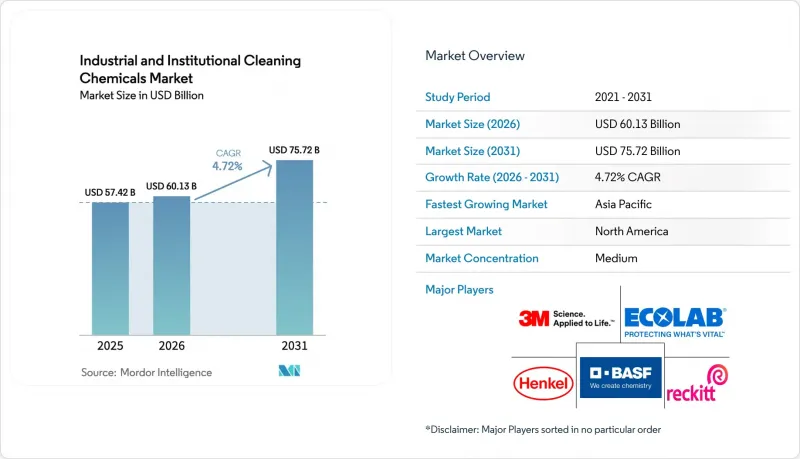
This report is Segmented by Raw Material (Chlor-Alkali, Surfactants, and More), Product Type (General-Purpose Cleaners, and More), Ingredient Origin (Bio-based/Green and More), Market Type (Commercial and Manufacturing), and Geography (Asia-Pacific, North America, Europe, South America, and Mthe Iddle-East and Africa). The Market Forecasts are Provided in Terms of Value (USD).
Global Industrial And Institutional Cleaning Chemicals Market Trends and Insights
Infection-Control Protocols in Acute and Long-Term Care Facilities
Hospital environmental-services teams are replacing quaternary-ammonium disinfectants with hydrogen-peroxide and peracetic-acid blends that satisfy EPA List N emerging-pathogen criteria without triggering asthma liabilities. The Centers for Disease Control and Prevention updated its environmental infection-control guidelines in 2024, recommending sporicidal agents for high-touch surfaces, a change that lifts per-gallon chemical spend by up to 40% but cuts hospital-acquired infection penalties under Medicare's Hospital-Acquired Condition Reduction Program. Long-term care operators face parallel mandates from state regulators that require logged contact times, driving uptake of ready-to-use sprayers with built-in timers. The World Health Organization's 2024 IPC guidance links rigorous surface disinfection to antimicrobial resistance mitigation, reinforcing the shift toward premium chemistries. Demand for low-irritation actives also benefits acute-care renovations that incorporate automated UV-C robots and electrostatic sprayers.
Sanitizer Adoption in Asian Meat and Seafood Processing
Processors in China, Thailand, Vietnam, and Indonesia are investing in Clean-in-Place systems that pair foaming alkaline detergents with peracetic-acid rinses to clear export inspections for HACCP certification. China's State Administration for Market Regulation began enforcing ATP bioluminescence verification in 2024, pushing operators to document chemical concentration for every shift. Trials by Meat & Livestock Australia showed that peracetic-acid carcass rinses combined with chlorine-dioxide flume treatments lowered Salmonella and E. coli prevalence by 1.5-2.0 log CFU/cm2, justifying a 25% cost premium. Rising scrutiny from US FDA import alerts and EU Rapid Alert System notices further pressures Southeast Asian exporters to adopt validated quaternary-ammonium foamers and iodophor dips.
Fluctuating Petrochemical Feedstock Prices
Ethylene-oxide spot values swung between USD 900 and USD 1,400/t in 2024-2025 after outages at Gulf Coast crackers, directly impacting ethoxylated alcohol costs. Propylene contracts traced similar volatility, pushing linear alkylbenzene sulfonate prices up or down by 30% each quarter. Small and mid-sized formulators without sophisticated hedging lost as much as five margin points during peak swings, whereas multinationals leveraged inventory buffers. European caustic-soda supply tightened when energy-intensive chlor-alkali units curtailed output, lifting prices by nearly 20% year-over-year.
Other drivers and restraints analyzed in the detailed report include:
- Quick-Service Restaurant Boom Requiring Automated Ware-wash Dosing
- Global Tourism and Hospitality Recovery
- Ethylene-Oxide Volatility Elevating Surfactant Costs
For complete list of drivers and restraints, kindly check the Table Of Contents.
Segment Analysis
Surfactants, while holding a 32.18% 2025 industrial and institutional cleaning chemicals market share, will cede incremental ground to these fast-evaporating systems. Chlor-alkali derivatives remain staples for alkaline Clean-in-Place cycles in dairy, brewery, and beverage plants. Solvents are poised to grow at a 6.41% CAGR through 2031, lifted by electronics and metal-fabrication users that require ether- and alcohol-based blends leaving <10 µg/cm2 residue.
Phosphate use is now largely restricted to heavy-duty degreasing in aerospace and automotive segments after bans in the European Union and multiple U.S. states. Meanwhile, citric acid is displacing mineral acids in descaling because it is stainless-steel-friendly and biodegradable. Biocides such as isothiazolinones make up only 0.5% of finished formulations, yet they are indispensable for microbial control in bulk concentrate storage, an attribute closely regulated under the EU Biocidal Products Regulation.
General-purpose cleaners retained a 35.65% slice of the industrial and institutional cleaning chemicals market size in 2025. Hydrogen-peroxide and peracetic-acid blends achieve 1-5 minute kill times versus the 10 minutes needed for legacy quats, making them the disinfectant of choice for hospitals seeking to speed room turnover. General-purpose formulations compete on fragrance, color, and eco-label score, with Green Seal GS-37 certification now a default tender requirement for many US school districts. Disinfectants and sanitizers are expanding at a 6.76% CAGR by 2031.
Laundry-care powders and liquids face pressure from on-premise dosing systems that shave 15% off chemical cost per kilogram of linen. Vehicle-wash pre-soaks are pivoting toward touchless chemistries containing chelants and high-foaming amphoterics so tunnel operators can satisfy insurance underwriters that now demand quarterly slip-risk audits.
Complete Report Scope:
- By Raw Material
- Chlor-alkali
- Caustic Soda
- Soda Ash
- Chlorine
- Surfactants
- Non-ionic
- Anionic
- Cationic
- Amphoteric
- Solvents
- Alcohols
- Hydrocarbons
- Chlorinated
- Ethers
- Phosphates
- Acids
- Biocides
- Other Raw Materials (Chelants, Rheology Modifiers, Opacifiers, Dispersants, Ketones, Esters)
- Chlor-alkali
- By Product Type
- General-Purpose Cleaners
- Disinfectants and Sanitizers
- Laundry Care Products
- Vehicle Wash Products
- By Ingredient Origin
- Bio-based / Green
- Conventional / Petrochemical
- By Market Type
- Commercial
- Foodservice
- Retail
- Laundry and Dry-Cleaning
- Healthcare
- Car Washes
- Offices, Hotels and Lodging
- Manufacturing
- Food and Beverage Processing
- Fabricated Metal Products
- Electronic Components
- Other Manufacturing (Textile, Pulp and Paper, Petrochemical)
- Commercial
- By Geography
- Asia-Pacific
- China
- India
- Japan
- South Korea
- Malaysia
- Thailand
- Indonesia
- Vietnam
- Rest of Asia-Pacific
- North America
- United States
- Canada
- Mexico
- Europe
- Germany
- United Kingdom
- France
- Italy
- Spain
- Nordics
- Turkey
- Russia
- Rest of Europe
- South America
- Brazil
- Argentina
- Colombia
- Rest of South America
- Middle-East and Africa
- Saudi Arabia
- United Arab Emirates
- Qatar
- Egypt
- South Africa
- Nigeria
- Rest of Middle-East and Africa
- Asia-Pacific
Geography Analysis
North America commanded 34.49% of the industrial and institutional cleaning chemicals market in 2025, thanks to entrenched distribution networks, stringent EPA and FDA standards, and high per-capita chemical use in healthcare and hospitality. Quick-service operators in the United States, facing 150% labor churn, rely on pre-measured sachets to maintain hygiene when onboarding windows shrink. Canada's food-processing clusters and Mexico's automotive corridors add steady solvent and degreaser demand.
Asia-Pacific is the fastest-growing region at a 6.98% CAGR through 2031, propelled by China's semiconductor wet-cleaning boom and India's foodservice sector. Tier-2 Indian cities are rolling out automated ware-wash systems, while Southeast Asian shrimp and poultry processors invest in validated sanitation protocols to avoid US FDA import alerts. Thailand's manufacturing sector, contributing 44% of 2024 GDP, sustains alkaline and solvent uptake in electronics and automotive facilities.
Europe posts moderate growth, constrained by mature consumption but lifted by sustainability premiums under EU Ecolabel and REACH. South America endures currency headwinds, yet agricultural exports keep sanitation volumes healthy in Brazil and Argentina. The Middle East and Africa show nascent uptake; water-scarce GCC nations favor low-rinse concentrates, while Egypt and South Africa deploy chlor-alkali cleaners in food-processing and hospitality builds linked to tourism diversification drives.
- 3M
- Akzo Nobel N.V.
- Albemarle Corporation
- BASF
- Betco
- Clariant
- Croda International Plc
- Ecolab
- Henkel AG & Co. KGaA
- Huntsman International LLC
- Kersia Group
- Lanxess
- National Chemical Laboratories Inc.
- Nouryon
- Procter & Gamble
- Reckitt
- Solenis
- Solvay
- Spartan Chemical Company Inc.
- Stepan Company
- Virox
- Westlake Corporation
- WM Barr
Additional Benefits:
- The market estimate (ME) sheet in Excel format
- 3 months of analyst support
TABLE OF CONTENTS
1 Introduction
- 1.1 Study Assumptions & Market Definition
- 1.2 Scope of the Study
2 Research Methodology
3 Executive Summary
4 Market Landscape
- 4.1 Market Overview
- 4.2 Market Drivers
- 4.2.1 Infection-Control Protocols in Acute and Long-Term Care Facilities
- 4.2.2 Sanitizer Adoption in Asian Meat and Seafood Processing
- 4.2.3 Quick-Service Restaurant Boom Requiring Automated Ware-wash Dosing
- 4.2.4 Global Tourism and Hospitality Recovery
- 4.2.5 Semiconductor Clean-room Expansion Driving Ultra-Low-Residue Blends
- 4.3 Market Restraints
- 4.3.1 Fluctuating Petrochemical Feed-stock Prices
- 4.3.2 Ethylene-Oxide Volatility Elevating Surfactant Costs
- 4.3.3 Stringent PFAS and VOC Regulations
- 4.4 Value Chain Analysis
- 4.5 Porter's Five Forces
- 4.5.1 Bargaining Power of Suppliers
- 4.5.2 Bargaining Power of Buyers
- 4.5.3 Threat of New Entrants
- 4.5.4 Threat of Substitutes
- 4.5.5 Degree of Competition
5 Market Size & Growth Forecasts (Value)
- 5.1 By Raw Material
- 5.1.1 Chlor-alkali
- 5.1.1.1 Caustic Soda
- 5.1.1.2 Soda Ash
- 5.1.1.3 Chlorine
- 5.1.2 Surfactants
- 5.1.2.1 Non-ionic
- 5.1.2.2 Anionic
- 5.1.2.3 Cationic
- 5.1.2.4 Amphoteric
- 5.1.3 Solvents
- 5.1.3.1 Alcohols
- 5.1.3.2 Hydrocarbons
- 5.1.3.3 Chlorinated
- 5.1.3.4 Ethers
- 5.1.4 Phosphates
- 5.1.5 Acids
- 5.1.6 Biocides
- 5.1.7 Other Raw Materials (Chelants, Rheology Modifiers, Opacifiers, Dispersants, Ketones, Esters)
- 5.1.1 Chlor-alkali
- 5.2 By Product Type
- 5.2.1 General-Purpose Cleaners
- 5.2.2 Disinfectants and Sanitizers
- 5.2.3 Laundry Care Products
- 5.2.4 Vehicle Wash Products
- 5.3 By Ingredient Origin
- 5.3.1 Bio-based / Green
- 5.3.2 Conventional / Petrochemical
- 5.4 By Market Type
- 5.4.1 Commercial
- 5.4.1.1 Foodservice
- 5.4.1.2 Retail
- 5.4.1.3 Laundry and Dry-Cleaning
- 5.4.1.4 Healthcare
- 5.4.1.5 Car Washes
- 5.4.1.6 Offices, Hotels and Lodging
- 5.4.2 Manufacturing
- 5.4.2.1 Food and Beverage Processing
- 5.4.2.2 Fabricated Metal Products
- 5.4.2.3 Electronic Components
- 5.4.2.4 Other Manufacturing (Textile, Pulp and Paper, Petrochemical)
- 5.4.1 Commercial
- 5.5 By Geography
- 5.5.1 Asia-Pacific
- 5.5.1.1 China
- 5.5.1.2 India
- 5.5.1.3 Japan
- 5.5.1.4 South Korea
- 5.5.1.5 Malaysia
- 5.5.1.6 Thailand
- 5.5.1.7 Indonesia
- 5.5.1.8 Vietnam
- 5.5.1.9 Rest of Asia-Pacific
- 5.5.2 North America
- 5.5.2.1 United States
- 5.5.2.2 Canada
- 5.5.2.3 Mexico
- 5.5.3 Europe
- 5.5.3.1 Germany
- 5.5.3.2 United Kingdom
- 5.5.3.3 France
- 5.5.3.4 Italy
- 5.5.3.5 Spain
- 5.5.3.6 Nordics
- 5.5.3.7 Turkey
- 5.5.3.8 Russia
- 5.5.3.9 Rest of Europe
- 5.5.4 South America
- 5.5.4.1 Brazil
- 5.5.4.2 Argentina
- 5.5.4.3 Colombia
- 5.5.4.4 Rest of South America
- 5.5.5 Middle-East and Africa
- 5.5.5.1 Saudi Arabia
- 5.5.5.2 United Arab Emirates
- 5.5.5.3 Qatar
- 5.5.5.4 Egypt
- 5.5.5.5 South Africa
- 5.5.5.6 Nigeria
- 5.5.5.7 Rest of Middle-East and Africa
- 5.5.1 Asia-Pacific
6 Competitive Landscape
- 6.1 Market Concentration
- 6.2 Strategic Moves
- 6.3 Market Share(%)/Ranking Analysis
- 6.4 Company Profiles (includes Global-level Overview, Market-level Overview, Core Segments, Financials, Strategic Information, Products & Services, Recent Developments)
- 6.4.1 3M
- 6.4.2 Akzo Nobel N.V.
- 6.4.3 Albemarle Corporation
- 6.4.4 BASF
- 6.4.5 Betco
- 6.4.6 Clariant
- 6.4.7 Croda International Plc
- 6.4.8 Ecolab
- 6.4.9 Henkel AG & Co. KGaA
- 6.4.10 Huntsman International LLC
- 6.4.11 Kersia Group
- 6.4.12 Lanxess
- 6.4.13 National Chemical Laboratories Inc.
- 6.4.14 Nouryon
- 6.4.15 Procter & Gamble
- 6.4.16 Reckitt
- 6.4.17 Solenis
- 6.4.18 Solvay
- 6.4.19 Spartan Chemical Company Inc.
- 6.4.20 Stepan Company
- 6.4.21 Virox
- 6.4.22 Westlake Corporation
- 6.4.23 WM Barr
7 Market Opportunities & Future Outlook
- 7.1 White-Space and Unmet-Need Assessment
- 7.2 Emerging Use of Bio-based Cleaning Chemicals

