PUBLISHER: Mordor Intelligence | PRODUCT CODE: 2121720

PUBLISHER: Mordor Intelligence | PRODUCT CODE: 2121720
South America Agrochemicals - Market Share Analysis, Industry Trends & Statistics, Growth Forecasts (2026 - 2031)
According to Mordor Intelligence, the South America agrochemicals market size was valued at USD 27.55 billion in 2025 and is estimated to reach USD 29.40 billion in 2026, further projected to grow to USD 40.70 billion by 2031, expanding at a CAGR of 6.72% over the forecast period (2026-2031).
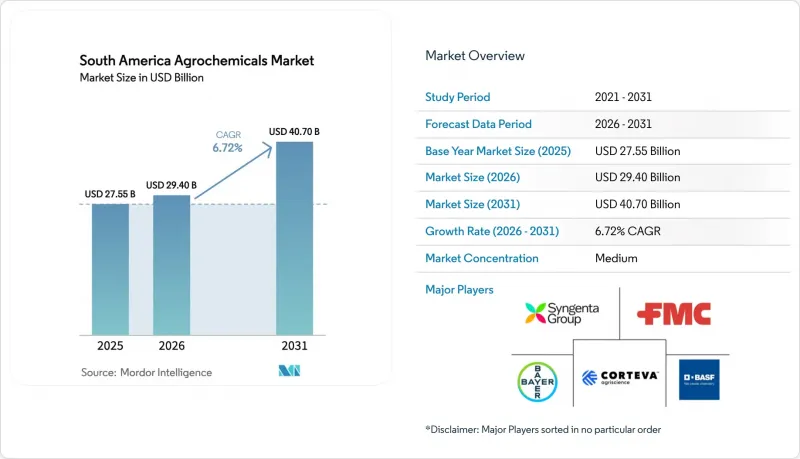
This report is Segmented by Product Type (Fertilizers, Crop Protection Chemicals, Adjuvants, and More), by Crop Type (Cereals and Grains, Oilseeds and Pulses, and More), and by Country (Brazil, Argentina, and More). The Market Forecasts are Provided in Terms of Value (USD).
South America Agrochemicals Market Trends and Insights
Expansion of soybean cultivation area
Brazil planted 46.2 million ha of soybeans in the 2024-2025 season, up 3.8% year on year, and Argentina reached 16.8 million ha in 2025, reversing prior drought losses. Larger acreage lifts herbicide volumes because each hectare receives 2-3 sequential applications, including glyphosate, residual pre-emergents, and burndown chemistries. Fertilizer demand is increasing steadily. The average NPK usage in Brazilian soybean cultivation rose to 185 kg per hectare in 2025, compared to 168 kg per hectare in 2020. The intensified soy-corn double-crop model compresses spray windows, favoring ready-to-mix liquids applied via high-clearance sprayers. Herbicide-tolerant varieties now cover 97% of Brazilian soybean hectares, enabling over-the-top applications that streamline weed control but spur resistance in Amaranthus species.
Adoption of Herbicide-Tolerant Biotech Seeds
Glyphosate- and glufosinate-tolerant traits dominated the majority of soybean seed sales in Argentina and Brazil during the 2025 planting season. Corteva's Enlist E3 platform gained a higher market share in Brazil, lifting sales of complementary herbicides Enlist One and Enlist Duo. BASF's Credenz varieties with Xtend technology captured larger Argentine acreage, boosting Engenia volumes. Trait-chemistry linkages lock in recurring revenue for integrated suppliers but concentrate purchasing power among large growers that negotiate discounts. The use of certified seeds in Paraguay increased significantly between 2023 and 2025, driven by cooperatives offering bundled packages that included seeds, herbicides, and credit.
Stricter Bans on Synthetic Active Ingredients
Brazilian National Health Surveillance Agency (ANVISA) scheduled paraquat phase-out by December 2026 and restricted 2,4-D use to closed systems by 2027. Paraquat represented 8% of Brazilian herbicide volume in 2024. Substitution with glufosinate or saflufenacil raises per-hectare costs by up to 50% and requires new application timing. National Service of Agri-Food Health and Quality SENASA (Argentina) announced bans on chlorpyrifos and carbofuran by mid-2027, impacting corn and sugarcane insecticide programs. Compliance investments favor large farms. Smaller growers may cut application frequency, risking yield losses.
Other drivers and restraints analyzed in the detailed report include:
- Government fertilizer subsidy programs
- Climate-linked crop-insurance uptake
- Volatile Raw-Material Costs (Oil-Derived Intermediates)
For complete list of drivers and restraints, kindly check the Table Of Contents.
Segment Analysis
Crop protection chemicals dominated the market in 2025, contributing 65.8% of product-type revenue. This emphasizes the role of herbicides, insecticides, fungicides, and other pesticides in protecting vast hectares of crops across the region. Fertilizers accounted for the next largest market share of revenue, supported by Brazil's zero-tariff import policy, which ensured high urea and potash volumes despite global price fluctuations. Adjuvants, while comprising a smaller share, emerged as the fastest-growing segment. This segment is projected to grow at a 9.2% CAGR through 2031, driven by the adoption of precision-spraying systems, drone applications, and the demand for advanced surfactants, drift-control agents, and pH conditioners in increasingly complex tank mixes.
Within crop protection, herbicides remain the key driver of demand, supported by herbicide-tolerant soybean systems. Insecticides and fungicides continue to play a vital role due to pest and disease pressures affecting crops such as cotton, corn, soybeans, grapes, and other high-value crops. Adjuvant growth is closely associated with the adoption of spot-spraying and variable-rate technologies, which boost adjuvant usage per treated hectare. Fertilizers continue to gain traction, particularly in nitrogenous and potassic products, supported by favorable policies and consistent demand. Plant growth regulators, while accounting for niche market value, show steady growth due to their high margins and expanding applications in sugarcane and export-oriented fruit crops. This niche segment is anticipated to experience specialized growth through 2031.
Complete Report Scope:
- By Product Type
- Fertilizers
- Nitrogenous
- Phosphatic
- Potassic
- Other Fertilizers
- Crop Protection Chemicals
- Herbicides
- Insecticides
- Fungicides
- Other Pesticides
- Adjuvants
- Plant Growth Regulators
- Fertilizers
- By Crop Type
- Cereals and Grains
- Oilseeds and Pulses
- Fruits and Vegetables
- Commercial Crops
- Turf and Ornamentals
- By Country
- Brazil
- Argentina
- Colombia
- Chile
- Peru
- Rest of South America
List of Companies Covered in this Report:
- Bayer AG
- Syngenta Group
- BASF SE
- Corteva Agriscience
- FMC Corporation
- UPL Ltd.
- Sumitomo Chemical Co., Ltd.
- Nufarm Ltd.
- Nutrien Ltd.
- Yara International ASA
- Lavoro Agro Holding S.A.
- Haifa Negev technologies LTD
- Albaugh LLC
- Compo Expert Brasil Fertilizantes Ltda. (Azoty Group S.A)
Additional Benefits:
- The market estimate (ME) sheet in Excel format
- 3 months of analyst support
TABLE OF CONTENTS
1 Introduction
- 1.1 Study Assumptions and Market Definition
- 1.2 Scope of the Study
2 Research Methodology
3 Executive Summary
4 Market Landscape
- 4.1 Market Overview
- 4.2 Market Drivers
- 4.2.1 Expansion of soybean cultivation area
- 4.2.2 Adoption of herbicide-tolerant biotech seeds
- 4.2.3 Government fertilizer subsidy programs
- 4.2.4 Growth in export-oriented specialty crops
- 4.2.5 Climate-linked crop-insurance uptake
- 4.2.6 AI-driven precision-spraying technologies
- 4.3 Market Restraints
- 4.3.1 Stricter bans on synthetic active ingredients
- 4.3.2 Volatile raw-material costs (oil-derived intermediates)
- 4.3.3 Rising herbicide resistance in key weed species
- 4.3.4 Amazon corridor logistics bottlenecks
- 4.4 Regulatory Landscape
- 4.5 Technological Outlook
- 4.6 Porter's Five Forces Analysis
- 4.6.1 Threat of New Entrants
- 4.6.2 Bargaining Power of Suppliers
- 4.6.3 Bargaining Power of Buyers
- 4.6.4 Threat of Substitutes
- 4.6.5 Intensity of Competitive Rivalry
5 Market Size and Growth Forecasts (Value)
- 5.1 By Product Type
- 5.1.1 Fertilizers
- 5.1.1.1 Nitrogenous
- 5.1.1.2 Phosphatic
- 5.1.1.3 Potassic
- 5.1.1.4 Other Fertilizers
- 5.1.2 Crop Protection Chemicals
- 5.1.2.1 Herbicides
- 5.1.2.2 Insecticides
- 5.1.2.3 Fungicides
- 5.1.2.4 Other Pesticides
- 5.1.3 Adjuvants
- 5.1.4 Plant Growth Regulators
- 5.1.1 Fertilizers
- 5.2 By Crop Type
- 5.2.1 Cereals and Grains
- 5.2.2 Oilseeds and Pulses
- 5.2.3 Fruits and Vegetables
- 5.2.4 Commercial Crops
- 5.2.5 Turf and Ornamentals
- 5.3 By Country
- 5.3.1 Brazil
- 5.3.2 Argentina
- 5.3.3 Colombia
- 5.3.4 Chile
- 5.3.5 Peru
- 5.3.6 Rest of South America
6 Competitive Landscape
- 6.1 Market Concentration
- 6.2 Strategic Moves
- 6.3 Market Share Analysis
- 6.4 Company Profiles (Includes Global Level Overview, Market Level Overview, Core Segments, Financials as Available, Strategic Information, Market Rank/Share for Key Companies, Products and Services, and Recent Developments)
- 6.4.1 Bayer AG
- 6.4.2 Syngenta Group
- 6.4.3 BASF SE
- 6.4.4 Corteva Agriscience
- 6.4.5 FMC Corporation
- 6.4.6 UPL Ltd.
- 6.4.7 Sumitomo Chemical Co., Ltd.
- 6.4.8 Nufarm Ltd.
- 6.4.9 Nutrien Ltd.
- 6.4.10 Yara International ASA
- 6.4.11 Lavoro Agro Holding S.A.
- 6.4.12 Haifa Negev technologies LTD
- 6.4.13 Albaugh LLC
- 6.4.14 Compo Expert Brasil Fertilizantes Ltda. (Azoty Group S.A)
7 Market Opportunities and Future Outlook

