PUBLISHER: Mordor Intelligence | PRODUCT CODE: 2121728

PUBLISHER: Mordor Intelligence | PRODUCT CODE: 2121728
Liquid Crystal On Silicon (LCoS) Display - Market Share Analysis, Industry Trends & Statistics, Growth Forecasts (2026 - 2031)
According to Mordor Intelligence, the liquid crystal on silicon (LCoS) display market size stood at USD 3.26 billion in 2026 and is projected to reach USD 5.16 billion by 2031, expanding at a 9.62% CAGR over 2026-2031.
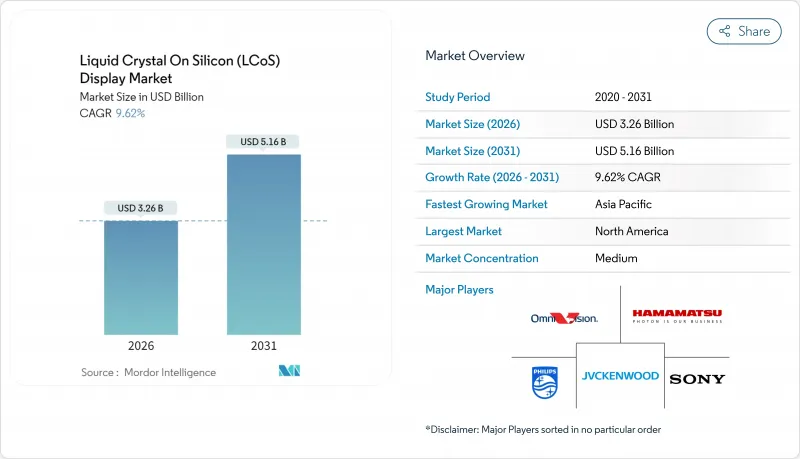
This report is Segmented by Product (Head-Mounted Display, Projector, and More), Technology (Ferroelectrics LCoS, Nematics LCoS, and More), End User (Consumer Electronics, Automotive, and More), Application (Display Applications, and Non-Display Applications), Resolution (HD, Full HD (1080p), and More), and Geography. The Market Forecasts are Provided in Terms of Value (USD).
Global Liquid Crystal On Silicon (LCoS) Display Market Trends and Insights
Increasing Demand for High-Resolution Display Products
Professional simulators, surgical microscopes, and home-theater enthusiasts are converging on 4K and 8K requirements, and the Liquid Crystal On Silicon (LCoS) display market is answering with sub-3 micrometer pixel pitches. Sony's VPL-GTZ380 stacks three 1.38-inch panels to achieve native 8K images that replicate vascular detail for surgical training. Panel makers are adopting immersion photolithography to maintain yields, which raises capex but fortifies entry barriers. While price limits slow 4K adoption in mainstream consumer projectors, corporate and education customers are upgrading faster to meet fine-text readability standards. As a result, high-resolution panels are expected to corner an ever-larger slice of future revenue.
Deployment of AR and VR in Consumer Devices and HMDs
Slimmer headsets need pixel densities that eliminate the screen-door effect at arm's-length viewing. OmniVision's December 2025 OP03021 chip integrates 1920 X 1080 pixels on a 0.39-inch diagonal and drives 120 Hz refresh, allowing mixed-reality glasses to weigh under 100 g. Himax followed with a dual-edge front-lit architecture that cuts optical-path length by 30%, letting designers carve thinner temple arms. Such gains underpin a 10.22% CAGR for HMD shipments within the wider Liquid Crystal On Silicon (LCoS) display market. Ferroelectric modes that switch in under a millisecond are also critical to reduce motion-to-photon latency below 10 ms, a threshold for user comfort.
High Cost of Technology Development and Manufacturing
Sub-3 micrometer patterning tools cost upward of USD 100 million each, and initial yield losses can hit 20% when liquid-crystal alignment drifts. Japan Display spun off its automotive micro display assets into AutoTech in October 2025 to ring-fence this capex pressure. Consumer-electronics buyers also demand annual price cuts, squeezing margin recovery. These economics discourage new entrants and keep most high-resolution capacity clustered in Japan, South Korea, and Taiwan.
Other drivers and restraints analyzed in the detailed report include:
- Growing Automotive Adoption of HUDs
- Emergence of Laser-Illuminated LCoS for High-Brightness Projectors
- Competition From OLED and MicroLED Alternatives
For complete list of drivers and restraints, kindly check the Table Of Contents.
Segment Analysis
The segment generated the largest slice of the Liquid Crystal On Silicon (LCoS) display market size from projectors in 2025, with projectors holding 46.06% revenue. However, head-mounted displays are set to grow faster at 10.22% annually. Pico projectors are pivoting toward smart-home interfaces that project controls on walls, while spatial-light-modulator panels, though niche, command the highest prices because laboratories pay for phase accuracy.
OmniVision's OP03021 enabled retinal-resolution pixels within a 0.39-inch diagonal, allowing consumer AR glasses to weigh under 100 g and reinforcing HMD momentum. At the same time, professional cinema owners continue to invest in USD 80,000 8K projectors, preserving cash flow for legacy vendors. This dual narrative keeps the LCoS display market balanced between cost-sensitive consumer products and premium projection solutions.
Nematic modes still dominated 60.11% of 2025 revenue, yet the ferroelectric share is expanding fastest, supported by a 10.54% CAGR that outstrips the overall Liquid Crystal On Silicon (LCoS) display market. Ferroelectric liquid crystals switch in under 100 µs, essential for holographic LiDAR and varifocal AR optics.
Fraunhofer IPMS demonstrated binary ferroelectric panels that reconfigure automotive LiDAR beams in real time. Yield hurdles persist because spontaneous polarization makes alignment sensitive, lifting defect rates above 15%. Even so, buyers in defense and photonics tolerate 30% price premiums for latency gains, ensuring healthy margins for suppliers able to master the process.
Complete Report Scope:
- By Product
- Head-Mounted Display (HMD)
- Projector
- Head-Up Display (HUD)
- Pico Projector
- Spatial Light Modulator Panel
- By Technology
- Ferroelectrics LCoS (FLCoS)
- Nematics LCoS (NLCoS)
- Wavelength Selective Switching (WSS)
- Reflective LCoS
- Transmissive LCoS
- By End User
- Consumer Electronics
- Automotive
- Aviation
- Optical 3D Measurement
- Medical
- Military
- Industrial and Scientific
- By Application
- Display Applications
- Projectors
- Microdisplays for AR/VR HMDs
- Head-Up Displays
- Non-Display Applications
- Wavelength Selective Switching in Optical Telecom
- Beam Steering and LiDAR
- Spatial Light Modulators for Holography and 3D Printing
- Display Applications
- By Resolution
- HD (Less than equal to 720p)
- Full HD (1080p)
- WQHD (1440p)
- 4K and Above
- By Geography
- North America
- United States
- Canada
- Mexico
- Europe
- United Kingdom
- Germany
- France
- Italy
- Rest of Europe
- Asia-Pacific
- China
- Japan
- India
- South Korea
- Rest of Asia
- Middle East
- Israel
- Saudi Arabia
- United Arab Emirates
- Turkey
- Rest of Middle East
- Africa
- South Africa
- Egypt
- Rest of Africa
- South America
- Brazil
- Argentina
- Rest of South America
- North America
Geography Analysis
North America commanded 34.38% of 2025 revenue thanks to strong enterprise projector sales, defense helmet orders, and early AR pilots in surgery and logistics. Research institutes such as national laboratories purchased the bulk of phase-only spatial light modulators, reinforcing local demand. The CHIPS and Science Act is expected to seed domestic fabs, though new lines had not broken ground by early 2026.
Asia-Pacific is forecast to expand at a 10.94% CAGR, the fastest rate worldwide. Japanese incumbents are repurposing older LCD fabs for micro displays, South Korean groups are investing in AR components, and China is consolidating liquid-crystal chemical supply. Slichem's acquisition of DIC's fluids allows Chinese panel makers to internalize key materials, but Western defense primes now vet supply chains more closely.
Europe sits mid-pack, buoyed by automotive HUD programs. Euro NCAP's 2025 scoring revisions reward augmented-reality displays, prompting German OEMs to standardize panoramic HUDs on new models. Horizon Europe earmarked EUR 1.2 billion (USD 1.3 billion) for photonics through 2027, part of which funds LCoS spatial-light-modulator research. Middle East markets buy LCoS systems for flight simulation, while Africa and South America remain nascent.
- Sony Corporation
- JVC Kenwood Corporation
- Himax Technologies Inc.
- OmniVision Technologies Inc.
- HOLOEYE Photonics AG
- Meadowlark Optics Inc.
- Hamamatsu Photonics KK
- Syndiant Inc.
- Canon Inc.
- Epson Corporation
- Kopin Corporation
- Forth Dimension Displays Ltd.
- Raontech Inc.
- AAXA Technologies Inc.
- MicroVision Inc.
- Magic Leap Inc.
- Google LLC
- Microsoft Corporation
- Koninklijke Philips NV
- May Co. Ltd.
Additional Benefits:
- The market estimate (ME) sheet in Excel format
- 3 months of analyst support
TABLE OF CONTENTS
1 INTRODUCTION
- 1.1 Study Assumptions and Market Definition
- 1.2 Scope of the Study
2 RESEARCH METHODOLOGY
3 EXECUTIVE SUMMARY
4 MARKET LANDSCAPE
- 4.1 Market Overview
- 4.2 Market Drivers
- 4.2.1 Increasing Demand for High-Resolution Display Products
- 4.2.2 Deployment of AR and VR in Consumer Devices and HMDs
- 4.2.3 Growing Automotive Adoption of HUDs
- 4.2.4 Emergence of Laser-Illuminated LCoS for High-Brightness Projectors
- 4.2.5 Integration of LCoS Spatial Light Modulators in Quantum and Photonics Research
- 4.2.6 Government Funding for Advanced Microdisplay Manufacturing
- 4.3 Market Restraints
- 4.3.1 High Cost of Technology Development and Manufacturing
- 4.3.2 Competition From OLED and MicroLED Alternatives
- 4.3.3 Supply Chain Dependence on Specialized Liquid Crystal Materials
- 4.3.4 Thermal Management Challenges in High-Brightness LCoS Panels
- 4.4 Industry Value-Chain Analysis
- 4.5 Regulatory Landscape
- 4.6 Technological Outlook
- 4.7 Impact of Macroeconomic Factors on the Market
- 4.8 Porter's Five Forces Analysis
- 4.8.1 Threat of New Entrants
- 4.8.2 Bargaining Power of Buyers
- 4.8.3 Bargaining Power of Suppliers
- 4.8.4 Threat of Substitute Products
- 4.8.5 Intensity of Competitive Rivalry
- 4.9 Investment Analysis
5 MARKET SIZE AND GROWTH FORECASTS (VALUE)
- 5.1 By Product
- 5.1.1 Head-Mounted Display (HMD)
- 5.1.2 Projector
- 5.1.3 Head-Up Display (HUD)
- 5.1.4 Pico Projector
- 5.1.5 Spatial Light Modulator Panel
- 5.2 By Technology
- 5.2.1 Ferroelectrics LCoS (FLCoS)
- 5.2.2 Nematics LCoS (NLCoS)
- 5.2.3 Wavelength Selective Switching (WSS)
- 5.2.4 Reflective LCoS
- 5.2.5 Transmissive LCoS
- 5.3 By End User
- 5.3.1 Consumer Electronics
- 5.3.2 Automotive
- 5.3.3 Aviation
- 5.3.4 Optical 3D Measurement
- 5.3.5 Medical
- 5.3.6 Military
- 5.3.7 Industrial and Scientific
- 5.4 By Application
- 5.4.1 Display Applications
- 5.4.1.1 Projectors
- 5.4.1.2 Microdisplays for AR/VR HMDs
- 5.4.1.3 Head-Up Displays
- 5.4.2 Non-Display Applications
- 5.4.2.1 Wavelength Selective Switching in Optical Telecom
- 5.4.2.2 Beam Steering and LiDAR
- 5.4.2.3 Spatial Light Modulators for Holography and 3D Printing
- 5.4.1 Display Applications
- 5.5 By Resolution
- 5.5.1 HD (Less than equal to 720p)
- 5.5.2 Full HD (1080p)
- 5.5.3 WQHD (1440p)
- 5.5.4 4K and Above
- 5.6 By Geography
- 5.6.1 North America
- 5.6.1.1 United States
- 5.6.1.2 Canada
- 5.6.1.3 Mexico
- 5.6.2 Europe
- 5.6.2.1 United Kingdom
- 5.6.2.2 Germany
- 5.6.2.3 France
- 5.6.2.4 Italy
- 5.6.2.5 Rest of Europe
- 5.6.3 Asia-Pacific
- 5.6.3.1 China
- 5.6.3.2 Japan
- 5.6.3.3 India
- 5.6.3.4 South Korea
- 5.6.3.5 Rest of Asia
- 5.6.4 Middle East
- 5.6.4.1 Israel
- 5.6.4.2 Saudi Arabia
- 5.6.4.3 United Arab Emirates
- 5.6.4.4 Turkey
- 5.6.4.5 Rest of Middle East
- 5.6.5 Africa
- 5.6.5.1 South Africa
- 5.6.5.2 Egypt
- 5.6.5.3 Rest of Africa
- 5.6.6 South America
- 5.6.6.1 Brazil
- 5.6.6.2 Argentina
- 5.6.6.3 Rest of South America
- 5.6.1 North America
6 COMPETITIVE LANDSCAPE
- 6.1 Market Concentration
- 6.2 Strategic Moves
- 6.3 Market Share Analysis
- 6.4 Company Profiles (includes Global Level Overview, Market Level Overview, Core Segments, Financials as Available, Strategic Information, Market Rank/Share for Key Companies, Products and Services, and Recent Developments)
- 6.4.1 Sony Corporation
- 6.4.2 JVC Kenwood Corporation
- 6.4.3 Himax Technologies Inc.
- 6.4.4 OmniVision Technologies Inc.
- 6.4.5 HOLOEYE Photonics AG
- 6.4.6 Meadowlark Optics Inc.
- 6.4.7 Hamamatsu Photonics KK
- 6.4.8 Syndiant Inc.
- 6.4.9 Canon Inc.
- 6.4.10 Epson Corporation
- 6.4.11 Kopin Corporation
- 6.4.12 Forth Dimension Displays Ltd.
- 6.4.13 Raontech Inc.
- 6.4.14 AAXA Technologies Inc.
- 6.4.15 MicroVision Inc.
- 6.4.16 Magic Leap Inc.
- 6.4.17 Google LLC
- 6.4.18 Microsoft Corporation
- 6.4.19 Koninklijke Philips NV
- 6.4.20 May Co. Ltd.
7 MARKET OPPORTUNITIES AND FUTURE OUTLOOK
- 7.1 White-Space and Unmet-Need Assessment

