PUBLISHER: Mordor Intelligence | PRODUCT CODE: 2121738

PUBLISHER: Mordor Intelligence | PRODUCT CODE: 2121738
Air Traffic Control Equipment - Market Share Analysis, Industry Trends & Statistics, Growth Forecasts (2026 - 2031)
According to Mordor Intelligence, the air traffic control equipment market size was valued at USD 12.08 billion in 2025 and estimated to grow from USD 13.09 billion in 2026 to reach USD 19.59 billion by 2031, at a CAGR of 8.39% during the forecast period (2026-2031).
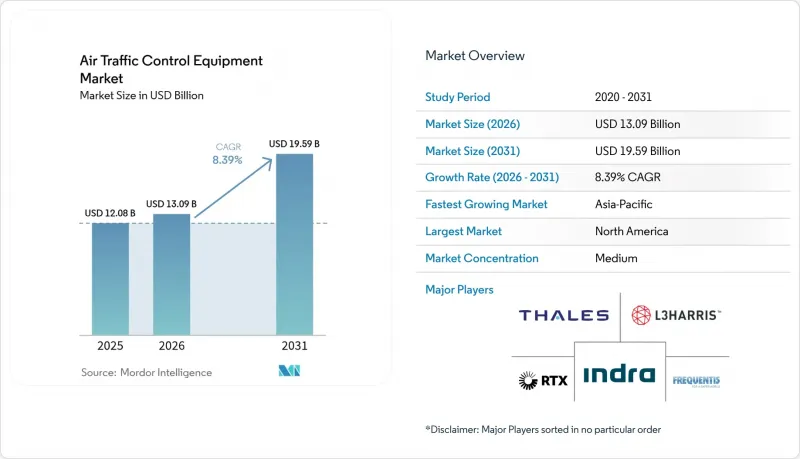
This report is Segmented by Equipment Type (Communication Equipment, Navigation Equipment, and More), End-User (Commercial and Military), Airport Type (Brownfield and Greenfield), Investment (New Installations and Modernization and Upgradation), and Geography (North America, Europe, Asia-Pacific, South America and More). The Market Forecasts are Provided in Terms of Value (USD).
Global Air Traffic Control Equipment Market Trends and Insights
NextGen and SESAR-funded digitalization wave
The European ATM Master Plan estimated a EUR 17 return per unit investment by 2050, encouraging authorities to channel budgets toward cloud-native, interoperable architectures. Parallel US NextGen programs prioritized satellite-based navigation, time-based flow management, and digital voice switching, locking in multiyear orders for platform suppliers. Top-tier vendors responded with Kubernetes-enabled open systems that simplify software updates and facilitate remote maintenance.
Mandated ADS-B Out deadlines
Twelve countries enforced ADS-B for defined airspace bands, sustaining retrofit demand for transponders and associated ground receivers. The FAA leveraged ADS-B data in its Surface Awareness Initiative to cut runway incursions, awarding Indra authority to roll out AeroBOSS at more than 450 airports. Europe advanced ADS-C common services under the Digital Sky framework, widening the surveillance data ecosystem.
High CAPEX and lengthy certification cycles
The US Government Accountability Office found 37% of FAA systems unsustainable, yet replacement projects often faced multi-year certification hurdles that slowed spending draws. European EASA Regulation 2023/1769 imposed design-organization approvals on ATM equipment, extending development timelines for small suppliers.
Other drivers and restraints analyzed in the detailed report include:
- Remote/digital tower adoption at secondary airports
- AI-driven predictive airspace management platforms
- Legacy-system interoperability bottlenecks
For complete list of drivers and restraints, kindly check the Table Of Contents.
Segment Analysis
Communication platforms represented 42.10% of 2025 revenue in the ATC equipment market, underlining the centrality of resilient voice channels and data links. Indra's USD 244.3 million FAA award to supply 46,000 dual-mode digital radios illustrated replacement momentum for aging analog fleets. Vendors such as Frequentis controlled a 30% share of global controller positions, highlighting the scale economies enjoyed by established providers.
Although remote and digital tower modules account for only 5.45% of 2025 revenue, they are forecast to post the fastest 10.86% CAGR as airports consolidate surveillance under multi-airport centers. The transition reduced staffing costs by up to 30% at Nordic regional fields, bolstering return on invested capital and encouraging regulators to certify low-visibility operations using 4K sensors.
Commercial carriers generated 66.00% of 2025 revenue for the ATC equipment market thanks to the rebound in global passenger demand and mandatory ADS-B equipage. Boeing projected Africa's fleet to double by 2043, indicating persistent downstream demand for tower, radar, and data-link upgrades. At the same time, defense agencies accelerated procurements, lifting military revenue at a 9.70% CAGR from 2026 to 2031. A USD 472 million US Air Force order for 19 TPY-4 radars underscored the size of modernization contracts flowing into the segment.
Military applications are mirroring layered air defense priorities. Convergence between civil and defense requirements around cybersecurity, artificial intelligence, and UTM hardware continues to blur supplier boundaries and open cross-selling opportunities for integrated platform vendors.
Complete Report Scope:
- By Equipment Type
- Communication Equipment
- Navigation Equipment
- Surveillance/Automation Systems
- Remote / Digital Tower Modules
- By End User
- Commercial
- Military
- By Airport Type
- Brownfield Airports
- Greenfield Airports
- By Investment Category
- New Installations
- Modernization and Upgradation
- By Region
- North America
- United States
- Canada
- Mexico
- Europe
- Germany
- United Kingdom
- France
- Russia
- Rest of Europe
- Asia-Pacific
- China
- Japan
- India
- South Korea
- Australia
- Rest of Asia-Pacific
- South America
- Brazil
- Rest of South America
- Middle East and Africa
- Middle East
- United Arab Emirates
- Saudi Arabia
- Turkey
- Rest of Middle East
- Africa
- South Africa
- Rest of Africa
- Middle East
- North America
Geography Analysis
North America retained 40.20% of 2025 revenue in the ATC equipment market, anchored by the FAA's USD 15 billion blueprint for digital voice switching, radar replacement, and tower construction. NAV CANADA invested in Digital Aerodrome Air Traffic Services to remotely manage isolated aerodromes, reinforcing the region's leadership in operational innovation.
Asia-Pacific registered the highest regional growth at 10.35% CAGR. India's "One Airspace" initiative unified 2.8 million nmi2 under a single national system, while China accelerated CNS/ATM roll-outs in tandem with new runways at major hubs. Australia's early adoption of off-site tower technology further boosted regional momentum.
Europe progressed on schedule with the SESAR 3 program, channeling EUR 30 billion into Digital Sky projects that promise 400 million tonnes of CO2 savings by 2050. The Middle East and Africa showed pockets of intense spending, led by USD 1 trillion of airport expansions across Dubai, Riyadh, and Doha. Latin America benefited from Indra's modernization of 70% of the region's control centers, though funding constraints moderated its growth trajectory.
- Thales Group
- IndraSistemas S.A.
- RTX Corporation
- L3Harris Technologies, Inc.
- SITA N.V.
- Honeywell International Inc.
- Frequentis AG
- ACAMS AS
- Searidge Technologies
- Saab AB
- Rohde & Schwarz USA, Inc. (Rohde & Schwarz GmbH & Co. KG)
- General Dynamics Mission Systems, Inc. (General Dynamics Corporation)
- Leonardo S.p.A
- NEC Corporation
- Intelcan Technosystems Inc.
- Aquila Air Traffic Management Services Limited
- ARTISYS, s.r.o.
- Leidos Holdings, Inc.
Additional Benefits:
- The market estimate (ME) sheet in Excel format
- 3 months of analyst support
TABLE OF CONTENTS
1 INTRODUCTION
- 1.1 Study Assumptions and Market Definition
- 1.2 Scope of the Study
2 RESEARCH METHODOLOGY
3 EXECUTIVE SUMMARY
4 MARKET LANDSCAPE
- 4.1 Market Overview
- 4.2 Market Drivers
- 4.2.1 NextGen and SESAR-funded digitalization wave
- 4.2.2 Mandated ADS-B Out deadlines
- 4.2.3 Remote/digital tower adoption at secondary airports
- 4.2.4 Integration of UAS-traffic-management (UTM) hardware
- 4.2.5 AI-driven predictive airspace management platforms
- 4.2.6 Green-flight-corridor demand for trajectory-based ops
- 4.3 Market Restraints
- 4.3.1 High CAPEX and lengthy certification cycles
- 4.3.2 Legacy-system interoperability bottlenecks
- 4.3.3 Escalating cyber-security liability on IP-based VCS
- 4.3.4 Urban-corridor RF-spectrum congestion
- 4.4 Value Chain Analysis
- 4.5 Regulatory Landscape
- 4.6 Technological Outlook
- 4.7 Porter's Five Forces Analysis
- 4.7.1 Bargaining Power of Buyers/Consumers
- 4.7.2 Bargaining Power of Suppliers
- 4.7.3 Threat of New Entrants
- 4.7.4 Threat of Substitutes
- 4.7.5 Intensity of Competitive Rivalry
5 MARKET SIZE AND GROWTH FORECASTS (VALUE)
- 5.1 By Equipment Type
- 5.1.1 Communication Equipment
- 5.1.2 Navigation Equipment
- 5.1.3 Surveillance/Automation Systems
- 5.1.4 Remote / Digital Tower Modules
- 5.2 By End User
- 5.2.1 Commercial
- 5.2.2 Military
- 5.3 By Airport Type
- 5.3.1 Brownfield Airports
- 5.3.2 Greenfield Airports
- 5.4 By Investment Category
- 5.4.1 New Installations
- 5.4.2 Modernization and Upgradation
- 5.5 By Region
- 5.5.1 North America
- 5.5.1.1 United States
- 5.5.1.2 Canada
- 5.5.1.3 Mexico
- 5.5.2 Europe
- 5.5.2.1 Germany
- 5.5.2.2 United Kingdom
- 5.5.2.3 France
- 5.5.2.4 Russia
- 5.5.2.5 Rest of Europe
- 5.5.3 Asia-Pacific
- 5.5.3.1 China
- 5.5.3.2 Japan
- 5.5.3.3 India
- 5.5.3.4 South Korea
- 5.5.3.5 Australia
- 5.5.3.6 Rest of Asia-Pacific
- 5.5.4 South America
- 5.5.4.1 Brazil
- 5.5.4.2 Rest of South America
- 5.5.5 Middle East and Africa
- 5.5.5.1 Middle East
- 5.5.5.1.1 United Arab Emirates
- 5.5.5.1.2 Saudi Arabia
- 5.5.5.1.3 Turkey
- 5.5.5.1.4 Rest of Middle East
- 5.5.5.2 Africa
- 5.5.5.2.1 South Africa
- 5.5.5.2.2 Rest of Africa
- 5.5.5.1 Middle East
- 5.5.1 North America
6 COMPETITIVE LANDSCAPE
- 6.1 Market Concentration
- 6.2 Strategic Moves
- 6.3 Market Share Analysis
- 6.4 Company Profiles (includes Global-level Overview, Market-level Overview, Core Segments, Financials as available, Strategic Information, Market Rank/Share, Products and Services, Recent Developments)
- 6.4.1 Thales Group
- 6.4.2 IndraSistemas S.A.
- 6.4.3 RTX Corporation
- 6.4.4 L3Harris Technologies, Inc.
- 6.4.5 SITA N.V.
- 6.4.6 Honeywell International Inc.
- 6.4.7 Frequentis AG
- 6.4.8 ACAMS AS
- 6.4.9 Searidge Technologies
- 6.4.10 Saab AB
- 6.4.11 Rohde & Schwarz USA, Inc. (Rohde & Schwarz GmbH & Co. KG)
- 6.4.12 General Dynamics Mission Systems, Inc. (General Dynamics Corporation)
- 6.4.13 Leonardo S.p.A
- 6.4.14 NEC Corporation
- 6.4.15 Intelcan Technosystems Inc.
- 6.4.16 Aquila Air Traffic Management Services Limited
- 6.4.17 ARTISYS, s.r.o.
- 6.4.18 Leidos Holdings, Inc.
7 MARKET OPPORTUNITIES AND FUTURE OUTLOOK
- 7.1 White-space and Unmet-Need Assessment

