PUBLISHER: Mordor Intelligence | PRODUCT CODE: 2121741

PUBLISHER: Mordor Intelligence | PRODUCT CODE: 2121741
Polypropylene Fibers - Market Share Analysis, Industry Trends & Statistics, Growth Forecasts (2026 - 2031)
According to Mordor Intelligence, the polypropylene fibers market size is projected to be 3.37 Million tons in 2025, 3.46 Million tons in 2026, and reach 3.96 Million tons by 2031, growing at a CAGR of 2.74% from 2026 to 2031.
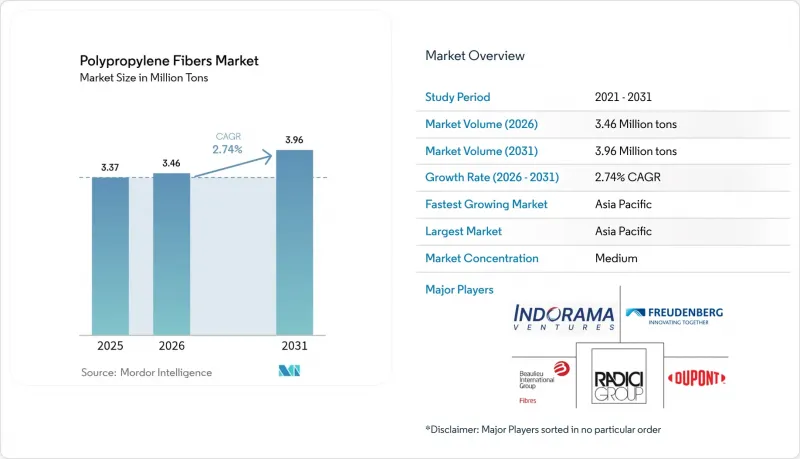
This report is Segmented by Type (Yarn and Staple), End-User Industry (Textile, Construction, Healthcare and Hygiene, and Other End-User Industries), and Geography (Asia-Pacific, North America, Europe, South America, and Middle-East and Africa). The Market Forecasts are Provided in Terms of Volume (Tons).
Global Polypropylene Fibers Market Trends and Insights
Infrastructure Shift Toward Macro-Synthetic Concrete Reinforcement
Transport ministries in India, Indonesia, and Brazil now allow 3-6 kg/m3 polypropylene macro-fibers to replace welded-wire mesh, cutting rebar by 20-35% and slashing corrosion-related repairs. India's clause 509 specifications alone create 42,000 tons of captive demand by 2028. Sao Paulo field trials show 60% crack-width reduction after 90 freeze-thaw cycles, unlocking federal resurfacing funds. Contractors value single-pour placement that trims labor by almost one-quarter in congested urban corridors.
Accelerating Geotextile Penetration in Road and Coastal Engineering
Monsoon-sensitive soils across Southeast Asia settle 15-20 cm within two years without separation layers, so Vietnam's USD 15 billion North-South Expressway specifies 200 g/m2 needle-punched PP nonwovens, consuming 9,200 tons through 2027. Indonesian and Filipino municipalities install geotextile tubes that require 18-22 tons per shoreline kilometre, financed by an Asian Development Bank USD 340 million loan package. Laboratory tests confirm 85% flow retention after 10,000 hours in aggressive leachate, meeting EU landfill rules. The resulting infrastructure pull lifts regional demand. Government tender rules that score life-cycle cost now favor geotextiles because they halve maintenance dredging over a road's service life, reinforcing adoption momentum.
Low Melting-Point Limits in High-Temperature Uses
Polypropylene melts at 160-165 °C, ruling it out for diesel particulate filters that regenerate at 180-220 °C and for cement-kiln baghouse filters now required to capture 99.5% particulates under the U.S. EPA's 2025 standards. OEMs therefore choose polyamide, aramid, or PTFE fibers that cost 40-80% more per square meter yet survive higher temperatures, diverting an estimated 14,000 tons of annual demand from PP fibers. Attempts to raise the service ceiling by grafting maleic anhydride or blending HDPE add USD 0.18-0.25 per kilogram and still fail to meet 180 °C thresholds. Continued R&D may improve heat resistance, but commercial impact is unlikely within the next two years.
Other drivers and restraints analyzed in the detailed report include:
- Lightweight Automotive Interior Adoption (EV Range Extension)
- Circular-Grade Recycled PP Fibers Enabled by Chemical Recycling
- ESG Scrutiny on Micro-Plastics Leakage from Non-Woven Disposables
For complete list of drivers and restraints, kindly check the Table Of Contents.
Segment Analysis
Continuous-filament yarn controlled 84.51% of the 2025 polypropylene fibers market size and is set to expand at a 2.78% CAGR through 2031, supported by 400-600 m/min weaving and spunbond lines that deliver 98% first-pass yield. Staple fiber is used in concrete reinforcement and needle-punched automotive carpets, but it incurs an additional conversion cost of USD 0.12-0.18/kg due to cutting and carding processes. U.S. and Turkish carpet mills migrated to bulked continuous filament because it eliminates carding, slashing labor 30-40% and ensuring just-in-time deliveries within 48 hours.
Staple fibers remain relevant in geotextile and shotcrete applications requiring 50-75 mm fibers. Tunnel constructors typically use 0.9-1.1 kg/m3 of fibers in shotcrete. Additionally, the demand for yarn is rising, particularly in hygiene spunbond and woven geotextiles.
Complete Report Scope:
- By Type
- Yarn
- Staple
- By End-user Industry
- Textile
- Construction
- Healthcare and Hygiene
- Other End-user Industries
- By Geography
- Asia-Pacific
- China
- India
- Japan
- South Korea
- ASEAN Countries
- Rest of Asia-Pacific
- North America
- United States
- Canada
- Mexico
- Europe
- Germany
- United Kingdom
- France
- Italy
- Spain
- Russia
- Rest of Europe
- South America
- Brazil
- Argentina
- Rest of South America
- Middle-East and Africa
- Saudi Arabia
- South Africa
- Rest of Middle-East and Africa
- Asia-Pacific
Geography Analysis
Asia-Pacific dominates the polypropylene fibers market, holding 51.12% of 2025 volume and growing at a 3.37% CAGR through 2031 on infrastructure megaprojects. China's production was led by Sinopec and PetroChina, supplying domestic converters at prices below import parity. In India, consumption increased following a mandate by the Ministry of Road Transport requiring geotextile layers on all national highways exceeding 10 km. Meanwhile, Japan and South Korea focused on producing ultra-fine electret melt-blown material for N95 respirators, a high-margin niche market with retail prices ranging from USD 3,200 to USD 3,800 per ton.
In North America, the U.S. Bipartisan Infrastructure Law is expected to generate additional demand for polypropylene (PP) macro-fiber across multiple states. In Canada, Ontario's electric vehicle (EV) assembly lines have seen increased utilization of glass-fiber-reinforced PP compounds for interior modules. Meanwhile, Mexico's maquiladoras imported yarn under USMCA regulations, which allow duty-free re-export when a significant portion of the value originates within North America.
Europe's demand is influenced by Extended Producer Responsibility fees that are impacting hygiene product margins. Germany, the regional leader, has seen reusable diaper lines capture a growing share of the retail market. France and Italy collectively consumed PP for applications such as Alpine road-stabilization geotextiles and carpet backing, driven by a rebound in housing construction.
South America and the Middle-East and Africa each account for a smaller portion of global market volume. In South America, Brazil's highway upgrades are expected to require separation fabrics. In the Middle-East, Saudi Arabia's NEOM and Qiddiya projects are projected to demand woven PP for desert stabilization. In South Africa, spinners imported PP resin for carpet yarn and baler twine, marking a notable increase compared to the previous year.
- ABC Polymer Industries LLC
- Beaulieu Fibres International NV
- Belgian Fibers
- Chemosvit Fibrochem SRO
- China National Petroleum Corporation
- DuPont
- Fiberpartner Aps
- Freudenberg Group
- Huimin Taili Chemical Fiber Products Co. Ltd
- Indorama Ventures Public Company Limited
- International Fibres Group
- Kolon Fiber Inc.
- Mitsubishi Chemical Corporation
- Radici Partecipazioni SpA
- Sika AG
- Tri Ocean Textile Co. Ltd
- W. Barnet GmbH & Co. KG
- Zenith Fibres Ltd
Additional Benefits:
- The market estimate (ME) sheet in Excel format
- 3 months of analyst support
TABLE OF CONTENTS
1 Introduction
- 1.1 Study Assumptions and Market Definition
- 1.2 Scope of the Study
2 Research Methodology
3 Executive Summary
4 Market Landscape
- 4.1 Market Overview
- 4.2 Market Drivers
- 4.2.1 Infrastructure shift toward macro-synthetic concrete reinforcement
- 4.2.2 Accelerating geotextile penetration in road and coastal engineering
- 4.2.3 Lightweight automotive interior adoption (EV range extension)
- 4.2.4 3-D printing of PP-fiber reinforced composites (mass-customization)
- 4.2.5 Circular-grade recycled PP fibers enabled by chemical recycling
- 4.3 Market Restraints
- 4.3.1 Low melting-point limits in high-temperature uses
- 4.3.2 ESG scrutiny on micro-plastics leakage from non-woven disposables
- 4.3.3 Ultrafine PP dust flagged in occupational-health regulations
- 4.4 Value Chain Analysis
- 4.5 Porter's Five Forces
- 4.5.1 Bargaining Power of Suppliers
- 4.5.2 Bargaining Power of Buyers
- 4.5.3 Threat of New Entrants
- 4.5.4 Threat of Substitutes
- 4.5.5 Degree of Competition
- 4.6 Raw-Material Analysis
5 Market Size and Growth Forecasts (Volume)
- 5.1 By Type
- 5.1.1 Yarn
- 5.1.2 Staple
- 5.2 By End-user Industry
- 5.2.1 Textile
- 5.2.2 Construction
- 5.2.3 Healthcare and Hygiene
- 5.2.4 Other End-user Industries
- 5.3 By Geography
- 5.3.1 Asia-Pacific
- 5.3.1.1 China
- 5.3.1.2 India
- 5.3.1.3 Japan
- 5.3.1.4 South Korea
- 5.3.1.5 ASEAN Countries
- 5.3.1.6 Rest of Asia-Pacific
- 5.3.2 North America
- 5.3.2.1 United States
- 5.3.2.2 Canada
- 5.3.2.3 Mexico
- 5.3.3 Europe
- 5.3.3.1 Germany
- 5.3.3.2 United Kingdom
- 5.3.3.3 France
- 5.3.3.4 Italy
- 5.3.3.5 Spain
- 5.3.3.6 Russia
- 5.3.3.7 Rest of Europe
- 5.3.4 South America
- 5.3.4.1 Brazil
- 5.3.4.2 Argentina
- 5.3.4.3 Rest of South America
- 5.3.5 Middle-East and Africa
- 5.3.5.1 Saudi Arabia
- 5.3.5.2 South Africa
- 5.3.5.3 Rest of Middle-East and Africa
- 5.3.1 Asia-Pacific
6 Competitive Landscape
- 6.1 Market Concentration
- 6.2 Strategic Moves
- 6.3 Market Share(%)/Ranking Analysis
- 6.4 Company Profiles (includes Global level Overview, Market level overview, Core Segments, Financials as available, Strategic Information, Products and Services, and Recent Developments)
- 6.4.1 ABC Polymer Industries LLC
- 6.4.2 Beaulieu Fibres International NV
- 6.4.3 Belgian Fibers
- 6.4.4 Chemosvit Fibrochem SRO
- 6.4.5 China National Petroleum Corporation
- 6.4.6 DuPont
- 6.4.7 Fiberpartner Aps
- 6.4.8 Freudenberg Group
- 6.4.9 Huimin Taili Chemical Fiber Products Co. Ltd
- 6.4.10 Indorama Ventures Public Company Limited
- 6.4.11 International Fibres Group
- 6.4.12 Kolon Fiber Inc.
- 6.4.13 Mitsubishi Chemical Corporation
- 6.4.14 Radici Partecipazioni SpA
- 6.4.15 Sika AG
- 6.4.16 Tri Ocean Textile Co. Ltd
- 6.4.17 W. Barnet GmbH & Co. KG
- 6.4.18 Zenith Fibres Ltd
7 Market Opportunities and Future Outlook
- 7.1 White-space and Unmet-Need Assessment

