PUBLISHER: Mordor Intelligence | PRODUCT CODE: 2121744

PUBLISHER: Mordor Intelligence | PRODUCT CODE: 2121744
Data Center Power - Market Share Analysis, Industry Trends & Statistics, Growth Forecasts (2026 - 2031)
According to Mordor Intelligence, the data center power market size reached USD 27.53 billion in 2026 and is forecast to advance to USD 38.52 billion by 2031, reflecting a 6.95% CAGR over the period.
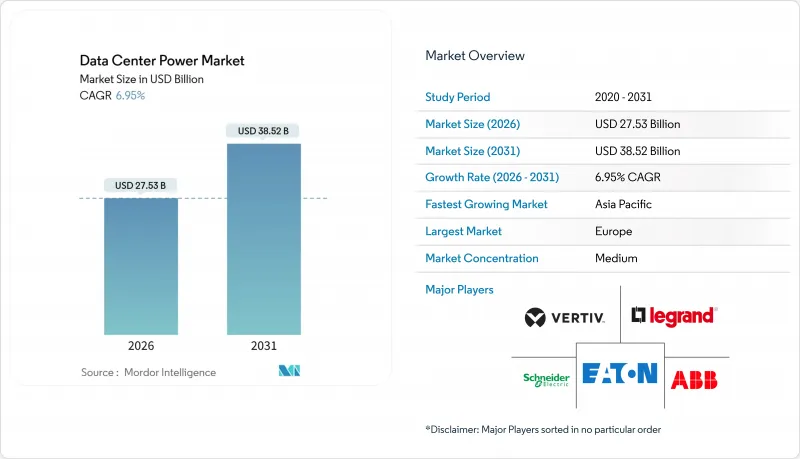
This report is Segmented by Component (Electrical Solution, and Service), Tier Type (Tier 1 and 2, Tier 3, and Tier 4), Data Center Size (Small, Medium, Large, and Hyperscale), Data Center Type (Colocation, Hyperscalers/CSPs, and Enterprise and Edge), and Geography (North America, South America, Europe, Asia-Pacific, and Middle East and Africa). The Market Forecasts are Provided in Terms of Value (USD).
Global Data Center Power Market Trends and Insights
Hyperscale and Cloud-Computing Expansion
Campus projects now exceed 100 megawatts of IT load, and each site requires dedicated 230-kilovolt substations plus N+1 generator farms. Microsoft commissioned 15 gigawatts of capacity in 2025, standardizing on modular switchgear that can be added without interrupting live racks. Amazon Web Services piloted liquid-cooled cabinets that draw 200 kilowatts, doubling rack density while shrinking floor plate. Google adopted 480-volt direct-current distribution for AI clusters, cutting AC-DC losses by 8%. These designs accelerate demand for busway, high-capacity PDUs, and solid-state breakers that tolerate continuous currents above 1,000 amperes.
AI-Driven High-Density Workloads
Generative AI training pushes GPU clusters to 40-50 megawatts per hall, a tenfold rise over virtualized enterprise workloads. Operators are abandoning raised-floor layouts in favor of overhead busways and in-row cooling placed within three meters of heat sources. Vertiv's Liebert EXL S1 UPS line, rated at 1.5 megawatts per module, saw 140% order growth in 2025 as hyperscalers retrofit existing halls. Lithium-ion cabinets now occupy one-third the footprint of valve-regulated lead-acid strings yet provide 15-minute ride-through at full load. Schneider Electric's Galaxy VXL integrates a three-megawatt-hour battery and delivers 97.5% efficiency, lowering thermal load by 30 kilowatts per megawatt protected.
High CAPEX of Electrical Infrastructure
A 10-megawatt Tier 3 facility needs USD 15-20 million in electrical gear, and hyperscale sites above 100 megawatts can exceed USD 200 million, including substations and gas-insulated switchgear. Access to finance remains limited in emerging economies, and new utility feeders can take 18-24 months to approve, adding holding costs. Vertiv's modular Smart Cabinet trims installation labor by 40% and accelerates revenue by eight weeks, yet the upfront outlay still deters mid-tier firms. Capital pressure is prompting growth of service-as-a-subscription models where vendors own switchgear and charge monthly fees, but adoption is still nascent.
Other drivers and restraints analyzed in the detailed report include:
- Stricter Uptime and Redundancy Standards
- Sustainability and Energy-Efficiency Mandates
- Transformer and Switchgear Supply Bottlenecks
For complete list of drivers and restraints, kindly check the Table Of Contents.
Segment Analysis
Services captured a rising slice of the data center power market size as operators outsourced integration of hybrid diesel-gas-hydrogen fleets and predictive maintenance contracts. Electrical solutions still held 63.54% of 2025 revenue, led by lithium-ion UPS systems, solid-state breakers, and rack-level PDUs. Service revenue is advancing at a 7.43% CAGR as suppliers bundle installation, firmware, and remote monitoring. Schneider Electric disclosed that 38% of data-center turnover in 2025 stemmed from multi-year service agreements, reflecting a shift toward outcome-based procurement.
UPS lines now scale in 500-kilowatt blocks positioned near the IT load, while natural-gas and hydrogen generators address urban emission limits. Switchgear adopts solid-state silicon carbide devices that cut panel depth by 40% and isolate faults in under two milliseconds. Energy-storage racks transition from standby roles to grid-support assets that earn USD 50,000-100,000 per megawatt-hour annually in organized markets. Field complexity strengthens the services value proposition, particularly in markets that lack skilled labor and enforce strict uptime clauses.
Tier 3 installations represented 64.42% of 2025 deployments, anchoring the data center power market share due to their balance of 99.982% availability and moderate capital intensity. Tier 4 sites, though costlier by 25-30%, are expanding at a 7.65% CAGR as regulated industries demand fault tolerance. Insurance premiums on Tier 3 halls can run 40% higher, and a single outage may exceed the saved capital, making Tier 4 certification compelling for mission-critical workloads.
Suppliers respond with modular architectures that allow stepwise migration. Eaton's Power Xpert 9395P lets operators parallel an additional UPS string without displacing existing gear. ISO/IEC 22237 and ANSI/TIA-942 standards now appear in public procurement clauses, effectively mandating Tier 4 for government workloads. Rising AI density further drives Tier 4 adoption, because any unexpected shutdown of GPU clusters triggers prolonged retraining cycles.
Complete Report Scope:
- By Component
- Electrical Solution
- UPS Systems
- Generators
- Diesel Generators
- Gas Generators
- Hydrogen Fuel-cell Generators
- Power Distribution Units
- Switchgear
- Transfer Switches
- Remote Power Panels
- Energy-storage Systems
- Service
- Installation and Commissioning
- Maintenance and Support
- Training and Consulting
- Electrical Solution
- By Tier Type
- Tier 1 and 2
- Tier 3
- Tier 4
- By Data Center Size
- Small Data Center
- Medium Data Center
- Large Data Center
- Hyperscale Data Center
- By Data Center Type
- Colocation Data Center
- Hyperscalers Data Center/CSPs
- Enterprise and Edge Data Center
- By Geography
- North America
- United States
- Canada
- Mexico
- South America
- Brazil
- Argentina
- Rest of South America
- Europe
- Germany
- United Kingdom
- France
- Italy
- Spain
- Rest of Europe
- Asia-Pacific
- China
- Japan
- India
- South Korea
- Australia
- Rest of Asia-Pacific
- Middle East and Africa
- Middle East
- United Arab Emirates
- Saudi Arabia
- Turkey
- Rest of Middle East
- Africa
- South Africa
- Nigeria
- Rest of Africa
- Middle East
- North America
Geography Analysis
Europe led with 38.54% of global data center power market revenue in 2025, driven by stringent energy-efficiency statutes and edge-node growth in Germany, the United Kingdom, and France. Frankfurt alone added 45 megawatts of colocation capacity as banks demanded low-latency links to clearing systems. Operators in London's Docklands brought 38 megawatts online, helped by upgrades to the 132-kilovolt London Ring Main. Paris facilities adopted liquid-cooling to comply with heat-island restrictions that cap chiller output, illustrating how municipal rules shape electrical design.
Asia-Pacific is the fastest region, with a 7.91% CAGR projected through 2031. China approved 85 megawatts of new capacity in Beijing, Shanghai, and Shenzhen in 2025, conditioning permits on power-usage effectiveness below 1.25 and 50% renewable energy. India's 2025 National Data Center Policy grants five-year tax holidays for Tier 3 sites above 20 megawatts that source indigenous UPS and switchgear. Japan added 18 megawatts and mandated seismic-rated switchgear that tolerates magnitude 7 seismic events. South Korea saw 12 megawatts of AI inference halls funded by Samsung and SK Telecom. Australia pioneered grid-interactive data centers that earn USD 80,000 per megawatt-hour in ancillary-service revenue.
North America remains the single largest country cluster, with Virginia, Texas, and California accounting for 60% of new U.S. capacity in 2025. Canada added 15 megawatts across Toronto and Montreal, leveraging cold-climate free cooling and low-cost hydropower. Mexico's Queretaro corridor delivered eight megawatts for near-shoring manufacturers needing low-latency links to U.S. regions. The Middle East and Africa drew investment in Dubai and Riyadh where smart-city programs require Tier 3 halls. Brazil led South America with 10 megawatts in Sao Paulo, supported by e-commerce and fintech demand.
- Schneider Electric SE
- Vertiv Holdings Co.
- ABB Ltd
- Eaton Corporation plc
- Legrand SA
- Huawei Technologies Co. Ltd
- Fujitsu Ltd
- Cisco Systems Inc.
- Rittal GmbH and Co. KG
- Mitsubishi Electric Corp.
- Cummins Inc.
- Kohler Power Systems
- PDU Experts UK Ltd
- Bloom Energy
- Delta Electronics Inc.
- Caterpillar Inc.
- Socomec Group
- Tripp Lite (by Eaton)
- Riello UPS S.p.A.
- KEHUA Tech
- Fluence Energy
Additional Benefits:
- The market estimate (ME) sheet in Excel format
- 3 months of analyst support
TABLE OF CONTENTS
1 INTRODUCTION
- 1.1 Study Assumptions and Market Definition
- 1.2 Scope of the Study
2 RESEARCH METHODOLOGY
3 EXECUTIVE SUMMARY
4 MARKET LANDSCAPE
- 4.1 Market Overview
- 4.2 Market Drivers
- 4.2.1 Hyperscale and Cloud-Computing Expansion
- 4.2.2 AI-Driven High-Density Workloads
- 4.2.3 Stricter Uptime and Redundancy Standards
- 4.2.4 Sustainability and Energy-Efficiency Mandates
- 4.2.5 Grid-Interactive Revenue Streams (Behind-the-Meter)
- 4.2.6 Coal-Plant Site Repurposing for Campuses
- 4.3 Market Restraints
- 4.3.1 High CAPEX of Electrical Infrastructure
- 4.3.2 Carbon-Intensity Regulations and Reporting
- 4.3.3 Transformer and Switchgear Supply Bottlenecks
- 4.3.4 Local Opposition to Sub-Station Expansion
- 4.4 Industry Supply-Chain Analysis
- 4.5 Regulatory Landscape
- 4.6 Technological Outlook
- 4.7 Porter's Five Forces Analysis
- 4.7.1 Threat of New Entrants
- 4.7.2 Bargaining Power of Buyers
- 4.7.3 Bargaining Power of Suppliers
- 4.7.4 Threat of Substitute Products
- 4.7.5 Intensity of Competitive Rivalry
- 4.8 Impact of Macroeconomic Factors on the Market
5 MARKET SIZE AND GROWTH FORECASTS (VALUE)
- 5.1 By Component
- 5.1.1 Electrical Solution
- 5.1.1.1 UPS Systems
- 5.1.1.2 Generators
- 5.1.1.2.1 Diesel Generators
- 5.1.1.2.2 Gas Generators
- 5.1.1.2.3 Hydrogen Fuel-cell Generators
- 5.1.1.3 Power Distribution Units
- 5.1.1.4 Switchgear
- 5.1.1.5 Transfer Switches
- 5.1.1.6 Remote Power Panels
- 5.1.1.7 Energy-storage Systems
- 5.1.2 Service
- 5.1.2.1 Installation and Commissioning
- 5.1.2.2 Maintenance and Support
- 5.1.2.3 Training and Consulting
- 5.1.1 Electrical Solution
- 5.2 By Tier Type
- 5.2.1 Tier 1 and 2
- 5.2.2 Tier 3
- 5.2.3 Tier 4
- 5.3 By Data Center Size
- 5.3.1 Small Data Center
- 5.3.2 Medium Data Center
- 5.3.3 Large Data Center
- 5.3.4 Hyperscale Data Center
- 5.4 By Data Center Type
- 5.4.1 Colocation Data Center
- 5.4.2 Hyperscalers Data Center/CSPs
- 5.4.3 Enterprise and Edge Data Center
- 5.5 By Geography
- 5.5.1 North America
- 5.5.1.1 United States
- 5.5.1.2 Canada
- 5.5.1.3 Mexico
- 5.5.2 South America
- 5.5.2.1 Brazil
- 5.5.2.2 Argentina
- 5.5.2.3 Rest of South America
- 5.5.3 Europe
- 5.5.3.1 Germany
- 5.5.3.2 United Kingdom
- 5.5.3.3 France
- 5.5.3.4 Italy
- 5.5.3.5 Spain
- 5.5.3.6 Rest of Europe
- 5.5.4 Asia-Pacific
- 5.5.4.1 China
- 5.5.4.2 Japan
- 5.5.4.3 India
- 5.5.4.4 South Korea
- 5.5.4.5 Australia
- 5.5.4.6 Rest of Asia-Pacific
- 5.5.5 Middle East and Africa
- 5.5.5.1 Middle East
- 5.5.5.1.1 United Arab Emirates
- 5.5.5.1.2 Saudi Arabia
- 5.5.5.1.3 Turkey
- 5.5.5.1.4 Rest of Middle East
- 5.5.5.2 Africa
- 5.5.5.2.1 South Africa
- 5.5.5.2.2 Nigeria
- 5.5.5.2.3 Rest of Africa
- 5.5.5.1 Middle East
- 5.5.1 North America
6 COMPETITIVE LANDSCAPE
- 6.1 Market Concentration
- 6.2 Strategic Moves
- 6.3 Market Share Analysis
- 6.4 Company Profiles (includes Global Level Overview, Market Level Overview, Core Segments, Financials as available, Strategic Information, Market Rank/Share, Products and Services, Recent Developments)
- 6.4.1 Schneider Electric SE
- 6.4.2 Vertiv Holdings Co.
- 6.4.3 ABB Ltd
- 6.4.4 Eaton Corporation plc
- 6.4.5 Legrand SA
- 6.4.6 Huawei Technologies Co. Ltd
- 6.4.7 Fujitsu Ltd
- 6.4.8 Cisco Systems Inc.
- 6.4.9 Rittal GmbH and Co. KG
- 6.4.10 Mitsubishi Electric Corp.
- 6.4.11 Cummins Inc.
- 6.4.12 Kohler Power Systems
- 6.4.13 PDU Experts UK Ltd
- 6.4.14 Bloom Energy
- 6.4.15 Delta Electronics Inc.
- 6.4.16 Caterpillar Inc.
- 6.4.17 Socomec Group
- 6.4.18 Tripp Lite (by Eaton)
- 6.4.19 Riello UPS S.p.A.
- 6.4.20 KEHUA Tech
- 6.4.21 Fluence Energy
7 MARKET OPPORTUNITIES AND FUTURE OUTLOOK
- 7.1 White-Space and Unmet-Need Assessment

