PUBLISHER: Mordor Intelligence | PRODUCT CODE: 2121752

PUBLISHER: Mordor Intelligence | PRODUCT CODE: 2121752
China Container Glass Packaging - Market Share Analysis, Industry Trends & Statistics, Growth Forecasts (2026 - 2031)
According to Mordor Intelligence, the China container glass packaging market size was valued at 11.18 million tonnes in 2025 and estimated to grow from 11.51 million tonnes in 2026 to reach 13.29 million tonnes by 2031, at a CAGR of 2.91% during the forecast period (2026-2031).
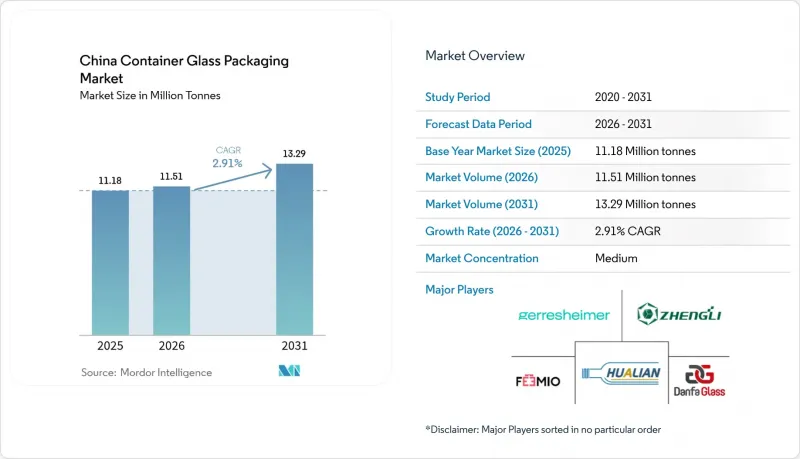
This report is Segmented by End-User (Beverages [Alcoholic {Beer, Wine, Spirits, Other Alcoholic Beverages}, and Non-Alcoholic {Carbonated Drinks (CSDs), Dairy Product Based Drinks, and More}], Food [Jam and Jelly, Condiments and Sauces, and More], Cosmetics and Personal Care, and More), Color (Flint, Amber, Green, and More). The Market Forecasts are Provided in Terms of Volume (Tonnes).
China Container Glass Packaging Market Trends and Insights
Surging Alcoholic Beverage Consumption Drives Glass Bottle Demand
Glass remains the vessel of choice for premium beer, wine, and baijiu, giving producers a trusted barrier that protects volatile flavors while signaling heritage to consumers. The easing of anti-corruption measures in late 2024 revived banquet occasions, restoring volumes for mid-range spirits. Craft breweries scaled nationwide distribution, relying on returnable 500 ml flint bottles that slot neatly into urban recycling loops. Export-oriented distillers shipped nostalgia-tinted clear baijiu bottles to overseas Chinese communities, bolstering the China glass container packaging market in coastal factories. Government modernization guidelines for the alcohol sector explicitly reference recyclable glass adoption, further entrenching the material in premium positioning.
Booming Cosmetics Industry Fuels Premium Glass Packaging Adoption
Domestic beauty labels pivoted to heavy-walled, colored glass jars that mimic foreign luxury aesthetics, a strategy that lifted unit prices and brand equity simultaneously. Regulations enacted by the National Medical Products Administration classify glass as an inert, refill-ready option for active-rich serums, an attribute that resonates with Gen-Z shoppers. Direct-to-consumer e-commerce lets small brands justify glass's weight premium through sustainability storytelling. Specialized furnaces in Jiangsu switched to double-gob feeders to handle miniature 15 ml droppers efficiently, expanding the China glass container packaging market footprint in this high-margin niche. Continuous demand helps offset raw-material cost swings, boosting investment in cosmetic-grade annealing lines.
Soda Ash and Silica Price Volatility Squeezes Margins
Spot soda-ash benchmarks jumped from CNY 2,100 to CNY 2,740 per ton between February and May 2024 after stricter pollutant-emission audits idled two major trona-based plants. The price shock lifted raw-material cost share to 43% of ex-factory bottle value, crimping EBITDA for sub-scale furnaces. Producers with short hedges faced cash-flow strain, prompting temporary line stoppages in Henan. Silica-sand grades above SiO2 99.8% grew scarce following tighter mining permits, adding further procurement risk. Scale players with in-house quarries weathered the turbulence better, underlining the growing consolidation theme in the China glass container packaging market.
Other drivers and restraints analyzed in the detailed report include:
- Sustainability Push and Plastic Substitution Favor Glass
- Export-Oriented Manufacturing Strengthens Global Supply Role
- Energy-Intensive Melting Raises Carbon Exposure and Cost Risk
For complete list of drivers and restraints, kindly check the Table Of Contents.
Segment Analysis
The beverages segment held 62.61% of the China glass container packaging market size in 2025, translating into roughly 7,000 kilotons of output. Beer, wine, and baijiu account for the bulk, while iced coffee and kombucha led premium non-alcoholic gains. Spirits suppliers pivoted to embossed flint decanters that command double-digit price uplifts, sustaining revenue momentum even as tonnage stabilizes. The Chinese glass container packaging market benefits when breweries cycle seasonal limited editions, raising SKU counts and mold complexity across the IS fleet.
Cosmetics and personal care recorded a 3.49% CAGR outlook, the fastest among end-users, yet delivered only 435 kilotons in 2025, highlighting sizable room for expansion. Serums, essential-oil droppers, and prestige skincare jars adopt glass to convey purity, pushing average unit prices to USD 0.24, versus USD 0.05 in beverages. Glass offers flawless barrier properties that preserve volatile actives, while thick bases lend tactile luxury. Refill station pilots in flagship stores encourage consumer return habits, embedding circularity in brand value propositions and boosting repeat bottle demand. These dynamics underline why the China glass container packaging market continues moving up the value pyramid.
Complete Report Scope:
- By End-user
- Beverages
- Alcoholic
- Beer
- Wine
- Spirits
- Other Alcoholic Beverages (Cider and Other Fermented Drinks)
- Non-Alcoholic
- Juices
- Carbonated Drinks (CSDs)
- Dairy Product Based Drinks
- Other Non-Alcoholic Beverages
- Alcoholic
- Food (Jam, Jelly, Marmalades, Honey, Sausages and Condiments, Oil, Pickles)
- Cosmetics and Personal Care
- Pharmaceuticals (excluding Vials and Ampoules)
- Perfumery
- Beverages
- By Color
- Green
- Amber
- Flint
- Other Colors
List of Companies Covered in this Report:
- Gerresheimer Shuangfeng Pharmaceutical Glass (Danyang) Co. Ltd.
- Danfa Glass Limited
- Shandong Pharmaceutical Glass Co., Ltd.
- Zhejiang Sunrise Glass Co., Ltd.
- Shanxi Borosilicate Glass Co., Ltd.
- Guangzhou Fine Glassware Co., Ltd.
- Feemio Packaging Co., Ltd.
- Huaxing Glass Co., Ltd.
- Shandong Huapeng Glass Co., Ltd.
- Ningbo Zhengli Pharmaceutical Packaging Co., Ltd.
- Zhenhua Glass Co., Ltd.
- SiChuan Skyhorse Glass Co., Ltd.
- Linlang (Shanghai) Glass Bottle Co., Ltd.
- New Tenda Glass Co.
- Hualian Glass Manufacturers Co., Ltd
- Jiangsu Rongtai Glass Products Co., Ltd
Additional Benefits:
- The market estimate (ME) sheet in Excel format
- 3 months of analyst support
TABLE OF CONTENTS
1 INTRODUCTION
- 1.1 Study Assumptions and Market Definition
- 1.2 Scope of the Study
2 RESEARCH METHODOLOGY
3 EXECUTIVE SUMMARY
4 MARKET LANDSCAPE
- 4.1 Market Overview
- 4.2 Market Drivers
- 4.2.1 Surging Alcoholic Beverage Consumption Drives Glass Bottle Demand
- 4.2.2 Booming Cosmetics Industry Fuels Premium Glass Packaging Adoption
- 4.2.3 Sustainability Push and Plastic Substitution Favor Glass
- 4.2.4 Export-Oriented Manufacturing Strengthens Global Supply Role
- 4.2.5 Technological Advancements Improve Efficiency and Customization
- 4.2.6 Pharma Sector Expansion Spurs Growth in Glass Packaging
- 4.3 Market Restraints
- 4.3.1 Soda Ash and Silica Price Volatility Squeezes Margins
- 4.3.2 Breakage Risks and High Transport Costs Limit Glass Adoption
- 4.3.3 Plastic and Flexible Packaging Alternatives Erode Market Share
- 4.3.4 Energy-Intensive Melting Raises Carbon Exposure and Cost Risk
- 4.4 PESTEL Analysis
- 4.5 Industry Supply-Chain Analysis
- 4.6 Container Glass Furnace Capacity and Locations in China
- 4.6.1 Plant Locations and Year of Commencement
- 4.6.2 Production Capacities
- 4.6.3 Types of Furnaces
- 4.6.4 Color of Glass Produced
- 4.7 Export-Import Data of Container Glass - Covering Key Import and Export Destinations
- 4.7.1 Import Volume and Value, 2021-2024
- 4.7.2 Export Volume and Value, 2021-2024
- 4.8 Porter's Five Forces Analysis
- 4.8.1 Threat of New Entrants
- 4.8.2 Bargaining Power of Suppliers
- 4.8.3 Bargaining Power of Buyers
- 4.8.4 Threat of Substitutes
- 4.8.5 Competitive Rivalry
- 4.9 Raw Material Analysis
- 4.10 Recycling Trends for Glass Packaging
- 4.11 Demand vs Supply Analysis for Glass Packaging
5 MARKET SIZE AND GROWTH FORECASTS (VOLUME)
- 5.1 By End-user
- 5.1.1 Beverages
- 5.1.1.1 Alcoholic
- 5.1.1.1.1 Beer
- 5.1.1.1.2 Wine
- 5.1.1.1.3 Spirits
- 5.1.1.1.4 Other Alcoholic Beverages (Cider and Other Fermented Drinks)
- 5.1.1.2 Non-Alcoholic
- 5.1.1.2.1 Juices
- 5.1.1.2.2 Carbonated Drinks (CSDs)
- 5.1.1.2.3 Dairy Product Based Drinks
- 5.1.1.2.4 Other Non-Alcoholic Beverages
- 5.1.1.1 Alcoholic
- 5.1.2 Food (Jam, Jelly, Marmalades, Honey, Sausages and Condiments, Oil, Pickles)
- 5.1.3 Cosmetics and Personal Care
- 5.1.4 Pharmaceuticals (excluding Vials and Ampoules)
- 5.1.5 Perfumery
- 5.1.1 Beverages
- 5.2 By Color
- 5.2.1 Green
- 5.2.2 Amber
- 5.2.3 Flint
- 5.2.4 Other Colors
6 COMPETITIVE LANDSCAPE
- 6.1 Market Concentration
- 6.2 Strategic Moves and Developments
- 6.3 Company Market Share Analysis, (Based on Latest Production Capacity)
- 6.4 Company Profiles (includes Global level Overview, Market level overview, Core Segments, Financials as available, Strategic Information, Market Rank/Share for key companies, Products and Services, and Recent Developments)
- 6.4.1 Gerresheimer Shuangfeng Pharmaceutical Glass (Danyang) Co. Ltd.
- 6.4.2 Danfa Glass Limited
- 6.4.3 Shandong Pharmaceutical Glass Co., Ltd.
- 6.4.4 Zhejiang Sunrise Glass Co., Ltd.
- 6.4.5 Shanxi Borosilicate Glass Co., Ltd.
- 6.4.6 Guangzhou Fine Glassware Co., Ltd.
- 6.4.7 Feemio Packaging Co., Ltd.
- 6.4.8 Huaxing Glass Co., Ltd.
- 6.4.9 Shandong Huapeng Glass Co., Ltd.
- 6.4.10 Ningbo Zhengli Pharmaceutical Packaging Co., Ltd.
- 6.4.11 Zhenhua Glass Co., Ltd.
- 6.4.12 SiChuan Skyhorse Glass Co., Ltd.
- 6.4.13 Linlang (Shanghai) Glass Bottle Co., Ltd.
- 6.4.14 New Tenda Glass Co.
- 6.4.15 Hualian Glass Manufacturers Co., Ltd
- 6.4.16 Jiangsu Rongtai Glass Products Co., Ltd
7 MARKET OPPORTUNITIES AND FUTURE OUTLOOK
- 7.1 White-space and Unmet-Need Assessment

