PUBLISHER: Mordor Intelligence | PRODUCT CODE: 2121757

PUBLISHER: Mordor Intelligence | PRODUCT CODE: 2121757
India Food Additives - Market Share Analysis, Industry Trends & Statistics, Growth Forecasts (2026 - 2031)
According to Mordor Intelligence, the India food additives market size is expected to grow from USD 10.52 billion in 2025 to USD 11.17 billion in 2026 and is forecast to reach USD 15.04 billion by 2031 at 6.13% CAGR over 2026-2031.
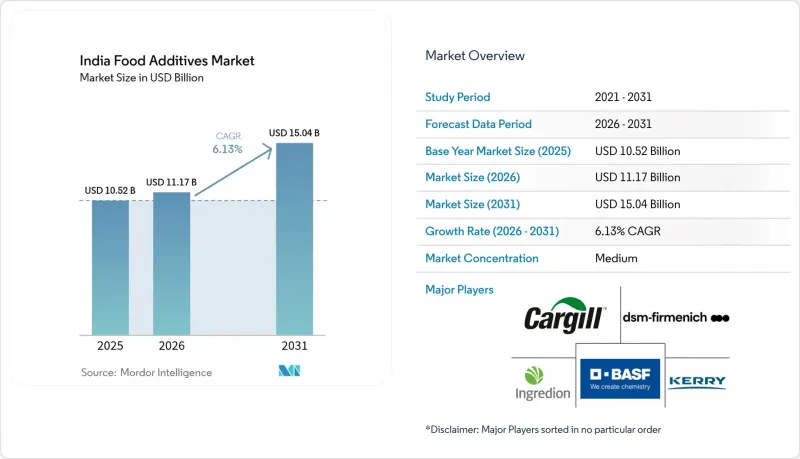
This report is Segmented by Product Type (Preservatives, Sweeteners, Emulsifiers, Anti-Caking Agents, Enzymes, Hydrocolloids, Food Flavors & Enhancers, Food Colorants, Acidulants), Source (Natural and Synthetic), Application (Bakery and Confectionery, Dairy and Desserts, Beverages, Meat and Meat Products, and More). The Market Forecasts are Provided in Terms of Value (USD).
India Food Additives Market Trends and Insights
Rising demand for processed and convenience foods
Urbanization and the rise of dual-income households are significantly altering consumption trends, leading to an increased allocation of household food budgets towards ready-to-eat meals, packaged snacks, and instant mixes. The Ministry of Food Processing Industries highlighted a notable growth in the sector's GDP contribution, which rose to 8.6% in the fiscal year 2024-2025, compared to 8.2% in 2022-2023. This growth reflects a swift and widespread adoption of preservatives, emulsifiers, and flavor enhancers, which not only extend shelf life but also ensure consistent sensory quality across extensive distribution networks. As e-commerce continues to penetrate tier-2 and tier-3 cities, there is a growing demand for products with enhanced ambient stability. To meet this demand, manufacturers are increasingly incorporating additives such as potassium sorbate, sodium benzoate, and natural rosemary extracts into their product formulations. Additionally, the rise of quick-commerce platforms, which promise grocery deliveries within 10-15 minutes, is inadvertently driving greater reliance on these additives. This trend is primarily due to the need for suppliers to maintain product integrity across multiple handling touchpoints in the supply chain.
Rising demand for natural, clean-label, and organic food additives
Rising demand for natural, clean-label, and organic food additives is emerging as a significant growth driver in the India food additives market. Increasing health awareness and preference for minimally processed foods are encouraging consumers to scrutinize ingredient labels more closely. Consumer skepticism toward synthetic additives is compelling brands to reformulate with plant-derived alternatives, even when cost premiums reach 20-30%, reflecting a strong shift toward perceived safety and transparency. Regulatory developments are further reinforcing this transition. The 2024 amendments by FSSAI to the Food Products Standards and Food Additives Regulations tightened permissible limits for certain synthetic colors and mandated clearer labeling of preservatives, accelerating the shift toward natural solutions. Food manufacturers are proactively aligning formulations with evolving compliance standards to mitigate regulatory risks and enhance brand positioning. Additionally, the expansion of modern retail and premium health-focused product lines is strengthening demand for clean-label ingredients across urban and semi-urban markets.
Stringent food safety regulations and compliance costs
Stringent food safety regulations and rising compliance costs pose a significant restraint to the India food additives market. Regulatory oversight by authorities such as the Food Safety and Standards Authority of India (FSSAI) requires manufacturers to adhere to strict permissible limits, labeling requirements, and quality standards for additives. Frequent amendments to food safety regulations necessitate continuous reformulation, documentation updates, and product testing, increasing operational complexity. Compliance with evolving standards often requires investment in advanced testing laboratories, traceability systems, and third-party certifications, thereby raising production costs. Small and medium-sized enterprises (SMEs) face greater challenges in meeting these requirements due to limited financial and technical resources. Delays in regulatory approvals for new additives or novel ingredients can further slow product innovation and time-to-market.
Other drivers and restraints analyzed in the detailed report include:
- Government initiatives supporting food processing industry growth
- Technological advancements in food processing
- Volatility in raw material prices
For complete list of drivers and restraints, kindly check the Table Of Contents.
Segment Analysis
Sweeteners accounted for the largest share of the India food additives market in 2025, capturing 68.23% of the total market revenue. This dominant position reflects their widespread use across multiple food and beverage categories, including packaged foods, carbonated drinks, dairy products, bakery items, and confectionery. The growing consumer preference for low-calorie and sugar-free alternatives has significantly contributed to the sustained demand for both natural and artificial sweeteners. Additionally, rising health awareness regarding diabetes, obesity, and lifestyle-related disorders has encouraged manufacturers to reformulate products with reduced sugar content. Food processing companies are increasingly incorporating high-intensity sweeteners and sugar substitutes to meet regulatory guidelines and evolving consumer expectations.
Food colorants are projected to register the fastest growth within the India food additives market, expanding at a CAGR of 7.61% through 2031. This accelerated growth is primarily driven by rising demand for visually appealing and aesthetically enhanced food products. As competition intensifies in packaged foods and beverages, manufacturers are leveraging vibrant and innovative colors to differentiate their products and strengthen brand appeal. The increasing popularity of ready-to-eat meals, bakery products, confectionery, and flavored beverages is further boosting the consumption of color additives. Moreover, the shift toward natural and plant-based colorants, in response to clean-label trends and consumer safety concerns, is creating new growth opportunities within the segment.
Complete Report Scope:
- By Product Type
- Preservatives
- Sweeteners
- Emulsifiers
- Anti-Caking Agents
- Enzymes
- Hydrocolloids
- Food Flavors & Enhancers
- Food Colorants
- Acidulants
- By Source
- Natural
- Synthetic
- By Application
- Bakery and Confectionery
- Dairy and Desserts
- Beverages
- Meat and Meat Products
- Soups, Sauces, and Dressings
- Other Applications
List of Companies Covered in this Report:
- Cargill, Incorporated
- BASF SE
- Kerry Group PLC
- Ingredion Incorporated
- DSM-Firmenich AG
- Tata Chemicals Limited
- Aarti Industries Limited
- Atul Ltd
- Gujarat Alkalies and Chemicals Limited
- Balaji Amines Limited
- Nitta Gelatin India Limited
- Archer Daniels Midland Company
- International Flavors & Fragrances Inc.
- Ajinomoto Co., Inc.
- Givaudan SA
- Roquette Freres SA
- Corbion N.V.
- Tate & Lyle PLC
- Sensient Technologies Corporation
- Novozymes A/S
Additional Benefits:
- The market estimate (ME) sheet in Excel format
- 3 months of analyst support
TABLE OF CONTENTS
1 INTRODUCTION
- 1.1 Study Assumptions & Market Definition
- 1.2 Scope of the Study
2 RESEARCH METHODOLOGY
3 EXECUTIVE SUMMARY
4 MARKET LANDSCAPE
- 4.1 Market Overview
- 4.2 Market Drivers
- 4.2.1 Rising demand for processed and convenience foods
- 4.2.2 Rising demand for natural, clean-label, and organic food additives
- 4.2.3 Government initiatives supporting food processing industry growth
- 4.2.4 Technological advancements in food processing
- 4.2.5 Increasing consumption of bakery and confectionery products
- 4.2.6 Increasing health awareness boosting low-fat and fortified products
- 4.3 Market Restraints
- 4.3.1 Stringent food safety regulations and compliance costs
- 4.3.2 Volatility in raw material prices
- 4.3.3 Growing consumer preference for additive-free products
- 4.3.4 Supply chain disruptions affecting ingredient availability
- 4.4 Supply Chain Analysis
- 4.5 Regulatory Outlook
- 4.6 Porter's Five Forces
- 4.6.1 Threat of New Entrants
- 4.6.2 Bargaining Power of Buyers/Consumers
- 4.6.3 Bargaining Power of Suppliers
- 4.6.4 Threat of Substitute Products
- 4.6.5 Intensity of Competitive Rivalry
5 MARKET SIZE AND GROWTH FORECAST (VALUE)
- 5.1 By Product Type
- 5.1.1 Preservatives
- 5.1.2 Sweeteners
- 5.1.3 Emulsifiers
- 5.1.4 Anti-Caking Agents
- 5.1.5 Enzymes
- 5.1.6 Hydrocolloids
- 5.1.7 Food Flavors & Enhancers
- 5.1.8 Food Colorants
- 5.1.9 Acidulants
- 5.2 By Source
- 5.2.1 Natural
- 5.2.2 Synthetic
- 5.3 By Application
- 5.3.1 Bakery and Confectionery
- 5.3.2 Dairy and Desserts
- 5.3.3 Beverages
- 5.3.4 Meat and Meat Products
- 5.3.5 Soups, Sauces, and Dressings
- 5.3.6 Other Applications
6 COMPETITIVE LANDSCAPE
- 6.1 Market Concentration
- 6.2 Strategic Moves
- 6.3 Market Ranking Analysis
- 6.4 Company Profiles (includes Global-level Overview, Market-level Overview, Core Segments, Financials (if available), Strategic Information, Market Rank/Share, Products & Services, Recent Developments)
- 6.4.1 Cargill, Incorporated
- 6.4.2 BASF SE
- 6.4.3 Kerry Group PLC
- 6.4.4 Ingredion Incorporated
- 6.4.5 DSM-Firmenich AG
- 6.4.6 Tata Chemicals Limited
- 6.4.7 Aarti Industries Limited
- 6.4.8 Atul Ltd
- 6.4.9 Gujarat Alkalies and Chemicals Limited
- 6.4.10 Balaji Amines Limited
- 6.4.11 Nitta Gelatin India Limited
- 6.4.12 Archer Daniels Midland Company
- 6.4.13 International Flavors & Fragrances Inc.
- 6.4.14 Ajinomoto Co., Inc.
- 6.4.15 Givaudan SA
- 6.4.16 Roquette Freres SA
- 6.4.17 Corbion N.V.
- 6.4.18 Tate & Lyle PLC
- 6.4.19 Sensient Technologies Corporation
- 6.4.20 Novozymes A/S
7 MARKET OPPORTUNITIES AND FUTURE OUTLOOK

