PUBLISHER: Mordor Intelligence | PRODUCT CODE: 2121761

PUBLISHER: Mordor Intelligence | PRODUCT CODE: 2121761
Vital Signs Monitoring - Market Share Analysis, Industry Trends & Statistics, Growth Forecasts (2026 - 2031)
According to Mordor Intelligence, the vital signs monitoring market size is projected to expand from USD 15.51 billion in 2025 and USD 17.88 billion in 2026 to USD 36.52 billion by 2031, registering a CAGR of 15.35% between 2026 to 2031.
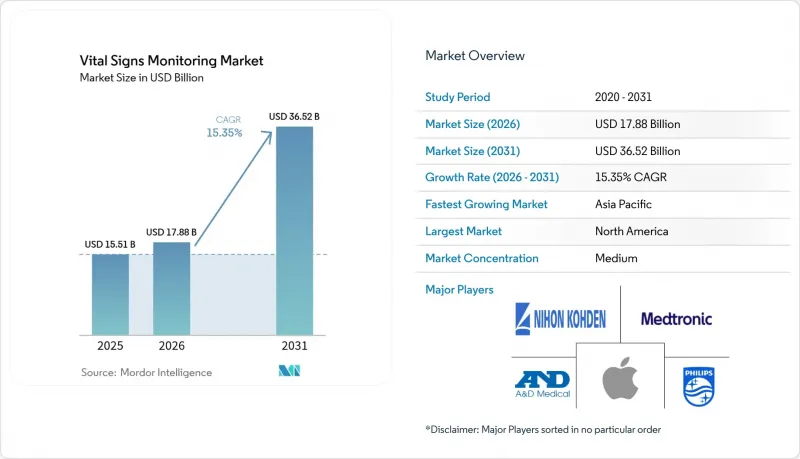
This report is Segmented by Product [Consumer Wearables (Smartwatches, Fitness & Activity Trackers and More), Medical Devices (Blood Pressure Monitors, and More)], End-User (Hospitals & Clinics, and More), Form Factor (Hand-Held, Table-Top, and More), and Geography (North America, South America, Europe, Asia-Pacific, Middle East & Africa). Market Forecasts are Provided in Value (USD).
Global Vital Signs Monitoring Market Trends and Insights
Rising Prevalence of Chronic and Lifestyle Diseases
Cardiovascular mortality climbed 18.6% globally between 2020 and 2024, prompting health systems to shift resources to continuous cardiac surveillance tools. As 48% of U.S. adults now live with some form of heart disease, ambulatory monitoring solutions that capture arrhythmia and nocturnal hypertension are gaining priority funding. Diabetes prevalence reached 537 million adults in 2024, reinforcing demand for multi-parameter monitors that track glucose alongside blood pressure and heart rate. Payers face a USD 4.1 trillion annual chronic-disease burden and are rewarding remote monitoring platforms that demonstrate outcome improvements, accelerating procurement of integrated vital-sign solutions. Collectively, these epidemiologic forces underpin the long-run expansion of the vital signs monitoring market .
Expanding Adoption of Tele-Health & RPM Reimbursement
CMS preserved core Remote Patient Monitoring (RPM) codes while private insurers mirrored coverage, guaranteeing a predictable fee schedule for data-driven care pathways. Although CPT 99457 faces a modest payment cut, large provider groups are offsetting the hit by scaling virtual nursing centers that can supervise hundreds of at-home patients simultaneously. In parallel, UnitedHealthcare and Anthem expanded RPM eligibility to nearly 20 million commercial members, stipulating ISO-validated accuracy for connected blood-pressure devices. Internationally, the United Kingdom's NHS Digital earmarked GBP 450 million to supply 2.5 million citizens with connected monitors, cementing Europe's reimbursement momentum. Sustained funding de-risks capital allocation for manufacturers, anchoring the volume growth that underpins the vital signs monitoring market.
Data-Privacy / Cyber-Security Compliance Burden
An upsurge in ransomware attacks has pushed regulators to tighten cybersecurity requirements. The FDA now demands a software bill-of-materials, proof of secure coding, and evergreen patching processes as part of every 510(k) submission. European MDR frameworks impose parallel obligations that include annual penetration testing and incident reporting within 72 hours. Compliance can lift pre-market development costs by up to USD 1.8 million for a single device family, diluting the margins of smaller entrants. Larger incumbents are scaling dedicated security teams and spreading overhead across wider portfolios, but startups face delayed launches or strategic exits, mildly dampening the overall CAGR of the vital signs monitoring market .
Other drivers and restraints analyzed in the detailed report include:
- Continuous Sensor & Wireless Technology Advances
- Hospital-at-Home Programs Creating ICU-Grade Domiciliary Demand
- High Cap-Ex & Pricing Pressure in Commoditized SKUs
For complete list of drivers and restraints, kindly check the Table Of Contents.
Segment Analysis
Medical devices captured a dominant 51.23% share of the vital signs monitoring market and consumer wearables are projected to rise at a 16.78% CAGR, eroding the long-held dominance of regulated medical devices. Apple Watch Series 10 introduced FDA-cleared sleep-apnea screening at a mass-market price point, proving that consumer brands can meet clinical thresholds without hospital distribution. Smartwatches captured a notable share of 2025 consumer revenue, while patch-based monitors are scaling in post-surgical pathways where their adhesive form eliminates patient setup steps. Within regulated medical devices, pulse oximeters still held significant share of 2025 receipts, but mandatory pigmentation-stratified validation is adding six to nine months to approval queues, tilting R&D dollars toward multi-parameter platforms. Together, these shifts broaden addressable users and underpin sustained expansion of the vital signs monitoring market.
Hardware makers are also converging glucose, ECG, and blood-pressure sensors into unified kits. This consolidation simplifies app ecosystems and multiplies reimbursable billing codes, shortening return-on-investment cycles for providers. The vital signs monitoring market size linked to consumer wearables, therefore, stands to leapfrog that of single-parameter medical devices well before 2031.
Complete Report Scope:
- By Product
- Consumer Wearables
- Smartwatches
- Fitness & Activity Trackers
- Smart Patches
- Other Wearables
- Medical Devices
- Blood Pressure Monitors
- Pulse Oximeters
- Temperature Monitoring Devices
- Respiratory-Rate Monitors
- Consumer Wearables
- By End-User
- Hospitals & Clinics
- Ambulatory & Health Centres
- Home-Care Settings
- By Form Factor
- Hand-Held Devices
- Table-Top / Bedside Monitors
- Wearables
- By Geography
- North America
- United States
- Canada
- Mexico
- Europe
- Germany
- United Kingdom
- France
- Italy
- Spain
- Rest of Europe
- Asia-Pacific
- China
- India
- Japan
- South Korea
- Australia
- Rest of Asia-Pacific
- Middle East and Africa
- GCC
- South Africa
- Rest of Middle East and Africa
- South America
- Brazil
- Argentina
- Rest of South America
- North America
Geography Analysis
North America kept its 45.3% lead in 2025, benefiting from clear CPT codes, large employer wellness budgets, and 124 health systems that run Hospital-at-Home wards. Provincial efforts in Canada and emerging pilots in Mexico further lift regional unit volumes. Asia-Pacific is set for the fastest proportional climb, at 18.11% CAGR, powered by China's RMB 1.2 trillion digital-health investment and India's unified health-record rollout. Reimbursement expansions in Japan and South Korea support incremental device densification in super-aging societies, while Australia targets rural connectivity gaps with federal grants.
Europe represents a significant share of 2025 revenue and is unified by national frameworks that reimburse connected devices for chronic heart failure, COPD, and diabetes. Germany's Digital Healthcare Act saw EUR 380 million in 2025 claims, validating statutory insurance appetite. France's centralized remote-monitoring platform pulls data from 18 device brands, proving interoperability at scale. South America and the Middle East & Africa collectively registered notable share, but strategic tender awards in Brazil and the Gulf states demonstrate the future upside for vendors that localize language support and battery-safety certifications. These regional nuances collectively orchestrate multi-speed expansion of the vital signs monitoring market.
- A&D Company
- Abbott Laboratories
- Apple
- Baxter
- BioBeat Technologies
- Contec Medical Systems
- GE Healthcare
- iRhythm Technologies
- Koninklijke Philips
- Masimo
- Medtronic
- Microlife Corp.
- Mindray
- Nihon Kohden
- Nonin Medical
- OMRON
- ICU Medical
- SunTech Medical
- VivaLNK
Additional Benefits:
- The market estimate (ME) sheet in Excel format
- 3 months of analyst support
TABLE OF CONTENTS
1 Introduction
- 1.1 Study Assumptions & Market Definition
- 1.2 Scope of the Study
2 Research Methodology
3 Executive Summary
4 Market Landscape
- 4.1 Market Overview
- 4.2 Market Drivers
- 4.2.1 Rapid Rise In Chronic Cardio-Metabolic Disorders
- 4.2.2 Expanding Adoption of Tele-Health & RPM Reimbursement
- 4.2.3 Continuous Sensor & Wireless Technology Advances
- 4.2.4 Rising Preference for Home-Based Care & Self-Management
- 4.2.5 Hospital-At-Home Programs Creating ICU-Grade Domiciliary Demand
- 4.2.6 AI-Driven Early-Deterioration Algorithms Bundled With Devices
- 4.3 Market Restraints
- 4.3.1 Data-Privacy / Cyber-Security Compliance Burden
- 4.3.2 High Cap-Ex & Pricing Pressure in Commoditized SKUS
- 4.3.3 Accuracy Bias on Dark-Skin Tones & Motion Artefacts
- 4.3.4 Battery-Life Limits for Multi-Parameter, Always-On Wearables
- 4.4 Supply-Chain Analysis
- 4.5 Regulatory Landscape
- 4.6 Technological Outlook
- 4.7 Porter's Five Forces
- 4.7.1 Threat of New Entrants
- 4.7.2 Bargaining Power of Buyers
- 4.7.3 Bargaining Power of Suppliers
- 4.7.4 Threat of Substitutes
- 4.7.5 Intensity of Competitive Rivalry
5 Market Size & Growth Forecasts (Value, USD)
- 5.1 By Product
- 5.1.1 Consumer Wearables
- 5.1.1.1 Smartwatches
- 5.1.1.2 Fitness & Activity Trackers
- 5.1.1.3 Smart Patches
- 5.1.1.4 Other Wearables
- 5.1.2 Medical Devices
- 5.1.2.1 Blood Pressure Monitors
- 5.1.2.2 Pulse Oximeters
- 5.1.2.3 Temperature Monitoring Devices
- 5.1.2.4 Respiratory-Rate Monitors
- 5.1.1 Consumer Wearables
- 5.2 By End-User
- 5.2.1 Hospitals & Clinics
- 5.2.2 Ambulatory & Health Centres
- 5.2.3 Home-Care Settings
- 5.3 By Form Factor
- 5.3.1 Hand-Held Devices
- 5.3.2 Table-Top / Bedside Monitors
- 5.3.3 Wearables
- 5.4 By Geography
- 5.4.1 North America
- 5.4.1.1 United States
- 5.4.1.2 Canada
- 5.4.1.3 Mexico
- 5.4.2 Europe
- 5.4.2.1 Germany
- 5.4.2.2 United Kingdom
- 5.4.2.3 France
- 5.4.2.4 Italy
- 5.4.2.5 Spain
- 5.4.2.6 Rest of Europe
- 5.4.3 Asia-Pacific
- 5.4.3.1 China
- 5.4.3.2 India
- 5.4.3.3 Japan
- 5.4.3.4 South Korea
- 5.4.3.5 Australia
- 5.4.3.6 Rest of Asia-Pacific
- 5.4.4 Middle East and Africa
- 5.4.4.1 GCC
- 5.4.4.2 South Africa
- 5.4.4.3 Rest of Middle East and Africa
- 5.4.5 South America
- 5.4.5.1 Brazil
- 5.4.5.2 Argentina
- 5.4.5.3 Rest of South America
- 5.4.1 North America
6 Competitive Landscape
- 6.1 Market Concentration
- 6.2 Market Share Analysis
- 6.3 Company Profiles (includes Global-level Overview, Market-level overview, Core Segments, Financials as available, Strategic Information, Market Rank/Share for key companies, Products & Services, and Recent Developments)
- 6.3.1 A&D Company
- 6.3.2 Abbott Laboratories
- 6.3.3 Apple Inc.
- 6.3.4 Baxter
- 6.3.5 BioBeat Technologies
- 6.3.6 Contec Medical Systems
- 6.3.7 GE HealthCare
- 6.3.8 iRhythm Technologies
- 6.3.9 Koninklijke Philips N.V.
- 6.3.10 Masimo Corporation
- 6.3.11 Medtronic plc
- 6.3.12 Microlife Corp.
- 6.3.13 Mindray
- 6.3.14 Nihon Kohden Corporation
- 6.3.15 Nonin Medical
- 6.3.16 Omron Healthcare
- 6.3.17 ICU Medical, Inc.
- 6.3.18 SunTech Medical
- 6.3.19 VivaLNK
7 Market Opportunities & Future Outlook
- 7.1 White-space & Unmet-Need Assessment

