PUBLISHER: Mordor Intelligence | PRODUCT CODE: 2121772

PUBLISHER: Mordor Intelligence | PRODUCT CODE: 2121772
Aerosol Paints - Market Share Analysis, Industry Trends & Statistics, Growth Forecasts (2026 - 2031)
According to Mordor Intelligence, the aerosol paints market size is expected to increase from USD 1.18 billion in 2025 to USD 1.24 billion in 2026 and reach USD 1.60 billion by 2031, growing at a CAGR of 5.32% over 2026-2031.
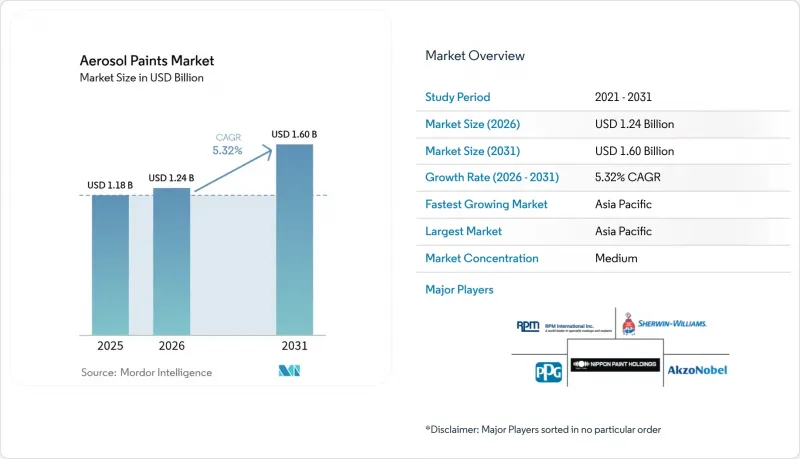
This report is Segmented by Resin (Acrylic, Epoxy, Polyurethane, Alkyd, and Other Resins), Technology (Solvent-Borne and Water-Borne), End-User Industry (Automotive, Architectural, Wood and Packaging, Transportation, Do-It-Yourself, and Other End-User Industries), and Geography (Asia-Pacific, North America, Europe, and More). The Market Forecasts are Provided in Terms of Value (USD).
Global Aerosol Paints Market Trends and Insights
Rising Residential and Commercial Construction Activities
In China, India, and Saudi Arabia, where housing mandates impose penalty clauses for delays, completion speed has become the primary criterion for paint selection, surpassing square-footage expansion. By reducing labor hours on trim and punch-list work, aerosol coatings help alleviate the pressures of skilled-worker shortages and rising wages. The Neom program in Saudi Arabia emphasizes modular building methods, which align seamlessly with single-coat aerosol primers. In North America, design-build contracts are increasingly internalizing finishing tasks, leading general contractors to favor aerosol paints to sidestep scheduling conflicts with subcontractors. Collectively, these trends are boosting the penetration of aerosol paints in new-build activities.
Increasing DIY Refurbishment and Decor Projects
PPG's Glidden Max Flex range, with a five-minute dry time and a no-drip formulation, underscores the growing preference among Millennials and Gen-Z homeowners for DIY projects, like accent walls and furniture up-cycling. Instead of purchasing contractor-sized liquid gallons, these homeowners now typically buy two to four aerosol cans per project. Furthermore, online sales saw an uptick in fiscal 2024, highlighting the strength of direct-to-consumer channels in bolstering overall demand. The fast-dry feature not only expedites the process but also minimizes the need for masking and cleanup, making the higher per-square-foot cost of aerosols more palatable.
Stringent VOC-Content Regulations
In 2024, the U.S. EPA set a flat-finish limit of 50 g/L, effectively phasing out legacy alkyd aerosols unless costly exempt solvents are used in place of xylene and toluene. California is set to impose a stricter 25 g/L cap on consumer aerosols in 2025, intensifying cost pressures, particularly for fast-dry lacquers favored by DIY enthusiasts. Meanwhile, Germany's TA Luft mandates third-party testing and annual emissions reporting, incurring an added cost for medium-sized companies. As a result, compliant raw material costs have surged, tightening margins for regional brands that lack the scale to distribute research and development and audit expenses.
Other drivers and restraints analyzed in the detailed report include:
- Growing Automotive Customization and Refinishing Culture
- Urban Micro-Manufacturing and Maker-Space Adoption of Spray Finishes
- Phase-Down of HFC Propellants under Kigali Amendment
For complete list of drivers and restraints, kindly check the Table Of Contents.
Segment Analysis
Acrylics accounted for 32.89% of 2025 revenue, the largest aerosol paints market share among resins, and are forecast to grow at a 5.59% CAGR through 2031. These resins, with a chemical backbone that seamlessly integrates solvent-borne and water-borne systems, offer tack-free surfaces in just 20 minutes. This rapid curing, combined with UV protection, caters to the needs of vehicle refinishers and furniture upcyclers. Sherwin-Williams' K2 two-component acrylic enamel boasts impressive coverage and excels in durability, passing rigorous salt-spray tests and meeting ISO C5 corrosion standards, making it particularly attractive to markets in humid coastal regions.
Epoxies, though lesser in volume, carve out a niche in maintenance-repair-operations. Here, they provide the robust adhesion needed for marginally prepared steel. As infrastructure budgets increasingly favor refurbishment, the adoption of epoxies is set to surge. Meanwhile, polyurethanes have carved a niche as specialty coatings, especially for chemical-resistant touch-ups. This is underscored by Sherwin-Williams' Acrolon 680, which boasts resilience against a 10% sulfuric acid immersion. On the sustainability front, innovations in recycled PET-based alkyds highlight potential eco-friendly pathways, though their price premiums currently hinder widespread adoption.
Complete Report Scope:
- By Resin
- Acrylic
- Epoxy
- Polyurethane
- Alkyd
- Other Resins
- By Technology
- Solvent-borne
- Water-borne
- By End-User Industry
- Automotive
- Architectural
- Wood and Packaging
- Transportation
- Do-It-Yourself (DIY)
- Other End-user Industries
- By Geography
- Asia-Pacific
- China
- India
- Japan
- South Korea
- Rest of Asia-Pacific
- North America
- United States
- Canada
- Mexico
- Europe
- Germany
- United Kingdom
- Italy
- France
- Rest of Europe
- South America
- Brazil
- Argentina
- Rest of South America
- Middle-East and Africa
- Saudi Arabia
- South Africa
- Rest of Middle-East and Africa
- Asia-Pacific
Geography Analysis
Asia-Pacific held 45.47% of global volume in 2025, and sustained a 5.72% CAGR through 2031. China rolled out significant urban housing units, while India's PMAY-Urban 2.0 fast-tracked affordable housing projects, ensuring completion within 18 months. In tier-2 cities of India, aerosol primers are proving their worth by slashing skilled labor hours, a timely advantage given the rising wage trends. Meanwhile, Japan and South Korea are increasingly adopting maker-space applications. At the same time, ASEAN nations are diversifying their demand, navigating the complexities of fragmented local VOC regulations that pose challenges for multinational entries.
North America accounted for a significant portion of the 2025 revenue pie. Here, the aerosol paints market is buoyed not by new constructions but by residential refurbishments, a surge in e-commerce, and ongoing infrastructure maintenance. Home Depot reported an uptick in online aerosol sales, crediting bundled project kits for easing customer decisions. With an infrastructure shortfall, Canadian provinces are turning to nano-ceramic aerosols, which notably extend coating lifespans, thereby slashing life-cycle costs. Additionally, Mexico's vehicle exports have spurred a surge in refinishing demand, especially along the U.S. border.
Europe secured a substantial share of the global volume in 2025. The region grapples with stringent VOC and fire-code regulations. For instance, Germany's TA Luft and the UK's post-Brexit standards, which, while inflating compliance costs, also favor players with robust regulatory budgets. Italy, with its heritage-restoration fund, mandates low-VOC aerosols for interior work to minimize disruptions. Concurrently, Eastern Europe's transport upgrades are driving demand for fast-cure marking paints.
South America and the Middle East-Africa regions together represent a modest portion of global consumption. Petrobras, with an offshore maintenance budget, is leaning towards single-coat aerosol systems, which significantly reduce the need for rope-access days. In a similar vein, Saudi Arabia's ambitious Neom project is utilizing aerosol primers for its modular units to expedite processes. Furthermore, South Africa's push towards renewable energy is fueling a demand for UV-stable topcoats. These topcoats are engineered to withstand intense radiation without chalking, with suppliers incorporating premium UV absorbers to meet the heightened specifications.
- Aeroaids Corporation
- Akzo Nobel N.V.
- BASF
- Kobra Paint
- Masco Corporation
- Nippon Paint Holdings Co., Ltd.
- PPG Industries Inc.
- RPM International Inc.
- RusTA
- The Sherwin-Williams Company
Additional Benefits:
- The market estimate (ME) sheet in Excel format
- 3 months of analyst support
TABLE OF CONTENTS
1 Introduction
- 1.1 Study Assumptions and Market Definition
- 1.2 Scope of the Study
2 Research Methodology
3 Executive Summary
4 Market Landscape
- 4.1 Market Overview
- 4.2 Market Drivers
- 4.2.1 Rising Residential and Commercial Construction Activities
- 4.2.2 Increasing DIY Refurbishment and Decor Projects
- 4.2.3 Growing Automotive Customisation and Refinishing Culture
- 4.2.4 Urban Micro-Manufacturing and Maker-Space Adoption of Spray Finishes
- 4.2.5 Nano-Ceramic Direct-to-Metal Sprays for Ageing Infrastructure
- 4.3 Market Restraints
- 4.3.1 Stringent VOC-Content Regulations
- 4.3.2 Phase-Down of HFC Propellants under Kigali Amendment
- 4.3.3 Fire-Code Restrictions on Pressurised Paint Storage
- 4.4 Value Chain Analysis
- 4.5 Porter's Five Forces
- 4.5.1 Bargaining Power of Suppliers
- 4.5.2 Bargaining Power of Buyers
- 4.5.3 Threat of New Entrants
- 4.5.4 Threat of Substitutes
- 4.5.5 Degree of Competition
5 Market Size and Growth Forecasts (Value)
- 5.1 By Resin
- 5.1.1 Acrylic
- 5.1.2 Epoxy
- 5.1.3 Polyurethane
- 5.1.4 Alkyd
- 5.1.5 Other Resins
- 5.2 By Technology
- 5.2.1 Solvent-borne
- 5.2.2 Water-borne
- 5.3 By End-User Industry
- 5.3.1 Automotive
- 5.3.2 Architectural
- 5.3.3 Wood and Packaging
- 5.3.4 Transportation
- 5.3.5 Do-It-Yourself (DIY)
- 5.3.6 Other End-user Industries
- 5.4 By Geography
- 5.4.1 Asia-Pacific
- 5.4.1.1 China
- 5.4.1.2 India
- 5.4.1.3 Japan
- 5.4.1.4 South Korea
- 5.4.1.5 Rest of Asia-Pacific
- 5.4.2 North America
- 5.4.2.1 United States
- 5.4.2.2 Canada
- 5.4.2.3 Mexico
- 5.4.3 Europe
- 5.4.3.1 Germany
- 5.4.3.2 United Kingdom
- 5.4.3.3 Italy
- 5.4.3.4 France
- 5.4.3.5 Rest of Europe
- 5.4.4 South America
- 5.4.4.1 Brazil
- 5.4.4.2 Argentina
- 5.4.4.3 Rest of South America
- 5.4.5 Middle-East and Africa
- 5.4.5.1 Saudi Arabia
- 5.4.5.2 South Africa
- 5.4.5.3 Rest of Middle-East and Africa
- 5.4.1 Asia-Pacific
6 Competitive Landscape
- 6.1 Market Concentration
- 6.2 Strategic Moves
- 6.3 Market Share (%)/Ranking Analysis
- 6.4 Company Profiles (includes Global level Overview, Market level overview, Core Segments, Financials as available, Strategic Information, Products and Services, and Recent Developments)
- 6.4.1 Aeroaids Corporation
- 6.4.2 Akzo Nobel N.V.
- 6.4.3 BASF
- 6.4.4 Kobra Paint
- 6.4.5 Masco Corporation
- 6.4.6 Nippon Paint Holdings Co., Ltd.
- 6.4.7 PPG Industries Inc.
- 6.4.8 RPM International Inc.
- 6.4.9 RusTA
- 6.4.10 The Sherwin-Williams Company
7 Market Opportunities and Future Outlook
- 7.1 White-space and Unmet-Need Assessment

