PUBLISHER: Mordor Intelligence | PRODUCT CODE: 2121816

PUBLISHER: Mordor Intelligence | PRODUCT CODE: 2121816
Force Sensors - Market Share Analysis, Industry Trends & Statistics, Growth Forecasts (2026 - 2031)
According to Mordor Intelligence, the force sensors market size was valued at USD 2.47 billion in 2025 and estimated to grow from USD 2.78 billion in 2026 to reach USD 5.04 billion by 2031, at a CAGR of 12.61% during the forecast period (2026-2031).
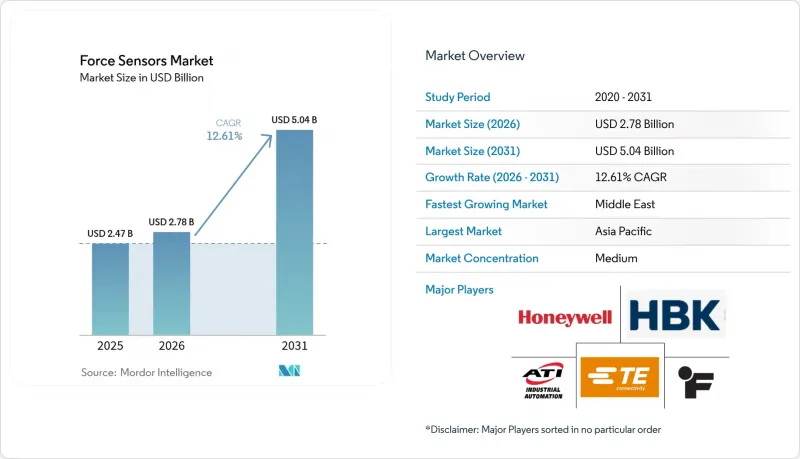
This report is Segmented by Type (Tension, Compression, and More), Technology (Strain Gauge, Load Cell, and More), End-User (Healthcare, Manufacturing, and More), Force Range (Micro <=10 N, Low 10 N-1 KN, and More), Application (Monitoring, Testing, Robotics, Structural Health), and Geography (North America, South America, Europe, and More). The Market Forecasts are Provided in Terms of Value (USD).
Global Force Sensors Market Trends and Insights
Innovation in Consumer Electronics
Smartphones and wearables now hide micro-force layers beneath displays and hinges, replacing mechanical buttons and enabling contextual gestures. Foldable handsets employ hinge-mounted arrays that report fold angle and structural stress to design teams, improving warranty analytics. Gaming consoles integrate piezoelectric triggers so users feel variable resistance aligned with game actions. Fitness trackers measure ground reaction forces from wrist or chest, bringing laboratory-grade gait analytics to consumer devices. These requirements are pushing suppliers to roll-to-roll print capacitive arrays under one millimeter thick, demanding investments in precision laser patterning lines.
Growing Automotive Electrification and ADAS Integration
Electric-vehicle battery lines mount force sensors at every workstation to avoid cell deformation that can shorten cycle life. Automated guided vehicles now keep tray-handling forces under 5 N to prevent micro-cracks in casings. Steering-column and brake-pedal load cells interpret driver intent, enabling smoother handoffs between humans and advanced driver-assistance systems monitored by safety agencies. High-speed crash labs record impact dynamics at 10 kHz, feeding sub-millisecond data into finite-element validation. Seat-occupancy mats distinguish child seats from cargo, optimizing airbag deployment force. Meanwhile, battery thermal plates rely on compressive monitoring to ensure uniform cooling across cell arrays.
Volatility in Key Raw Material Prices
Lead zirconate titanate ceramics used in piezoelectric sensors swung 18% in 2024 after export quotas on rare-earth oxides, while nickel-chromium alloy moved 14% amid Indonesian bottlenecks. Fixed-price automotive and aerospace contracts left suppliers absorbing margin shocks or forcing mid-cycle renegotiations that delayed new qualifications. Smaller producers without hedging programs were hit hardest, risking quarterly losses that jeopardized R&D funding. The EU drive toward lead-free ceramics adds uncertainty by requiring alternative materials that deliver lower piezo coefficients, forcing larger sensor footprints that clash with consumer miniaturization goals.
Other drivers and restraints analyzed in the detailed report include:
- Expansion of Industrial Robotics and Automation
- Development of Self-Powered Wireless Force Sensors for IIoT Edge Nodes
- Calibration and Long-Term Drift Challenges in Harsh Environments
For complete list of drivers and restraints, kindly check the Table Of Contents.
Segment Analysis
The tension-and-compression category held 44.78% revenue in 2025 and will grow at 6.62% CAGR as manufacturers retrofit hydraulic stands with digital load cells, confirming its commanding slice of the force sensors market size. Dual-mode versatility shortens maintenance training and reduces inventory, driving adoption in crash barriers, structural monitoring, and universal testing machines. Suppliers are rolling out modular platforms that swap mounting kits instead of entire elements, lowering total cost of ownership.
Calibration services now include bidirectional standards up to 500 kN, reflecting demand for single-sensor validation across tension and compression. Digital twins also raise the need for high-fidelity data under both load directions, boosting shipments of smart dual-mode units with on-board diagnostics. Inventory simplification is especially valuable for contract manufacturers with frequent product changeovers.
Strain-gauge sensors controlled 39.92% revenue in 2025 because decades of refinement drove cost below USD 50 for low-capacity models, yielding a durable pillar of the force sensors market. Piezoelectric designs rise fastest at 7.71% CAGR thanks to 10 kHz bandwidth that captures millisecond impact events demanded by aerospace and crash labs. Capacitive arrays serve ultra-thin touch interfaces, while hybrid packages combine static preload and high-frequency data in a single device.
Makers of strain-gauge load cells are embedding EtherCAT and Wi-Fi modules to transform passive elements into smart nodes that alert users before drift exceeds limits. Piezo vendors expand cleanrooms for micro-force chips used in semiconductor handling where sub-newton resolution and contamination control are critical. Hybrid concepts target turbine-blade monitoring by merging static and dynamic sensing within one housing.
Complete Report Scope:
- By Type
- Tension Force Sensors
- Compression Force Sensors
- Tension And Compression Force Sensors
- By Technology
- Strain Gauge Force Sensors
- Load Cell Force Sensors
- Piezoelectric Force Sensors
- Capacitive Force Sensors
- By End-User Industry
- Healthcare
- Industrial Manufacturing
- Automotive
- Aerospace And Defense
- Consumer Electronics
- Other End-User Industries
- By Force Range
- Micro-Force (<=10 N) Sensors
- Low-Force (10 N-1 kN) Sensors
- Medium-Force (1 kN-100 kN) Sensors
- High-Force (>=100 kN) Sensors
- By Application
- Process Monitoring
- Test And Measurement
- Robotics And Automation
- Structural Health Monitoring
- By Geography
- North America
- United States
- Canada
- Mexico
- South America
- Brazil
- Argentina
- Rest of South America
- Europe
- United Kingdom
- Germany
- France
- Spain
- Italy
- Rest of Europe
- Asia Pacific
- China
- India
- Japan
- Australia
- South Korea
- Rest of Asia Pacific
- Middle East and Africa
- Middle East
- Saudi Arabia
- United Arab Emirates
- Turkey
- Rest of Middle East
- Africa
- South Africa
- Kenya
- Rest of Africa
- Middle East
- North America
Geography Analysis
Asia Pacific generated 35.22% revenue in 2025, supported by China's electronics output, Japan's precision machinery exports, and South Korea's battery fabrication lines. Chinese robot installations hit 276,000 units with force options on 24% of deliveries, reflecting local investment in flexible automation. Japanese suppliers repurpose automotive strain-gauge know-how to craft ultrathin arrays for foldable phones and wearable health devices. South Korean battery plants integrate micro-force arrays at every insertion step to protect lithium-ion cells. India's production-linked incentives spur orders for press monitoring and tablet compression sensors.
The Middle East advances at 7.29% CAGR as Saudi industrial diversification and UAE aerospace hubs adopt high-capacity load cells for quality assurance. Saudi Arabia earmarked USD 6.4 billion for vehicle and defense projects that rely on structural testing sensors, while Abu Dhabi's aerospace center needs wing-load and engine-thrust rigs. Turkey's export plants embed load cells in brake validation to meet EU norms, and early African deployments appear in South African mines and Kenyan agriculture.
North America holds 28.85% share, anchored by aerospace, automotive, and medical device sectors that require traceability to national standards bodies. The FDA's 510(k) regime favors suppliers with accredited labs. Europe represents 23.76%, buoyed by EV charging connectors that include misalignment detection per revised Machinery Directive requirements. Germany's Fraunhofer Institute demonstrated self-calibrating cobot sensors that cut drift error 40% within 12 months, indicating research momentum toward maintenance-free operation. South American makers slowly integrate load cells into planters and harvesters as precision agriculture gains ground in Brazil and Argentina.
- TE Connectivity Ltd.
- Honeywell International Inc.
- Hottinger Bruel and Kjaer GmbH
- Futek Advanced Sensor Technology Inc.
- ATI Industrial Automation Inc.
- Kistler Holding AG
- Sensata Technologies Inc.
- Vishay Precision Group Inc.
- Flintec Group AB
- Alps Alpine Co. Ltd.
- Synaptics Incorporated
- Interlink Electronics Inc.
- Pressure Profile Systems Inc.
- Uneo Incorporated
- Tekscan Inc.
- Kavlico Corporation
- Tecsis GmbH
- Shenzhen New Degree Technology Co. Ltd.
- Sensel Inc.
- Tangio Printed Electronics
- NextInput Inc.
Additional Benefits:
- The market estimate (ME) sheet in Excel format
- 3 months of analyst support
TABLE OF CONTENTS
1 INTRODUCTION
- 1.1 Study Assumptions and Market Definition
- 1.2 Scope of the Study
2 RESEARCH METHODOLOGY
3 EXECUTIVE SUMMARY
4 MARKET LANDSCAPE
- 4.1 Market Overview
- 4.2 Market Drivers
- 4.2.1 Innovation And Development In The Consumer Electronics Sector
- 4.2.2 Growing Automotive Electrification And ADAS Integration
- 4.2.3 Expansion Of Industrial Robotics And Automation
- 4.2.4 Rising Adoption Of Smart Medical Devices And Wearables
- 4.2.5 Emergence Of High-Force Six-Axis Sensors For Humanoid Robots
- 4.2.6 Development Of Self-Powered Wireless Force Sensors For IIoT Edge Nodes
- 4.3 Market Restraints
- 4.3.1 Volatility In Key Raw Material Prices
- 4.3.2 Calibration And Long-Term Drift Challenges In Harsh Environments
- 4.3.3 Intellectual Property Constraints Hindering Open-Source Sensor Modules
- 4.3.4 Limited Recycling Pathways For Miniaturized Multi-Material Sensors
- 4.4 Impact of Macroeconomic Factors on the Market
- 4.5 Industry Value Chain Analysis
- 4.6 Regulatory Landscape
- 4.7 Technological Outlook
- 4.8 Porter's Five Forces Analysis
- 4.8.1 Threat of New Entrants
- 4.8.2 Bargaining Power of Buyers
- 4.8.3 Bargaining Power of Suppliers
- 4.8.4 Threat of Substitute Products
- 4.8.5 Intensity of Competitive Rivalry
5 MARKET SIZE AND GROWTH FORECASTS (VALUE)
- 5.1 By Type
- 5.1.1 Tension Force Sensors
- 5.1.2 Compression Force Sensors
- 5.1.3 Tension And Compression Force Sensors
- 5.2 By Technology
- 5.2.1 Strain Gauge Force Sensors
- 5.2.2 Load Cell Force Sensors
- 5.2.3 Piezoelectric Force Sensors
- 5.2.4 Capacitive Force Sensors
- 5.3 By End-User Industry
- 5.3.1 Healthcare
- 5.3.2 Industrial Manufacturing
- 5.3.3 Automotive
- 5.3.4 Aerospace And Defense
- 5.3.5 Consumer Electronics
- 5.3.6 Other End-User Industries
- 5.4 By Force Range
- 5.4.1 Micro-Force (<=10 N) Sensors
- 5.4.2 Low-Force (10 N-1 kN) Sensors
- 5.4.3 Medium-Force (1 kN-100 kN) Sensors
- 5.4.4 High-Force (>=100 kN) Sensors
- 5.5 By Application
- 5.5.1 Process Monitoring
- 5.5.2 Test And Measurement
- 5.5.3 Robotics And Automation
- 5.5.4 Structural Health Monitoring
- 5.6 By Geography
- 5.6.1 North America
- 5.6.1.1 United States
- 5.6.1.2 Canada
- 5.6.1.3 Mexico
- 5.6.2 South America
- 5.6.2.1 Brazil
- 5.6.2.2 Argentina
- 5.6.2.3 Rest of South America
- 5.6.3 Europe
- 5.6.3.1 United Kingdom
- 5.6.3.2 Germany
- 5.6.3.3 France
- 5.6.3.4 Spain
- 5.6.3.5 Italy
- 5.6.3.6 Rest of Europe
- 5.6.4 Asia Pacific
- 5.6.4.1 China
- 5.6.4.2 India
- 5.6.4.3 Japan
- 5.6.4.4 Australia
- 5.6.4.5 South Korea
- 5.6.4.6 Rest of Asia Pacific
- 5.6.5 Middle East and Africa
- 5.6.5.1 Middle East
- 5.6.5.1.1 Saudi Arabia
- 5.6.5.1.2 United Arab Emirates
- 5.6.5.1.3 Turkey
- 5.6.5.1.4 Rest of Middle East
- 5.6.5.2 Africa
- 5.6.5.2.1 South Africa
- 5.6.5.2.2 Kenya
- 5.6.5.2.3 Rest of Africa
- 5.6.5.1 Middle East
- 5.6.1 North America
6 COMPETITIVE LANDSCAPE
- 6.1 Market Concentration
- 6.2 Strategic Moves
- 6.3 Market Share Analysis
- 6.4 Company Profiles (includes Global Level Overview, Market Level Overview, Core Segments, Financials as available, Strategic Information, Market Rank/Share for key companies, Products and Services, and Recent Developments)
- 6.4.1 TE Connectivity Ltd.
- 6.4.2 Honeywell International Inc.
- 6.4.3 Hottinger Bruel and Kjaer GmbH
- 6.4.4 Futek Advanced Sensor Technology Inc.
- 6.4.5 ATI Industrial Automation Inc.
- 6.4.6 Kistler Holding AG
- 6.4.7 Sensata Technologies Inc.
- 6.4.8 Vishay Precision Group Inc.
- 6.4.9 Flintec Group AB
- 6.4.10 Alps Alpine Co. Ltd.
- 6.4.11 Synaptics Incorporated
- 6.4.12 Interlink Electronics Inc.
- 6.4.13 Pressure Profile Systems Inc.
- 6.4.14 Uneo Incorporated
- 6.4.15 Tekscan Inc.
- 6.4.16 Kavlico Corporation
- 6.4.17 Tecsis GmbH
- 6.4.18 Shenzhen New Degree Technology Co. Ltd.
- 6.4.19 Sensel Inc.
- 6.4.20 Tangio Printed Electronics
- 6.4.21 NextInput Inc.
7 MARKET OPPORTUNITIES AND FUTURE OUTLOOK
- 7.1 White-Space and Unmet-Need Assessment

