PUBLISHER: Mordor Intelligence | PRODUCT CODE: 2121822

PUBLISHER: Mordor Intelligence | PRODUCT CODE: 2121822
Hydroquinone - Market Share Analysis, Industry Trends & Statistics, Growth Forecasts (2026 - 2031)
According to Mordor Intelligence, the hydroquinone market size is expected to increase from USD 412.23 million in 2025 to USD 428.68 million in 2026 and reach USD 521.30 million by 2031, growing at a CAGR of 3.99% over 2026-2031.
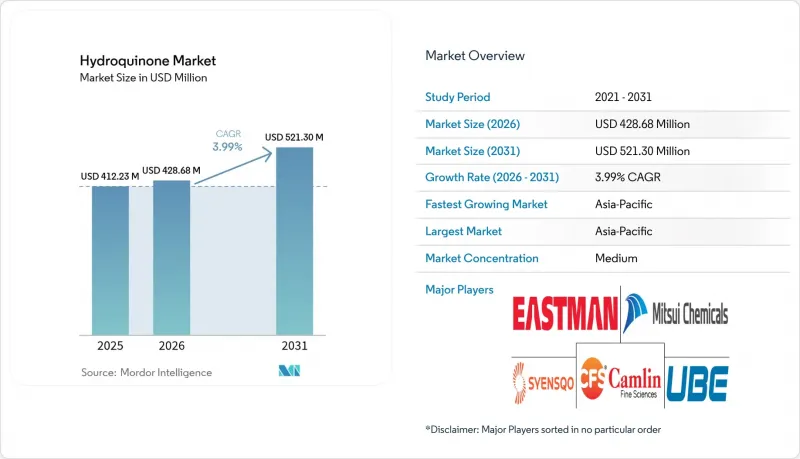
This report is Segmented by Production Process (Cumene Hydroperoxide Route, H2O2 Hydroxylation of Phenol, and Aniline Oxidation), Application (Intermediate, Antioxidant, Polymerization Inhibitor, and Photosensitive Chemical), End-Use Industry (Polymers, Cosmetics, Paints and Adhesives, Rubber and More), and Geography (Asia-Pacific, North America, Europe, South America, and Middle-East and Africa).
Global Hydroquinone Market Trends and Insights
Rising Demand for Non-Phenolic Antioxidants in Food Packaging
Food processors now embed tert-butylhydroquinone (TBHQ) in about 40% of packaged foods because it remains effective at fry-oil temperatures and cuts oxygen uptake one-hundredfold compared with older phenolics. Global TBHQ sales reached USD 8.216 billion in 2025 and are set to top USD 10.958 billion by 2032 at a 4.2% CAGR, comfortably ahead of the broader hydroquinone market trajectory. WHO and FDA intake limits of 0.2 mg/kg body weight have standardized formulation practices, linking demand directly to snack and ready-meal volumes. Manufacturers with integrated TBHQ capacity-such as Camlin Fine Sciences-can hedge regulatory swings in cosmetics by locking in long-term supply deals with food-packaging converters. Certification under ISO 22000 and FSSC 22000 is emerging as a purchasing prerequisite, rewarding suppliers that invest in traceable, GMP-compliant production lines.
Capacity Additions in Asia for Polymerization Inhibitors
India's Dahej hub ramped hydroquinone nameplate capacity from 10,000 MTPA in 2020 to 15,000 MTPA by 2022, offering a cost base lower than energy-intensive European plants. Methyl ethyl hydroquinone (MEHQ), dosed at 10-300 ppm, stabilizes acrylic acid in transit, and modern spectroscopic analyzers now maintain +- 0.22 ppm accuracy in real time. Tropical conditions shorten inhibitor hold-time from 50 hours at 80 °C to 12 hours at 90 °C, prompting continuous-dosing systems across Southeast Asian monomer units. Chinese exporters have amplified supply, keeping regional prices subdued and pressuring European producers to trim output, yet Asian demand from new MMA and acrylic acid lines is expected to absorb the glut by 2027. Integrated facilities that bundle MEHQ with acrylic monomer offtake agreements enjoy volume security and better working-capital cycles.
ECHA REACH Restrictions on Leave-On Cosmetics
Hydroquinone lists under Annex II entry 1339 as prohibited in cosmetics, with only a 0.02% allowance for artificial nail systems under Annex III entry 14. The 2024 tightening eliminated indirect delivery routes through arbutin derivatives, sparking widespread product recalls that removed a steady 10-15% demand slice almost overnight. The compound also holds Carc. 2 and Muta. 2 classifications, dissuading formulators from seeking niche exemptions. U.S. EPA's provisional oral reference dose of 0.04 mg/kg/day raises liability risks for dermal exposure. Producers without downstream TBHQ or MEHQ diversification face pronounced revenue cliffs.
Other drivers and restraints analyzed in the detailed report include:
- Growing Preference for Green H2O2 Hydroxylation Routes
- Up-Cycling of Lignin to HQ via Biocatalysis Unlocking Supply Flexibility
- Price Volatility of Cumene Feedstock
For complete list of drivers and restraints, kindly check the Table Of Contents.
Segment Analysis
The cumene hydroperoxide route provided 54.36% of hydroquinone market share in 2025, owing to its favorable co-product acetone economics. However, the H2O2 hydroxylation of phenol is expanding at a 4.52% CAGR as operators in Europe and North America seek lower waste-treatment costs and lighter capital investment. Continuous-flow reactors using Cu(II)-bipyridine catalysts have lifted phenol conversion efficiency, signaling a step change toward modular plants that switch feedstocks in response to price swings.
Lower purification loads, absence of acetone, and faster commissioning make H2O2 systems attractive to Southeast Asian entrants that supply nearby acrylic acid complexes. Direct benzene oxidation and aniline-based routes remain niche but offer strategic hedges where nitrobenzene or benzene overhangs exist. Integrated companies such as Eastman maintain dual-route assets, enabling agile raw-material arbitrage whenever propylene or hydrogen-peroxide spreads widen.
Complete Report Scope:
- By Production Process
- Cumene Hydroperoxide Route
- H2O2 Hydroxylation of Phenol
- Aniline Oxidation
- By Application
- Intermediate
- Antioxidant
- Polymerization Inhibitor
- Photosensitive Chemical
- By End-use Industry
- Polymers
- Cosmetics
- Paints and Adhesives
- Rubber
- Other End-use Industries
- By Geography
- Asia-Pacific
- China
- India
- Japan
- South Korea
- Malaysia
- Thailand
- Indonesia
- Vietnam
- Rest of Asia-Pacific
- North America
- United States
- Canada
- Mexico
- Europe
- Germany
- United Kingdom
- Italy
- France
- Russia
- Spain
- Turkey
- NORDIC Countries
- Rest of Europe
- South America
- Brazil
- Argentina
- Colombia
- Rest of South America
- Middle-East and Africa
- Saudi Arabia
- United Arab Emirates
- Qatar
- Egypt
- Nigeria
- South Africa
- Rest of Middle-East and Africa
- Asia-Pacific
Geography Analysis
Asia-Pacific dominated the hydroquinone market with a 47.92% revenue share in 2025 and is advancing at a 4.33% CAGR, fueled by India's capacity ramp-up and China's price-led export strategy. Although discounting compresses margins, regional producers benefit from proximity to acrylic-acid complexes and lower energy tariffs.
North America is supported by strong MEHQ pull from acrylic resin makers and TBHQ demand from snack-food brands. Eastman's dual-route set-up in the United States helps cushion phenol price gyrations and shortens lead times for pharmaceutical-grade shipments.
Europe faces the twin headwinds of REACH compliance costs and elevated electricity prices, restraining local output expansion. Nevertheless, premium niches such as USP-grade hydroquinone and novel antioxidants sustain select high-purity facilities. South America and the Middle-East and Africa collectively consume a low global supply, importing mainly for rubber, petrochemical, and packaging applications.
- Brother Technology
- Camlin Fine Sciences Ltd.
- Clean Science and Technology Limited
- Eastman Chemical Company
- FUJIFILM Wako Pure Chemical Corporation
- Haihang Industry
- Hubei Kaiyuan Chemicals & Technology Co., Ltd.
- Jiangsu Sanjili Chemical Co., LTD
- Mitsui Chemicals, Inc.
- Syensqo
- TIANJIN ZHONGXIN CHEMTECH CO.,LTD.(ZX CHEMTECH)
- UBE Corporation
- Yancheng Fengyang Chemical Co., Ltd.
Additional Benefits:
- The market estimate (ME) sheet in Excel format
- 3 months of analyst support
TABLE OF CONTENTS
1 Introduction
- 1.1 Study Assumptions and Market Definition
- 1.2 Scope of the Study
2 Research Methodology
3 Executive Summary
4 Market Landscape
- 4.1 Market Overview
- 4.2 Market Drivers
- 4.2.1 Rising demand for non-phenolic antioxidants in food packaging
- 4.2.2 Capacity additions in Asia for polymerization inhibitors
- 4.2.3 Growing preference for green H2O2 hydroxylation routes
- 4.2.4 Upcycling of lignin to HQ via biocatalysis unlocking supply flexibility
- 4.2.5 Emergence of HQ-dipalmitate as safer derivative broadens demand
- 4.3 Market Restraints
- 4.3.1 ECHA REACH restrictions on leave-on cosmetics
- 4.3.2 Price volatility of cumene feedstock
- 4.3.3 ESG-driven investor pull-out from phenolic value chains
- 4.4 Value Chain Analysis
- 4.5 Porter's Five Forces Analysis
- 4.5.1 Bargaining Power of Suppliers
- 4.5.2 Bargaining Power of Buyers
- 4.5.3 Threat of New Entrants
- 4.5.4 Threat of Substitutes
- 4.5.5 Degree of Competition
5 Market Size and Growth Forecasts (Value)
- 5.1 By Production Process
- 5.1.1 Cumene Hydroperoxide Route
- 5.1.2 H2O2 Hydroxylation of Phenol
- 5.1.3 Aniline Oxidation
- 5.2 By Application
- 5.2.1 Intermediate
- 5.2.2 Antioxidant
- 5.2.3 Polymerization Inhibitor
- 5.2.4 Photosensitive Chemical
- 5.3 By End-use Industry
- 5.3.1 Polymers
- 5.3.2 Cosmetics
- 5.3.3 Paints and Adhesives
- 5.3.4 Rubber
- 5.3.5 Other End-use Industries
- 5.4 By Geography
- 5.4.1 Asia-Pacific
- 5.4.1.1 China
- 5.4.1.2 India
- 5.4.1.3 Japan
- 5.4.1.4 South Korea
- 5.4.1.5 Malaysia
- 5.4.1.6 Thailand
- 5.4.1.7 Indonesia
- 5.4.1.8 Vietnam
- 5.4.1.9 Rest of Asia-Pacific
- 5.4.2 North America
- 5.4.2.1 United States
- 5.4.2.2 Canada
- 5.4.2.3 Mexico
- 5.4.3 Europe
- 5.4.3.1 Germany
- 5.4.3.2 United Kingdom
- 5.4.3.3 Italy
- 5.4.3.4 France
- 5.4.3.5 Russia
- 5.4.3.6 Spain
- 5.4.3.7 Turkey
- 5.4.3.8 NORDIC Countries
- 5.4.3.9 Rest of Europe
- 5.4.4 South America
- 5.4.4.1 Brazil
- 5.4.4.2 Argentina
- 5.4.4.3 Colombia
- 5.4.4.4 Rest of South America
- 5.4.5 Middle-East and Africa
- 5.4.5.1 Saudi Arabia
- 5.4.5.2 United Arab Emirates
- 5.4.5.3 Qatar
- 5.4.5.4 Egypt
- 5.4.5.5 Nigeria
- 5.4.5.6 South Africa
- 5.4.5.7 Rest of Middle-East and Africa
- 5.4.1 Asia-Pacific
6 Competitive Landscape
- 6.1 Market Concentration
- 6.2 Strategic Moves
- 6.3 Market Share (%)/Ranking Analysis
- 6.4 Company Profiles (includes Global level Overview, Market level overview, Core Segments, Financials as available, Strategic Information, Products and Services, and Recent Developments)
- 6.4.1 Brother Technology
- 6.4.2 Camlin Fine Sciences Ltd.
- 6.4.3 Clean Science and Technology Limited
- 6.4.4 Eastman Chemical Company
- 6.4.5 FUJIFILM Wako Pure Chemical Corporation
- 6.4.6 Haihang Industry
- 6.4.7 Hubei Kaiyuan Chemicals & Technology Co., Ltd.
- 6.4.8 Jiangsu Sanjili Chemical Co., LTD
- 6.4.9 Mitsui Chemicals, Inc.
- 6.4.10 Syensqo
- 6.4.11 TIANJIN ZHONGXIN CHEMTECH CO.,LTD.(ZX CHEMTECH)
- 6.4.12 UBE Corporation
- 6.4.13 Yancheng Fengyang Chemical Co., Ltd.
7 Market Opportunities and Future Outlook
- 7.1 White-space and Unmet-need Assessment

