PUBLISHER: Mordor Intelligence | PRODUCT CODE: 2121836

PUBLISHER: Mordor Intelligence | PRODUCT CODE: 2121836
Metal Working Fluids - Market Share Analysis, Industry Trends & Statistics, Growth Forecasts (2026 - 2031)
According to Mordor Intelligence, the metal working fluids market size is expected to grow from 1.60 billion liters in 2025 to 1.63 billion liters in 2026 and is forecast to reach 1.78 billion liters by 2031 at 1.77% CAGR over 2026-2031.
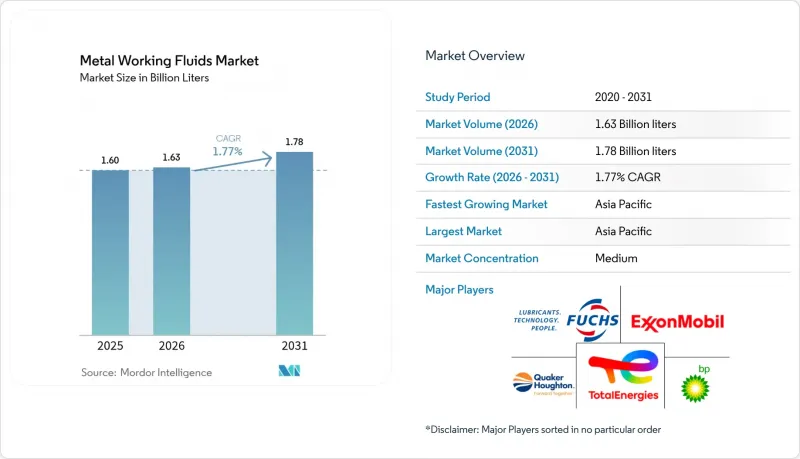
This report is Segmented by Product Type (Removal Fluids, Forming Fluids, Protection Fluids, Treating Fluids), End-User Industry (Automotive, Heavy Machinery, General Manufacturing, Metal Fabrication and Job Shops, Aerospace and Defense, Marine, Oil and Gas, Others), and Geography (Asia-Pacific, North America, Europe, South America, Middle-East and Africa).
Global Metal Working Fluids Market Trends and Insights
Growing Demand from Automotive Precision Machining
Electric-vehicle platforms require tight dimensional tolerances in battery housings, motor shafts, and structural aluminum castings. Leading plants in Shanghai, Berlin, and Austin have installed high-pressure die-casting cells that depend on synthetic or semi-synthetic fluids to prevent die soldering and maintain surface integrity. Formulators able to deliver PFAS-free additives with robust lubricity are winning long-term supply contracts as OEMs ramp integrated gigacasting lines. Parallel demand emerges from drivetrain downsizing in hybrids, where higher spindle speeds intensify thermal management requirements. Automotive fluid consumption, therefore, stays elevated even as internal-combustion engine block machining plateaus, supporting steady volume for the metal working fluids market.
Rapid Expansion of Global Aerospace Component Output
Airbus and Boeing project combined deliveries close to 1,550 aircraft in 2025, versus 1,263 in 2024, driving sustained titanium and nickel-alloy machining. These alloys demand high-flash-point synthetics with advanced extreme-pressure (EP) packages that manage chip adhesion and tool wear. Aerospace primes require supplier traceability and REACH compliance that few regional blenders can meet, reinforcing share for global incumbents. Defense programs like Europe's Future Combat Air System and Japan's fighter replacement add an additional layer of demand. Consequently, premium-priced neo-synthetic fluids climb faster than base-grade emulsions, lifting overall value in the metal working fluids market.
Shift Toward Dry and Near-Dry Machining Processes
Minimum-quantity lubrication (MQL) delivers atomized oil at 50 ml/h, compared with 50 L/min in flood systems. Laboratory trials on 7075-T6 aluminum achieved 20% longer tool life and superior Ra values, debunking myths that MQL underperforms in light metals. Automotive plants in Germany now run MQL on crankshaft lines, cutting coolant disposal volumes by 88%. As carbide-coated tools and adaptive controls mature, dry machining can cover a wider work-piece palette, removing liters from the metal working fluids market.
Other drivers and restraints analyzed in the detailed report include:
- Re-tooling Boom for EV Battery-Housing Fabrication
- Rising Adoption of IIoT-Enabled Fluid Monitoring
- Tightening Global VOC and Biocide Regulations
For complete list of drivers and restraints, kindly check the Table Of Contents.
Segment Analysis
Removal fluids retained 51.48% metal working fluids market share in 2025. Their wide applicability in turning, drilling, and grinding across steel and aluminum explains sustained dominance. Yet forming fluids, with a smaller 2025 base, register a 2.04% CAGR to 2031-the fastest among product types-reflecting growth in EV battery casings and aerospace stretch-forming. Within removal fluids, high-performance semi-synthetics capture incremental value as plants prioritize extended sump life and lower mist. Protection and treating fluids remain niche but indispensable for naval and heat-treat furnaces where corrosion inhibition and quench integrity matter. Bio-derived esters enter both removal and forming categories, offering 15% lower coefficient of friction while meeting biodegradability targets. Synthetic chemistries command premium pricing where downtime avoidance outweighs per-liter cost, reinforcing overall revenue resilience for the metal working fluids market.
Advances in additive technology now blend boron-free corrosion inhibitors with polymeric EP agents, making non-chlorinated fluids competitive in heavy cutting. Formulators also integrate nanodiamond particles to improve heat transfer in deep-hole drilling. Hybrid emulsions suited to both stamping and subsequent machining improve inventory efficiency at tier-one suppliers. Regional shifts are evident: Asia-Pacific consumes majority of global forming volume as Chinese and Korean battery factories scale output.
Complete Report Scope:
- By Product Type
- Removal Fluids
- Forming Fluids
- Protection Fluids
- Treating Fluids
- By End-User Industry
- Automotive
- Heavy Machinery
- General Manufacturing
- Metal Fabrication and Job Shops
- Aerospace and Defense
- Marine
- Oil and Gas
- Others
- By Geography
- Asia-Pacific
- China
- India
- Japan
- South Korea
- Malaysia
- Thailand
- Indonesia
- Vietnam
- Rest of Asia-Pacific
- North America
- United States
- Canada
- Mexico
- Europe
- Germany
- United Kingdom
- France
- Italy
- Spain
- Nordic Countries
- Russia
- Rest of Europe
- South America
- Brazil
- Argentina
- Colombia
- Rest of South America
- Middle-East and Africa
- Saudi Arabia
- United Arab Emirates
- Qatar
- Turkey
- Nigeria
- Egypt
- South Africa
- Rest of Middle-East and Africa
- Asia-Pacific
Geography Analysis
Asia-Pacific hosts nearly half of all machining centers installed since 2023, underpinning its 47.70% share of the metal working fluids market. The region's CAGR of 2.12% through 2031 outpaces the global average, driven by Chinese battery manufacturing and Indian aerospace offsets. Supply chains cluster near coastal industrial zones, lowering transport costs for bulk fluids. Government incentives for smart manufacturing in South Korea and Singapore add upside for IIoT-integrated formulations. Japan's precision-grinding culture sustains demand for ultra-low-sulfur synthetics, reinforcing the premium end of the spectrum.
North America holds a significant share and benefits from defense spending and ongoing shale gas investment. Regional EV assembly shifts to the Midwest require localized blending plants to reduce logistics emissions. Tight OSHA limits on mist exposure create steady pull for low-VOC products, nudging the metal working fluids market toward semi-synthetics. Europe faces the stiffest regulatory headwinds, especially around PFAS bans. Formulators there accelerate development of bio-based EP packages to preempt compliance risks. German and Italian machine-tool builders collaborate with lubricant suppliers to optimize toolpath and coolant packages, sustaining innovation.
South America and Middle East & Africa together comprise smaller share of global liters, with Brazil's agricultural machinery and Saudi fabrication yards as key demand nodes. Political risk and currency volatility challenge pricing strategies, yet infrastructure build-outs anchor baseline consumption. Regional blenders leverage flexible toll-manufacturing to hedge against import freight spikes, protecting local supply resilience in the metal working fluids market.
- Blaser Swisslube
- BP p.l.c.
- Carl Bechem Lubricants India Private Limited
- Chevron Corporation
- ENEOS Corporation
- Exxon Mobil Corporation
- FUCHS
- Hindustan Petroleum Corporation Limited
- Idemitsu Kosan Co.,Ltd.
- Indian Oil Corporation Ltd
- Kemipex
- LANXESS
- Master Fluid Solutions
- Motul
- Oelheld GmbH
- PETRONAS Lubricants International
- Quaker Chemical Corporation d/b/a Quaker Houghton
- Saudi Arabian Oil Co.
- Shell plc
- SKF
- TotalEnergies
- YUSHIRO Inc.
Additional Benefits:
- The market estimate (ME) sheet in Excel format
- 3 months of analyst support
TABLE OF CONTENTS
1 Introduction
- 1.1 Study Assumptions and Market Definition
- 1.2 Scope of the Study
2 Research Methodology
3 Executive Summary
4 Market Landscape
- 4.1 Market Overview
- 4.2 Market Drivers
- 4.2.1 Growing demand from automotive precision machining
- 4.2.2 Rapid expansion of global aerospace component output
- 4.2.3 Re-tooling boom for EV battery-housing fabrication
- 4.2.4 Rising adoption of IIoT-enabled fluid monitoring
- 4.2.5 Resurgence in oil and gas drilling tool manufacture
- 4.3 Market Restraints
- 4.3.1 Shift toward dry and near-dry machining processes
- 4.3.2 Tightening global VOC and biocide regulations
- 4.3.3 Volatility in Group I/II base-oil supply
- 4.3.4 High disposal costs from microbial contamination
- 4.4 Value Chain Analysis
- 4.5 Regulatory Landscape
- 4.6 Porter's Five Forces
- 4.6.1 Bargaining Power of Suppliers
- 4.6.2 Bargaining Power of Buyers
- 4.6.3 Threat of New Entrants
- 4.6.4 Threat of Substitutes
- 4.6.5 Degree of Competition
5 Market Size and Growth Forecasts (Volume)
- 5.1 By Product Type
- 5.1.1 Removal Fluids
- 5.1.2 Forming Fluids
- 5.1.3 Protection Fluids
- 5.1.4 Treating Fluids
- 5.2 By End-User Industry
- 5.2.1 Automotive
- 5.2.2 Heavy Machinery
- 5.2.3 General Manufacturing
- 5.2.4 Metal Fabrication and Job Shops
- 5.2.5 Aerospace and Defense
- 5.2.6 Marine
- 5.2.7 Oil and Gas
- 5.2.8 Others
- 5.3 By Geography
- 5.3.1 Asia-Pacific
- 5.3.1.1 China
- 5.3.1.2 India
- 5.3.1.3 Japan
- 5.3.1.4 South Korea
- 5.3.1.5 Malaysia
- 5.3.1.6 Thailand
- 5.3.1.7 Indonesia
- 5.3.1.8 Vietnam
- 5.3.1.9 Rest of Asia-Pacific
- 5.3.2 North America
- 5.3.2.1 United States
- 5.3.2.2 Canada
- 5.3.2.3 Mexico
- 5.3.3 Europe
- 5.3.3.1 Germany
- 5.3.3.2 United Kingdom
- 5.3.3.3 France
- 5.3.3.4 Italy
- 5.3.3.5 Spain
- 5.3.3.6 Nordic Countries
- 5.3.3.7 Russia
- 5.3.3.8 Rest of Europe
- 5.3.4 South America
- 5.3.4.1 Brazil
- 5.3.4.2 Argentina
- 5.3.4.3 Colombia
- 5.3.4.4 Rest of South America
- 5.3.5 Middle-East and Africa
- 5.3.5.1 Saudi Arabia
- 5.3.5.2 United Arab Emirates
- 5.3.5.3 Qatar
- 5.3.5.4 Turkey
- 5.3.5.5 Nigeria
- 5.3.5.6 Egypt
- 5.3.5.7 South Africa
- 5.3.5.8 Rest of Middle-East and Africa
- 5.3.1 Asia-Pacific
6 Competitive Landscape
- 6.1 Market Concentration
- 6.2 Strategic Moves
- 6.3 Market Share**/Ranking Analysis
- 6.4 Company Profiles (includes Global level Overview, Market level overview, Core Segments, Financials as available, Strategic Information, Market Rank/Share, Products and Services, Recent Developments)
- 6.4.1 Blaser Swisslube
- 6.4.2 BP p.l.c.
- 6.4.3 Carl Bechem Lubricants India Private Limited
- 6.4.4 Chevron Corporation
- 6.4.5 ENEOS Corporation
- 6.4.6 Exxon Mobil Corporation
- 6.4.7 FUCHS
- 6.4.8 Hindustan Petroleum Corporation Limited
- 6.4.9 Idemitsu Kosan Co.,Ltd.
- 6.4.10 Indian Oil Corporation Ltd
- 6.4.11 Kemipex
- 6.4.12 LANXESS
- 6.4.13 Master Fluid Solutions
- 6.4.14 Motul
- 6.4.15 Oelheld GmbH
- 6.4.16 PETRONAS Lubricants International
- 6.4.17 Quaker Chemical Corporation d/b/a Quaker Houghton
- 6.4.18 Saudi Arabian Oil Co.
- 6.4.19 Shell plc
- 6.4.20 SKF
- 6.4.21 TotalEnergies
- 6.4.22 YUSHIRO Inc.
7 Market Opportunities and Future Outlook
- 7.1 White-space and Unmet-Need Assessment

