PUBLISHER: Mordor Intelligence | PRODUCT CODE: 2121882

PUBLISHER: Mordor Intelligence | PRODUCT CODE: 2121882
North America Surfactants - Market Share Analysis, Industry Trends & Statistics, Growth Forecasts (2026 - 2031)
According to Mordor Intelligence, the North America surfactants market size in 2026 is estimated at USD 14.67 billion, growing from 2025 value of USD 14.15 billion with 2031 projections showing USD 17.56 billion, growing at 3.67% CAGR over 2026-2031.
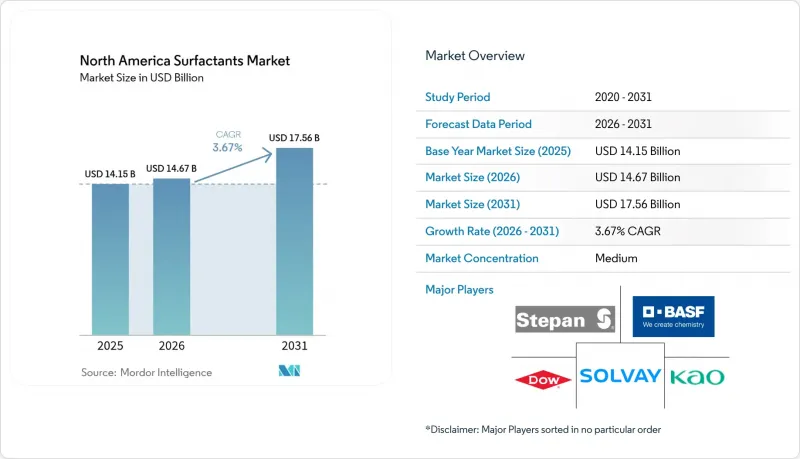
This report Segments the Industry Into Type (Anionic Surfactant, Cationic Surfactant, Non-Ionic Surfactant, Amphoteric Surfactant, and More), Origin (Synthetic Surfactant, Bio-Based Surfactant), Application (Household Soap and Detergent, Personal Care, Lubricants and Fuel Additives, and More), and Geography (United States, Canada, and More).
North America Surfactants Market Trends and Insights
Accelerating Shift to Bio-Surfactants in Home and Personal-Care Formulations
Brand owners embed minimum bio-content thresholds in supplier scorecards, shrinking the historic cost gap between petro-derived and renewable systems. Evonik commissioned a bio-succinic-acid line to service alkyl-polyglucoside demand, while Croda's Atlas Point site rolled out 100% bio-based alcohol ethoxylates to secure USDA BioPreferred seals. California and New York bans on nonylphenol ethoxylates advance the transition as formulators pre-empt future restrictions. EPA's August 2024 Safer Choice update allocates extra points for non-food-crop feedstocks such as camelina, guiding purchasing away from palm kernel. Collectively, these measures accelerate the North America Surfactants market's pivot to renewable inputs without compromising detergency targets.
Growth of I&I and Institutional Cleaning Post-COVID
Hospitals, restaurants, and office buildings locked higher cleaning frequencies into standard operating procedures after the pandemic, permanently lifting surfactant demand in sanitizers and floor cleaners. State rules that discourage quaternary ammonium compounds steer buyers toward anionic-nonionic blends that rinse cleanly and pose fewer residue concerns. Pilot Chemical and Innospec win share by offering pre-diluted concentrates that cut shipping weight and satisfy sustainability targets. Office occupancy stabilized in 2024, restoring janitorial budgets to pre-pandemic levels and boosting institutional volumes. Together these shifts lift I&I surfactant growth above household-care averages through 2027.
Petro-Feedstock Price Volatility and Supply Shocks
WTI crude oscillated between USD 70 and USD 85 per barrel through 2024, resulting in 20-30% swings in ethylene oxide spot prices that compressed producer margins. Mexican ethane diversification eases some pressure, yet Braskem Idesa's new import terminal also feeds polymers, limiting relief for surfactants. Import-dependent Canadian formulators face dual freight and currency risk because all ethylene oxide must cross borders. Such volatility discourages long-cycle capital projects, slowing capacity additions despite steady demand growth. The result is a fragile cost base for regional toll manufacturers serving the North America surfactants market.
Other drivers and restraints analyzed in the detailed report include:
- Tightening U.S. and Canadian VOC and Toxicity Regulations
- Rising Demand for High-Performance Surfactants in Enhanced Oil Recovery
- Aquatic-Toxicity Scrutiny of Legacy LAS and NPE Grades
For complete list of drivers and restraints, kindly check the Table Of Contents.
Segment Analysis
Non-ionic surfactants accounted for 44.12% of the 2025 volume, driven by the utility of alcohol-ethoxylates in concentrated pods that require high detergency at low doses. The North American surfactants market size for non-ionics is forecast to rise 3.78% annually as institutional sanitizers continue to shift to low-foam blends that expedite rinse cycles. California's nonylphenol-ethoxylate ban pushes suppliers toward fatty-acid-ester and alkyl-polyglucoside substitutes, both of which qualify for EPA Safer Choice labels. Anionic surfactants remain the workhorse: Stepan's 25% alpha-olefin-sulfonate expansion underscores confidence that sulfonate demand in laundry and dishwashing will hold even as biosurfactants scale. Regulatory scrutiny of linear-alkylbenzene sulfonates boosts secondary-alkane and methyl-ester sulfonates, especially for products exported to Europe under the EU Detergents Regulation.
Specialty cationic quats face headwinds because proposed California disinfectant limits reduce QAC inclusion, yet uses in fabric softeners and hair conditioners preserve modest growth. Amphoterics such as betaines gain popularity in sulfate-free shampoos that require mildness and stable foam. Silicone surfactants remain a niche market, primarily focused on agrochemical adjuvants and polyurethane foams, where their unique spreading properties justify premiums. Overall, non-ionics maintain baseline volume while anionics innovate, ensuring that type-level demand within the North America Surfactants market remains broad and defensible.
Complete Report Scope:
- By Type
- Anionic Surfactant
- Linear Alkylbenzene Sulfolane (LAS or LABS)
- Alcohol Ethoxysulfates (AES)
- Alpha Olefin Sulfonates (AOS)
- Secondary Alkane Sulfonate (SAS)
- Methyl Ester Sulfonates (MES)
- Sulfosuccinates
- Others
- Cationic Surfactant
- Quaternary ammonium compound
- Others
- Non-ionic Surfactant
- Alcohol ethoxylate
- Alkylphenol ethoxylate
- Fatty acid ester
- Others
- Amphoteric Surfactant
- Silicone Surfactant
- Other Types
- Anionic Surfactant
- By Origin
- Synthetic Surfactant
- Bio-based Surfactant
- Chemically-Synthesized Bio-Based Surfactants
- Biosurfactants
- By Application
- Household Soap and Detergent
- Personal Care
- Lubricants and Fuel Additives
- Industry and Institutional Cleaning
- Food Processing
- Oilfield Chemicals
- Agricultural Chemicals
- Textile Processing
- Emulsion Polymerisation
- Others
- By Geography
- United States
- Canada
- Mexico
List of Companies Covered in this Report:
- 3M
- Ashland
- BASF
- CLARIANT
- Croda International Plc
- Dow
- Evonik Industries AG
- GALAXY
- Godrej Industries Limited
- Henkel Corporation
- Innospec
- Kao Corporation
- MITSUI CHEMICALS AMERICA, INC.
- Nouryon
- Procter & Gamble
- Sasol
- Solvay
- Stepan Company
Additional Benefits:
- The market estimate (ME) sheet in Excel format
- 3 months of analyst support
TABLE OF CONTENTS
1 Introduction
- 1.1 Study Assumptions and Market Definition
- 1.2 Scope of the Study
2 Research Methodology
3 Executive Summary
4 Market Landscape
- 4.1 Market Overview
- 4.2 Market Drivers
- 4.2.1 Accelerating shift to bio-surfactants in home and personal-care formulations
- 4.2.2 Growth of IandI and institutional cleaning post-COVID
- 4.2.3 Tightening U.S./Canadian VOC and toxicity regulations
- 4.2.4 Rising demand for high-performance surfactants in enhanced-oil-recovery (EOR)
- 4.2.5 Commercialisation of carbon-capture-derived feedstocks
- 4.3 Market Restraints
- 4.3.1 Petro-feedstock price volatility and supply shocks
- 4.3.2 Aquatic-toxicity scrutiny of legacy LAS/NPE grades
- 4.3.3 Limited regional capacity for specialized microbial strains
- 4.4 Value Chain Analysis
- 4.5 Porter's Five Forces
- 4.5.1 Bargaining Power of Suppliers
- 4.5.2 Bargaining Power of Consumers
- 4.5.3 Threat of New Entrants
- 4.5.4 Threat of Substitute Products and Services
- 4.5.5 Degree of Competition
5 Market Size and Growth Forecasts (Value)
- 5.1 By Type
- 5.1.1 Anionic Surfactant
- 5.1.1.1 Linear Alkylbenzene Sulfolane (LAS or LABS)
- 5.1.1.2 Alcohol Ethoxysulfates (AES)
- 5.1.1.3 Alpha Olefin Sulfonates (AOS)
- 5.1.1.4 Secondary Alkane Sulfonate (SAS)
- 5.1.1.5 Methyl Ester Sulfonates (MES)
- 5.1.1.6 Sulfosuccinates
- 5.1.1.7 Others
- 5.1.2 Cationic Surfactant
- 5.1.2.1 Quaternary ammonium compound
- 5.1.2.2 Others
- 5.1.3 Non-ionic Surfactant
- 5.1.3.1 Alcohol ethoxylate
- 5.1.3.2 Alkylphenol ethoxylate
- 5.1.3.3 Fatty acid ester
- 5.1.3.4 Others
- 5.1.4 Amphoteric Surfactant
- 5.1.5 Silicone Surfactant
- 5.1.6 Other Types
- 5.1.1 Anionic Surfactant
- 5.2 By Origin
- 5.2.1 Synthetic Surfactant
- 5.2.2 Bio-based Surfactant
- 5.2.2.1 Chemically-Synthesized Bio-Based Surfactants
- 5.2.2.2 Biosurfactants
- 5.3 By Application
- 5.3.1 Household Soap and Detergent
- 5.3.2 Personal Care
- 5.3.3 Lubricants and Fuel Additives
- 5.3.4 Industry and Institutional Cleaning
- 5.3.5 Food Processing
- 5.3.6 Oilfield Chemicals
- 5.3.7 Agricultural Chemicals
- 5.3.8 Textile Processing
- 5.3.9 Emulsion Polymerisation
- 5.3.10 Others
- 5.4 By Geography
- 5.4.1 United States
- 5.4.2 Canada
- 5.4.3 Mexico
6 Competitive Landscape
- 6.1 Market Concentration
- 6.2 Strategic Moves
- 6.3 Market Share Analysis
- 6.4 Company Profiles (includes Global level Overview, Market level overview, Core Segments, Financials as available, Strategic Information, Market Rank/Share for key companies, Products and Services, and Recent Developments)
- 6.4.1 3M
- 6.4.2 Ashland
- 6.4.3 BASF
- 6.4.4 CLARIANT
- 6.4.5 Croda International Plc
- 6.4.6 Dow
- 6.4.7 Evonik Industries AG
- 6.4.8 GALAXY
- 6.4.9 Godrej Industries Limited
- 6.4.10 Henkel Corporation
- 6.4.11 Innospec
- 6.4.12 Kao Corporation
- 6.4.13 MITSUI CHEMICALS AMERICA, INC.
- 6.4.14 Nouryon
- 6.4.15 Procter & Gamble
- 6.4.16 Sasol
- 6.4.17 Solvay
- 6.4.18 Stepan Company
7 Market Opportunities and Future Outlook
- 7.1 White-space and Unmet-Need Assessment

