PUBLISHER: Mordor Intelligence | PRODUCT CODE: 2121883

PUBLISHER: Mordor Intelligence | PRODUCT CODE: 2121883
Optical Coatings - Market Share Analysis, Industry Trends & Statistics, Growth Forecasts (2026 - 2031)
According to Mordor Intelligence, the optical coatings market size was valued at USD 23.54 billion in 2025 and is estimated to grow from USD 24.99 billion in 2026 to reach USD 33.71 billion by 2031, at a CAGR of 6.17% during the forecast period (2026-2031).
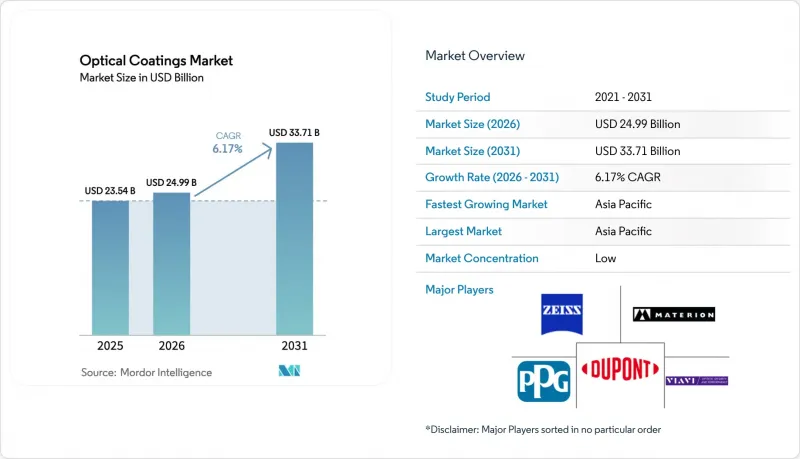
This report is Segmented by Product Type (Optical Filter, Anti-Reflective, and More), Deposition Technology (Chemical Vapor Deposition, Ion-Beam Sputtering, and More), End-User Industry (Aerospace and Defense, Electronics and Semiconductors, and More), and Geography (Asia-Pacific, North America, Europe, and More). The Market Forecasts are Provided in Terms of Revenue (USD).
Global Optical Coatings Market Trends and Insights
Solar-Grade Anti-Reflective Films Slash LCOE in Bifacial PV Modules
Bifacial photovoltaic modules equipped with dual-sided anti-reflective stacks now exceed 25% cell efficiency, pushing the levelized cost of energy below USD 0.03 per kilowatt-hour in high-irradiance zones. Tongwei Solar's 25.5% tunnel-oxide passivated-contact cell, announced in 2025, attributed 0.8 percentage points of gain to optimized front- and rear-surface coatings that minimize reflection from 300 to 1,200 nanometers. Higher output cuts balance-of-system costs, prompting India's National Institute of Solar Energy to note 18% greater annual yield for bifacial arrays in desert climates. Module manufacturers are internalizing coating steps to secure stack recipes, tightening supply for independent coaters, and favoring players that amortize plasma-enhanced CVD capital across gigawatt-class lines.
AR/HR Meta-Coatings Enabling AR/VR Waveguides for Consumer Headsets
Metasurface waveguides replace bulky multilayer stacks with sub-wavelength nanostructures that slim optical engines below 5 millimeters. Meta Platforms documented a 92%-efficient titanium-dioxide design in 2024, and Samsung Research followed with a holographic variant in 2025, delivering a 50-degree field of view compatible with eyeglasses. Brands that secure meta-coating intellectual property and align with ion-beam sputtering specialists will control forthcoming consumer-electronics bill of materials, whereas legacy AR vendors face obsolescence unless they invest in nano-fabrication capacity.
Indium-Tin-Oxide Supply Vulnerability
China controls 60% of refined indium, and the United States imported 100% of its need in 2024 according to the US Geological Survey. A 35% price jump in 2023-2024 reflects tightened export quotas, while recycling captures less than 15% of scrap. Display makers fund alternatives such as graphene and silver nanowires, yet none match ITO's conductivity-transparency balance at mass scale. Samsung Display allocated USD 120 million to ITO-free research, but commercial release is unlikely before 2028, leaving coaters exposed to raw-material inflation.
Other drivers and restraints analyzed in the detailed report include:
- 6G-Ready Ultra-Low-Loss Filter Stacks for Photonic Integrated Circuits
- Military Hyperspectral Imaging Demand for Broad-Band Filter Coatings
- Stricter PFAS Bans Hitting Fluoride-Based Hard Coats
For complete list of drivers and restraints, kindly check the Table Of Contents.
Segment Analysis
Anti-reflective coatings commanded 37.94% of revenue in 2025, and the segment is projected to expand at a 6.46% CAGR through 2031. Dual-sided stacks on bifacial solar glass and low-reflectance layers on OLED panels account for nearly two-thirds of consumption. Transparent conductive coatings, hindered by indium constraints, still post mid-single-digit growth as microLED head-up displays and wearables mature. High-reflective mirror coatings remain specialized for laser systems, while beam splitters support machine-vision cameras in industrial automation. Specialty filters servicing biophotonics and quantum optics sustain gross margins above 50%.
Momentum is shifting from broadband AR stacks toward wavelength-selective metasurface films that reduce reflection below 0.5% with sub-10-nanometer thickness. Samsung Research unveiled a flexible variant in 2024, and Tokyo Electron is scaling nano-imprint tools that pattern 300-millimeter wafers at 20-per-hour throughput. Coaters tied solely to CVD or sputtering lack sub-50-nanometer pattern capabilities and risk commoditization as Asian fabs internalize multilayer recipes.
Complete Report Scope:
- By Product Type
- Optical Filter Coatings
- Anti-reflective Coatings
- Transparent Conductive Coatings
- High-Reflective Mirror Coatings
- Beam Splitter Coatings
- Others
- By Deposition Technology
- Chemical Vapor Deposition
- Ion-beam Sputtering
- Plasma Sputtering
- Atomic Layer Deposition
- Sub-wavelength Structured Surfaces
- By End-user Industry
- Aerospace and Defense
- Electronics and Semiconductors
- Telecommunications
- Healthcare
- Solar
- Automotive
- Others
- By Geography
- Asia-Pacific
- China
- Japan
- South Korea
- India
- ASEAN Countries
- Rest of Asia-Pacific
- North America
- United States
- Canada
- Mexico
- Europe
- Germany
- United Kingdom
- France
- Italy
- Spain
- Nordic Countries
- Russia
- Rest of Europe
- South America
- Brazil
- Argentina
- Rest of South America
- Middle-East and Africa
- Saudi Arabia
- South Africa
- Rest of Middle-East and Africa
- Asia-Pacific
Geography Analysis
Asia-Pacific held 34.78% of 2025 revenue and is advancing at an 8.11% CAGR to 2031, adding more than USD 3 billion to the optical coatings market size during the period. China, South Korea, and Japan anchor regional dominance through OLED production, solar module assembly, and precision metrology toolmaking. India's National Institute of Solar Energy reported that locally coated bifacial glass trims module costs by USD 0.02 per watt, stimulating domestic coating-line investment. Southeast Asia emerges as a secondary hub as brands diversify away from China, although limited semiconductor infrastructure restrains photonic-grade growth.
Military optics and photonic integrated circuits propel North America's optical coatings market growth. The US Department of Defense allocated USD 1.8 billion in 2024 for electro-optical and infrared systems, driving demand for ion-beam coatings that survive harsh environments. Materion and Coherent leverage classified-program credentials to secure contracts, while Canada's photonics cluster leverages National Research Council grants for coating development. Mexico attracts automotive-coating projects such as PPG's USD 45 million expansion in Tlaxcala, serving Ford and GM plants.
Europe accounts for a significant share of the global optical coatings market as Germany, France, and the United Kingdom dominate automotive and industrial optics. Schott and Zeiss supply PFAS-free conformal layers following the EU's tightened chemical regulations. The Middle East and Africa are witnessing rising demand for optical coatings due to solar mega-projects like Saudi Arabia's NEOM, which incorporates 5 gigawatts of bifacial modules requiring dual-side coatings.
- 3M
- Abrisa Technologies
- AccuCoat Inc.
- Artemis Optical Ltd
- DuPont
- Edmund Optics Inc.
- Inrad Optics
- Materion Corporation
- Newport Corporation
- Nippon Sheet Glass Co., Ltd.
- Optical Coatings Technologies
- PPG Industries Inc.
- Quantum Coating Inc.
- Reynard Corporation
- Schott AG
- SIGMAKOKI CO., LTD
- VIAVI Solutions Inc.
- Zeiss International
- Zygo
Additional Benefits:
- The market estimate (ME) sheet in Excel format
- 3 months of analyst support
TABLE OF CONTENTS
1 Introduction
- 1.1 Study Assumptions and Market Definition
- 1.2 Scope of the Study
2 Research Methodology
3 Executive Summary
4 Market Landscape
- 4.1 Market Overview
- 4.2 Market Drivers
- 4.2.1 Solar-grade anti-reflective (AR) films slash LCOE in bifacial PV modules
- 4.2.2 AR/HR "meta-coatings" enabling AR/VR waveguides for consumer headsets
- 4.2.3 6G-ready ultra-low-loss filter stacks for photonic integrated circuits
- 4.2.4 Military hyperspectral imaging demand for broad-band filter coatings
- 4.2.5 Mainstream demand surge from OLED/µLED displays
- 4.3 Market Restraints
- 4.3.1 Indium-tin-oxide (ITO) supply vulnerability
- 4.3.2 Stricter PFAS bans hitting fluoride-based hard coats
- 4.3.3 CAPEX intensity of atomic-layer deposition (ALD) lines
- 4.4 Value Chain Analysis
- 4.5 Porter's Five Forces Analysis
- 4.5.1 Bargaining Power of Suppliers
- 4.5.2 Bargaining Power of Buyers
- 4.5.3 Threat of New Entrants
- 4.5.4 Threat of Substitutes
- 4.5.5 Degree of Competition
5 Market Size and Growth Forecasts (Value)
- 5.1 By Product Type
- 5.1.1 Optical Filter Coatings
- 5.1.2 Anti-reflective Coatings
- 5.1.3 Transparent Conductive Coatings
- 5.1.4 High-Reflective Mirror Coatings
- 5.1.5 Beam Splitter Coatings
- 5.1.6 Others
- 5.2 By Deposition Technology
- 5.2.1 Chemical Vapor Deposition
- 5.2.2 Ion-beam Sputtering
- 5.2.3 Plasma Sputtering
- 5.2.4 Atomic Layer Deposition
- 5.2.5 Sub-wavelength Structured Surfaces
- 5.3 By End-user Industry
- 5.3.1 Aerospace and Defense
- 5.3.2 Electronics and Semiconductors
- 5.3.3 Telecommunications
- 5.3.4 Healthcare
- 5.3.5 Solar
- 5.3.6 Automotive
- 5.3.7 Others
- 5.4 By Geography
- 5.4.1 Asia-Pacific
- 5.4.1.1 China
- 5.4.1.2 Japan
- 5.4.1.3 South Korea
- 5.4.1.4 India
- 5.4.1.5 ASEAN Countries
- 5.4.1.6 Rest of Asia-Pacific
- 5.4.2 North America
- 5.4.2.1 United States
- 5.4.2.2 Canada
- 5.4.2.3 Mexico
- 5.4.3 Europe
- 5.4.3.1 Germany
- 5.4.3.2 United Kingdom
- 5.4.3.3 France
- 5.4.3.4 Italy
- 5.4.3.5 Spain
- 5.4.3.6 Nordic Countries
- 5.4.3.7 Russia
- 5.4.3.8 Rest of Europe
- 5.4.4 South America
- 5.4.4.1 Brazil
- 5.4.4.2 Argentina
- 5.4.4.3 Rest of South America
- 5.4.5 Middle-East and Africa
- 5.4.5.1 Saudi Arabia
- 5.4.5.2 South Africa
- 5.4.5.3 Rest of Middle-East and Africa
- 5.4.1 Asia-Pacific
6 Competitive Landscape
- 6.1 Market Concentration
- 6.2 Strategic Moves
- 6.3 Market Share/Ranking Analysis
- 6.4 Company Profiles (includes Global level Overview, Market level overview, Core Segments, Financials as available, Strategic Information, Market Rank/Share for key companies, Products and Services, and Recent Developments)
- 6.4.1 3M
- 6.4.2 Abrisa Technologies
- 6.4.3 AccuCoat Inc.
- 6.4.4 Artemis Optical Ltd
- 6.4.5 DuPont
- 6.4.6 Edmund Optics Inc.
- 6.4.7 Inrad Optics
- 6.4.8 Materion Corporation
- 6.4.9 Newport Corporation
- 6.4.10 Nippon Sheet Glass Co., Ltd.
- 6.4.11 Optical Coatings Technologies
- 6.4.12 PPG Industries Inc.
- 6.4.13 Quantum Coating Inc.
- 6.4.14 Reynard Corporation
- 6.4.15 Schott AG
- 6.4.16 SIGMAKOKI CO., LTD
- 6.4.17 VIAVI Solutions Inc.
- 6.4.18 Zeiss International
- 6.4.19 Zygo
7 Market Opportunities and Future Outlook
- 7.1 White-space and Unmet-need Assessment

