PUBLISHER: Mordor Intelligence | PRODUCT CODE: 2121891

PUBLISHER: Mordor Intelligence | PRODUCT CODE: 2121891
Europe Flexible Packaging - Market Share Analysis, Industry Trends & Statistics, Growth Forecasts (2026 - 2031)
According to Mordor Intelligence, the Europe flexible packaging market size size was valued at USD 54.42 billion in 2025 and is estimated to grow from USD 55.83 billion in 2026 to reach USD 64.52 billion by 2031, at a CAGR of 2.94% during the forecast period (2026-2031).
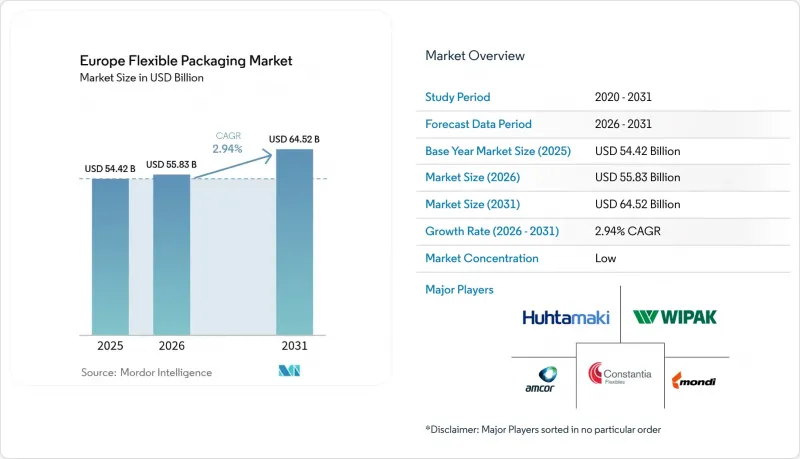
This report is Segmented by Material (Plastics, Paper, Metal Foil, and Bioplastics and Compostable Materials), Product Type (Bags and Pouches, Films and Wraps, and More), End-User Industry (Food, Beverage, Healthcare and Pharmaceutical, and More), Printing Technology (Flexography, Rotogravure, Digital Printing, and More), and Country. The Market Forecasts are Provided in Terms of Value (USD).
Europe Flexible Packaging Market Trends and Insights
Surge in Demand for Recyclable Mono-Material Films Driven by EU Circular-Economy Targets
Europe's recyclability-by-design mandate is dismantling the long-running cost advantage of mixed-polymer laminates. Converters are engineering single-polyethylene or single-polypropylene films that integrate oxygen and moisture barriers through specialty tie layers and ultra-thin EVOH cores, thereby complying with the Packaging and Packaging Waste Regulation, which requires 30% post-consumer resin in flexible packs by 2030. Mechanical-recycling constraints force many converters to blend downgraded PCR with virgin resin, raising material cost and driving innovation toward solvent-based delamination and chemical-recycling alliances. Extended Producer Responsibility fees now vary with recyclability scores, adding up to EUR 0.80 (USD 0.90) per kilogram for non-recyclable films in France's CITEO system, a direct hit to brand-owner budgets. The European Chemicals Agency's looming PFAS ban, effective 2026, further tightens material choices by eliminating a class of grease-resistant coatings. The result is a synchronized rush toward mono-material platforms despite unresolved trade-offs in barrier performance.
Accelerated Growth of E-Commerce Elevating Demand for Flexible Mailers and Protective Formats in Europe
Parcel volumes topped 87 billion in 2024, and flexible mailers are displacing corrugated boxes wherever dimensional-weight rules punish oversized packaging. The European Parliament capped empty space at 40% for e-commerce parcels by 2026, effectively steering retailers toward thinner, form-fitting mailers. Automated fulfillment lines that dispense custom-sized pouches reduce warehouse storage by up to 20% and lower carrier surcharges linked to volumetric weight. Yet, the same regulation compels reusability or recyclability, forcing a design compromise: durability for reverse logistics versus compatibility with polyethylene film streams. Germany's 2025 VerpackG amendment requires online retailers to fund take-back schemes, adding EUR 0.05-0.10 (USD 0.06-0.11) per mailer, a cost that nudges some merchants toward coated-paper solutions despite higher moisture-barrier challenges.
Stringent EU Plastics and Packaging-Waste Regulations Increasing Compliance Costs
More than 20 national EPR schemes now impose differentiated fees based on pack design, and converters must fund recyclability lab tests, migration studies, and cross-border registrations that can total USD 100,000 per plant each year. France's AGEC law adds blockchain-level traceability for recycled content, raising material premiums by USD 0.02-0.05 per kilogram. Small converters are diverting capital from growth projects just to keep SKUs compliant. In parallel, Germany's updated VerpackG enforces a 65% recycling target for plastics by 2025, a level that flexible films cannot meet today, thereby exposing converters to penalty fees or market exits. Some firms relocate production to lower-fee jurisdictions, but the European Commission plans a harmonized fee model by 2027 that will close such loopholes.
Other drivers and restraints analyzed in the detailed report include:
- Consumer Shift Toward Convenience and Portion-Control Products Boosting Flexible-Pouch Adoption
- Technological Advances in High-Barrier Co-Extrusion Enhancing Shelf-Life for Ready Meals
- Limited Recycling Infrastructure for Multi-Layer Films Hampering Circularity Goals
For complete list of drivers and restraints, kindly check the Table Of Contents.
Segment Analysis
Plastics represented 66.12% of market share in 2025, confirming that virgin and recycled polyolefins still anchor the Europe flexible packaging market. Yet, bioplastics are poised for the fastest 4.21% CAGR as brand owners hedge against future fossil-based bans. Polylactic acid films find a niche in bakery liners where short shelf-life tolerates limited barrier properties, while cast polypropylene remains the default sealant layer even as converters trial pure-PP laminates to meet recyclability rules. Paper-based laminates are rebounding in dry goods, though the Europe flexible packaging market size for coated paper remains modest because plastic liners exceeding 2% by weight disqualify most packs from paper-mill streams. Aluminum foil retains critical roles in pharmaceutical blister and coffee applications where near-zero oxygen transmission is non-negotiable.
The mono-material pivot accelerates demand for specialty tie-layer resins that bond EVOH micro-layers to polyethylene without compromising seal strength. Polymer suppliers are marketing compatibilizers that claim to preserve optical clarity and drop-test performance, yet converters report a learning curve that increases scrap rates during early production. Brands accept these inefficiencies to secure "designed for recycling" logos that ease EPR fees and bolster corporate-sustainability disclosures. Despite high interest in compostables, industrial-scale composting infrastructure remains rare outside Italy and Austria, meaning most PLA or starch blends still end in landfill or incineration. Until consumer-collection systems mature, polyolefins are expected to dominate the Europe flexible packaging market share for at least the next five years.
Bags and pouches held 46.63% of the market share in 2025, benefiting from stand-up formats that replace rigid tubs in baby food, ready meals, and household cleaners. Europe flexible packaging market size linked to sachets and stick packs is forecast to rise at a 3.45% CAGR through 2031 thanks to pharmaceutical unit-dose demand and single-serve coffee innovations. Films and wraps remain a bulk-volume workhorse in palletizing and silage, but margin compression is acute as resin-price swings transfer directly to commoditized contracts. Correspondingly, converters are steering investments toward higher-value mailers with multi-layer cushioning and printable zones for reverse-logistics labels.
Mailers illustrate the trade-off between operational efficiency and regulatory compliance. A 60-gram-per-square-meter co-extruded mailer can cut shipping costs by 40% compared with a small corrugated box, yet PPWR's draft rules favor reusability, forcing retailers to trial thicker, returnable pouches embossed with QR codes for tracking. Pilot programs in the Nordics show 30% consumer return rates, insufficient to justify higher unit costs without deposit incentives. Paper mailers laminated with water-based barriers gain favor in humid climates where uncoated kraft fails, even though mixed-material construction complicates recycling. Converters that can deliver a certified recyclable PE mailer compatible with automated pack-in-bag systems are likely to seize profitable share over the forecast period.
Complete Report Scope:
- By Material
- Plastics
- Polyethylene (PE)
- Biaxially Oriented Polypropylene (BOPP)
- Cast Polypropylene (CPP)
- Other Plastics
- Paper
- Metal Foil
- Bioplastics and Compostable Materials
- Plastics
- By Product Type
- Bags and Pouches
- Films and Wraps
- Sachets and Stick Packs
- Other Product Types
- BY End-user Industry
- Food
- Baked Goods
- Snacks
- Meat, Poultry and Seafood
- Confectionery
- Pet Food
- Other Food Products
- Beverage
- Healthcare and Pharmaceutical
- Personal Care and Cosmetics
- Agriculture
- Other End-Use Industries
- Food
- By Printing Technology
- Flexography
- Rotogravure
- Digital Printing
- Other Printing Technologies
- By Country
- Germany
- United Kingdom
- France
- Italy
- Spain
- Rest of Europe
List of Companies Covered in this Report:
- Amcor PLC
- Mondi Group
- Huhtamaki Oyj
- Constantia Flexibles GmbH
- Sealed Air Corporation
- Coveris Management GmbH
- ProAmpac LLC
- Novolex Holdings Inc.
- Sonoco Products Company
- Bischof + Klein SE & Co. KG
- Wipak Oy
- Schur International A/S
- Gualapack SpA
- ePac Holdings LLC
- Danaflex Group
- Cellografica Gerosa SpA
- Di Mauro Officine Grafiche SpA
- Bak Ambalaj Sanayi ve Ticaret AS
- Flextrus AB
- Sipospack Kft.
- Clondalkin Flexible Packaging
- Innovia Films Ltd.
- AR Packaging Group AB
- RKW Group
- Uflex Limited
- Schur Flexibles Group
- Sudpack Verpackungen GmbH
- Leefung ASG Europe
Additional Benefits:
- The market estimate (ME) sheet in Excel format
- 3 months of analyst support
TABLE OF CONTENTS
1 INTRODUCTION
- 1.1 Study Assumptions and Market Definition
- 1.2 Scope of the Study
2 RESEARCH METHODOLOGY
3 EXECUTIVE SUMMARY
4 MARKET LANDSCAPE
- 4.1 Market Overview
- 4.2 Market Drivers
- 4.2.1 Surge in Demand for Recyclable Mono-Material Films Driven by EU Circular Economy Targets
- 4.2.2 Accelerated Growth of E-commerce Elevating Demand for Flexible Mailer and Protective Formats in Europe
- 4.2.3 Consumer Shift Toward Convenience and Portion-Control Products Boosting Flexible Pouch Adoption
- 4.2.4 Technological Advances in High-Barrier Co-Extrusion Enhancing Shelf-Life for Ready Meals
- 4.2.5 Rising Penetration of Digital and Hybrid Printing Enabling Short Runs and Mass Personalisation
- 4.2.6 Rapid Expansion of European Pet-Food Industry Using Retort and Stand-Up Pouches
- 4.3 Market Restraints
- 4.3.1 Stringent EU Plastics and Packaging-Waste Regulations Increasing Compliance Costs
- 4.3.2 Limited Recycling Infrastructure for Multi-Layer Films Hampering Circularity Goals
- 4.3.3 Volatile Polyolefin and Aluminium-Foil Prices Post-Energy Crisis Impacting Margins
- 4.3.4 Competitive Pressure from Rigid Recyclable Alternatives Among Sustainability-Minded Brands
- 4.4 Industry Value Chain Analysis
- 4.5 Regulatory Landscape
- 4.6 Technological Outlook
- 4.7 Impact of Macroeconomic Factors on the Market
- 4.8 Porter's Five Forces Analysis
- 4.8.1 Threat of New Entrants
- 4.8.2 Bargaining Power of Buyers
- 4.8.3 Bargaining Power of Suppliers
- 4.8.4 Threat of Substitutes
- 4.8.5 Intensity of Competitive Rivalry
5 MARKET SIZE AND GROWTH FORECASTS (VALUE)
- 5.1 By Material
- 5.1.1 Plastics
- 5.1.1.1 Polyethylene (PE)
- 5.1.1.2 Biaxially Oriented Polypropylene (BOPP)
- 5.1.1.3 Cast Polypropylene (CPP)
- 5.1.1.4 Other Plastics
- 5.1.2 Paper
- 5.1.3 Metal Foil
- 5.1.4 Bioplastics and Compostable Materials
- 5.1.1 Plastics
- 5.2 By Product Type
- 5.2.1 Bags and Pouches
- 5.2.2 Films and Wraps
- 5.2.3 Sachets and Stick Packs
- 5.2.4 Other Product Types
- 5.3 BY End-user Industry
- 5.3.1 Food
- 5.3.1.1 Baked Goods
- 5.3.1.2 Snacks
- 5.3.1.3 Meat, Poultry and Seafood
- 5.3.1.4 Confectionery
- 5.3.1.5 Pet Food
- 5.3.1.6 Other Food Products
- 5.3.2 Beverage
- 5.3.3 Healthcare and Pharmaceutical
- 5.3.4 Personal Care and Cosmetics
- 5.3.5 Agriculture
- 5.3.6 Other End-Use Industries
- 5.3.1 Food
- 5.4 By Printing Technology
- 5.4.1 Flexography
- 5.4.2 Rotogravure
- 5.4.3 Digital Printing
- 5.4.4 Other Printing Technologies
- 5.5 By Country
- 5.5.1 Germany
- 5.5.2 United Kingdom
- 5.5.3 France
- 5.5.4 Italy
- 5.5.5 Spain
- 5.5.6 Rest of Europe
6 COMPETITIVE LANDSCAPE
- 6.1 Market Concentration
- 6.2 Strategic Moves
- 6.3 Market Share Analysis
- 6.4 Company Profiles (Includes Global Level Overview, Market Level Overview, Core Segments, Financials as Available, Strategic Information, Market Rank/Share, Products and Services, and Recent Developments)
- 6.4.1 Amcor PLC
- 6.4.2 Mondi Group
- 6.4.3 Huhtamaki Oyj
- 6.4.4 Constantia Flexibles GmbH
- 6.4.5 Sealed Air Corporation
- 6.4.6 Coveris Management GmbH
- 6.4.7 ProAmpac LLC
- 6.4.8 Novolex Holdings Inc.
- 6.4.9 Sonoco Products Company
- 6.4.10 Bischof + Klein SE & Co. KG
- 6.4.11 Wipak Oy
- 6.4.12 Schur International A/S
- 6.4.13 Gualapack SpA
- 6.4.14 ePac Holdings LLC
- 6.4.15 Danaflex Group
- 6.4.16 Cellografica Gerosa SpA
- 6.4.17 Di Mauro Officine Grafiche SpA
- 6.4.18 Bak Ambalaj Sanayi ve Ticaret AS
- 6.4.19 Flextrus AB
- 6.4.20 Sipospack Kft.
- 6.4.21 Clondalkin Flexible Packaging
- 6.4.22 Innovia Films Ltd.
- 6.4.23 AR Packaging Group AB
- 6.4.24 RKW Group
- 6.4.25 Uflex Limited
- 6.4.26 Schur Flexibles Group
- 6.4.27 Sudpack Verpackungen GmbH
- 6.4.28 Leefung ASG Europe
7 MARKET OPPORTUNITIES AND FUTURE OUTLOOK
- 7.1 White-Space and Unmet-Need Assessment

