PUBLISHER: Mordor Intelligence | PRODUCT CODE: 2121911

PUBLISHER: Mordor Intelligence | PRODUCT CODE: 2121911
Electrochemical Sensor - Market Share Analysis, Industry Trends & Statistics, Growth Forecasts (2026 - 2031)
According to Mordor Intelligence, the electrochemical sensor market size is expected to increase from USD 10.27 billion in 2025 to USD 11.28 billion in 2026 and reach USD 16.97 billion by 2031, growing at a CAGR of 8.51% over 2026-2031.
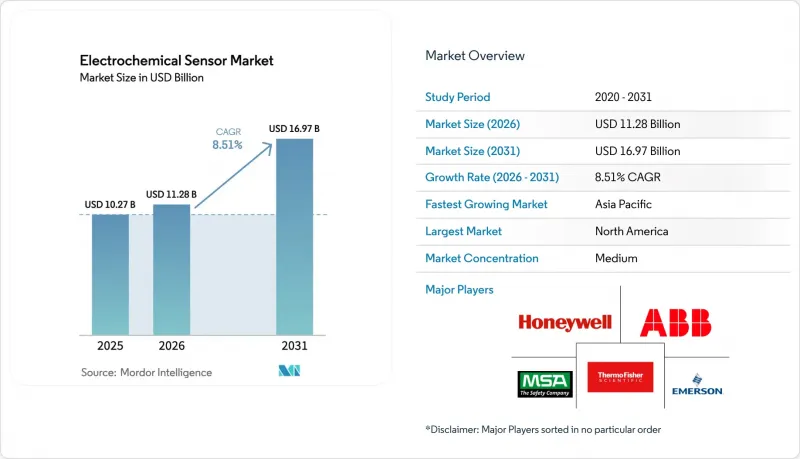
This report is Segmented by Sensor Type (Potentiometric Sensors, Amperometric Sensors, and More), End-User Industry (Healthcare, Automotive, and More), Application (Medical Diagnostics, Environmental Monitoring, and More), Technology (Solid-State Sensors, Liquid-State Sensors, MEMS-Based Sensors, Thick-Film / Thin-Film Sensors), and Geography. The Market Forecasts are Provided in Terms of Value (USD).
Global Electrochemical Sensor Market Trends and Insights
Rising Demand for Portable and Wearable Detection Devices
Clinical approval for on-body continuous glucose monitors that do not require finger-stick calibration is expanding the market for electrochemical sensors. The United States Food and Drug Administration cleared Abbott FreeStyle Libre 3 in December 2024 and approved Dexcom Stelo for over-the-counter sales in June 2025, opening access for more than 30 million U.S. adults with Type 2 diabetes who do not use insulin. Printed electrodes on polyethylene terephthalate, combined with Bluetooth Low Energy modules, keep the bill of materials below USD 50, a threshold that unlocks cash-pay consumer segments. Research groups have already demonstrated amperometric lactate and cortisol patches smaller than 5 square millimeters that operate on 10 microwatts, enabling multi-day monitoring on a coin cell. Sports and wellness brands are using the same platform to measure sweat alcohol and hydration markers, turning biochemical feedback into app-based coaching subscriptions.
Expansion of Stringent Workplace-Safety Regulations Across Developing Economies
India's 2024 amendments to the Factories Act make continuous hydrogen sulfide and carbon monoxide surveillance mandatory in chemical plants employing more than 50 workers, while China's Ministry of Emergency Management added wastewater treatment sites and subway tunnels to its gas-monitoring list in the same year. Demand centers on amperometric cells that deliver sub-1 ppm sensitivity and operate from -40°C to 50°C without requiring active heating. ATEX Zone 1 enclosures incur an additional cost of USD 200-500 per detector, but are non-negotiable for petrochemical operators. Vendors with pre-certified platforms are shipping upgrade kits that slot into legacy catalytic-bead housings, reducing retrofit downtime to a single shift and accelerating adoption across more than 200,000 aging units in India alone.
Short Operational Life in High-Temperature and High-Humidity Environments
Electrolyte evaporation and membrane degradation can reduce service life from 24 months to as little as nine in refineries where daytime temperatures exceed 45 °C and humidity exceeds 90%. Operators in Saudi petrochemical complexes report replacement rates triple those in temperate zones. Ionic-liquid electrolytes and hermetic housings extend life but add USD 10-20 per detector and slow response times by up to 30%. Some end-users are switching to metal-oxide or optical sensors for furnace zones, thereby constraining the electrochemical sensor market in precisely the environments where its selectivity would otherwise be most beneficial.
Other drivers and restraints analyzed in the detailed report include:
- Integration of Electrochemical Sensors into Industry 4.0 and Smart Manufacturing Platforms
- Rapid Growth of Continuous Glucose Monitoring and Other Point-of-Care Diagnostics
- Lengthy Certification Cycles for Hazardous-Area Applications
For complete list of drivers and restraints, kindly check the Table Of Contents.
Segment Analysis
Amperometric models generated 42.38% of 2025 revenue, anchored by glucose monitoring and hydrogen sulfide safety applications, where they combine sub-1 ppm detection with simple two-point calibration. Conductometric sensors, although smaller in absolute terms, are expanding at a 9.43% CAGR because water utilities rely on them for real-time dissolved solids tracking in desalination plants and municipal distribution loops. Potentiometric systems remain the go-to choice for pH and ion-selective bioprocess control, while voltammetric devices serve as a niche tool for heavy-metal analysis. The miniaturization of amperometric cells onto MEMS hotplates underpins the integration of four-electrode arrays inside smartwatches and insulin pumps, a frontier that could add USD 2 billion to the electrochemical sensor market by 2031.
Second-generation amperometric dies already measure 0.3 cubic centimeters and leverage platinum nanofibers that boost signal-to-noise by 25%. Conductometric makers are countering with drift-resistant polymer films that allow six-month deployments without field recalibration, a requirement for distributed water-quality nodes in rural India. Potentiometric vendors are enhancing ion-exchange membranes to withstand industrial cleaners, thereby broadening pH applications from food fermentation to semiconductor rinse baths. Voltammetric entrants are bundling heavy-metal and pesticide assays into cloud-linked kits aimed at agricultural extension officers. Together, these innovations keep the electrochemical sensor market on a steady trajectory of diversification.
Healthcare represented 29.71% of 2025 demand, powered by double-digit growth in continuous glucose monitoring. Hospital procurement teams favor amperometric cartridges that clip into multi-analyte blood-gas analyzers, enabling sepsis triage to be sped up from hours to minutes. Oil and gas operators account for a similar share, but growth is flatter as mature installations move into replacement mode. The environmental monitoring community is growing more briskly, with a 9.74% CAGR, because cities in China and Europe must hit sub-1 kilometer resolution under the latest Ambient Air Quality Directive. Food and beverage processors continue to adopt dissolved oxygen and pH probes that integrate into Hazard Analysis and Critical Control Points (HACCP) dashboards.
Field interviews reveal that pharmaceutical cleanrooms spend twice as much per sensor as other verticals, due to the requirement for traceable calibration certificates. Mining companies in Australia and South Africa are upgrading portable detectors with Bluetooth connectivity, allowing readings to auto-populate safety logs. Automotive tier-ones in Japan and South Korea now design MEMS amperometric nitrogen oxide modules into exhaust after-treatment systems for Euro 7 compliance. Each of these verticals adds incremental volume, keeping the electrochemical sensor market diversified against shocks from a single industry.
Complete Report Scope:
- By Sensor Type
- Potentiometric Sensors
- Amperometric Sensors
- Conductometric Sensors
- Voltammetric Sensors
- By End-User Industry
- Healthcare
- Oil and Gas
- Chemical and Petrochemicals
- Automotive
- Food and Beverage
- Environmental Monitoring and Other End-User Industries
- By Application
- Medical Diagnostics
- Industrial Safety and Gas Detection
- Environmental Monitoring
- Food Quality Control
- Automotive Emissions Monitoring
- Wearable and Consumer Wellness Devices
- By Technology
- Solid-State Sensors
- Liquid-State Sensors
- MEMS-Based Sensors
- Thick-Film / Thin-Film Sensors
- By Geography
- North America
- United States
- Canada
- Mexico
- Europe
- Germany
- United Kingdom
- France
- Russia
- Rest of Europe
- Asia-Pacific
- China
- Japan
- India
- South Korea
- Australia
- Rest of Asia-Pacific
- Middle East and Africa
- Middle East
- Saudi Arabia
- United Arab Emirates
- Rest of Middle East
- Africa
- South Africa
- Egypt
- Rest of Africa
- Middle East
- South America
- Brazil
- Argentina
- Rest of South America
- North America
Geography Analysis
North America generated 36.16% of 2025 revenue, anchored by 8 million insulin-dependent patients who already use continuous glucose monitors and a larger Type 2 cohort now eligible for over-the-counter devices. Occupational Safety and Health Administration codes require sub-1 ppm hydrogen sulfide alarms in wastewater plants, driving the replacement of legacy catalytic-bead units with amperometric cells. Canada funds air-quality grids that deploy thousands of printed nitrogen dioxide nodes across Toronto and Vancouver, while Mexico's automakers fit MEMS nitrogen oxide probes to comply with United States Environmental Protection Agency Tier 3 rules.
The Asia-Pacific is the fastest-growing region, with a growth rate of 9.57% through 2031. China's Ministry of Ecology and Environment mandates round-the-clock urban air quality checks in more than 300 cities, ordering domestic vendors to build sensors at a price point of less than USD 50. India's chemical hubs must install fixed hydrogen sulfide and ammonia detectors under the revised 2024 Factory Act. Japan's chip foundries co-integrate analog front-ends and electrochemical dies for export-oriented cabin-air modules, while South Korean tier-ones lead in exhaust gas arrays for Euro 7.
Europe maintains a sizeable installed base because the revised Ambient Air Quality Directive forces municipalities to cover every square kilometer with sensors. Germany pioneers Euro 7 exhaust implementations that rely on MEMS nitrogen oxide sensors, and the United Kingdom's National Health Service reimburses continuous glucose monitoring for Type 2 diabetics, thereby fueling patient uptake. France deploys printed flexible sensors in dense Parisian grids, and Spain upgrades winery fermenters with dissolved-oxygen probes. Eastern European refineries are investing in ATEX Zone 1 electrochemical detectors as they modernize their aging Soviet-era infrastructure.
The Middle East and Africa growth centers on Saudi petrochemical complexes and South African mines that require intrinsically safe detectors. Harsh climate shortens sensor life, so operators pay premiums for ionic-liquid models rated to 55 °C. South America sees momentum in Brazil's PROCONVE L7 adoption, which involves nitrogen oxide probes on diesel pickups, and in Argentina's use of soil nitrate sensors to optimize fertilizer use, thereby curbing runoff into the Parana River basin.
- Thermo Fisher Scientific Inc.
- MSA Safety Incorporated
- Emerson Electric Co.
- Honeywell International Inc.
- ABB Ltd.
- Siemens AG
- General Electric Company
- Conductive Technologies Inc.
- Delphian Corporation
- SGX Sensortech Ltd.
- Ametek Inc.
- Figaro Engineering Inc.
- Dragerwerk AG & Co. KGaA
- Membrapor AG
- Alphasense Ltd.
- City Technology Ltd.
- Endress+Hauser Group
- Smiths Detection Ltd.
- Winsen Electronics Technology Co. Ltd.
- Nova Biomedical Corp.
Additional Benefits:
- The market estimate (ME) sheet in Excel format
- 3 months of analyst support
TABLE OF CONTENTS
1 INTRODUCTION
- 1.1 Study Assumptions and Market Definition
- 1.2 Scope of the Study
2 RESEARCH METHODOLOGY
3 EXECUTIVE SUMMARY
4 MARKET LANDSCAPE
- 4.1 Market Overview
- 4.2 Market Drivers
- 4.2.1 Rising Demand for Portable and Wearable Detection Devices
- 4.2.2 Expansion of Stringent Workplace-Safety Regulations Across Developing Economies
- 4.2.3 Integration of Electrochemical Sensors into Industry 4.0 and Smart Manufacturing Platforms
- 4.2.4 Rapid Growth of Continuous Glucose Monitoring (CGM) and Other Point-of-Care Diagnostics
- 4.2.5 Adoption of MEMS-Based Solid-State Architectures Reducing Cost and Foot-print
- 4.2.6 Emergence of Printed/Flexible Electrochemical Sensors for Large-Area Environmental Networks
- 4.3 Market Restraints
- 4.3.1 Short Operational Life in High-Temperature and High-Humidity Environments
- 4.3.2 Lengthy Certification Cycles for Hazardous-Area Applications (ATEX/IECEx)
- 4.3.3 Drift and Re-calibration Burden in Long-Term Continuous-Monitoring Installations
- 4.3.4 Fragmented Standardisation for Printed and Wearable Sensor Performance
- 4.4 Industry Value Chain Analysis
- 4.5 Regulatory Landscape
- 4.6 Technological Outlook
- 4.7 Impact of Macroeconomic Factors on the Market
- 4.8 Porter's Five Forces Analysis
- 4.8.1 Bargaining Power of Suppliers
- 4.8.2 Bargaining Power of Buyers
- 4.8.3 Threat of New Entrants
- 4.8.4 Threat of Substitutes
- 4.8.5 Intensity of Competitive Rivalry
5 MARKET SIZE AND GROWTH FORECASTS (VALUE)
- 5.1 By Sensor Type
- 5.1.1 Potentiometric Sensors
- 5.1.2 Amperometric Sensors
- 5.1.3 Conductometric Sensors
- 5.1.4 Voltammetric Sensors
- 5.2 By End-User Industry
- 5.2.1 Healthcare
- 5.2.2 Oil and Gas
- 5.2.3 Chemical and Petrochemicals
- 5.2.4 Automotive
- 5.2.5 Food and Beverage
- 5.2.6 Environmental Monitoring and Other End-User Industries
- 5.3 By Application
- 5.3.1 Medical Diagnostics
- 5.3.2 Industrial Safety and Gas Detection
- 5.3.3 Environmental Monitoring
- 5.3.4 Food Quality Control
- 5.3.5 Automotive Emissions Monitoring
- 5.3.6 Wearable and Consumer Wellness Devices
- 5.4 By Technology
- 5.4.1 Solid-State Sensors
- 5.4.2 Liquid-State Sensors
- 5.4.3 MEMS-Based Sensors
- 5.4.4 Thick-Film / Thin-Film Sensors
- 5.5 By Geography
- 5.5.1 North America
- 5.5.1.1 United States
- 5.5.1.2 Canada
- 5.5.1.3 Mexico
- 5.5.2 Europe
- 5.5.2.1 Germany
- 5.5.2.2 United Kingdom
- 5.5.2.3 France
- 5.5.2.4 Russia
- 5.5.2.5 Rest of Europe
- 5.5.3 Asia-Pacific
- 5.5.3.1 China
- 5.5.3.2 Japan
- 5.5.3.3 India
- 5.5.3.4 South Korea
- 5.5.3.5 Australia
- 5.5.3.6 Rest of Asia-Pacific
- 5.5.4 Middle East and Africa
- 5.5.4.1 Middle East
- 5.5.4.1.1 Saudi Arabia
- 5.5.4.1.2 United Arab Emirates
- 5.5.4.1.3 Rest of Middle East
- 5.5.4.2 Africa
- 5.5.4.2.1 South Africa
- 5.5.4.2.2 Egypt
- 5.5.4.2.3 Rest of Africa
- 5.5.4.1 Middle East
- 5.5.5 South America
- 5.5.5.1 Brazil
- 5.5.5.2 Argentina
- 5.5.5.3 Rest of South America
- 5.5.1 North America
6 COMPETITIVE LANDSCAPE
- 6.1 Market Concentration
- 6.2 Strategic Moves
- 6.3 Market Share Analysis
- 6.4 Company Profiles (includes Global Level Overview, Market Level Overview, Core Segments, Financials as available, Strategic Information, Market Rank/Share, Products and Services, and Recent Developments)
- 6.4.1 Thermo Fisher Scientific Inc.
- 6.4.2 MSA Safety Incorporated
- 6.4.3 Emerson Electric Co.
- 6.4.4 Honeywell International Inc.
- 6.4.5 ABB Ltd.
- 6.4.6 Siemens AG
- 6.4.7 General Electric Company
- 6.4.8 Conductive Technologies Inc.
- 6.4.9 Delphian Corporation
- 6.4.10 SGX Sensortech Ltd.
- 6.4.11 Ametek Inc.
- 6.4.12 Figaro Engineering Inc.
- 6.4.13 Dragerwerk AG & Co. KGaA
- 6.4.14 Membrapor AG
- 6.4.15 Alphasense Ltd.
- 6.4.16 City Technology Ltd.
- 6.4.17 Endress+Hauser Group
- 6.4.18 Smiths Detection Ltd.
- 6.4.19 Winsen Electronics Technology Co. Ltd.
- 6.4.20 Nova Biomedical Corp.
7 MARKET OPPORTUNITIES AND FUTURE OUTLOOK
- 7.1 White-Space and Unmet-Need Assessment

