PUBLISHER: Mordor Intelligence | PRODUCT CODE: 2121931

PUBLISHER: Mordor Intelligence | PRODUCT CODE: 2121931
Emotion Detection And Recognition (EDR) - Market Share Analysis, Industry Trends & Statistics, Growth Forecasts (2026 - 2031)
According to Mordor Intelligence, the emotion detection and Recognition market size in 2026 is estimated at USD 81.51 billion, growing from 2025 value of USD 68.41 billion with 2031 projections showing USD 195.74 billion, growing at 19.15% CAGR over 2026-2031.
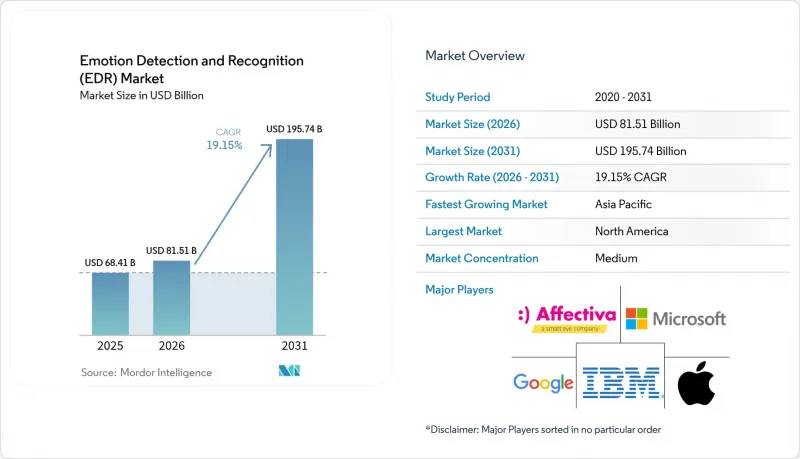
This report is Segmented by Software Tool (Facial Expression and Emotion Recognition, and More), Technology (Machine Learning, and More), Application (Customer Experience Management, and More), End User Vertical (Government Agencies, Healthcare Providers, and More), Deployment Model (Cloud, Edge and On-Premises), and Geography the Market Forecasts are Provided in Terms of Value (USD).
Global Emotion Detection And Recognition (EDR) Market Trends and Insights
Proliferation of IoT-Enabled Wearables
Continuous emotion tracking migrates from cameras toward wrist, ear, and head-worn devices that collect heart-rate variability, galvanic-skin-response, and motion data. Apple's patent filings highlight mainstream interest in multimodal sensing that extends fitness wearables into emotional-wellness functions USPTO. Enterprises see value in fatigue detection for drivers, warehouse staff, and pilots, while insurers explore risk-based pricing tied to physiological stress. Regulatory acceptance is higher because face images are absent and data storage remains local, aligning with privacy statutes.
Surge in Demand for Speech-Based Biometric Security
Financial services and public-sector agencies integrate emotion recognition with voice authentication to flag coercion, stress, or deceit during transactions. Neural-network models surpass 85% accuracy across languages. Contact-center deployments lower fraud losses and shorten call-handling time, delivering quick ROI. Growth accelerates as pandemic-driven hygiene concerns keep demand for touchless authentication elevated.
Data-Privacy Regulation Tightening (GDPR, CCPA)
Explicit-consent mandates, data-localization rules, and algorithm-explainability clauses increase compliance costs for deployers, favoring established companies and slowing consumer-facing rollouts. Vendors respond by adopting federated learning and differential privacy, which can degrade model performance and extend deployment cycles. Product-design revisions toward on-device inference gain urgency to avoid cross-border transfers of biometric data.
Other drivers and restraints analyzed in the detailed report include:
- Rising Need for Personalized Customer Experience Tools
- Automotive OEM Mandates for In-Cabin Driver Emotion Monitoring
- GPU Supply Constraints Inflating Total Cost of Ownership
For complete list of drivers and restraints, kindly check the Table Of Contents.
Segment Analysis
Facial expression recognition held a 37.40% share of the Emotion Detection and Recognition market size in 2025, reflecting the ubiquity of cameras and the maturity of vision models. Enterprise adoption spans retail analytics and marketing research. Yet growth moderates as privacy rules restrict public-space imaging. Gesture and posture recognition is expected to exhibit a forecasted 19.33% CAGR as organizations favor non-identifying signals to infer engagement or fatigue. The Emotion Detection and Recognition market continues to blend computer-vision libraries with skeletal-tracking modules inside edge devices for unobtrusive sensing. Speech and voice analysis captures call-center demand, while bio-sensing tools ride the wearable boom to penetrate healthcare and workplace-wellness ecosystems.
Regulators are increasingly prioritizing physiological monitoring over face-based systems, which is boosting interest in multimodal fusion that combines galvanic skin response, heart rate variability, and respiratory data. Bio-sensing tools, though small today, enjoy higher accuracy in low-light or obstructed-face conditions and address fairness concerns. Vendors embed such analytics into smart headphones, watches, and vehicle seats. Cross-tool interoperability frameworks are emerging to enable enterprises to switch modalities without rewriting business logic, thereby reinforcing platform strategies across the Emotion Detection and Recognition market.
Machine learning technology accounted for 42.10% of the Emotion Detection and Recognition market share in 2025, driven by the maturity of its algorithms and the reusability of datasets across modalities. Transfer learning cuts time to deploy, while auto-ML tools democratize model building. Natural-language processing remains vital for text-centric sentiment analyses; computer vision persists for facial cues but faces regulatory drag. The Emotion Detection and Recognition market size associated with computer vision stacks grows more slowly as data protection agencies scrutinize facial analysis.
Bio-sensor technology is projected to post a 19.03% CAGR through 2031. Health systems adopt continuous monitoring to flag depressive episodes or post-surgical stress, aligning with tele-mental-health reimbursement policies, JMIR. Wearable device penetration supplies large labeled datasets that refine emotion-biomarker correlations, breaking the cold-start barrier. Regulatory leniency for physiological signals versus imagery supports this rise. Advanced sensor fusion enhances classifier confidence in noisy environments, thereby expanding its applicability to environments such as noisy factory floors and on-road settings. Edge-native chips capture data at the source, trimming cloud costs and appealing to privacy-first enterprises within the broader Emotion Detection and Recognition market.
Complete Report Scope:
- By Software Tool
- Facial Expression and Emotion Recognition
- Gesture and Posture Recognition
- Speech and Voice Recognition
- Bio-Sensing Software Tools
- By Technology
- Machine Learning
- Natural Language Processing
- Computer Vision and 3-D Modeling
- Bio-Sensors Technology
- By Application
- Customer Experience Management
- Law Enforcement Surveillance and Monitoring
- Healthcare and Medical Diagnostics
- Automotive Driver Monitoring
- Marketing and Advertising Analytics
- By End User Vertical
- Government Agencies
- Healthcare Providers
- Retail and E-Commerce
- Media and Entertainment
- Transportation and Logistics
- By Deployment Model
- Cloud
- Edge and On-Premises
- By Geography
- North America
- United States
- Canada
- South America
- Brazil
- Argentina
- Rest of South America
- Europe
- Germany
- France
- United Kingdom
- Italy
- Spain
- Russia
- Rest of Europe
- Asia Pacific
- China
- Japan
- India
- South Korea
- Rest of Asia Pacific
- Middle East
- Saudi Arabia
- United Arab Emirates
- Turkey
- Rest of Middle East
- Africa
- South Africa
- Nigeria
- Rest of Africa
- North America
Geography Analysis
Asia Pacific maintains a 33.70% share of the Emotion Detection and Recognition market, led by China's large-scale surveillance infrastructure and Japan's innovation in automotive HMIs. Government grants subsidize AI startup pilots in healthcare and smart city programs, while a comparatively permissive regulatory climate accelerates commercial deployments. South Korea leverages consumer electronics supply chains to embed emotion AI in smartphones and home appliances, while India's IT services giants build export-oriented emotion analytics modules for U.S. clients.
North America ranks second in AI spending for emotional applications. U.S. retailers, banks, and tech platforms can quickly run pilot-to-production cycles, thanks to deep venture funding and mature cloud offerings. Healthcare growth accelerates under reimbursement codes for remote behavioral assessment. Canadian research groups partner with wearable firms to validate emotion biomarkers, reinforcing the region's reputation for ethical AI frameworks even as CCPA-like state laws proliferate.
Europe experiences mixed momentum. GDPR compliance hurdles and looming AI-Act restrictions deter some public-space deployments. Yet, the continent leads in automotive driver monitoring due to safety regulations, and German Tier-1 suppliers funnel R&D into cabin-embedded sensors. Financial hubs in the United Kingdom are adopting voice-emotion analytics to flag potential fraud, capitalizing on the use of regulatory sandboxes. Privacy-preserving techniques, such as federated learning, flourish as vendors adapt to strict rules, influencing product designs exported worldwide. Collectively, these dynamics sustain a wide geographic dispersion of revenue within the Emotion Detection and Recognition market.
- Affectiva Inc. (Smart Eye)
- IBM Corporation
- Microsoft Corporation
- Google LLC (Alphabet)
- Apple Inc.
- Amazon Web Services Inc.
- Realeyes OU
- NVISO SA
- Tobii AB
- Eyeris Technologies Inc.
- Entropik Technologies Pvt Ltd
- Uniphore Technologies Inc.
- Kairos Inc.
- Noldus Information Technology BV
- Sightcorp BV
- Beyond Verbal Communication Ltd
- Sentiance NV
- Cogito Corporation
- Hume AI Inc.
- Adoreboard Ltd
Additional Benefits:
- The market estimate (ME) sheet in Excel format
- 3 months of analyst support
TABLE OF CONTENTS
1 INTRODUCTION
- 1.1 Study Assumptions and Market Definition
- 1.2 Scope of the Study
2 RESEARCH METHODOLOGY
3 EXECUTIVE SUMMARY
4 MARKET LANDCSAPE
- 4.1 Market Overview
- 4.2 Market Drivers
- 4.2.1 Proliferation of IoT-enabled wearables
- 4.2.2 Surge in demand for speech-based biometric security
- 4.2.3 Rising need for personalized customer experience tools
- 4.2.4 Automotive OEM mandates for in-cabin driver emotion monitoring
- 4.2.5 Integration of emotion AI into tele-mental-health triage platforms
- 4.2.6 Edge-based multimodal analytics to avoid cloud-privacy penalties
- 4.3 Market Restraints
- 4.3.1 Data-privacy regulation tightening (GDPR, CCPA)
- 4.3.2 Accuracy bias across ethnic groups
- 4.3.3 GPU supply constraints inflating total cost of ownership
- 4.3.4 Pending EU ban on real-time public facial emotion surveillance
- 4.4 Industry Value / Supply-Chain Analysis
- 4.5 Regulatory Landscape
- 4.6 Technological Outlook
- 4.7 Impact of Macroeconomic Factors
- 4.8 Porter's Five Forces Analysis
- 4.8.1 Threat of New Entrants
- 4.8.2 Bargaining Power of Suppliers
- 4.8.3 Bargaining Power of Buyers/Consumers
- 4.8.4 Threat of Substitutes
- 4.8.5 Intensity of Competitive Rivalry
5 MARKET SIZE AND GROWTH FORECASTS (VALUE)
- 5.1 By Software Tool
- 5.1.1 Facial Expression and Emotion Recognition
- 5.1.2 Gesture and Posture Recognition
- 5.1.3 Speech and Voice Recognition
- 5.1.4 Bio-Sensing Software Tools
- 5.2 By Technology
- 5.2.1 Machine Learning
- 5.2.2 Natural Language Processing
- 5.2.3 Computer Vision and 3-D Modeling
- 5.2.4 Bio-Sensors Technology
- 5.3 By Application
- 5.3.1 Customer Experience Management
- 5.3.2 Law Enforcement Surveillance and Monitoring
- 5.3.3 Healthcare and Medical Diagnostics
- 5.3.4 Automotive Driver Monitoring
- 5.3.5 Marketing and Advertising Analytics
- 5.4 By End User Vertical
- 5.4.1 Government Agencies
- 5.4.2 Healthcare Providers
- 5.4.3 Retail and E-Commerce
- 5.4.4 Media and Entertainment
- 5.4.5 Transportation and Logistics
- 5.5 By Deployment Model
- 5.5.1 Cloud
- 5.5.2 Edge and On-Premises
- 5.6 By Geography
- 5.6.1 North America
- 5.6.1.1 United States
- 5.6.1.2 Canada
- 5.6.2 South America
- 5.6.2.1 Brazil
- 5.6.2.2 Argentina
- 5.6.2.3 Rest of South America
- 5.6.3 Europe
- 5.6.3.1 Germany
- 5.6.3.2 France
- 5.6.3.3 United Kingdom
- 5.6.3.4 Italy
- 5.6.3.5 Spain
- 5.6.3.6 Russia
- 5.6.3.7 Rest of Europe
- 5.6.4 Asia Pacific
- 5.6.4.1 China
- 5.6.4.2 Japan
- 5.6.4.3 India
- 5.6.4.4 South Korea
- 5.6.4.5 Rest of Asia Pacific
- 5.6.5 Middle East
- 5.6.5.1 Saudi Arabia
- 5.6.5.2 United Arab Emirates
- 5.6.5.3 Turkey
- 5.6.5.4 Rest of Middle East
- 5.6.6 Africa
- 5.6.6.1 South Africa
- 5.6.6.2 Nigeria
- 5.6.6.3 Rest of Africa
- 5.6.1 North America
6 COMPETITIVE LANDSCAPE
- 6.1 Market Concentration
- 6.2 Strategic Moves
- 6.3 Market Share Analysis
- 6.4 Company Profiles (includes Global Level Overview, Market Level Overview, Core Segments, Financials as available, Strategic Information, Market Rank/Share for key companies, Products and Services, and Recent Developments)
- 6.4.1 Affectiva Inc. (Smart Eye)
- 6.4.2 IBM Corporation
- 6.4.3 Microsoft Corporation
- 6.4.4 Google LLC (Alphabet)
- 6.4.5 Apple Inc.
- 6.4.6 Amazon Web Services Inc.
- 6.4.7 Realeyes OU
- 6.4.8 NVISO SA
- 6.4.9 Tobii AB
- 6.4.10 Eyeris Technologies Inc.
- 6.4.11 Entropik Technologies Pvt Ltd
- 6.4.12 Uniphore Technologies Inc.
- 6.4.13 Kairos Inc.
- 6.4.14 Noldus Information Technology BV
- 6.4.15 Sightcorp BV
- 6.4.16 Beyond Verbal Communication Ltd
- 6.4.17 Sentiance NV
- 6.4.18 Cogito Corporation
- 6.4.19 Hume AI Inc.
- 6.4.20 Adoreboard Ltd
7 MARKET OPPORTUNITIES AND FUTURE OUTLOOK
- 7.1 White-Space and Unmet-Need Assessment

