PUBLISHER: Mordor Intelligence | PRODUCT CODE: 2121934

PUBLISHER: Mordor Intelligence | PRODUCT CODE: 2121934
Asia Pacific Automated Material Handling And Storage Systems - Market Share Analysis, Industry Trends & Statistics, Growth Forecasts (2026 - 2031)
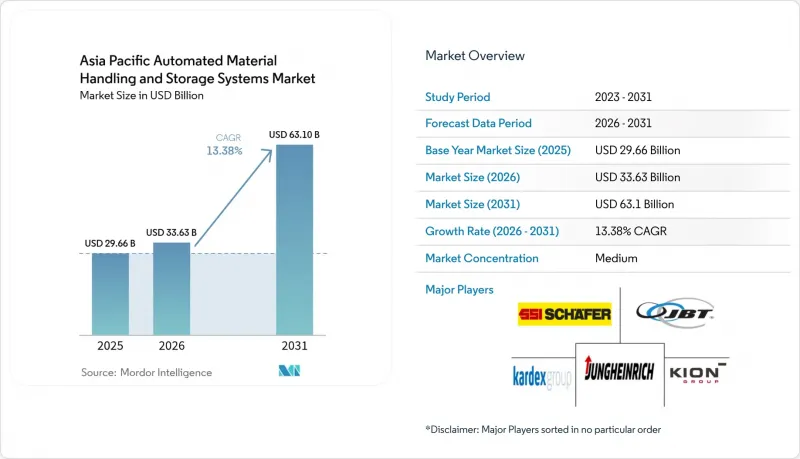
According to Mordor Intelligence, the Asia Pacific automated material handling and storage systems market size in 2026 is estimated at USD 33.63 billion, growing from 2025 value of USD 29.66 billion with 2031 projections showing USD 63.1 billion, growing at 13.38% CAGR over 2026-2031.
This report is Segmented by Product Type (Hardware, Software, and Services), Equipment Type (Mobile Robots, ASRS, Automated Conveyor, Palletizer, and Sortation System), End-User Industry (Airport, Automotive, and More), Function (Storage, Transportation, and More), and Geography. The Market Forecasts are Provided in Terms of Value (USD).
Asia Pacific Automated Material Handling And Storage Systems Market Trends and Insights
Booming E-commerce Fulfilment Centers Across Tier-2 Asian Cities
The construction boom of automation-ready warehouses in cities such as Chengdu, Pune, and Surabaya sharply elevates demand for standardized yet scalable systems. Operators must harmonize global best practices with local infrastructure constraints, prompting integrators to design modular platforms that support phased rollouts and localized spare-parts ecosystems. Retailers targeting one-day delivery windows view automated picking, sorting, and storage as non-negotiable capabilities, spurring multi-year procurement pipelines that underpin the Asia Pacific automated material handling and storage systems market.
Accelerated Adoption of 5G-Enabled Industrial IoT Networks
Private 5G networks shrink latency to sub-10 milliseconds, enabling real-time fleet orchestration, synchronized AMR swarms, and cloud-based digital twins. Early adopters in Seoul and Yokohama report double-digit productivity gains and 30% reductions in unplanned downtime as predictive maintenance algorithms mature. The connectivity layer also underwrites new service models such as remote performance monitoring and outcome-based service contracts, strengthening the recurring-revenue profile of the Asia Pacific automated material handling and storage systems market.
High Initial Capex and Long ROI Cycles for SMEs
Small and midsize exporters in Jakarta and Manila often confront upfront project costs equalling 1-2 years of free cash flow. Even with vendor financing, a three-to-five-year payback stretches risk tolerance, delaying purchase decisions and marginally tempering the Asia Pacific automated material handling and storage systems market growth trajectory.
Other drivers and restraints analyzed in the detailed report include:
- Government Incentives for Smart-Factory Automation
- Cost Pressure from Rising Intra-Asia Wages Pushing Warehouse Automation
- Cyber-security Vulnerabilities in Connected Automation Fleets
For complete list of drivers and restraints, kindly check the Table Of Contents.
Segment Analysis
The software sub-segment is on track to log a 14.12% CAGR to 2031, reflecting the shift from basic control logic to analytics-enabled orchestration. Advanced warehouse management and digital-twin suites allow predictive slotting and dynamic order batching, bolstering throughput by up to 20% in several Shanghai consumer-electronics facilities. While hardware sustains the bulk of 2024 spending, software-centric value propositions increasingly sway capital-allocation committees, expanding the Asia Pacific automated material handling and storage systems market size among data-mature operators.
Heightened demand for cloud-native applications fuels vendor competition centered on open APIs and edge-to-cloud cybersecurity layers. Providers that bundle software subscriptions with lifecycle services realize higher margins and stickier customer relationships, solidifying long-term revenue streams within the Asia Pacific automated material handling and storage systems market.
AMRs outperform legacy AGVs by navigating dynamic racks and tight aisles without infrastructure-embedded guidance, cutting deployment time by half and accommodating frequent SKU re-profiling. As a result, AMR shipments advance at a 14.78% CAGR, reallocating capital flows away from fixed conveyor expansions toward robot fleets managed by AI-based traffic software.
Automated storage and retrieval systems remain essential in high-throughput omnichannel nodes, though buyers increasingly couple them with AMR-led picking zones. Palletizing robots gain traction among beverage bottlers seeking ergonomic risk mitigation, reinforcing the diversity of demand across the Asia Pacific automated material handling and storage systems market.
Complete Report Scope:
- By Product Type
- Hardware
- Software
- Services
- By Equipment Type
- Mobile Robots
- Automated Guided Vehicle (AGV)
- Automated Forklift
- Automated Tow / Tractor / Tug
- Unit Load
- Assembly Line
- Special Purpose
- Autonomous Mobile Robots (AMR)
- Automated Guided Vehicle (AGV)
- Automated Storage and Retrieval System (ASRS)
- Fixed Aisle
- Carousel
- Vertical Lift Module
- Automated Conveyor
- Belt
- Roller
- Pallet
- Overhead
- Palletizer
- Conventional
- Robotic
- Sortation System
- Mobile Robots
- By End-user Industry
- Airport
- Automotive
- Food and Beverage
- Retail / Warehousing / Distribution Centres / Logistic Centres
- General Manufacturing
- Pharmaceuticals
- Post and Parcel
- Electronics and Semiconductor Manufacturing
- Other End-user Industries
- By Function
- Storage
- Transportation
- Sorting
- Packaging / Palletising
- Assembly / Kitting
- By Country
- China
- Japan
- India
- South Korea
- Australia
- Indonesia
- Thailand
- Singapore
- Malaysia
- Taiwan
- Rest of Asia Pacific
List of Companies Covered in this Report:
- Daifuku Co., Ltd.
- Kardex Holding AG
- KION Group AG
- Dematic Corp. (KION subsidiary)
- Jungheinrich AG
- SSI Schaefer AG
- Toyota Industries Corporation
- Murata Machinery, Ltd.
- Honeywell Intelligrated Inc.
- BEUMER Group GmbH and Co. KG
- Interroll Holding AG
- Witron Logistik and Informatik GmbH
- JBT Corporation
- VisionNav Robotics (Shenzhen) Co., Ltd.
- Geekplus Technology Co., Ltd.
- Grey Orange Pte. Ltd.
- AutoStore Holdings Ltd.
- System Logistics S.p.A.
- Swisslog Holding AG
- Quicktron Intelligent Technology Co., Ltd.
Additional Benefits:
- The market estimate (ME) sheet in Excel format
- 3 months of analyst support
TABLE OF CONTENTS
1 INTRODUCTION
- 1.1 Study Assumptions and Market Definition
- 1.2 Scope of the Study
2 RESEARCH METHODOLOGY
3 EXECUTIVE SUMMARY
4 MARKET LANDSCAPE
- 4.1 Market Overview
- 4.2 Industry Value-Chain Analysis
- 4.3 Impact of Macroeconomic Factors
- 4.4 Market Drivers
- 4.4.1 Booming e-commerce fulfilment centres across Tier-2 Asian cities
- 4.4.2 Accelerated adoption of 5G-enabled industrial IoT networks
- 4.4.3 Government incentives for smart-factory automation (e.g., China MIIT, India PLI)
- 4.4.4 Cost pressure from rising intra-Asia wages pushing warehouse automation
- 4.4.5 Surge in dark-store micro-fulfilment models
- 4.4.6 ESG-driven demand for energy-efficient material handling systems
- 4.5 Market Restraints
- 4.5.1 High initial capex and long ROI cycles for SMEs
- 4.5.2 Fragmented intra-Asian safety regulations complicating standardisation
- 4.5.3 Cyber-security vulnerabilities in connected automation fleets
- 4.5.4 Limited grid power quality in developing economies hampering uptime
- 4.6 Regulatory Landscape
- 4.7 Technological Outlook
- 4.8 Porter's Five Forces Analysis
- 4.8.1 Bargaining Power of Suppliers
- 4.8.2 Bargaining Power of Consumers
- 4.8.3 Threat of New Entrants
- 4.8.4 Intensity of Competitive Rivalry
- 4.8.5 Threat of Substitute Products
5 MARKET SIZE AND GROWTH FORECASTS (VALUE)
- 5.1 By Product Type
- 5.1.1 Hardware
- 5.1.2 Software
- 5.1.3 Services
- 5.2 By Equipment Type
- 5.2.1 Mobile Robots
- 5.2.1.1 Automated Guided Vehicle (AGV)
- 5.2.1.1.1 Automated Forklift
- 5.2.1.1.2 Automated Tow / Tractor / Tug
- 5.2.1.1.3 Unit Load
- 5.2.1.1.4 Assembly Line
- 5.2.1.1.5 Special Purpose
- 5.2.1.2 Autonomous Mobile Robots (AMR)
- 5.2.1.1 Automated Guided Vehicle (AGV)
- 5.2.2 Automated Storage and Retrieval System (ASRS)
- 5.2.2.1 Fixed Aisle
- 5.2.2.2 Carousel
- 5.2.2.3 Vertical Lift Module
- 5.2.3 Automated Conveyor
- 5.2.3.1 Belt
- 5.2.3.2 Roller
- 5.2.3.3 Pallet
- 5.2.3.4 Overhead
- 5.2.4 Palletizer
- 5.2.4.1 Conventional
- 5.2.4.2 Robotic
- 5.2.5 Sortation System
- 5.2.1 Mobile Robots
- 5.3 By End-user Industry
- 5.3.1 Airport
- 5.3.2 Automotive
- 5.3.3 Food and Beverage
- 5.3.4 Retail / Warehousing / Distribution Centres / Logistic Centres
- 5.3.5 General Manufacturing
- 5.3.6 Pharmaceuticals
- 5.3.7 Post and Parcel
- 5.3.8 Electronics and Semiconductor Manufacturing
- 5.3.9 Other End-user Industries
- 5.4 By Function
- 5.4.1 Storage
- 5.4.2 Transportation
- 5.4.3 Sorting
- 5.4.4 Packaging / Palletising
- 5.4.5 Assembly / Kitting
- 5.5 By Country
- 5.5.1 China
- 5.5.2 Japan
- 5.5.3 India
- 5.5.4 South Korea
- 5.5.5 Australia
- 5.5.6 Indonesia
- 5.5.7 Thailand
- 5.5.8 Singapore
- 5.5.9 Malaysia
- 5.5.10 Taiwan
- 5.5.11 Rest of Asia Pacific
6 COMPETITIVE LANDSCAPE
- 6.1 Market Concentration
- 6.2 Strategic Moves
- 6.3 Market Share Analysis
- 6.4 Company Profiles (includes Global level Overview, Market level overview, Core Segments, Financials as available, Strategic Information, Market Rank / Share for key companies, Products and Services, and Recent Developments)
- 6.4.1 Daifuku Co., Ltd.
- 6.4.2 Kardex Holding AG
- 6.4.3 KION Group AG
- 6.4.4 Dematic Corp. (KION subsidiary)
- 6.4.5 Jungheinrich AG
- 6.4.6 SSI Schaefer AG
- 6.4.7 Toyota Industries Corporation
- 6.4.8 Murata Machinery, Ltd.
- 6.4.9 Honeywell Intelligrated Inc.
- 6.4.10 BEUMER Group GmbH and Co. KG
- 6.4.11 Interroll Holding AG
- 6.4.12 Witron Logistik and Informatik GmbH
- 6.4.13 JBT Corporation
- 6.4.14 VisionNav Robotics (Shenzhen) Co., Ltd.
- 6.4.15 Geekplus Technology Co., Ltd.
- 6.4.16 Grey Orange Pte. Ltd.
- 6.4.17 AutoStore Holdings Ltd.
- 6.4.18 System Logistics S.p.A.
- 6.4.19 Swisslog Holding AG
- 6.4.20 Quicktron Intelligent Technology Co., Ltd.
7 MARKET OPPORTUNITIES AND FUTURE OUTLOOK
- 7.1 White-space and Unmet-need Assessment

