PUBLISHER: Mordor Intelligence | PRODUCT CODE: 2121952

PUBLISHER: Mordor Intelligence | PRODUCT CODE: 2121952
Network Attached Storage (NAS) - Market Share Analysis, Industry Trends & Statistics, Growth Forecasts (2026 - 2031)
According to Mordor Intelligence, the network attached storage market size was valued at USD 39.62 billion in 2025 and is estimated to grow from USD 46.32 billion in 2026 to reach USD 101.24 billion by 2031, at a CAGR of 16.93% during the forecast period (2026-2031).
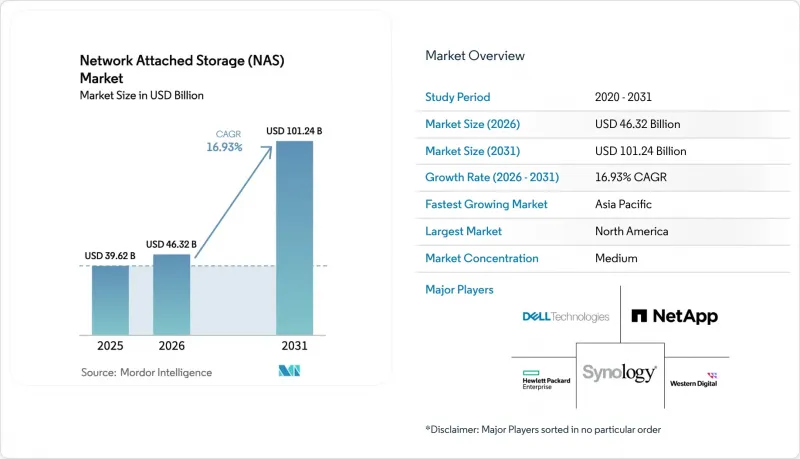
This report is Segmented by Type (Scale-Up, and Scale-Out), End-User Industry (BFSI, IT and Telecom, Healthcare, Retail and E-Commerce, Media and Entertainment, Government and Public Sector, and More), Deployment (On-Premise, Cloud, and Hybrid), Product Tier (High-End/Enterprise, Mid-Market, and Low-End/SOHO), and Geography. The Market Forecasts are Provided in Terms of Value (USD).
Global Network Attached Storage (NAS) Market Trends and Insights
Explosion of Unstructured Data
Up to 80% of enterprise information now arrives in unstructured form, and annual growth rates near 50% drive urgent capacity expansion on file-based platforms. Video surveillance, IoT telemetry, and collaborative content overwhelm legacy scale-up controllers, pushing buyers toward scalable clusters that add nodes without disrupting service. A parallel shift replaces backup-centric thinking with analytics-centric strategies, as data-lake projects rely on NAS to query files directly instead of staging them in data warehouses. Regulatory file-retention rules, such as SEC 17a-4 for broker-dealers, prolong on-premise storage lifecycles because cloud egress costs and jurisdictional risks complicate retention in object stores. Retailers likewise consolidate point-of-sale logs and omnichannel transcripts onto deduplicated NAS volumes that compress petabyte estates into affordable footprints.
Remote and Hybrid-Work Data Surge
Permanent hybrid work doubled home-directory creation rates, magnifying branch-office storage traffic and fueling demand for edge-NAS appliances that cache files close to users. VPN-integrated NAS devices synchronize with core data centers overnight, cutting WAN bandwidth needs by more than 40%. Telehealth rollouts during 2025 generated persistent uploads of consultation recordings that hospitals store on HIPAA-compliant appliances, maintaining role-based access and immutable logs. Universities moved lecture videos onto local arrays after discovering that streaming archives from cloud regions incurred USD 0.09 per gigabyte in egress fees, a cost unsustainable at multi-terabyte scales.
Cloud-Storage Substitution
Hyperscaler object stores undercut NAS for cold archives, prompting some teams to offload backup volumes to pay-as-you-go buckets. However, egress charges near USD 90,000 per petabyte discourage retrieval, locking data in cloud silos and complicating analytics that require local proximity. Media studios confronted this when editing 4K masters, and many responded by adopting hybrid appliances that pin hot content on-site while tiering aged assets to Glacier or Archive classes.
Other drivers and restraints analyzed in the detailed report include:
- Data-Center Virtualization And Software-Defined NAS
- AI/ML Training Workloads Need Parallel File Access
- Performance Bottlenecks at Petabyte Scale
For complete list of drivers and restraints, kindly check the Table Of Contents.
Segment Analysis
Scale-out platforms captured 53.81% of 2025 revenue in the network attached storage market and will grow at a 17.33% CAGR through 2031. Their node-level elasticity lets operators align capacity and throughput with unpredictable AI training surges, enabling 200 GB/s aggregate bandwidth for GPU clusters. In turn, scale-out clusters often replace Hadoop Distributed File System deployments because standard NFS and SMB simplify application integration. Scale-up systems maintain a foothold among midsize firms that prize management simplicity over petabyte ambitions, but controller ceilings appear once file counts push beyond 100 million sessions.
Scale-up appliances remain attractive at price points below USD 10,000, dominated by Synology and QNAP units that address small departments. Yet their dual-controller architectures face CPU and RAM bottlenecks as clients proliferate, limiting viability in hyperscale AI environments. Consequently, the network attached storage market size for scale-up platforms is likely to expand more slowly than the overall 16.93% pace.
Healthcare leads growth at an 18.47% CAGR, driven by daily ingestion of terabytes of DICOM scans and genomic sequences. Electronic-health-record vendors integrate directly with NAS arrays, reinforcing demand for on-premise file stores that satisfy HIPAA and GDPR. IT and telecom firms, which held 28.61% network attached storage market share in 2025, spearheaded early virtualization and remain the largest spender, but maturation tempers their expansion rate.
BFSI players rely on tamper-proof NAS archives for regulatory communication logs, while retail and e-commerce operators use deduplication to store omnichannel transcripts efficiently. Media studios sustain heavy parallel-workflow demands, pushing all-flash NAS adoption, whereas government, education, and manufacturing accelerate modestly on sovereign-data and predictive-maintenance drivers. The network attached storage market size attributable to healthcare workloads is projected to eclipse USD 20 billion by 2031.
Complete Report Scope:
- By Type
- Scale-Up
- Scale-Out
- By End-User Industry
- BFSI
- IT and Telecom
- Healthcare
- Retail and E-Commerce
- Media and Entertainment
- Government and Public Sector
- Education and Manufacturing
- Other End-User Industries
- By Deployment
- On-Premise
- Cloud
- Hybrid
- By Product Tier
- High-End / Enterprise
- Mid-Market
- Low-End / SOHO
- By Geography
- North America
- United States
- Canada
- Mexico
- South America
- Brazil
- Argentina
- Rest of South America
- Europe
- United Kingdom
- Germany
- France
- Italy
- Spain
- Rest of Europe
- Asia-Pacific
- China
- Japan
- India
- South Korea
- Rest of Asia-Pacific
- Middle East and Africa
- Middle East
- Israel
- Saudi Arabia
- United Arab Emirates
- Turkey
- Rest of Middle East
- Africa
- South Africa
- Egypt
- Rest of Africa
- Middle East
- North America
Geography Analysis
North America accounted for 39.66% of network attached storage market revenue in 2025, supported by USD 120 billion-plus hyperscaler data-center spending and regulations that mandate tamper-proof on-premise storage. U.S. federal agencies deploy FedRAMP-authorized, air-gapped appliances for classified workloads, while Canadian banks rely on local arrays to avoid cross-border PIPEDA conflicts. Mexico's automotive factories add edge-NAS nodes that perform real-time quality inspections without cloud latency.
Asia-Pacific is the fastest-growing region at 17.91% CAGR, propelled by China's USD 50 billion data-center build-out and India's Digital India residency rules. Japanese autonomous-vehicle pilots and South Korean 5G edge rollouts depend on sub-10 ms local storage, catalyzing demand for ruggedized appliances. In India, HIPAA-equivalent health regulations steer hospitals toward sovereign NAS clusters, boosting the region's share of the network attached storage market.
Europe embraces hybrid deployments to navigate GDPR and DORA requirements that complicate multi-region cloud architectures. German Industry 4.0 plants store sensor telemetry locally for predictive analytics, while the United Kingdom's MiFID II rules extend tape-replacement cycles and sustain archive NAS budgets. France's HDS mandate keeps patient data inside certified on-premise infrastructure, driving further appliance sales.
Middle East and Africa experience double-digit growth on the back of smart-city mega-projects. Saudi Arabia's Vision 2030 funding underwrites NEOM's massive edge-NAS rollout, caching 8K video feeds at tens of thousands of cameras. UAE retailers replicate similar architectures inside malls, and Israel deploys air-gapped clusters for defense analytics. South African finance and Egyptian municipal IT likewise invest to comply with data-protection statutes, although unreliable power grids impede broader adoption across sub-Saharan regions.
- Dell Technologies Inc.
- NetApp Inc.
- Hewlett Packard Enterprise Co.
- Synology Inc.
- Western Digital Corp.
- Seagate Technology Holdings PLC
- QNAP Systems Inc.
- IBM Corp.
- Hitachi Vantara LLC
- Cisco Systems Inc.
- Huawei Technologies Co. Ltd.
- Lenovo Group Ltd.
- Super Micro Computer Inc.
- Buffalo Inc.
- Zyxel Communications Corp.
- Asustor Inc.
- TerraMaster Technology Co. Ltd.
- Thecus Technology Corp.
- Promise Technology Inc.
- Infortrend Technology Inc.
- Netgear Inc.
- Pure Storage Inc.
- Fujitsu Ltd.
- NEC Corp.
Additional Benefits:
- The market estimate (ME) sheet in Excel format
- 3 months of analyst support
TABLE OF CONTENTS
1 INTRODUCTION
- 1.1 Study Assumptions and Market Definition
- 1.2 Scope of the Study
2 RESEARCH METHODOLOGY
3 EXECUTIVE SUMMARY
4 MARKET LANDSCAPE
- 4.1 Market Overview
- 4.2 Market Drivers
- 4.2.1 Explosion of Unstructured Data
- 4.2.2 Remote and Hybrid-Work Data Surge
- 4.2.3 Data-Center Virtualization and Software-Defined NAS
- 4.2.4 AI/ML Training Workloads Need Parallel File Access
- 4.2.5 5G Edge Build-Out Boosts On-Prem NAS
- 4.2.6 Tariff-Driven Reshoring of NAS Production
- 4.3 Market Restraints
- 4.3.1 Cloud-Storage Substitution
- 4.3.2 Performance Bottlenecks at Petabyte Scale
- 4.3.3 Rising Cyber-Insurance Premiums for On-Prem File Systems
- 4.3.4 Power-Density Caps in Urban Data Centers
- 4.4 Industry Value Chain Analysis
- 4.5 Regulatory Landscape
- 4.6 Technological Outlook
- 4.7 Impact of Macroeconomic Factors on the Market
- 4.8 Porter's Five Forces Analysis
- 4.8.1 Bargaining Power of Suppliers
- 4.8.2 Bargaining Power of Buyers
- 4.8.3 Threat of New Entrants
- 4.8.4 Threat of Substitutes
- 4.8.5 Intensity of Competitive Rivalry
5 MARKET SIZE AND GROWTH FORECASTS (VALUE)
- 5.1 By Type
- 5.1.1 Scale-Up
- 5.1.2 Scale-Out
- 5.2 By End-User Industry
- 5.2.1 BFSI
- 5.2.2 IT and Telecom
- 5.2.3 Healthcare
- 5.2.4 Retail and E-Commerce
- 5.2.5 Media and Entertainment
- 5.2.6 Government and Public Sector
- 5.2.7 Education and Manufacturing
- 5.2.8 Other End-User Industries
- 5.3 By Deployment
- 5.3.1 On-Premise
- 5.3.2 Cloud
- 5.3.3 Hybrid
- 5.4 By Product Tier
- 5.4.1 High-End / Enterprise
- 5.4.2 Mid-Market
- 5.4.3 Low-End / SOHO
- 5.5 By Geography
- 5.5.1 North America
- 5.5.1.1 United States
- 5.5.1.2 Canada
- 5.5.1.3 Mexico
- 5.5.2 South America
- 5.5.2.1 Brazil
- 5.5.2.2 Argentina
- 5.5.2.3 Rest of South America
- 5.5.3 Europe
- 5.5.3.1 United Kingdom
- 5.5.3.2 Germany
- 5.5.3.3 France
- 5.5.3.4 Italy
- 5.5.3.5 Spain
- 5.5.3.6 Rest of Europe
- 5.5.4 Asia-Pacific
- 5.5.4.1 China
- 5.5.4.2 Japan
- 5.5.4.3 India
- 5.5.4.4 South Korea
- 5.5.4.5 Rest of Asia-Pacific
- 5.5.5 Middle East and Africa
- 5.5.5.1 Middle East
- 5.5.5.1.1 Israel
- 5.5.5.1.2 Saudi Arabia
- 5.5.5.1.3 United Arab Emirates
- 5.5.5.1.4 Turkey
- 5.5.5.1.5 Rest of Middle East
- 5.5.5.2 Africa
- 5.5.5.2.1 South Africa
- 5.5.5.2.2 Egypt
- 5.5.5.2.3 Rest of Africa
- 5.5.5.1 Middle East
- 5.5.1 North America
6 COMPETITIVE LANDSCAPE
- 6.1 Market Concentration
- 6.2 Strategic Moves
- 6.3 Market Share Analysis
- 6.4 Company Profiles (includes Global level Overview, Market level overview, Core Segments, Financials as available, Strategic Information, Market Rank/Share for key companies, Products and Services, and Recent Developments)
- 6.4.1 Dell Technologies Inc.
- 6.4.2 NetApp Inc.
- 6.4.3 Hewlett Packard Enterprise Co.
- 6.4.4 Synology Inc.
- 6.4.5 Western Digital Corp.
- 6.4.6 Seagate Technology Holdings PLC
- 6.4.7 QNAP Systems Inc.
- 6.4.8 IBM Corp.
- 6.4.9 Hitachi Vantara LLC
- 6.4.10 Cisco Systems Inc.
- 6.4.11 Huawei Technologies Co. Ltd.
- 6.4.12 Lenovo Group Ltd.
- 6.4.13 Super Micro Computer Inc.
- 6.4.14 Buffalo Inc.
- 6.4.15 Zyxel Communications Corp.
- 6.4.16 Asustor Inc.
- 6.4.17 TerraMaster Technology Co. Ltd.
- 6.4.18 Thecus Technology Corp.
- 6.4.19 Promise Technology Inc.
- 6.4.20 Infortrend Technology Inc.
- 6.4.21 Netgear Inc.
- 6.4.22 Pure Storage Inc.
- 6.4.23 Fujitsu Ltd.
- 6.4.24 NEC Corp.
7 MARKET OPPORTUNITIES AND FUTURE OUTLOOK
- 7.1 White-Space and Unmet-Need Assessment

