PUBLISHER: Mordor Intelligence | PRODUCT CODE: 2121982

PUBLISHER: Mordor Intelligence | PRODUCT CODE: 2121982
Next Generation Memory - Market Share Analysis, Industry Trends & Statistics, Growth Forecasts (2026 - 2031)
According to Mordor Intelligence, the next-generation memory market size is projected to expand from USD 15.10 billion in 2025 and USD 18.23 billion in 2026 to USD 46.09 billion by 2031, registering a CAGR of 20.38% between 2026 to 2031.
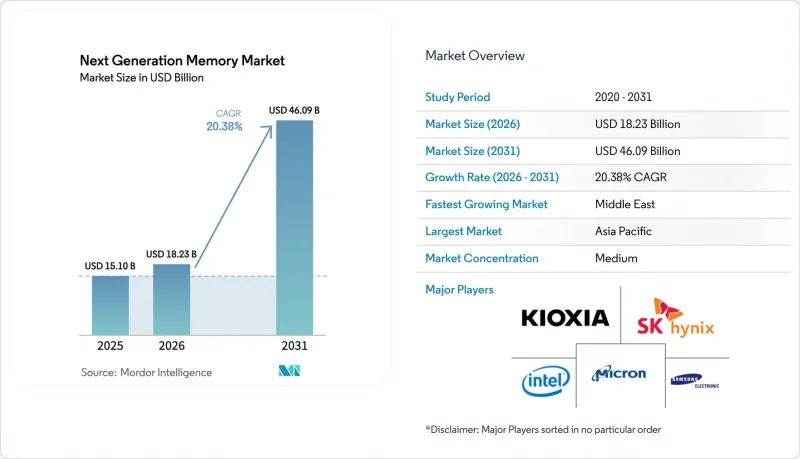
This report is Segmented by Technology (Non-Volatile, and Volatile), Memory Interface (DDR/LPDDR, PCIe/NVMe, SATA, and More), End-Use Device (Consumer Electronics, Enterprise Storage and Data Centers, Automotive Electronics and ADAS, Industrial IoT, Aerospace and Defense, and More), Wafer Size (Up To 200mm, 300mm, and 450mm), and Geography. The Market Forecasts are Provided in Terms of Value (USD).
Global Next Generation Memory Market Trends and Insights
AI-Driven Demand for HBM in Hyperscale Data Centers
Generative-AI clusters are breaching GDDR6 bandwidth ceilings, and hyperscalers have moved to HBM3E stacks that deliver up to 819 GB/s per package. SK Hynix began mass production of 12-layer HBM3E in 2024, yet advanced-packaging capacity at leading outsourced assembly houses remains fully booked through mid-2026. NVIDIA's Blackwell and AMD's MI300 lines each integrate eight HBM3E stacks, lifting per-accelerator memory content to 192 GB. Power savings of up to 40% versus discrete GDDR modules support data-center sustainability pledges, reinforcing HBM adoption momentum. The consequence is a 6.2-point uplift to the overall CAGR of the next generation memory market.
Automotive L4 ADAS Need for Instant-On Persistent Memory
Level 4 autonomy specifications cap system-start latency at 100 ms, a target unreachable with NAND-based boot paths. STT-MRAM delivers DRAM-like read speed with non-volatility, enabling controllers to resume sensor fusion instantly. Everspin shipped more than 1 million automotive-qualified MRAM units in 2025, and STMicroelectronics entered volume production of 28 nm embedded PCM for 2026 vehicles. Regulatory frameworks such as UNECE WP.29 strengthen the business case by requiring tamper-proof logging. These forces add 4.8 points to the CAGR of the next generation memory market.
450 mm Wafer Delay Constraining ReRAM Scale-Up
Transitioning from 300 mm to 450 mm wafers promises a significant 2.25X increase in die output, which could substantially enhance production efficiency and reduce costs. However, ASML currently lacks a commercial EUV platform designed to accommodate these larger substrates, creating a critical gap in the technological infrastructure required for this transition. Vendors of ReRAM, who are heavily reliant on sub-28 nm nodes, are unable to leverage these cost advantages, which significantly hinders their ability to achieve parity with NAND technology. This technological limitation has a notable impact on growth expectations. The effect is particularly pronounced in regions that have chosen to delay their investments in 450 mm wafer technology, further stalling advancements in these areas.
Other drivers and restraints analyzed in the detailed report include:
- Smartphone Migration to LPDDR5X and Embedded ReRAM
- National Memory Localization Programs
- High Per-Bit MRAM Cost Versus NAND
For complete list of drivers and restraints, kindly check the Table Of Contents.
Segment Analysis
Volatile secured 52.14% of the next generation memory market share in 2025, reflecting its role as the preferred stack for AI accelerators. The next-generation memory market size for volatile technologies stays elevated as Samsung prepares a 24-layer HBM4 prototype with 1.5 TB/s bandwidth. Spin-Transfer-Torque MRAM, however, is on track for a 23.03% CAGR through 2031 as automotive and industrial buyers prioritize instant-on and radiation-tolerant features.
Non-volatile alternatives such as phase-change memory, toggle MRAM, and resistive RAM collectively accounted for roughly 12% in 2025, with embedded ReRAM moving into payment cards and biometric modules. Ferroelectric RAM remains essential in ultra-low-power industrial sensors, while NanoRAM is advancing in space-grade systems. Discontinuation of Intel Optane in 2024 created a vacuum that STT-MRAM suppliers are exploiting to capture enterprise storage slots.
In 2025, DDR and LPDDR interfaces commanded a dominant 46.51% share of the revenue, leveraging their backward compatibility and widespread controller support. These interfaces have become a cornerstone in the memory market due to their ability to seamlessly integrate with existing systems and their compatibility with a broad range of controllers. The market for next-generation memory, linked to Compute Express Link, is set to surge at a robust 22.16% CAGR, driven by CXL 3.0's capability to facilitate coherent sharing among 4,096 devices. This growth highlights the increasing demand for advanced memory solutions that can support high-performance computing and data-intensive applications.
While PCIe and NVMe accounted for roughly a third of the revenues, the landscape is shifting as new technologies emerge. Hyperscale buyers are increasingly turning to rack-scale memory fabrics to optimize capacity usage and reduce inefficiencies caused by stranded memory. With Intel's Xeon 6 and AMD's EPYC Genoa integrating native CXL 2.0 controllers, the ecosystem is poised for maturity by 2026, ensuring a more robust and scalable infrastructure for future applications. Although proprietary automotive serial links maintain a specialized foothold, their market share is dwindling as JEDEC moves to standardize CXL extensions for vehicles. This standardization is expected to drive innovation and adoption in the automotive sector, further transforming the competitive dynamics of the memory market.
Complete Report Scope:
- By Technology
- Non-Volatile
- Phase-Change Memory (PCM)
- Spin-Transfer MRAM (STT-MRAM)
- Toggle MRAM
- Resistive RAM (ReRAM)
- 3D XPoint / Optane
- Ferroelectric RAM (FeRAM)
- NanoRAM
- Volatile
- High-Bandwidth Memory (HBM)
- Hybrid Memory Cube (HMC)
- Low-Power DDR5 / LPDDR5X
- Non-Volatile
- By Memory Interface
- DDR / LPDDR
- PCIe / NVMe
- SATA
- Others, Memory Interface
- By End-Use Device
- Consumer Electronics
- Enterprise Storage and Data Centers
- Automotive Electronics and ADAS
- Industrial IoT and Manufacturing Automation
- Aerospace and Defense
- Healthcare and Medical Devices
- Others, End-Use Device
- By Wafer Size
- Up to 200 mm
- 300 mm
- 450 mm
- By Geography
- North America
- United States
- Canada
- Mexico
- South America
- Brazil
- Argentina
- Rest of South America
- Europe
- Germany
- United Kingdom
- France
- Italy
- Spain
- Rest of Europe
- Asia Pacific
- China
- Japan
- South Korea
- India
- Australia
- New Zealand
- Rest of Asia-Pacific
- Middle East and Africa
- Middle East
- United Arab Emirates
- Saudi Arabia
- Turkey
- Rest of Middle East
- Africa
- South Africa
- Nigeria
- Kenya
- Rest of Africa
- Middle East
- North America
Geography Analysis
In 2025, Asia-Pacific dominated the revenue landscape with a commanding 56.43% share. This significant market leadership was bolstered by South Korea's substantial KRW 26 trillion (USD 19 billion) investment in advanced memory lines, aimed at enhancing production capabilities and technological advancements. Additionally, China's CNY 50 billion (USD 7 billion) expansion at Changxin Memory Technologies further strengthened the region's position by increasing its manufacturing capacity and competitiveness in the global market. Meanwhile, Taiwan and Japan's robust foundry ecosystems played a pivotal role in supporting the region's dominance. These ecosystems streamline the journey from prototype development to mass production, enabling faster time-to-market cycles and fostering innovation across the supply chain.
North America secured approximately 23% of the next-generation memory market in 2025, driven by expansive hyperscale AI deployments that continue to transform industries and create demand for advanced memory solutions. The region also benefited significantly from the USD 39 billion CHIPS Act subsidy, which provided critical funding to bolster domestic semiconductor manufacturing and research capabilities. This strategic investment has positioned North America as a key player in the global memory market, ensuring its competitiveness and resilience. Europe, with a 12% market share, leveraged the EU Chips Act's generous grants of EUR 43 billion (USD 47 billion), which were directed towards embedded memory research and development. Notably, Germany and France collaborated to co-fund pilot lines, aiming to reduce their reliance on imports and establish a more self-sufficient semiconductor ecosystem. These efforts reflect Europe's commitment to strengthening its technological infrastructure and fostering innovation in the memory market.
Though modest in size, the Middle East is making waves with a projected 21.65% CAGR, marking it as the fastest-growing region in the next-generation memory market. This impressive growth is largely attributed to Saudi Arabia and the United Arab Emirates integrating on-device inference into their ambitious smart-city initiatives. These initiatives are designed to enhance urban infrastructure and improve the efficiency of city operations, driving demand for advanced memory technologies. In contrast, South America and Africa lag behind with a combined market share of under 5%. Their growth is stunted by a lack of fabrication infrastructure, which limits their ability to compete on a global scale. However, Brazil's automotive sector presents a promising niche opportunity for automotive-grade MRAM, as the country continues to develop its capabilities in this specialized area. This niche market could serve as a stepping stone for further advancements in the region's memory technology landscape.
- Samsung Electronics Co., Ltd.
- SK Hynix Inc.
- Micron Technology, Inc.
- Kioxia Holdings Corporation
- Intel Corporation
- Western Digital Corporation
- Everspin Technologies, Inc.
- Crossbar Inc.
- Avalanche Technology Inc.
- Spin Memory, Inc.
- Nantero Inc.
- Weebit Nano Ltd.
- Renesas Electronics Corporation
- Infineon Technologies AG
- NXP Semiconductors N.V.
- Changxin Memory Technologies (CXMT)
- Taiwan Semiconductor Manufacturing Co. Ltd.
- GlobalFoundries Inc.
- Winbond Electronics Corporation
- Macronix International Co., Ltd.
- Nanya Technology Corporation
- Advanced Semiconductor Engineering Inc.
- Powerchip Semiconductor Manufacturing Corp.
- Yangtze Memory Technologies Co.
- Microchip Technology Inc.
Additional Benefits:
- The market estimate (ME) sheet in Excel format
- 3 months of analyst support
TABLE OF CONTENTS
1 INTRODUCTION
- 1.1 Study Assumptions and Market Definition
- 1.2 Scope of the Study
2 RESEARCH METHODOLOGY
3 EXECUTIVE SUMMARY
4 MARKET LANDSCAPE
- 4.1 Market Overview
- 4.2 Market Drivers
- 4.2.1 AI-Driven Demand for HBM in Hyperscale Data Centers
- 4.2.2 Automotive L4 ADAS Need for Instant-On Persistent Memory
- 4.2.3 Smartphone Migration to LPDDR5X and Embedded ReRAM
- 4.2.4 National Memory Localization Programs
- 4.2.5 Industrial Edge-IoT Requiring Ultra-Low-Power FRAM
- 4.2.6 Data-Privacy-Driven Persistent In-Memory Databases Using 3D XPoint
- 4.3 Market Restraints
- 4.3.1 450 mm Wafer Delay Constraining ReRAM Scale-Up
- 4.3.2 High Per-Bit MRAM Cost Versus NAND
- 4.3.3 Thermal Stability Failures of Automotive-Grade PCM
- 4.3.4 Foundry Concentration for Sub-28 nm STT-MRAM
- 4.4 Industry Value Chain Analysis
- 4.5 Regulatory Landscape
- 4.6 Technological Outlook
- 4.7 Porter's Five Forces Analysis
- 4.7.1 Bargaining Power of Buyers
- 4.7.2 Bargaining Power of Suppliers
- 4.7.3 Threat of New Entrants
- 4.7.4 Threat of Substitutes
- 4.7.5 Competitive Rivalry
5 MARKET SIZE AND GROWTH FORECASTS (VALUE)
- 5.1 By Technology
- 5.1.1 Non-Volatile
- 5.1.1.1 Phase-Change Memory (PCM)
- 5.1.1.2 Spin-Transfer MRAM (STT-MRAM)
- 5.1.1.3 Toggle MRAM
- 5.1.1.4 Resistive RAM (ReRAM)
- 5.1.1.5 3D XPoint / Optane
- 5.1.1.6 Ferroelectric RAM (FeRAM)
- 5.1.1.7 NanoRAM
- 5.1.2 Volatile
- 5.1.2.1 High-Bandwidth Memory (HBM)
- 5.1.2.2 Hybrid Memory Cube (HMC)
- 5.1.2.3 Low-Power DDR5 / LPDDR5X
- 5.1.1 Non-Volatile
- 5.2 By Memory Interface
- 5.2.1 DDR / LPDDR
- 5.2.2 PCIe / NVMe
- 5.2.3 SATA
- 5.2.4 Others, Memory Interface
- 5.3 By End-Use Device
- 5.3.1 Consumer Electronics
- 5.3.2 Enterprise Storage and Data Centers
- 5.3.3 Automotive Electronics and ADAS
- 5.3.4 Industrial IoT and Manufacturing Automation
- 5.3.5 Aerospace and Defense
- 5.3.6 Healthcare and Medical Devices
- 5.3.7 Others, End-Use Device
- 5.4 By Wafer Size
- 5.4.1 Up to 200 mm
- 5.4.2 300 mm
- 5.4.3 450 mm
- 5.5 By Geography
- 5.5.1 North America
- 5.5.1.1 United States
- 5.5.1.2 Canada
- 5.5.1.3 Mexico
- 5.5.2 South America
- 5.5.2.1 Brazil
- 5.5.2.2 Argentina
- 5.5.2.3 Rest of South America
- 5.5.3 Europe
- 5.5.3.1 Germany
- 5.5.3.2 United Kingdom
- 5.5.3.3 France
- 5.5.3.4 Italy
- 5.5.3.5 Spain
- 5.5.3.6 Rest of Europe
- 5.5.4 Asia Pacific
- 5.5.4.1 China
- 5.5.4.2 Japan
- 5.5.4.3 South Korea
- 5.5.4.4 India
- 5.5.4.5 Australia
- 5.5.4.6 New Zealand
- 5.5.4.7 Rest of Asia-Pacific
- 5.5.5 Middle East and Africa
- 5.5.5.1 Middle East
- 5.5.5.1.1 United Arab Emirates
- 5.5.5.1.2 Saudi Arabia
- 5.5.5.1.3 Turkey
- 5.5.5.1.4 Rest of Middle East
- 5.5.5.2 Africa
- 5.5.5.2.1 South Africa
- 5.5.5.2.2 Nigeria
- 5.5.5.2.3 Kenya
- 5.5.5.2.4 Rest of Africa
- 5.5.5.1 Middle East
- 5.5.1 North America
6 COMPETITIVE LANDSCAPE
- 6.1 Market Concentration
- 6.2 Strategic Moves
- 6.3 Market Share Analysis
- 6.4 Company Profiles (includes Global Level Overview, Market Level Overview, Core Segments, Financials as available, Strategic Information, Market Rank/Share, Products and Services, Recent Developments)
- 6.4.1 Samsung Electronics Co., Ltd.
- 6.4.2 SK Hynix Inc.
- 6.4.3 Micron Technology, Inc.
- 6.4.4 Kioxia Holdings Corporation
- 6.4.5 Intel Corporation
- 6.4.6 Western Digital Corporation
- 6.4.7 Everspin Technologies, Inc.
- 6.4.8 Crossbar Inc.
- 6.4.9 Avalanche Technology Inc.
- 6.4.10 Spin Memory, Inc.
- 6.4.11 Nantero Inc.
- 6.4.12 Weebit Nano Ltd.
- 6.4.13 Renesas Electronics Corporation
- 6.4.14 Infineon Technologies AG
- 6.4.15 NXP Semiconductors N.V.
- 6.4.16 Changxin Memory Technologies (CXMT)
- 6.4.17 Taiwan Semiconductor Manufacturing Co. Ltd.
- 6.4.18 GlobalFoundries Inc.
- 6.4.19 Winbond Electronics Corporation
- 6.4.20 Macronix International Co., Ltd.
- 6.4.21 Nanya Technology Corporation
- 6.4.22 Advanced Semiconductor Engineering Inc.
- 6.4.23 Powerchip Semiconductor Manufacturing Corp.
- 6.4.24 Yangtze Memory Technologies Co.
- 6.4.25 Microchip Technology Inc.
7 MARKET OPPORTUNITIES AND FUTURE OUTLOOK
- 7.1 White-Space and Unmet-Need Assessment

