PUBLISHER: Mordor Intelligence | PRODUCT CODE: 2122007

PUBLISHER: Mordor Intelligence | PRODUCT CODE: 2122007
Asia-Pacific Medical Aesthetic Devices - Market Share Analysis, Industry Trends & Statistics, Growth Forecasts (2026 - 2031)
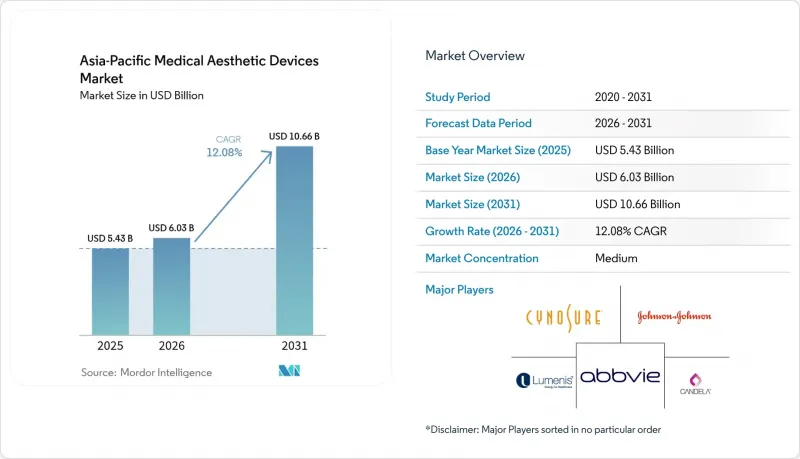
According to Mordor Intelligence, the Asia-Pacific medical aesthetic devices market size is projected to expand from USD 5.43 billion in 2025 and USD 6.03 billion in 2026 to USD 10.66 billion by 2031, registering a CAGR of 12.08% between 2026 to 2031.
This report is Segmented by Product Type (Energy-Based Devices, Non-Energy Devices), Application (Facial & Body Contouring, Skin Rejuvenation, Hair Removal, Breast Augmentation, Others), Gender (Female, Male), Age Group (18-34, 35-50, Above 50), End-User (Clinics, Hospitals, and More), and Geography (China, and More). Market Forecasts are Provided in Value (USD).
Asia-Pacific Medical Aesthetic Devices Market Trends and Insights
Rising Disposable Incomes & Aesthetic Awareness
Per-capita disposable income in urban China exceeded CNY 50 000 (USD 7 000) in 2024, and India's middle class could reach 580 million by 2030, enlarging the Asia-Pacific medical aesthetic devices market's consumption base. Vietnam's personal-care device segment rose 23.7% between 2022 and 2024, led by Korean-branded lasers online. Social media influencers on Douyin and TikTok normalize preventive treatments for users in their twenties. Bali logged a 21% jump in plastic-surgery tourism in 2024, underscoring cross-border willingness to spend on aesthetics. Clinics respond with "skin-health" packages that bundle laser rejuvenation with nutrient IV drips, extending the Asia-Pacific medical aesthetic devices market's procedural breadth.
Expansion of Medical Tourism Hubs
South Korea hosted more than 600 000 foreign patients in 2024, most seeking skincare and plastic-surgery procedures that rely on premium energy platforms. Thailand and Singapore leverage international accreditation and multilingual staff to sustain throughput that shortens payback cycles. Bali positions itself as a wellness retreat, fusing spa experiences with minimally invasive procedures. The model elevates device utilization but highlights follow-up care gaps once travelers return home, driving interest in teledermatology. Continued tourist inflows reinforce stable demand across the Asia-Pacific medical aesthetic devices market.
High Procedure & Device Costs Beyond Metro Areas
Picosecond and HIFU systems list above USD 100 000, prices rural clinics in India or Indonesia struggle to finance. Import duties inflate costs by up to 60%, forcing operators to rely on older IPL units that offer lower efficacy. Pay-per-pulse contracts are emerging yet hinge on dependable credit enforcement, which remains patchy across ASEAN, restraining the Asia-Pacific medical aesthetic devices market.
Other drivers and restraints analyzed in the detailed report include:
- Aging Population Seeking Anti-Aging Solutions
- Heightened Beauty Awareness Via Social Media Influence
- Fragmented & Evolving Regulatory Regimes
For complete list of drivers and restraints, kindly check the Table Of Contents.
Segment Analysis
Energy platforms commanded 37.36% of Asia-Pacific medical aesthetic devices market size in 2025, led by lasers that cover hair removal, pigmentation, and vascular lesions. Competitive pressure from Shenzhen and Seoul lowers unit prices, driving brands to differentiate via AI-guided spot sizing and cloud analytics. HIFU systems with imaging layers reduce adverse events, helping Japan and South Korea refresh installed fleets. Fractional RF-microneedling devices gain traction in urban China for cellulite and acne-scar repair. Cryolipolysis faces post-patent price erosion yet widens access in tier-3 Chinese cities. Light and IPL systems appeal to budget clinics despite efficacy limits on darker skin types. Plasma pens, electroporation wands, and LED masks capture niche demand on social-commerce sites. Non-energy segments-breast implants, thread lifts, injector pens-diversify revenue; thread-lift kits resurge among patients seeking quick facelifts in Seoul and Bangkok. Vendors bundle multi-modality workstations that lock clinics into proprietary consumables, anchoring lifetime value inside the Asia-Pacific medical aesthetic devices market.
Facial and body contouring held 32.57% of Asia-Pacific medical aesthetic devices market share in 2025 as consumers pursued jawline sculpting and muscle toning. Radiofrequency, HIFU, and cryolipolysis platforms dominate, now incorporating impedance sensors for safety. Hair removal is projected to expand at 15.13% through 2031 on male grooming trends and falling diode-laser costs. Compact units optimized for Fitzpatrick IV-V drive adoption in Ho Chi Minh City and Bangalore. Picosecond lasers, validated by Shanghai Jiao Tong University's 2025 study, propel tattoo and pigmented-lesion removal. Acne, vascular, and scar treatments rely on pulsed-dye lasers and microneedling. Breast augmentation stays hospital-centric but supports adjunct RF scar-management sales. Stretch-mark and intimate-rejuvenation niches grow as social stigma wanes, broadening the Asia-Pacific medical aesthetic devices market's procedure mix.
Complete Report Scope:
- By Product Type
- Energy-based Aesthetic Devices
- Laser-based Devices
- Light / Intense Pulsed Light (IPL) Devices
- Radiofrequency Devices
- Ultrasound / HIFU Devices
- Cryolipolysis Devices
- Plasma & Electroporation Devices
- LED & Photodynamic Therapy Devices
- Non-energy Aesthetic Devices
- Breast Implants (Silicone & Saline)
- Tissue Expanders
- Dermal Injector Systems
- Microdermabrasion Devices
- Thread-Lift Devices
- Others
- Energy-based Aesthetic Devices
- By Application
- Facial & Body Contouring
- Skin Rejuvenation & Resurfacing
- Hair Removal
- Tattoo, Pigmented & Scar Lesion Removal
- Breast Augmentation & Reconstruction
- Acne & Vascular Lesion Treatment
- Others
- By Gender
- Female
- Male
- By Age Group
- 18-34 Years
- 35-50 Years
- Above 50 Years
- By End-User
- Dermatology & Cosmetic Clinics
- Hospitals & Ambulatory Surgery Centers
- Medical Spas & Wellness Centers
- Home-use / Direct-to-Consumer
- Academic & Research Institutes
- Specialty Aesthetic Chain Centers
- By Country
- China
- Japan
- India
- South Korea
- Australia
- Rest of Asia-Pacific
List of Companies Covered in this Report:
- AbbVie (Allergan Aesthetics)
- BTL
- Candela Medical
- Cutera
- Cynosure LLC
- Fotona d.o.o.
- GC Aesthetics
- Huadong Medicine Co.
- InMode Ltd.
- Jeisys Medical Inc.
- Johnson and Johnson Services LLC
- Lumenis
- Sanhe Tongfei Medical
- Sciton
- SharpLight Technologies
- Sientra
- Sisram Medical
- Solta Medical
- Venus Concept Inc.
Additional Benefits:
- The market estimate (ME) sheet in Excel format
- 3 months of analyst support
TABLE OF CONTENTS
1 Introduction
- 1.1 Study Assumptions & Market Definition
- 1.2 Scope of the Study
2 Research Methodology
3 Executive Summary
4 Market Landscape
- 4.1 Market Overview
- 4.2 Market Drivers
- 4.2.1 Rising Disposable Incomes & Aesthetic Awareness
- 4.2.2 Expansion of Medical Tourism Hubs
- 4.2.3 Aging Population Seeking Anti-Aging Solutions
- 4.2.4 Rapid Tech Advances in Minimally Invasive Systems
- 4.2.5 China's Domestic Device-Manufacturing Incentives
- 4.2.6 Social-Commerce-Fueled Demand in Tier-3 Asian Cities
- 4.3 Market Restraints
- 4.3.1 High Procedure & Device Costs Beyond Metro Areas
- 4.3.2 Fragmented & Evolving Regulatory Regimes
- 4.3.3 Proliferation of Counterfeit/Grey-Market Devices
- 4.3.4 Shortage of Certified Aesthetic Practitioners
- 4.4 Value/Supply-Chain Analysis
- 4.5 Regulatory Landscape
- 4.6 Technological Outlook
- 4.7 Porter's Five Forces Analysis
- 4.7.1 Threat of New Entrants
- 4.7.2 Bargaining Power of Buyers
- 4.7.3 Bargaining Power of Suppliers
- 4.7.4 Threat of Substitutes
- 4.7.5 Competitive Rivalry
5 Market Size & Growth Forecasts (Value in USD)
- 5.1 By Product Type
- 5.1.1 Energy-based Aesthetic Devices
- 5.1.1.1 Laser-based Devices
- 5.1.1.2 Light / Intense Pulsed Light (IPL) Devices
- 5.1.1.3 Radiofrequency Devices
- 5.1.1.4 Ultrasound / HIFU Devices
- 5.1.1.5 Cryolipolysis Devices
- 5.1.1.6 Plasma & Electroporation Devices
- 5.1.1.7 LED & Photodynamic Therapy Devices
- 5.1.2 Non-energy Aesthetic Devices
- 5.1.2.1 Breast Implants (Silicone & Saline)
- 5.1.2.2 Tissue Expanders
- 5.1.2.3 Dermal Injector Systems
- 5.1.2.4 Microdermabrasion Devices
- 5.1.2.5 Thread-Lift Devices
- 5.1.2.6 Others
- 5.1.1 Energy-based Aesthetic Devices
- 5.2 By Application
- 5.2.1 Facial & Body Contouring
- 5.2.2 Skin Rejuvenation & Resurfacing
- 5.2.3 Hair Removal
- 5.2.4 Tattoo, Pigmented & Scar Lesion Removal
- 5.2.5 Breast Augmentation & Reconstruction
- 5.2.6 Acne & Vascular Lesion Treatment
- 5.2.7 Others
- 5.3 By Gender
- 5.3.1 Female
- 5.3.2 Male
- 5.4 By Age Group
- 5.4.1 18-34 Years
- 5.4.2 35-50 Years
- 5.4.3 Above 50 Years
- 5.5 By End-User
- 5.5.1 Dermatology & Cosmetic Clinics
- 5.5.2 Hospitals & Ambulatory Surgery Centers
- 5.5.3 Medical Spas & Wellness Centers
- 5.5.4 Home-use / Direct-to-Consumer
- 5.5.5 Academic & Research Institutes
- 5.5.6 Specialty Aesthetic Chain Centers
- 5.6 By Country
- 5.6.1 China
- 5.6.2 Japan
- 5.6.3 India
- 5.6.4 South Korea
- 5.6.5 Australia
- 5.6.6 Rest of Asia-Pacific
6 Competitive Landscape
- 6.1 Market Concentration
- 6.2 Market Share Analysis
- 6.3 Company Profiles (includes Global level Overview, Market level overview, Core Segments, Financials as available, Strategic Information, Market Rank/Share for key companies, Products and Services, and Recent Developments)
- 6.3.1 AbbVie (Allergan Aesthetics)
- 6.3.2 BTL Aesthetics
- 6.3.3 Candela Medical
- 6.3.4 Cutera Inc.
- 6.3.5 Cynosure LLC
- 6.3.6 Fotona d.o.o.
- 6.3.7 GC Aesthetics
- 6.3.8 Huadong Medicine Co.
- 6.3.9 InMode Ltd.
- 6.3.10 Jeisys Medical Inc.
- 6.3.11 Johnson and Johnson Services LLC
- 6.3.12 Lumenis Be Ltd.
- 6.3.13 Sanhe Tongfei Medical
- 6.3.14 Sciton Inc.
- 6.3.15 SharpLight Technologies
- 6.3.16 Sientra Inc.
- 6.3.17 Sisram Medical
- 6.3.18 Solta Medical
- 6.3.19 Venus Concept Inc.
7 Market Opportunities & Future Outlook
- 7.1 White-space & Unmet-Need Assessment

