PUBLISHER: Mordor Intelligence | PRODUCT CODE: 2122015

PUBLISHER: Mordor Intelligence | PRODUCT CODE: 2122015
Autoimmune Disease Diagnostics - Market Share Analysis, Industry Trends & Statistics, Growth Forecasts (2026 - 2031)
According to Mordor Intelligence, the autoimmune disease diagnostics market size is expected to grow from USD 6.78 billion in 2025 to USD 7.36 billion in 2026 and is forecast to reach USD 10.78 billion by 2031 at 7.93% CAGR over 2026-2031.
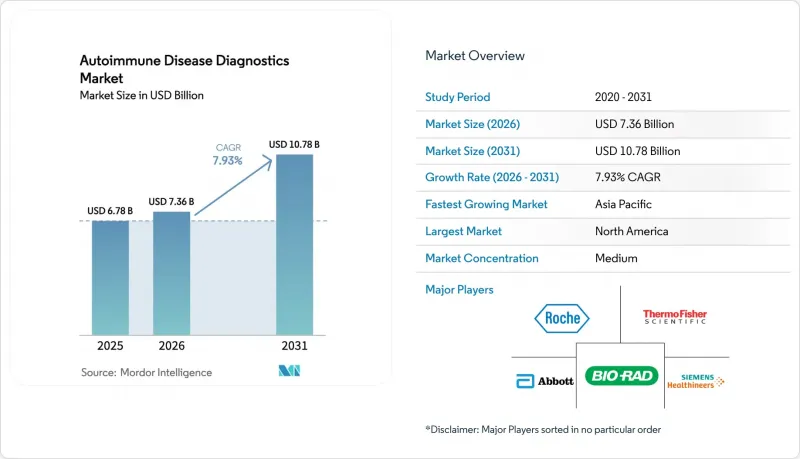
This report is Segmented by Product Type (Instruments, Assay Kits & Consumables), Disease Type (Systemic Autoimmune Diseases, Localized Autoimmune Diseases), Technology (Immunoassays, and More), End User (Hospitals & Clinics, Clinical Laboratories, and More), and Geography (North America, Europe, Asia-Pacific, MEA, South America). The Market Forecasts are Provided in Terms of Value (USD).
Global Autoimmune Disease Diagnostics Market Trends and Insights
Rising Prevalence of Autoimmune Diseases
Global incidence continues to climb, with rheumatoid arthritis affecting 18 million adults in 2025, up from 16 million in 2020. Systemic lupus erythematosus prevalence climbed 12% over the same span, mainly among women of childbearing age, while Type 1 diabetes diagnoses in children under 15 increased 3% annually across OECD nations. Environmental factors such as urbanization and dietary change now feature prominently in multi-year cohort studies across Southeast Asia. Payers are expanding coverage for autoantibody panels, citing evidence that early diagnosis can delay biologic therapy by up to 3 years.
Advances in Immunoassay & Molecular Diagnostics
Chemiluminescent immunoassays now achieve greater than 95% sensitivity for anti-CCP antibodies, surpassing the sensitivity of first-generation ELISAs. Next-generation sequencing of T-cell receptor repertoires reveals clonal expansions in inflammatory bowel disease up to six months before lesion appearance. Siemens Healthineers' Atellica IM, cleared in March 2025, merges immunoassay and molecular modules, reducing sample handling and cutting per-test labor costs by 25%.
High Cost of Advanced Diagnostics in LMICs
Multiplex panels priced at USD 150-300 remain out of reach in many low-income markets where per-capita health spending averages USD 50. Public laboratories rely on donated single-plex assays, which extends the median time-to-treatment by 18 months compared to high-income countries. Pooled procurement pilots in East Africa negotiate 40% discounts yet still cover less than 10% of regional need.
Other drivers and restraints analyzed in the detailed report include:
- Growing Awareness & Early-Detection Initiatives
- Expansion of Automated Multiplex Testing Platforms
- Lack of Standardized Criteria / False Positives
For complete list of drivers and restraints, kindly check the Table Of Contents.
Segment Analysis
In 2025, assay kits and consumables captured 52.31% of the autoimmune disease diagnostics market share, benefiting from recurring demand for reagents. Instruments are, however, expanding at a 10.06% CAGR, as reference laboratories replace manual microscopes with fully automated systems that run 500 samples per day. Beckman Coulter's DxI 9000 Access, launched August 2025, merges chemiluminescent and immunofluorescence workflows on one platform.
Consumables account for a larger share of revenue, with each installed instrument generating USD 200,000-400,000 in yearly reagent sales. Yet payer-driven consolidation favors labs that invest in closed-ecosystem analyzers, locking in multi-year service contracts. Smaller hospital laboratories continue to rely on open-platform reagent purchases, but their 6.5% growth lags the overall autoimmune disease diagnostics market.
Systemic diseases held a 66.73% share in 2025, but localized autoimmune disorders are predicted to drive a 10.72% CAGR on the strength of mandated thyroid and Type 1 diabetes screening. China's policy alone accounts for an additional 15 million thyroid tests per year. The localized segment's contribution to the autoimmune disease diagnostics market size will therefore accelerate faster than systemic testing, especially as U.S. NIH-funded pilots screen 500,000 high-risk children by 2027.
Inflammatory bowel disease panels that differentiate between Crohn's disease and ulcerative colitis with 80% accuracy support treatment stratification. Thyroid autoantibody testing volumes in the Asia-Pacific region are rising at a 15% annual rate, cementing localized conditions as the fastest-growing area within the autoimmune disease diagnostics market.
Complete Report Scope:
- By Product Type
- Instruments
- Assay Kits & Consumables
- By Disease Type
- Systemic Autoimmune Diseases
- Rheumatoid Arthritis
- Systemic Lupus Erythematosus
- Scleroderma
- Vasculitis
- Inflammatory Bowel Disease
- Others
- Localized Autoimmune Diseases
- Type 1 Diabetes
- Autoimmune Thyroid Diseases
- Systemic Autoimmune Diseases
- By Technology
- Immunoassays
- Indirect Immunofluorescence
- Multiplex Assays
- Molecular Diagnostics
- Point-of-Care Testing
- Others
- By End User
- Hospitals & Clinics
- Clinical Laboratories
- Academic & Research Institutes
- Other End Users
- By Geography
- North America
- United States
- Canada
- Mexico
- Europe
- Germany
- United Kingdom
- France
- Italy
- Spain
- Rest of Europe
- Asia-Pacific
- China
- Japan
- India
- Australia
- South Korea
- Rest of Asia-Pacific
- Middle East & Africa
- GCC
- South Africa
- Rest of Middle East & Africa
- South America
- Brazil
- Argentina
- Rest of South America
- North America
Geography Analysis
North America retained a 39.26% share in 2025, with the United States accounting for 85% of regional revenue, primarily due to reimbursement rates exceeding USD 200 per panel. Canada broadened rheumatoid arthritis test coverage, and Mexico initiated lupus screening pilots in high-prevalence states. FDA clearance of 12 autoimmune assays in 2025 underscores sustained innovation, but also highlights longer approval times for multiplex platforms.
Germany's January 2025 reimbursement for multiplex rheumatoid arthritis panels drove a 30% rise in volumes by mid-year. The United Kingdom boosted capacity by 15% through private-lab contracts, while Spain and Italy piloted POC testing to shorten diagnostic delays. EMA's 2025 adoption of commutable reference materials streamlines multi-country approvals.
The Asia-Pacific region is the fastest-growing, with an 11.53% CAGR from 2026 to 2031. China's thyroid screening mandate, India's adolescent Type 1 diabetes pilot, and Japan's approval of eight new assays in 2025 collectively expand the size of the autoimmune disease diagnostics market across the region. Australia reduced the POC regulatory timelines from 18 to 10 months to address the needs of remote areas. South Korea added ANA testing for 25 million adults in April 2025.
The Middle East & Africa and South America are smaller but evolving. GCC investments target tertiary centers, while South Africa's public labs expanded capacity by 10% in 2025. Brazil approved five new assays in 2025, aiming to address the needs of underserved Amazon regions.
- Abbott Laboratories
- Bio-Rad Laboratories
- Bio-Techne
- Danaher
- DiaSorin
- Euroimmun
- Exagen
- Roche
- Grifols
- Hologic
- Hycor Biomedical
- Inova Diagnostics
- LabCorp
- Myriad Genetics
- Ortho Clinical Diagnostics
- PerkinElmer
- Quest Diagnostics
- R-Biopharm
- Roche
- Siemens Healthineers
- Thermo Fisher Scientific
- Werfen
Additional Benefits:
- The market estimate (ME) sheet in Excel format
- 3 months of analyst support
TABLE OF CONTENTS
1 Introduction
- 1.1 Study Assumptions & Market Definition
- 1.2 Scope of the Study
2 Research Methodology
3 Executive Summary
4 Market Landscape
- 4.1 Market Overview
- 4.2 Market Drivers
- 4.2.1 Rising Prevalence of Autoimmune Diseases
- 4.2.2 Advances in Immunoassay & Molecular Diagnostics
- 4.2.3 Growing Awareness & Early-Detection Initiatives
- 4.2.4 Expansion of Automated Multiplex Testing Platforms
- 4.2.5 AI-Enabled Pattern Recognition Reducing Turnaround
- 4.2.6 Commutable Reference Materials Speeding Approvals
- 4.3 Market Restraints
- 4.3.1 High Cost of Advanced Diagnostics in LMICs
- 4.3.2 Lack of Standardized Criteria / False Positives
- 4.3.3 Specialty Reagent Supply-Chain Vulnerabilities
- 4.3.4 Heightened Regulatory Scrutiny of Multiplex Assays
- 4.4 Regulatory Landscape
- 4.5 Technological Outlook
- 4.6 Porter's Five Forces Analysis
- 4.6.1 Threat of New Entrants
- 4.6.2 Bargaining Power of Buyers
- 4.6.3 Bargaining Power of Suppliers
- 4.6.4 Threat of Substitutes
- 4.6.5 Competitive Rivalry
5 Market Size & Growth Forecasts
- 5.1 By Product Type
- 5.1.1 Instruments
- 5.1.2 Assay Kits & Consumables
- 5.2 By Disease Type
- 5.2.1 Systemic Autoimmune Diseases
- 5.2.1.1 Rheumatoid Arthritis
- 5.2.1.2 Systemic Lupus Erythematosus
- 5.2.1.3 Scleroderma
- 5.2.1.4 Vasculitis
- 5.2.1.5 Inflammatory Bowel Disease
- 5.2.1.6 Others
- 5.2.2 Localized Autoimmune Diseases
- 5.2.2.1 Type 1 Diabetes
- 5.2.2.2 Autoimmune Thyroid Diseases
- 5.2.1 Systemic Autoimmune Diseases
- 5.3 By Technology
- 5.3.1 Immunoassays
- 5.3.2 Indirect Immunofluorescence
- 5.3.3 Multiplex Assays
- 5.3.4 Molecular Diagnostics
- 5.3.5 Point-of-Care Testing
- 5.3.6 Others
- 5.4 By End User
- 5.4.1 Hospitals & Clinics
- 5.4.2 Clinical Laboratories
- 5.4.3 Academic & Research Institutes
- 5.4.4 Other End Users
- 5.5 By Geography
- 5.5.1 North America
- 5.5.1.1 United States
- 5.5.1.2 Canada
- 5.5.1.3 Mexico
- 5.5.2 Europe
- 5.5.2.1 Germany
- 5.5.2.2 United Kingdom
- 5.5.2.3 France
- 5.5.2.4 Italy
- 5.5.2.5 Spain
- 5.5.2.6 Rest of Europe
- 5.5.3 Asia-Pacific
- 5.5.3.1 China
- 5.5.3.2 Japan
- 5.5.3.3 India
- 5.5.3.4 Australia
- 5.5.3.5 South Korea
- 5.5.3.6 Rest of Asia-Pacific
- 5.5.4 Middle East & Africa
- 5.5.4.1 GCC
- 5.5.4.2 South Africa
- 5.5.4.3 Rest of Middle East & Africa
- 5.5.5 South America
- 5.5.5.1 Brazil
- 5.5.5.2 Argentina
- 5.5.5.3 Rest of South America
- 5.5.1 North America
6 Competitive Landscape
- 6.1 Market Concentration
- 6.2 Market Share Analysis
- 6.3 Company Profiles (includes Global level Overview, Market-level Overview, Core Segments, Financials, Strategic Information, Market Rank/Share, Products & Services, Recent Developments)
- 6.3.1 Abbott Laboratories
- 6.3.2 Bio-Rad Laboratories Inc.
- 6.3.3 Bio-Techne
- 6.3.4 Danaher (Beckman Coulter)
- 6.3.5 DiaSorin
- 6.3.6 Euroimmun AG
- 6.3.7 Exagen Inc.
- 6.3.8 F. Hoffmann-La Roche AG
- 6.3.9 Grifols S.A.
- 6.3.10 Hologic Inc.
- 6.3.11 Hycor Biomedical
- 6.3.12 Inova Diagnostics
- 6.3.13 LabCorp
- 6.3.14 Myriad Genetics
- 6.3.15 Ortho Clinical Diagnostics
- 6.3.16 PerkinElmer
- 6.3.17 Quest Diagnostics
- 6.3.18 R-Biopharm
- 6.3.19 Roche Diagnostics
- 6.3.20 Siemens Healthineers
- 6.3.21 Thermo Fisher Scientific Inc.
- 6.3.22 Werfen
7 Market Opportunities & Future Outlook
- 7.1 White-space & Unmet-need Assessment

