PUBLISHER: Mordor Intelligence | PRODUCT CODE: 2122022

PUBLISHER: Mordor Intelligence | PRODUCT CODE: 2122022
Radar Systems - Market Share Analysis, Industry Trends & Statistics, Growth Forecasts (2026 - 2031)
According to Mordor Intelligence, the radar systems market size is expected to grow from USD 36.12 billion in 2025 to USD 38.06 billion in 2026 and is forecast to reach USD 49.44 billion by 2031 at 5.38% CAGR over 2026-2031.
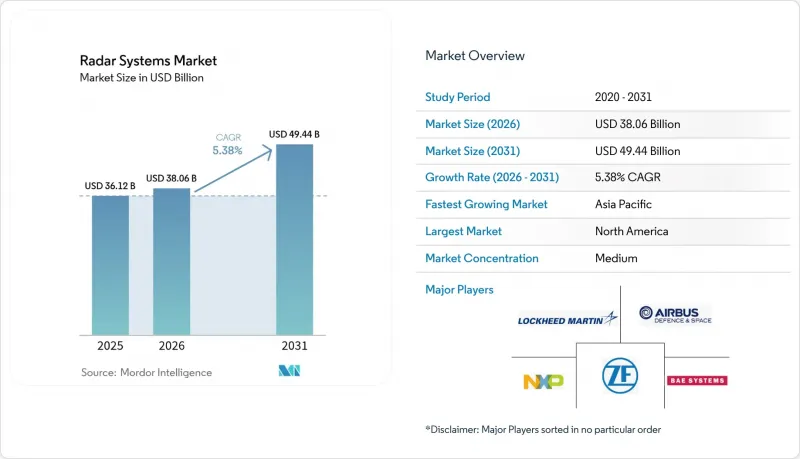
This report is Segmented by Type (Continuous Wave, and Pulsated Wave), Component (Antenna Modules, Transmit-Receive Modules, Power Amplifiers, Signal Processors, and Software and Services), Application (Airborne, Land-Based, and Naval), End-User Industry (Aviation, Maritime, Automotive, and Military and Defense), and Geography. The Market Forecasts are Provided in Terms of Value USD.
Global Radar Systems Market Trends and Insights
Escalating Global Defense Budgets
Defense ministries continue to channel funding toward next-generation sensors. The United States Department of Defense allocated USD 1.7 billion for the Lower Tier Air and Missile Defense Sensor and USD 537 million for ongoing AN/SPY-6 production in fiscal-year 2025. Similar momentum is visible in Europe, where Latvia and Slovenia ordered HENSOLDT TRML-4D systems worth EUR 100 million (USD 109 million) to reinforce integrated air defense. Asia Pacific defense investment is accelerating through Hanwha Systems' AESA radar contracts for the KF-21 fighter and L-SAM II missile battery. Multilateral frameworks, such as NATO standardization agreements, ease cross-border technology flow and support volume procurement efficiencies.
Rapid Adoption of Automotive ADAS Radar
Automotive manufacturers are extending radar nodes from adaptive cruise control to full 360-degree perception. Arbe Robotics and NVIDIA cooperated on a 4D imaging radar that maps elevation and velocity for Level-3 autonomy requirements. NXP Semiconductors partnered with Bitsensing to raise resolution and reduce latency for safety functions across multiple vehicle classes. Regulatory push adds urgency: European rules mandate advanced emergency braking in all new cars, and the U.S. National Highway Traffic Safety Administration promulgated similar proposals. Transition to the 77-81 GHz band provides higher range resolution and smaller antenna footprints, enabling mass-market deployment.
High Upfront Acquisition and Lifecycle Costs
Premium AESA radars strain budgets. Egypt's order for a single AN/TPS-78 installation reached USD 304 million, and the Ivory Coast's GM200 radar cost EUR 50 million (USD 54.5 million). Beyond procurement, gallium nitride module maintenance and specialized calibration prolong the total cost of ownership. Mercury Systems is targeting an 80% reduction in radar assembly size, weight, and power under a USD 8.5 million Department of Defense contract, illustrating industry moves to compress lifecycle expense
Other drivers and restraints analyzed in the detailed report include:
- Air-Traffic Control Modernization Programmes
- Increasing Demand for Advanced Weather Surveillance
- Radio-Frequency Spectrum Congestion and Allocation Barriers
For complete list of drivers and restraints, kindly check the Table Of Contents.
Segment Analysis
The pulsated wave category accounted for 60.48% of radar systems market share in 2025, supported by long-range missile defense radars such as AN/SPY-6 and TPY-2. Pulsated wave technology continues to anchor strategic early-warning missions due to its superior peak power and range-gate discrimination. Continuous wave designs, however, are forecast to register a 5.74% CAGR, reflecting their suitability for automotive ADAS, small UAV sense-and-avoid, and compact maritime safety installations. 4D imaging radar solutions from Arbe Robotics capitalize on frequency-modulated continuous wave modulation to deliver precise elevation data, promoting adoption across Level-3 autonomy programs.
Continuous wave radars reduce size, weight, and power, easing integration in space-constrained platforms. Leonardo's Osprey family demonstrates low-SWaP performance for unmanned aerial vehicles. Regulatory allocation in the 77-81 GHz band favors continuous wave automotive sensors, reinforcing volume production economics. Over the next five years, the radar systems market size revenue split between the two architectures is expected to narrow as automotive, drone, and infrastructure deployments outpace traditional defense spending.
Antenna modules anchored 32.35% of the overall revenue in 2025, propelled by gallium nitride transmit-receive modules enabling simultaneous multi-mission operations. As phased-array density climbs, antenna tiles integrate control, calibration, and health-monitoring sensors, boosting subsystem value. Transmit-receive and power amplifier modules transition from gallium arsenide to gallium nitride for higher thermal margins, while mixed-signal RFIC integration shrinks board count.
Software and services will rise at 5.89% CAGR through 2031, buoyed by AI-driven threat classification, radar-data analytics, and cloud-hosted post-processing. AI frameworks such as RTX Corporation's Cognitive Aircraft Defense System demonstrate real-time electromagnetic environment learning. As procurement migrates to capability-as-a-service models, vendors secure recurring revenue through algorithm updates and cybersecurity patches. Regulatory compliance, including FCC certification and ISO-9001 quality audits, stimulates demand for professional services, accelerating ecosystem monetization.
Complete Report Scope:
- By System Type
- Continuous Wave Radar Systems
- Pulsated Wave Radar Systems
- By Component
- Antenna Modules
- Transmit-Receive Modules
- Power Amplifiers and Oscillators
- Signal Processors and Controllers
- Software and Services
- By Application
- Airborne
- Land-based
- Naval
- By End-user Industry
- Aviation
- Maritime Applications
- Automotive
- Military and Defense
- Geography
- North America
- United States
- Canada
- Mexico
- Europe
- United Kingdom
- Germany
- France
- Russia
- Rest of Europe
- Asia Pacific
- China
- Japan
- India
- South Korea
- Rest of Asia Pacific
- Middle East
- Saudi Arabia
- United Arab Emirates
- Turkey
- Rest of Middle East
- Africa
- South Africa
- Egypt
- Nigeria
- Rest of Africa
- South America
- Brazil
- Argentina
- Colombia
- Rest of South America
- North America
Geography Analysis
North America held 36.94% of 2025 revenue, underpinned by the United States Department of Defense's USD 849.8 billion fiscal-year 2025 allocation and the FAA's USD 8 billion radar replacement program. Canada advances NORAD upgrades, while Mexico invests in air-traffic management and coastal surveillance. Automotive adoption grows in tandem with U.S. and Canadian EV manufacturing, supporting sensor demand.
Asia Pacific is the fastest-growing region at 6.09% CAGR. China fielded more than 50 X-band phased-array weather radars and invests in maritime surveillance for the South China Sea CIIS. South Korea's Hanwha Systems supplies AESA units to the KF-21 and L-SAM II, and Japan accelerates fighter radar upgrades. Automotive radar deployment accelerates on domestic electric and autonomous vehicle platforms, supported by regulatory clarity in the 77-81 GHz band.
Europe sees steady uptake, anchored by NATO commitments and Single European Sky modernization. Latvia and Slovenia ordered EUR 100 million (USD 109 million) of TRML-4D units, while Leonardo's ECRS Mk2 completed its first Typhoon flight. Thales GM400a radars bolster Baltic defense. Advanced driver-assistance mandates in Germany, France, and Italy accelerate automotive radar penetration, reinforcing cross-segment demand.
- Lockheed Martin Corporation
- RTX Corporation
- Thales Group
- Leonardo S.p.A.
- Saab AB
- Israel Aerospace Industries Ltd.
- Northrop Grumman Corporation
- BAE Systems plc
- Airbus SE
- General Dynamics Corporation
- NXP Semiconductors N.V.
- Infineon Technologies AG
- HENSOLDT AG
- Rohde and Schwarz GmbH and Co KG
- Teledyne FLIR LLC
- Mitsubishi Electric Corporation
- Honeywell International Inc.
- Bharat Electronics Limited
- Fujitsu Limited
- Indra Sistemas S.A.
- Reutech Radar Systems (Pty) Ltd.
- Terma A/S
Additional Benefits:
- The market estimate (ME) sheet in Excel format
- 3 months of analyst support
TABLE OF CONTENTS
1 INTRODUCTION
- 1.1 Study Assumptions and Market Definition
- 1.2 Scope of the Study
2 RESEARCH METHODOLOGY
3 EXECUTIVE SUMMARY
4 MARKET LANDSCAPE
- 4.1 Market Overview
- 4.2 Technological Outlook
- 4.3 Impact of Macroeconomic Factors
- 4.4 Market Drivers
- 4.4.1 Escalating global defence budgets
- 4.4.2 Rapid adoption of automotive ADAS radar
- 4.4.3 Air-traffic control modernisation programmes
- 4.4.4 Increasing demand for advanced weather surveillance
- 4.4.5 Miniaturised radar for small-UAV integration
- 4.4.6 AI-enabled digital beamforming-based radars
- 4.5 Market Restraints
- 4.5.1 High upfront acquisition and lifecycle costs
- 4.5.2 Radio-frequency spectrum congestion and allocation barriers
- 4.5.3 Supply-chain tightness for GaN power devices
- 4.5.4 Cyber-security vulnerabilities in network-connected radar nodes
- 4.6 Industry Ecosystem Analysis
- 4.7 Regulatory Landscape
- 4.8 Porter's Five Forces Analysis
- 4.8.1 Threat of New Entrants
- 4.8.2 Bargaining Power of Buyers
- 4.8.3 Bargaining Power of Suppliers
- 4.8.4 Threat of Substitute Products
- 4.8.5 Intensity of Competitive Rivalry
5 MARKET SIZE AND GROWTH FORECASTS (VALUE)
- 5.1 By System Type
- 5.1.1 Continuous Wave Radar Systems
- 5.1.2 Pulsated Wave Radar Systems
- 5.2 By Component
- 5.2.1 Antenna Modules
- 5.2.2 Transmit-Receive Modules
- 5.2.3 Power Amplifiers and Oscillators
- 5.2.4 Signal Processors and Controllers
- 5.2.5 Software and Services
- 5.3 By Application
- 5.3.1 Airborne
- 5.3.2 Land-based
- 5.3.3 Naval
- 5.4 By End-user Industry
- 5.4.1 Aviation
- 5.4.2 Maritime Applications
- 5.4.3 Automotive
- 5.4.4 Military and Defense
- 5.5 Geography
- 5.5.1 North America
- 5.5.1.1 United States
- 5.5.1.2 Canada
- 5.5.1.3 Mexico
- 5.5.2 Europe
- 5.5.2.1 United Kingdom
- 5.5.2.2 Germany
- 5.5.2.3 France
- 5.5.2.4 Russia
- 5.5.2.5 Rest of Europe
- 5.5.3 Asia Pacific
- 5.5.3.1 China
- 5.5.3.2 Japan
- 5.5.3.3 India
- 5.5.3.4 South Korea
- 5.5.3.5 Rest of Asia Pacific
- 5.5.4 Middle East
- 5.5.4.1 Saudi Arabia
- 5.5.4.2 United Arab Emirates
- 5.5.4.3 Turkey
- 5.5.4.4 Rest of Middle East
- 5.5.5 Africa
- 5.5.5.1 South Africa
- 5.5.5.2 Egypt
- 5.5.5.3 Nigeria
- 5.5.5.4 Rest of Africa
- 5.5.6 South America
- 5.5.6.1 Brazil
- 5.5.6.2 Argentina
- 5.5.6.3 Colombia
- 5.5.6.4 Rest of South America
- 5.5.1 North America
6 COMPETITIVE LANDSCAPE
- 6.1 Market Concentration
- 6.2 Strategic Moves
- 6.3 Market Share Analysis
- 6.4 Company Profiles (includes global level overview, market level overview, core segments, financials as available, strategic information, market rank/share for key companies, products and services, and recent developments)
- 6.4.1 Lockheed Martin Corporation
- 6.4.2 RTX Corporation
- 6.4.3 Thales Group
- 6.4.4 Leonardo S.p.A.
- 6.4.5 Saab AB
- 6.4.6 Israel Aerospace Industries Ltd.
- 6.4.7 Northrop Grumman Corporation
- 6.4.8 BAE Systems plc
- 6.4.9 Airbus SE
- 6.4.10 General Dynamics Corporation
- 6.4.11 NXP Semiconductors N.V.
- 6.4.12 Infineon Technologies AG
- 6.4.13 HENSOLDT AG
- 6.4.14 Rohde and Schwarz GmbH and Co KG
- 6.4.15 Teledyne FLIR LLC
- 6.4.16 Mitsubishi Electric Corporation
- 6.4.17 Honeywell International Inc.
- 6.4.18 Bharat Electronics Limited
- 6.4.19 Fujitsu Limited
- 6.4.20 Indra Sistemas S.A.
- 6.4.21 Reutech Radar Systems (Pty) Ltd.
- 6.4.22 Terma A/S
7 MARKET OPPORTUNITIES AND FUTURE OUTLOOK
- 7.1 White-Space and Unmet-Need Assessment

