PUBLISHER: Mordor Intelligence | PRODUCT CODE: 2122038

PUBLISHER: Mordor Intelligence | PRODUCT CODE: 2122038
Food Service Packaging - Market Share Analysis, Industry Trends & Statistics, Growth Forecasts (2026 - 2031)
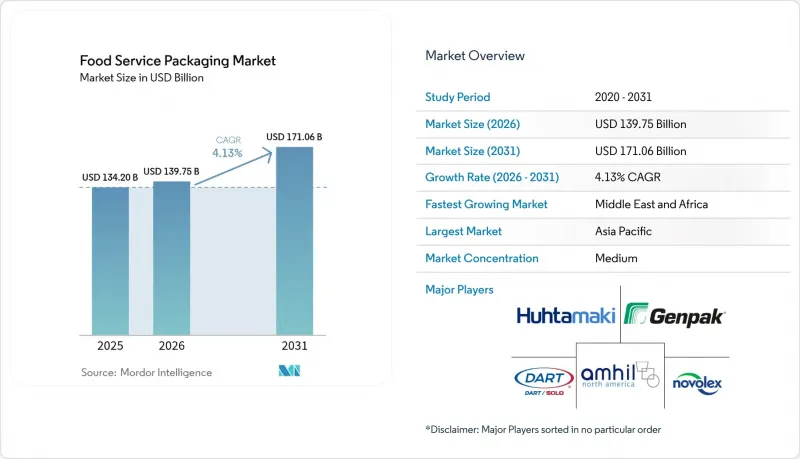
According to Mordor Intelligence, the food service packaging market size is expected to grow from USD 134.20 billion in 2025 to USD 139.75 billion in 2026 and is forecast to reach USD 171.06 billion by 2031 at 4.13% CAGR over 2026-2031.
This report is Segmented by Material (Paper and Paperboard, Plastics, and More), Packaging Type (Clamshells, Cups and Tubs, and More), End-User Industry (QSR, FSR, Institutional Catering, and More), Sustainability Profile (Conventional, Sustainable), and Geography (North America, South America, Europe, Asia-Pacific, Middle East and Africa). The Market Forecasts are Provided in Terms of Value (USD).
Global Food Service Packaging Market Trends and Insights
Growing Demand for On-the-Go, Portion-Controlled Meals in Urban Centers
Portion-specific packs have outpaced bulk formats as younger, city-dwelling consumers favor convenient single-serve meals they can finish during short commutes. Brand owners now specify stackable trays with integrated calorie icons and scannable QR nutrition tags that fit automated vending and micro-fulfillment lockers. McDonald's pilot of grass-paper burger wraps in Germany illustrates how multinational QSR chains marry convenience with sustainability to satisfy urban diners. Institutional buyers reinforce the trend; the United Kingdom's National Health Service framework for catering consumables standardizes portion sizes while mandating allergen-compliant labels. As a result, converters that master modular die-cutting and variable-data labeling gain a cost edge while meeting complex urban service requirements.
E-commerce Meal-Kit Boom Accelerating Secondary and Tertiary Packaging Volumes
Meal-kit operators require multi-layered solutions that shield raw proteins, prevent odor transfer, and withstand two-day courier cycles. Demand has spurred investment in customized barrier pouches, corrugated coolers, and molded-fiber inserts designed to curb refrigerant use and shipping weight. Providers increasingly embed NFC freshness tags in outer cartons to signal tamper events and temperature excursions, mirroring Tetra Pak's sensor-equipped pilot for direct-to-consumer dairy in 2024. Domestic fiber molding lines have been added in the United States and Germany to curb supply risk, and Asia-Pacific manufacturers are retooling to supply water-based ink systems compatible with meal-kit ovens and microwaves.
Regulatory Phase-Outs of Single-Use EPS and PVC in More Than 60 Countries
Fast-tracked bans compress transition windows to 12-18 months, straining the capacity of alternative substrate suppliers. France's AGEC law obliged McDonald's to roll out reusable polypropylene trays in 2024, rewiring front-of-house workflows and piloting silicone-rubber containers for eat-in orders. Small operators lack the capex to overhaul back-of-house dishwashing or deposit logistics, nudging them to third-party pooling services and reinforcing consolidation toward well-capitalized chains.
Other drivers and restraints analyzed in the detailed report include:
- Quick-Service Restaurants' Shift to Fiber-Based Serviceware Amid PFAS Bans
- Recycled PET Capacity Expansions Lowering Price Premium vs. Virgin Resin
- Volatility in Virgin Polymer Prices Squeezing Converter Margins
For complete list of drivers and restraints, kindly check the Table Of Contents.
Segment Analysis
Plastics kept the largest 41.98% food service packaging market share in 2025, leveraged by cost efficiency, high-clarity display, and seal integrity that remain critical for beverage lids and hot-fill soup tubs. Still, biodegradable and specialty substrates are slated for a 5.42% CAGR, reflecting stronger eco-labeling pull and expanding compost infrastructure in urban Northern Europe. The food service packaging market size for biodegradable films is forecast to reach USD 26.36 billion by 2031, buoyed by starch blends that now tolerate microwave reheating at 100 °C without warpage. In conventional plastics, PFAS removal and chemical-recycle pathways dominate R&D budgets, evidenced by McDonald's 99.5% fluorinated-compound phase-out milestone in 2024.
Paper and paperboard continue to migrate up-market; aqueous dispersion coatings now achieve 8-hour hot-grease resistance, opening burger clam shells and noodle bowls to fiber conversion. Aluminum cans and trays preserve niche demand for airline catering and high-acid meal components but struggle against lightweight composite cartons. Glass sees negligible penetration because delivery platforms penalize weight and breakage risk. As resin volatility persists, converters hedge with hybrid PP-pulp solutions that trim polymer usage by 50% while safeguarding heat retention, reinforcing biodegradable materials as the prime innovation arena within the food service packaging market.
Cups and tubs retained a 37.89% revenue lead in 2025, anchored by universal beverage and soup applications and mega-volume QSR procurement that lowers unit costs. Nonetheless, trays and containers surge ahead at a 5.11% CAGR, supported by courier-centric menu designs. The food service packaging market size for trays could hit USD 47.30 billion by 2031 as ghost kitchens favor leak-proof, microwavable designs with snap-fit lids and anti-fog windows. Tamper bands and peel-away freshness seals migrate from pharma to food, creating incremental tooling demand for thermoformers.
Clamshells, once synonymous with EPS, reposition toward molded-fiber and post-consumer recycled PET formats to meet bans, while sachets and pouches fill portion-controlled condiment niches. Sabert's Tray2Go pulp line, introduced in 2024, pairs compostability with shelf stacking strength, giving airlines and hospital caterers a cost-neutral swap from PP trays. Overall, packaging-type diversification indicates that suppliers offering multi-format portfolios will command premium bids in the food service packaging market.
Complete Report Scope:
- By Material
- Paper and Paperboard
- Plastics
- Polyethylene Terephthalate (PET)
- Polypropylene (PP)
- Polystyrene (PS) and Expanded Polystyrene (EPS)
- Other Plastics
- Aluminum
- Glass
- Biodegradable and specialty materials
- By Packaging Type
- Clamshells
- Cups and Tubs
- Trays and Containers
- Sachets and Pouches
- Other Packaging Types
- By End-user Industry
- Quick-Service Restaurants (QSR)
- Full-Service Restaurants (FSR)
- Institutional Catering
- Hospitality and Cafes
- Other End-user Industries
- By Sustainability Profile
- Conventional Type
- Sustainable Packaging
- By Geography
- North America
- United States
- Canada
- Mexico
- South America
- Brazil
- Argentina
- Chile
- Rest of South America
- Europe
- United Kingdom
- Germany
- France
- Spain
- Italy
- Rest of Europe
- Asia-Pacific
- China
- India
- Japan
- Australia
- South Korea
- Vietnam
- Rest of Asia-Pacific
- Middle East and Africa
- Middle East
- Saudi Arabia
- United Arab Emirates
- Turkey
- Rest of Middle East
- Africa
- South Africa
- Nigeria
- Egypt
- Rest of Africa
- Middle East
- North America
Geography Analysis
Asia-Pacific commands the food service packaging market with 40.32% share, fueled by expanding urban consumption in China, India, and Southeast Asian economies. As bricks-and-clicks food aggregators scale, packaging converters relocate extrusion and printing assets closer to megacities to shrink lead times and tailor SKUs to local taste profiles. Vietnam's draft EPR law signals an impending shift toward mandatory recycled-content quotas, prompting RPET flake exporters to build domestic washing lines. Yet inconsistent municipal collection slows bottle-to-food trials, keeping virgin resin demand resilient across high-temperature noodle applications.
North America displays mature yet innovation-led dynamics. State-level PFAS prohibitions catalyze rapid fiber-lid conversions and push chemical-recycling joint ventures between resin majors and packaging converters. The New York Office of General Services now publishes an annual purchasing specification for compliant fiber containers and wraps, giving public-sector buyers a vetted list of sustainable SKUs. U.S. brands pioneer pilot reuse schemes in stadium concessions, collecting data on wash-cycle durability and consumer acceptance to inform 2030 zero-waste targets.
Europe follows a harmonized regulatory path via the Single-Use Plastics Directive. Deposit-return systems in Germany and the Nordics deliver high PET collection rates, lowering RPET pellet costs. Fiber-coated pizza discs and molded drink carriers gain traction, supported by compost infrastructure integrated with municipal bio-waste streams. Supply, however, is constrained by cellulose pulp availability, spurring investments in sustainable forestry and agricultural-waste fiber pulping.
The Middle East and Africa, though only 6 % of current revenue, present a 5.98% CAGR upside. Fast-food franchisors such as KFC and Burger King deploy standardized packaging kits to support rapid outlet roll-outs in the Gulf and North Africa. UFlex's USD 200 million Egypt plant positions the firm to serve both African growth markets and European proximity sourcing, shortening lead times and hedging Red Sea shipping risks. Waste infrastructure remains nascent, prompting interest in mono-material PP tubs that facilitate downstream mechanical recycling once collection systems scale.
- Pactiv Evergreen Inc.
- Dart Container Corporation
- Amhil North America
- Genpak LLC
- Huhtamaki Oyj
- Novolex Holdings LLC
- Sabert Corporation
- Silgan Holdings Inc.
- B & R Plastics Inc.
- Graphic Packaging Holding Company
- Amcor plc
- Sonoco Products Company
- Anchor Packaging LLC
- Smurfit WestRock
- Georgia-Pacific LLC
- Coveris Holdings S.A.
- Reynolds Group Holdings Ltd.
- International Paper Company
- Vegware Ltd.
- BioPak Pty Ltd.
- Fabri-Kal Corporation
- Eco-Products LLC
- Sealed Air Corporation
Additional Benefits:
- The market estimate (ME) sheet in Excel format
- 3 months of analyst support
TABLE OF CONTENTS
1 INTRODUCTION
- 1.1 Study Assumptions and Market Definition
- 1.2 Scope of the Study
2 RESEARCH METHODOLOGY
3 EXECUTIVE SUMMARY
4 MARKET LANDSCAPE
- 4.1 Market Overview
- 4.2 Market Drivers
- 4.2.1 Growing demand for on-the-go, portion-controlled meals in urban centres
- 4.2.2 E-commerce meal-kit boom accelerating secondary and tertiary packaging volumes
- 4.2.3 Quick-service restaurants' shift to fiber-based serviceware amid PFAS bans
- 4.2.4 Recycled PET capacity expansions lowering price premium vs. virgin resin
- 4.2.5 Sensor-enabled "smart lids" improving delivery food safety and brand differentiation
- 4.2.6 Surge in ghost-kitchen franchising requiring lightweight, tamper-evident packs
- 4.3 Market Restraints
- 4.3.1 Regulatory phase-outs of single-use EPS and PVC in >60 countries
- 4.3.2 Volatility in virgin polymer prices squeezing converter margins
- 4.3.3 Insufficient post-consumer collection infrastructure in emerging Asia
- 4.3.4 High upfront capex for reusable food-service systems in stadiums and campuses
- 4.4 Industry Value Chain Analysis
- 4.5 Regulatory Landscape
- 4.6 Technological Outlook
- 4.7 Porter's Five Forces Analysis
- 4.7.1 Bargaining Power of Suppliers
- 4.7.2 Bargaining Power of Buyers
- 4.7.3 Threat of New Entrants
- 4.7.4 Threat of Substitutes
- 4.7.5 Intensity of Competitive Rivalry
- 4.8 Impact of Macroeconomic Factors on the Market
5 MARKET SIZE AND GROWTH FORECASTS(VALUE)
- 5.1 By Material
- 5.1.1 Paper and Paperboard
- 5.1.2 Plastics
- 5.1.2.1 Polyethylene Terephthalate (PET)
- 5.1.2.2 Polypropylene (PP)
- 5.1.2.3 Polystyrene (PS) and Expanded Polystyrene (EPS)
- 5.1.2.4 Other Plastics
- 5.1.3 Aluminum
- 5.1.4 Glass
- 5.1.5 Biodegradable and specialty materials
- 5.2 By Packaging Type
- 5.2.1 Clamshells
- 5.2.2 Cups and Tubs
- 5.2.3 Trays and Containers
- 5.2.4 Sachets and Pouches
- 5.2.5 Other Packaging Types
- 5.3 By End-user Industry
- 5.3.1 Quick-Service Restaurants (QSR)
- 5.3.2 Full-Service Restaurants (FSR)
- 5.3.3 Institutional Catering
- 5.3.4 Hospitality and Cafes
- 5.3.5 Other End-user Industries
- 5.4 By Sustainability Profile
- 5.4.1 Conventional Type
- 5.4.2 Sustainable Packaging
- 5.5 By Geography
- 5.5.1 North America
- 5.5.1.1 United States
- 5.5.1.2 Canada
- 5.5.1.3 Mexico
- 5.5.2 South America
- 5.5.2.1 Brazil
- 5.5.2.2 Argentina
- 5.5.2.3 Chile
- 5.5.2.4 Rest of South America
- 5.5.3 Europe
- 5.5.3.1 United Kingdom
- 5.5.3.2 Germany
- 5.5.3.3 France
- 5.5.3.4 Spain
- 5.5.3.5 Italy
- 5.5.3.6 Rest of Europe
- 5.5.4 Asia-Pacific
- 5.5.4.1 China
- 5.5.4.2 India
- 5.5.4.3 Japan
- 5.5.4.4 Australia
- 5.5.4.5 South Korea
- 5.5.4.6 Vietnam
- 5.5.4.7 Rest of Asia-Pacific
- 5.5.5 Middle East and Africa
- 5.5.5.1 Middle East
- 5.5.5.1.1 Saudi Arabia
- 5.5.5.1.2 United Arab Emirates
- 5.5.5.1.3 Turkey
- 5.5.5.1.4 Rest of Middle East
- 5.5.5.2 Africa
- 5.5.5.2.1 South Africa
- 5.5.5.2.2 Nigeria
- 5.5.5.2.3 Egypt
- 5.5.5.2.4 Rest of Africa
- 5.5.5.1 Middle East
- 5.5.1 North America
6 COMPETITIVE LANDSCAPE
- 6.1 Market Concentration
- 6.2 Strategic Moves
- 6.3 Market Share Analysis
- 6.4 Company Profiles (includes Global level Overview, Market level overview, Core Segments, Financials as available, Strategic Information, Market Rank/Share for key companies, Products and Services, and Recent Developments)
- 6.4.1 Pactiv Evergreen Inc.
- 6.4.2 Dart Container Corporation
- 6.4.3 Amhil North America
- 6.4.4 Genpak LLC
- 6.4.5 Huhtamaki Oyj
- 6.4.6 Novolex Holdings LLC
- 6.4.7 Sabert Corporation
- 6.4.8 Silgan Holdings Inc.
- 6.4.9 B & R Plastics Inc.
- 6.4.10 Graphic Packaging Holding Company
- 6.4.11 Amcor plc
- 6.4.12 Sonoco Products Company
- 6.4.13 Anchor Packaging LLC
- 6.4.14 Smurfit WestRock
- 6.4.15 Georgia-Pacific LLC
- 6.4.16 Coveris Holdings S.A.
- 6.4.17 Reynolds Group Holdings Ltd.
- 6.4.18 International Paper Company
- 6.4.19 Vegware Ltd.
- 6.4.20 BioPak Pty Ltd.
- 6.4.21 Fabri-Kal Corporation
- 6.4.22 Eco-Products LLC
- 6.4.23 Sealed Air Corporation
7 MARKET OPPORTUNITIES AND FUTURE OUTLOOK
- 7.1 White-space and Unmet-need Assessment

