PUBLISHER: Mordor Intelligence | PRODUCT CODE: 2122167

PUBLISHER: Mordor Intelligence | PRODUCT CODE: 2122167
Europe Telemedicine - Market Share Analysis, Industry Trends & Statistics, Growth Forecasts (2026 - 2031)
According to Mordor Intelligence, the Europe telemedicine market size was valued at USD 48.72 billion in 2025 and is estimated to grow from USD 57.88 billion in 2026 to reach USD 137.03 billion by 2031, at a CAGR of 18.81% during the forecast period (2026-2031).
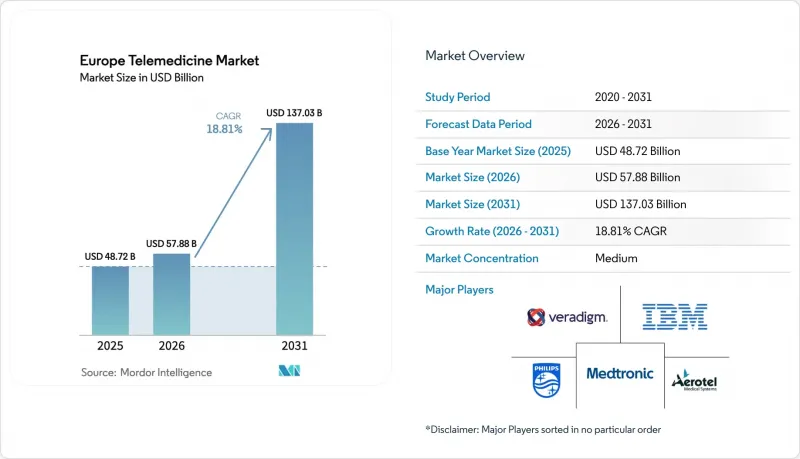
This report is Segmented by Telemedicine Type (Telehospitals, Telehomes, and MHealth), Component (Products [Hardware, and More] and Services), Mode of Delivery (On-Premise Delivery and Cloud-Based Delivery), End-User (Hospitals & Clinics, and More), and Geography (Germany, United Kingdom, and More). The Market Size and Forecasts are Provided in Terms of Value (USD) for the Above Segments.
Europe Telemedicine Market Trends and Insights
Increasing Remote Patient Monitoring
Remote monitoring converts episodic encounters into continuous data streams, allowing clinicians to intervene before decompensation and reduce emergency visits. Germany's cap removal showed reimbursement, not preference, limited uptake, and Norway's e-consult law cut primary-care backlogs by 18%. Wearable biosensors transmit glucose, blood pressure, and ECG data, letting specialists manage triple the patient load asynchronously. A 2024 European heart-failure study found 25% fewer 30-day readmissions, saving EUR 3,200 per patient annually. Remote programs therefore anchor demand growth for the Europe telemedicine market.
Growing Burden of Chronic Diseases
Chronic conditions drive 70% of European health spending, but only 30% of patients receive guideline-level monitoring due to capacity limits. Telemedicine lets endocrinologists review continuous glucose data remotely, replacing quarterly clinic visits. Every 1% shift from in-person to virtual chronic-disease follow-up saves EUR 2.1 billion annually across the bloc. Mental-health demand mirrors this trend; Norway's eMeistring platform treated 40,000 users in 2024 at 60% of the face-to-face cost. These savings reinforce sustained expansion of the Europe telemedicine market.
Legal & Reimbursement Complexity
Twenty-seven distinct licensing and billing regimes raise compliance costs that hinder smaller entrants, freezing Polish adoption at 3% of consultations. Cross-border care still demands multi-country licensure despite EHDS interoperability. Liability rules vary, inflating insurance premiums by up to 50% for multi-jurisdiction operators. Teleconsult fees range from EUR 15 in Spain to EUR 45 in Germany, forcing granular pricing engines. EU attempts to harmonize codes remain in committee, dragging on the Europe telemedicine market.
Other drivers and restraints analyzed in the detailed report include:
- Government Reimbursement Reforms for Digital Health
- Expansion of 5G & Fibre Connectivity
- GDPR-Driven Data-Privacy Concerns
For complete list of drivers and restraints, kindly check the Table Of Contents.
Segment Analysis
Telehospitals accounted for 45.56% of the Europe telemedicine market share in 2025, with ICU and radiology workflows justifying dedicated cameras and secure networks. Remote intensivist oversight lowered hospital mortality by 15% that year. Telehomes, though smaller, will outpace the Europe telemedicine market at a 19.25% CAGR to 2031 as wearables support continuous chronic-care surveillance. National mandates to cut bed use, such as France's EUR 400 million home-monitoring fund, accelerate adoption.
Hospital-at-home pilots in 42 facilities already show equal outcomes at 30% lower cost, fuelling policy momentum. mHealth apps leverage smartphone ubiquity yet still hunt viable revenue models. The NHS App hit 35 million users in 2024, giving governments scale but constraining innovation. Norway's e-consult sick-leave feature saved EUR 25 million in productivity. Convergence across settings will blur categories, supporting diversified growth in the Europe telemedicine market.
Services held 65.53% of the Europe telemedicine market size in 2025, led by teleradiology, telepsychiatry, and tele-ICU consults. AI image assistance cut radiologist time per study by nearly half in Norway. Telepsychiatry volumes remain elevated, with eMeistring delivering CBT at 60% of traditional costs.
Products - hardware, software, and connectivity - will grow at a 20.85% CAGR as the PSTN sunset drives device refreshes. Remote-monitoring kits and AI-stethoscopes integrate software subscriptions at EUR 50-150 per clinician monthly. Smartphone cameras now meet dermatology resolution standards, reducing hardware prices by 70%. Integration of predictive analytics into devices differentiates offerings and underpins long-term expansion of the Europe telemedicine market.
Complete Report Scope:
- By Telemedicine Type
- Telehospitals
- Telehomes
- mHealth (Mobile Health)
- By Component
- Products
- Hardware
- Software
- Other Products
- Services
- Telepathology
- Telecardiology
- Teleradiology
- Teledermatology
- Telepsychiatry
- Tele-ICU
- Products
- By Mode of Delivery
- On-premise Delivery
- Cloud-based Delivery
- By End-user
- Hospitals & Clinics
- Home-care Settings
- Payers & Insurers
- Others (NGOs, Pharma-sponsored Programs)
- By Country
- Germany
- United Kingdom
- France
- Italy
- Spain
- Rest of Europe
List of Companies Covered in this Report:
- Aerotel Medical Systems
- AMD Global Telemedicine
- Babylon Health
- Banner Health (tele-ICU EU JV)
- Chiptech Europe
- Comarch
- Dignio AS
- Doctolib SE
- Essence Group
- GlobalMedia Group
- Huma Therapeutics
- IBM
- Koninklijke Philips
- KRY International AB
- Legrand Care
- Luscii Healthtech
- Medtronic
- OTH.IO
- Resideo Technologies
- SHL Telemedicine
- Teladoc Health
- Tunstall Healthcare
- Veradigm
Additional Benefits:
- The market estimate (ME) sheet in Excel format
- 3 months of analyst support
TABLE OF CONTENTS
1 Introduction
- 1.1 Study Assumptions & Market Definition
- 1.2 Scope of the Study
2 Research Methodology
3 Executive Summary
4 Market Landscape
- 4.1 Market Overview
- 4.2 Market Drivers
- 4.2.1 Increasing remote patient monitoring
- 4.2.2 Growing burden of chronic diseases
- 4.2.3 Government reimbursement reforms for digital health
- 4.2.4 Expansion of 5G & fibre connectivity
- 4.2.5 Cross-border value-based hospital procurement
- 4.2.6 Pan-EU AI-triage APIs integrated into national EHR nodes
- 4.3 Market Restraints
- 4.3.1 Legal & reimbursement complexity
- 4.3.2 GDPR-driven data-privacy concerns
- 4.3.3 PSTN switch-off risking legacy telecare hardware
- 4.3.4 Clinician digital-fatigue lowering post-COVID retention
- 4.4 Regulatory Landscape
- 4.5 Technological Outlook
- 4.6 Porter's Five Forces
- 4.6.1 Bargaining Power of Suppliers
- 4.6.2 Bargaining Power of Buyers
- 4.6.3 Threat of New Entrants
- 4.6.4 Threat of Substitutes
- 4.6.5 Competitive Rivalry
5 Market Size & Growth Forecasts (Value, USD)
- 5.1 By Telemedicine Type
- 5.1.1 Telehospitals
- 5.1.2 Telehomes
- 5.1.3 mHealth (Mobile Health)
- 5.2 By Component
- 5.2.1 Products
- 5.2.1.1 Hardware
- 5.2.1.2 Software
- 5.2.1.3 Other Products
- 5.2.2 Services
- 5.2.2.1 Telepathology
- 5.2.2.2 Telecardiology
- 5.2.2.3 Teleradiology
- 5.2.2.4 Teledermatology
- 5.2.2.5 Telepsychiatry
- 5.2.2.6 Tele-ICU
- 5.2.1 Products
- 5.3 By Mode of Delivery
- 5.3.1 On-premise Delivery
- 5.3.2 Cloud-based Delivery
- 5.4 By End-user
- 5.4.1 Hospitals & Clinics
- 5.4.2 Home-care Settings
- 5.4.3 Payers & Insurers
- 5.4.4 Others (NGOs, Pharma-sponsored Programs)
- 5.5 By Country
- 5.5.1 Germany
- 5.5.2 United Kingdom
- 5.5.3 France
- 5.5.4 Italy
- 5.5.5 Spain
- 5.5.6 Rest of Europe
6 Competitive Landscape
- 6.1 Market Concentration
- 6.2 Market Share Analysis
- 6.3 Company Profiles (includes Global level Overview, Market level overview, Core Segments, Financials as available, Strategic Information, Market Rank/Share, Products & Services, Recent Developments)
- 6.3.1 Aerotel Medical Systems Ltd.
- 6.3.2 AMD Global Telemedicine
- 6.3.3 Babylon Health
- 6.3.4 Banner Health (tele-ICU EU JV)
- 6.3.5 Chiptech Europe
- 6.3.6 Comarch SA
- 6.3.7 Dignio AS
- 6.3.8 Doctolib SE
- 6.3.9 Essence Group
- 6.3.10 GlobalMedia Group
- 6.3.11 Huma Therapeutics
- 6.3.12 IBM Corporation
- 6.3.13 Koninklijke Philips N.V.
- 6.3.14 KRY International AB
- 6.3.15 Legrand Care
- 6.3.16 Luscii Healthtech
- 6.3.17 Medtronic plc
- 6.3.18 OTH.IO
- 6.3.19 Resideo Technologies Inc.
- 6.3.20 SHL Telemedicine
- 6.3.21 Teladoc Health Inc.
- 6.3.22 Tunstall Healthcare
- 6.3.23 Veradigm LLC
7 Market Opportunities & Future Outlook
- 7.1 White-space & Unmet-need Assessment

