PUBLISHER: Mordor Intelligence | PRODUCT CODE: 2122256

PUBLISHER: Mordor Intelligence | PRODUCT CODE: 2122256
Fructo-Oligosaccharides - Market Share Analysis, Industry Trends & Statistics, Growth Forecasts (2026 - 2031)
According to Mordor Intelligence, the fructo-Oligosaccharides market size was valued at USD 3.74 billion in 2025 and is estimated to grow from USD 4.05 billion in 2026 to reach USD 6.02 billion by 2031, at a CAGR of 8.25% during the forecast period (2026-2031).
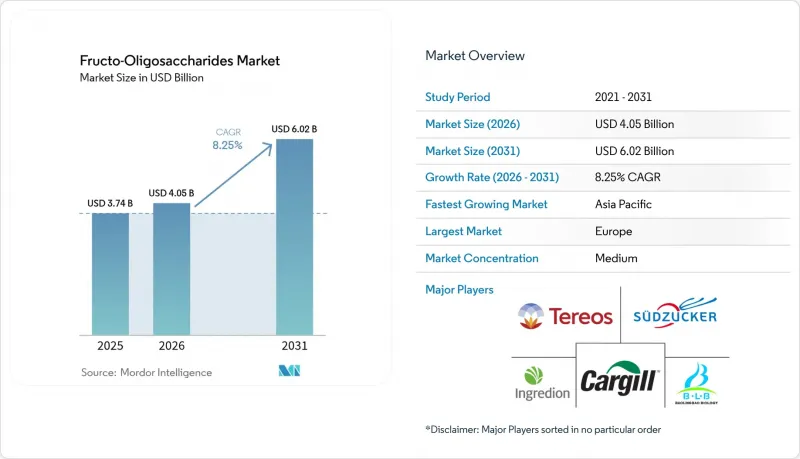
This report is Segmented by Form (Liquid/Syrup, Powder), Application (Infant Formula, Fortified Food and Beverage, Dietary Supplements, Animal Feed, Pharmaceuticals, Other Applications), and Geography (North America, South America, Europe, Asia-Pacific, Middle East and Africa). Market Forecasts are Provided in Terms of Value (USD) and Volume (Tons).
Global Fructo-Oligosaccharides Market Trends and Insights
Rising demand for functional foods and dietary supplements
Consumer spending on functional foods and dietary supplements is shifting from reactive sick-care to proactive wellness management, with prebiotics playing a crucial role in modulating gut microbiota composition. The International Food Information Council's Food and Health Survey 2024 indicates that nearly 67% of Americans consider healthfulness a key factor in their food and beverage purchasing decisions. Regular Fructooligosaccharides (FOS) consumption is associated with improved mineral absorption, enhanced immune function, and better lipid profiles, benefits that appeal to aging populations in developed markets and health-conscious millennials in emerging economies. The European Food Safety Authority has approved health claims for oligosaccharides, enabling brands to highlight prebiotic benefits on product labels without regulatory challenges. This regulatory clarity is driving product innovation: dietary supplement manufacturers are incorporating 3 to 5 grams of FOS per serving into gut-health formulations, while functional beverage brands are adding liquid FOS syrups to ready-to-drink products, ensuring prebiotic fiber is delivered without affecting taste or mouthfeel. However, a major challenge persists in educating consumers about the difference between prebiotics and probiotics. This lack of awareness slows conversion rates despite strong clinical evidence supporting prebiotic benefits.
Increasing incorporation of FOS in infant nutrition formulas
Pediatric nutritionists have consistently worked to replicate the oligosaccharide profile of human breast milk, which contains over 200 structurally unique oligosaccharides that selectively support beneficial gut bacteria in infants. EU Regulation 2016/127 permits the use of fructo-oligosaccharide and galacto-oligosaccharide blends in infant formulas, with a maximum limit of 0.8 grams per 100 milliliters. These blends must adhere to a 90:10 GOS-to-FOS ratio, designed to mimic the prebiotic activity of human milk oligosaccharides. In 2024, China's National Health Commission updated its infant-formula standards to align with Codex Alimentarius guidelines. The National Bureau of Statistics of China reported 7.92 million births in China in 2025, creating a market opportunity for FOS-fortified products. Formulators prefer short-chain FOS over inulin-type fructans because shorter molecules dissolve more easily in reconstituted formula and generate less gas in immature digestive systems. This shift highlights that infant-formula demand is becoming less price-sensitive and more focused on specific formulations, benefiting suppliers capable of delivering pharmaceutical-grade FOS with low endotoxin levels and consistent batch quality.
High production and extraction costs
While the enzymatic synthesis of fructo-oligosaccharides (FOS) from sucrose using B-fructofuranosidase stands as the primary industrial method, it comes with notable cost challenges. These include the expenses of enzyme procurement or in-house production, energy-heavy purification processes like chromatography or membrane filtration, and a sucrose feedstock whose prices are tethered to global sugar market fluctuations. On the other hand, hydrolyzing chicory inulin presents a viable alternative, producing FOS with a purity of around 81%, compared to just 55% from the enzymatic method. However, this method's reliance on chicory root supplies introduces an added layer of risk tied to agricultural commodity prices. Furthermore, energy expenses for processes like spray drying and the cold-chain logistics needed for liquid syrups further strain profit margins. This is especially pronounced in regions like Europe and Japan, where industrial electricity rates surpass USD 0.15 per kilowatt-hour. In response, major producers are strategically positioning FOS plants in proximity to either sucrose refineries or chicory-processing sites, aiming to cut down on feedstock transport costs and secure volume discounts.
Other drivers and restraints analyzed in the detailed report include:
- Rising prevalence of lifestyle diseases
- Rising gut-health and prebiotic awareness
- Consumer sensitivity related to low-FODMAP diets
For complete list of drivers and restraints, kindly check the Table Of Contents.
Segment Analysis
In 2025, powder grades emerged as the leading segment in the Fructo-Oligosaccharides market, accounting for 64.17% of the total revenue. Their widespread adoption is attributed to their stability and compatibility with dry-blend infant formulas and solid-dose pharmaceuticals. These powders, characterized by their free-flowing and agglomerated properties, can withstand prolonged shipping durations without caking, making them highly reliable. This resilience and functionality have enabled powder grades to secure the largest market share. Looking forward to the period from 2026 to 2031, powder sales are anticipated to align closely with the overall market growth. This steady demand is primarily driven by the increasing popularity of sachet-based supplements, particularly across the Asia-Pacific region, where consumer preferences and health awareness are on the rise.
On the other hand, liquid and syrup grades are projected to achieve a robust compound annual growth rate (CAGR) of 8.69%, surpassing the overall market growth rate. This growth is fueled by the increasing demand from beverage and pediatric-syrup formulators who prioritize instant solubility in their products. Suppliers capable of offering both powder and liquid formats from a single facility gain a strategic advantage, as multinational food companies continue to streamline their vendor lists to enhance operational efficiency. High-solids syrups, which typically contain 70-75% solids, offer an optimal balance between viscosity and sweetness, making them a preferred choice in various applications. However, the production of these syrups requires energy-intensive concentration equipment, which poses significant capital investment challenges for new entrants attempting to penetrate the market.
Complete Report Scope:
- Form
- Liquid/Syrup
- Powder
- Application
- Infant Formula
- Fortified Food and Beverage
- Dietary Supplements
- Animal Feed
- Pharmaceuticals
- Other Applications (Cosmetics and personal care, Processed Meat)
- By Geography
- North America
- United States
- Canada
- Mexico
- Rest of North America
- South America
- Brazil
- Argentina
- Colombia
- Chile
- Rest of South America
- Europe
- United Kingdom
- Germany
- France
- Italy
- Spain
- Russia
- Poland
- Netherlands
- Rest of Europe
- Asia-Pacific
- China
- Japan
- India
- Thailand
- Singapore
- Indonesia
- South Korea
- Australia
- Rest of Asia-Pacific
- Middle East and Africa
- United Arab Emirates
- South Africa
- Saudi Arabia
- Egypt
- Turkey
- Rest of Middle East and Africa
- North America
Geography Analysis
In 2025, Europe commanded a 34.97% share of the market, bolstered by its mature functional-food channels, stringent clean-label regulations favoring naturally derived prebiotics, and a well-entrenched infant-formula market where prebiotic fortification is the norm. The European Food Safety Authority's endorsement of oligosaccharide health claims has empowered brands to prominently feature prebiotic benefits on their labels. This regulatory clarity not only accelerates product launches but also boosts consumer acceptance. Leading the regional consumption are Germany, France, and the United Kingdom, thanks to their high per-capita spending on dietary supplements and functional foods. Meanwhile, Eastern European nations like Poland and Russia are emerging growth hotspots, buoyed by rising disposable incomes and the encroachment of Western retail formats. However, Europe grapples with market saturation: prebiotic use in infant formulas has surpassed 80%, and growth in dietary supplements is slowing as the market matures. In response, suppliers are pivoting towards pharmaceutical applications and premium synbiotic formulations, which offer higher margins compared to standard prebiotic powders.
From 2026 to 2031, the Asia-Pacific region is set to grow at a robust 10.03% CAGR, driven by a burgeoning middle class in China demanding premium infant nutrition. Japan's Foods for Specified Health Uses (FOSHU) framework is expediting prebiotic approvals, while India's Food Safety and Standards Authority is liberalizing fortification norms. In China, as parents increasingly seek infant formulas that mimic the oligosaccharide profile of human breast milk, there's a pronounced shift towards high-purity FOS, especially when blended with 2'-fucosyllactose and other human milk oligosaccharides. Japan's FOSHU system streamlines the process for manufacturers, allowing them to make health claims on prebiotic products post clinical evidence submission to the Consumer Affairs Agency. This has paved the way for swift market entry of FOS-fortified functional foods and beverages. In India, heightened health awareness and the rise of e-commerce are propelling the dietary supplement market, spurring demand for budget-friendly prebiotic powders and sachets. However, price sensitivity poses challenges, particularly in rural and semi-urban locales. Southeast Asian nations, notably Thailand, Indonesia, and Vietnam, are witnessing a surge in infant-formula sales and a swift embrace of functional foods among urban millennials.
In 2025, North America, South America, and the Middle East and Africa together made up the rest of the market share, with North America leading the pack. This dominance is attributed to its high consumption of dietary supplements and a robust functional-food retail landscape. In South America, countries like Brazil, Argentina, and Chile are slowly warming up to prebiotic-fortified products, thanks to rising disposable incomes and the spread of Western dietary habits. However, challenges like regulatory fragmentation and import tariffs hinder cross-border trade. Meanwhile, in the Middle East and Africa, demand for FOS is still in its infancy. Yet, urban hubs like Dubai, Riyadh, and Johannesburg, bolstered by their expatriate communities and affluent locals, are driving the consumption of imported functional foods and dietary supplements.
- Sudzucker AG (BENEO)
- Cargill Inc.
- Ingredion Incorporated
- Tereos Group
- Baolingbao Biological Co. Ltd.
- Tate and Lyle PLC
- Galam Group
- Quantum Hi-Tech Biological
- Cosucra Groupe Warcoing
- Royal FrieslandCampina N.V.
- Meiji Holdings Co. Ltd.
- Yakult Honsha Co. Ltd.
- CJ CheilJedang Corp.
- DSM-Firmenich AG
- Archer Daniels Midland Company
- Jarrow Formulas Inc.
- Brenntag SE
- Roquette Freres
- Sensus (Royal Cosun)
- Nexira
- Samyang Corporation
Additional Benefits:
- The market estimate (ME) sheet in Excel format
- 3 months of analyst support
TABLE OF CONTENTS
1 INTRODUCTION
- 1.1 Study Assumptions and Market Definition
- 1.2 Scope of the Study
2 RESEARCH METHODOLOGY
3 EXECUTIVE SUMMARY
4 MARKET LANDSCAPE
- 4.1 Market Overview
- 4.2 Market Drivers
- 4.2.1 Rising demand for functional foods and dietary supplements
- 4.2.2 Increasing incorporation of FOS in infant nutrition formulas
- 4.2.3 Rising prevalence of lifestyle diseases
- 4.2.4 Rising gut-health and prebiotic awareness
- 4.2.5 Strategic collaborations and supply agreements
- 4.2.6 Industry investment in R and D to develop innovative synbiotic products
- 4.3 Market Restraints
- 4.3.1 High production and extraction costs
- 4.3.2 Consumer Sensitivity Related to Low-FODMAP Diets
- 4.3.3 Gastrointestinal Tolerance Issues at High Dosages
- 4.3.4 Price sensitivity among end-users and manufacturers
- 4.4 Supply Chain Analysis
- 4.5 Regulatory Landscape
- 4.6 Technological Outlook
- 4.7 Porter's Five Forces
- 4.7.1 Threat of New Entrants
- 4.7.2 Bargaining Power of Buyers
- 4.7.3 Bargaining Power of Suppliers
- 4.7.4 Threat of Substitutes
- 4.7.5 Intensity of Competitive Rivalry
5 MARKET SIZE AND GROWTH FORECASTS (VALUE AND VOLUME)
- 5.1 Form
- 5.1.1 Liquid/Syrup
- 5.1.2 Powder
- 5.2 Application
- 5.2.1 Infant Formula
- 5.2.2 Fortified Food and Beverage
- 5.2.3 Dietary Supplements
- 5.2.4 Animal Feed
- 5.2.5 Pharmaceuticals
- 5.2.6 Other Applications (Cosmetics and personal care, Processed Meat)
- 5.3 By Geography
- 5.3.1 North America
- 5.3.1.1 United States
- 5.3.1.2 Canada
- 5.3.1.3 Mexico
- 5.3.1.4 Rest of North America
- 5.3.2 South America
- 5.3.2.1 Brazil
- 5.3.2.2 Argentina
- 5.3.2.3 Colombia
- 5.3.2.4 Chile
- 5.3.2.5 Rest of South America
- 5.3.3 Europe
- 5.3.3.1 United Kingdom
- 5.3.3.2 Germany
- 5.3.3.3 France
- 5.3.3.4 Italy
- 5.3.3.5 Spain
- 5.3.3.6 Russia
- 5.3.3.7 Poland
- 5.3.3.8 Netherlands
- 5.3.3.9 Rest of Europe
- 5.3.4 Asia-Pacific
- 5.3.4.1 China
- 5.3.4.2 Japan
- 5.3.4.3 India
- 5.3.4.4 Thailand
- 5.3.4.5 Singapore
- 5.3.4.6 Indonesia
- 5.3.4.7 South Korea
- 5.3.4.8 Australia
- 5.3.4.9 Rest of Asia-Pacific
- 5.3.5 Middle East and Africa
- 5.3.5.1 United Arab Emirates
- 5.3.5.2 South Africa
- 5.3.5.3 Saudi Arabia
- 5.3.5.4 Egypt
- 5.3.5.5 Turkey
- 5.3.5.6 Rest of Middle East and Africa
- 5.3.1 North America
6 COMPETITIVE LANDSCAPE
- 6.1 Market Concentration
- 6.2 Strategic Moves
- 6.3 Market Share Analysis
- 6.4 Company Profiles (includes Global level Overview, Market level overview, Core Segments, Financials as available, Strategic Information, Market Rank/Share for key companies, Products and Services, and Recent Developments)
- 6.4.1 Sudzucker AG (BENEO)
- 6.4.2 Cargill Inc.
- 6.4.3 Ingredion Incorporated
- 6.4.4 Tereos Group
- 6.4.5 Baolingbao Biological Co. Ltd.
- 6.4.6 Tate and Lyle PLC
- 6.4.7 Galam Group
- 6.4.8 Quantum Hi-Tech Biological
- 6.4.9 Cosucra Groupe Warcoing
- 6.4.10 Royal FrieslandCampina N.V.
- 6.4.11 Meiji Holdings Co. Ltd.
- 6.4.12 Yakult Honsha Co. Ltd.
- 6.4.13 CJ CheilJedang Corp.
- 6.4.14 DSM-Firmenich AG
- 6.4.15 Archer Daniels Midland Company
- 6.4.16 Jarrow Formulas Inc.
- 6.4.17 Brenntag SE
- 6.4.18 Roquette Freres
- 6.4.19 Sensus (Royal Cosun)
- 6.4.20 Nexira
- 6.4.21 Samyang Corporation
7 MARKET OPPORTUNITIES AND FUTURE OUTLOOK

