PUBLISHER: Mordor Intelligence | PRODUCT CODE: 2122274

PUBLISHER: Mordor Intelligence | PRODUCT CODE: 2122274
Submarine Optical Fiber Cable - Market Share Analysis, Industry Trends & Statistics, Growth Forecasts (2026 - 2031)
According to Mordor Intelligence, the submarine optical fiber cable market size is projected to be USD 5.22 billion in 2025, USD 5.89 billion in 2026, and reach USD 9.87 billion by 2031, growing at a CAGR of 10.87% from 2026 to 2031.
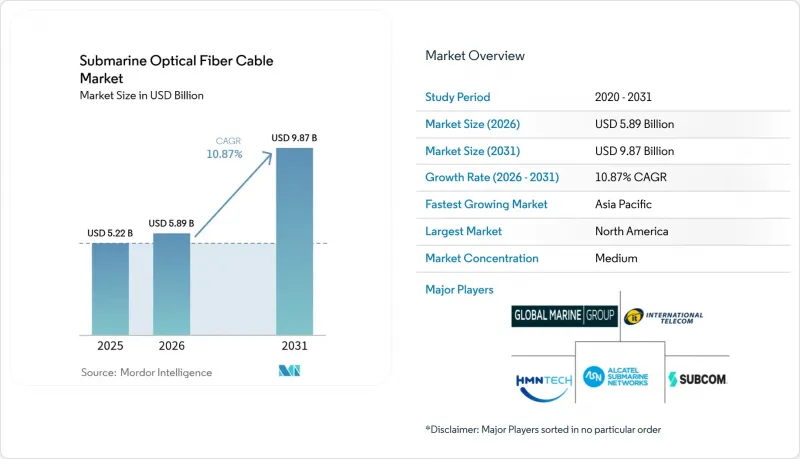
This report is Segmented by Component (Wet-Plant Equipment, Dry-Plant Equipment, and More), Cable Type (Single-Mode Fiber, Multimode Fiber, and More), Client Type (Telecom Operators, Content and Hyperscale Cloud Providers, and More), Capacity Design (less Than or Equal To 16 Tbps Systems, 16-60 Tbps Systems, and More), and Geography. The Market Forecasts are Provided in Terms of Value (USD).
Global Submarine Optical Fiber Cable Market Trends and Insights
Hyperscale Cloud and OTT Investment in Private Cables
Content platforms now commission the majority of new trans-oceanic systems. Meta's 2Africa and Waterworth programs together exceed 90,000 km of route length and secure end-to-end ownership, eliminating bandwidth-lease negotiations. Google activated the Dhivaru link between Singapore and the Maldives in 2025 to ensure low-latency replication for AI model training. Amazon obtained landing rights in Ireland for a 100 Tbit-s trans-Atlantic route scheduled for 2027. These moves channel multi-billion-dollar capital flows directly to fiber manufacturers, reshaping supplier power dynamics. Telecom groups respond by repositioning as wholesale landlords rather than end-to-end owners.
Rapid 400 GbE and 800 GbE Upgrade Cycle Among Carriers
Coherent pluggable optics let operators quadruple wavelength throughput on legacy cables. Omantel proved the economics in 2025 by lifting each channel to 800 Gbps with Ciena's WaveLogic 6 and deferring a USD 200 million rip-and-replace project by at least five years. Altibox has already validated 1.6 Tbit-s single-wavelength trials, hinting at commercial adoption before 2028. Adoption of ITU-T G.654.E low-attenuation fiber in 60% of 2025 tenders further extends span lengths, lowering amplifier counts and operating power budgets.
High Maintenance and Repair-Ship Costs
Deep-water repairs typically range from USD 1 million to 3 million. This cost is influenced by daily vessel charter rates, which hover between USD 0.1 million and 0.3 million, and the unpredictable nature of multi-week weather windows. With only 60 dedicated repair ships available globally, the industry faces significant bottlenecks, especially when multiple vessels encounter faults simultaneously. In 2025, insurers responded to these challenges by increasing premiums by as much as 30% for corridors deemed high-risk. In light of these rising costs and potential downtimes, operators have begun pre-booking standby contracts. While this strategy adds an extra 5-8% to their project budgets, it significantly mitigates the risk of extended downtimes.
Other drivers and restraints analyzed in the detailed report include:
- Growing Smartphone Penetration and Rising Internet Bandwidth Demand
- Increasing Fiber Connectivity in Emerging Regions
- Growing Investment in LEO Satellite Constellations
For complete list of drivers and restraints, kindly check the Table Of Contents.
Segment Analysis
The submarine optical fiber cable market size for wet-plant equipment stood at USD 2.67 billion in 2025, equal to 51.32% of overall revenue, as repeaters and branching units remain the single largest cost block. Yet auxiliary and marine services are growing at 11.69% annually because operators in conflict-prone corridors purchase round-the-clock repair coverage and seabed route audits. That service-centric shift increases recurring revenue and cushions suppliers against the lumpiness of turnkey hardware contracts.
Dry-plant equipment, namely optical line terminals and monitoring platforms, faces commoditization as hyperscalers demand open architectures that disaggregate transport electronics from wet-plant vendors. Smaller niches, including distributed acoustic sensing units that repurpose the fiber itself as a vibration sensor, have emerged after National Grid's 2024 deployment proved 15% turbine-downtime savings for offshore wind projects. Across components, suppliers diversify into hybrid power-data cables to tap an adjacent USD 500 million addressable pool by 2030.
Single-mode designs held 66.32% of 2025 revenue, but multi-core and SDM fiber posted the highest growth at 11.43% as NEC's 22-core demonstration reached 680 Tbit-s on a single fiber pair. Early deployments remain inside data-center campuses, yet splicing-cost declines to below USD 10,000 per joint, anticipated by 2027, will unlock long-haul adoption. The ITU-T G.654.E low-attenuation specification underpins most new tender documents, enabling amplifier spacing of 400 km and trimming repeater counts by 40% versus legacy G.652.D.
Multimode fiber persists for short offshore-platform hops under 10 km but continues to cede share as single-mode prices fall. Suppliers funnel R&D toward hollow-core variants that promise sub-latency propagation and could complement SDM in the next decade if manufacturing yields stabilize.
Complete Report Scope:
- By Component
- Wet-Plant Equipment
- Dry-Plant Equipment
- Auxiliary and Marine Services
- Other Components
- By Cable Type
- Single-mode Fiber
- Multimode Fiber
- SDM / Multi-core Fiber
- By Client Type
- Telecom Operators
- Content and Hyperscale Cloud Providers
- Government and Research Networks
- Offshore Energy Operators
- Other Clinet Types
- By Capacity Design
- less than or equal to 16 Tbps Systems
- 16 - 60 Tbps Systems
- above 60 Tbps Systems
- By Geography
- North America
- United States
- Canada
- South America
- Brazil
- Argentina
- Rest of South America
- Europe
- Germany
- France
- United Kingdom
- Rest of Europe
- Asia-Pacific
- China
- India
- Japan
- Australia
- Rest of Asia-Pacific
- Middle East
- Saudi Arabia
- United Arab Emirates
- Turkey
- Rest of Middle East
- Africa
- South Africa
- Egypt
- Nigeria
- Rest of Africa
- North America
Geography Analysis
Asia-Pacific led the submarine optical fiber cable market with 33.21% revenue in 2025, driven by the SEA-ME-WE-6's Mumbai landing and Japan's USD 300 million JUNO route, which secures disaster-recovery links for Tokyo enterprises. China's manufacturers remain active but face political headwinds in Australia and the United States, rerouting traffic through Singapore and Hong Kong to comply with national-security screening requirements.
Africa delivers the fastest growth at 11.83% CAGR through 2031. Meta's 2Africa system now spans the continent with 180 Tbit-s of capacity across 33 landings, slashing wholesale Mbps prices by double digits in Nigeria, Kenya, and South Africa. Lower tariffs stimulate local data-center builds and cloud on-ramp deployments that were impossible under satellite-backed terabit ceilings.
North America sees steady replacement demand as early-2000s cables reach end of life and are upgraded to 800 GbE wavelengths. Europe's permitting cycle grew longer after Brexit split licensing regimes for cross-Channel landings, while strict EU environmental reviews add 12-18 months to Mediterranean routes. South America diversifies away from its Miami choke point via Brazil-Portugal links such as Seabras-2, creating alternate corridors that lower single-point-failure risk. Middle Eastern traffic remains transit-heavy; operators now deploy Red Sea protection loops to hedge against disruption, and insurers levy higher premiums on Suez passages. Emerging trans-polar routes promise 30% latency cuts between Asia and Europe once Far North Fiber's 14,000 km link activates in late 2026..
- Alcatel Submarine Networks Ltd.
- HMN Technologies Co., Ltd.
- Nexans S.A.
- SubCom, LLC
- Fujitsu Ltd.
- Global Marine Group Ltd.
- IT International Telecom Inc.
- Orange Marine SAS
- Sumitomo Electric Industries Ltd.
- LS Cable and System Ltd.
- Jiangsu Hengtong Marine Cable Systems Co., Ltd.
- S.B. Submarine Systems Co., Ltd.
- PT Communication Cable Systems Indonesia Tbk
- NTT Communications Corporation
- Verizon Communications Inc.
- Telstra Group Limited
- China Unicom Global Limited
- Telekom Malaysia Berhad
- Oman Telecommunications Company S.A.O.G. (Omantel)
- Meta Platforms, Inc.
- Amazon.com, Inc.
- Google LLC
Additional Benefits:
- The market estimate (ME) sheet in Excel format
- 3 months of analyst support
TABLE OF CONTENTS
1 INTRODUCTION
- 1.1 Study Assumptions and Market Definition
- 1.2 Scope of the Study
2 RESEARCH METHODOLOGY
3 EXECUTIVE SUMMARY
4 MARKET LANDSCAPE
- 4.1 Market Overview
- 4.2 Market Drivers
- 4.2.1 Growing Smartphone Penetration and Rising Internet Bandwidth Demand
- 4.2.2 Increasing Fiber Connectivity in Emerging Regions
- 4.2.3 Rapid 400 GbE and 800 GbE Upgrade Cycle among Carriers
- 4.2.4 Hyperscale Cloud and OTT Investment in Private Cables
- 4.2.5 Push toward Low-Latency Trans-polar Routes
- 4.2.6 Offshore Wind Farms Adopting Hybrid Power-Data Cables
- 4.3 Market Restraints
- 4.3.1 High Maintenance and Repair-Ship Costs
- 4.3.2 Growing Investment in LEO Satellite Constellations
- 4.3.3 Geopolitical Cable-Landing Permit Delays
- 4.3.4 Fiber-Optic Theft and Vandalism in Shallow Waters
- 4.4 Industry Value / Supply-Chain Analysis
- 4.5 Regulatory Landscape
- 4.6 Technological Outlook
- 4.7 Porter's Five Forces
- 4.7.1 Bargaining Power of Suppliers
- 4.7.2 Bargaining Power of Buyers
- 4.7.3 Threat of New Entrants
- 4.7.4 Threat of Substitute Products
- 4.7.5 Degree of Competition
- 4.8 Impact of Macroeconomic Factors on the Market
- 4.9 Investment Analysis
- 4.10 Submarine Cable Projects Database
5 MARKET SIZE AND GROWTH FORECASTS (VALUE)
- 5.1 By Component
- 5.1.1 Wet-Plant Equipment
- 5.1.2 Dry-Plant Equipment
- 5.1.3 Auxiliary and Marine Services
- 5.1.4 Other Components
- 5.2 By Cable Type
- 5.2.1 Single-mode Fiber
- 5.2.2 Multimode Fiber
- 5.2.3 SDM / Multi-core Fiber
- 5.3 By Client Type
- 5.3.1 Telecom Operators
- 5.3.2 Content and Hyperscale Cloud Providers
- 5.3.3 Government and Research Networks
- 5.3.4 Offshore Energy Operators
- 5.3.5 Other Clinet Types
- 5.4 By Capacity Design
- 5.4.1 less than or equal to 16 Tbps Systems
- 5.4.2 16 - 60 Tbps Systems
- 5.4.3 above 60 Tbps Systems
- 5.5 By Geography
- 5.5.1 North America
- 5.5.1.1 United States
- 5.5.1.2 Canada
- 5.5.2 South America
- 5.5.2.1 Brazil
- 5.5.2.2 Argentina
- 5.5.2.3 Rest of South America
- 5.5.3 Europe
- 5.5.3.1 Germany
- 5.5.3.2 France
- 5.5.3.3 United Kingdom
- 5.5.3.4 Rest of Europe
- 5.5.4 Asia-Pacific
- 5.5.4.1 China
- 5.5.4.2 India
- 5.5.4.3 Japan
- 5.5.4.4 Australia
- 5.5.4.5 Rest of Asia-Pacific
- 5.5.5 Middle East
- 5.5.5.1 Saudi Arabia
- 5.5.5.2 United Arab Emirates
- 5.5.5.3 Turkey
- 5.5.5.4 Rest of Middle East
- 5.5.6 Africa
- 5.5.6.1 South Africa
- 5.5.6.2 Egypt
- 5.5.6.3 Nigeria
- 5.5.6.4 Rest of Africa
- 5.5.1 North America
6 COMPETITIVE LANDSCAPE
- 6.1 Market Concentration
- 6.2 Strategic Moves
- 6.3 Market Share Analysis
- 6.4 Company Profiles (includes Global level Overview, Market level overview, Core Segments, Financials as available, Strategic Information, Market Rank/Share for key companies, Products and Services, and Recent Developments)
- 6.4.1 Alcatel Submarine Networks Ltd.
- 6.4.2 HMN Technologies Co., Ltd.
- 6.4.3 Nexans S.A.
- 6.4.4 SubCom, LLC
- 6.4.5 Fujitsu Ltd.
- 6.4.6 Global Marine Group Ltd.
- 6.4.7 IT International Telecom Inc.
- 6.4.8 Orange Marine SAS
- 6.4.9 Sumitomo Electric Industries Ltd.
- 6.4.10 LS Cable and System Ltd.
- 6.4.11 Jiangsu Hengtong Marine Cable Systems Co., Ltd.
- 6.4.12 S.B. Submarine Systems Co., Ltd.
- 6.4.13 PT Communication Cable Systems Indonesia Tbk
- 6.4.14 NTT Communications Corporation
- 6.4.15 Verizon Communications Inc.
- 6.4.16 Telstra Group Limited
- 6.4.17 China Unicom Global Limited
- 6.4.18 Telekom Malaysia Berhad
- 6.4.19 Oman Telecommunications Company S.A.O.G. (Omantel)
- 6.4.20 Meta Platforms, Inc.
- 6.4.21 Amazon.com, Inc.
- 6.4.22 Google LLC
7 MARKET OPPORTUNITIES AND FUTURE OUTLOOK
- 7.1 White-space and Unmet-Need Assessment

