PUBLISHER: Mordor Intelligence | PRODUCT CODE: 2122286

PUBLISHER: Mordor Intelligence | PRODUCT CODE: 2122286
IAM Security Services - Market Share Analysis, Industry Trends & Statistics, Growth Forecasts (2026 - 2031)
According to Mordor Intelligence, the IAM security services market size was valued at USD 19.04 billion in 2025 and is estimated to grow from USD 21.42 billion in 2026 to reach USD 36.29 billion by 2031, at a CAGR of 11.12% during the forecast period (2026-2031).
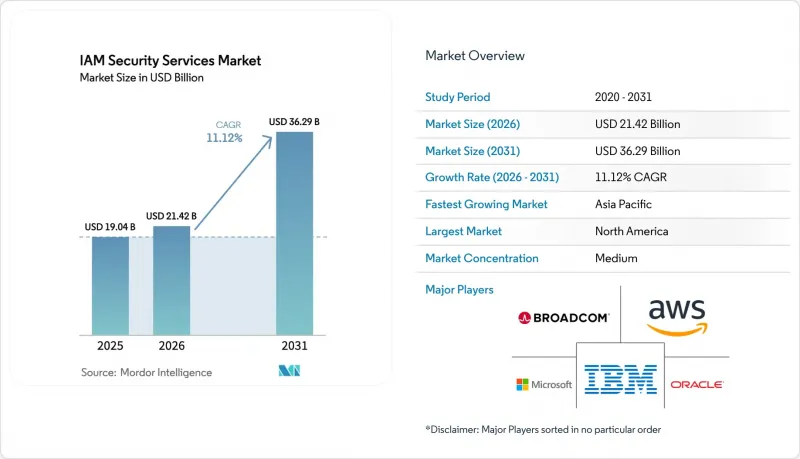
This report is Segmented by Type of Solutions (Identity Cloud, and More), Service Type (Professional Services, and Managed Services), Type of Deployment (On-Premise, Hybrid, and Cloud-Based), Organization Size (Large Enterprises, and Small and Medium Enterprises), End-User Vertical (BFSI, IT and Telecom, Manufacturing, and More), and Geography. The Market Forecasts are Provided in Terms of Value (USD).
Global IAM Security Services Market Trends and Insights
Rising Cybersecurity Threats and Data Breaches
Phishing kits that automate adversary-in-the-middle attacks now bypass SMS one-time codes in real time, eroding trust in legacy factors. The United States Cybersecurity and Infrastructure Security Agency requires all federal bodies to move to phishing-resistant factors by fiscal year 2024, endorsing FIDO2 tokens and biometrics. Firms are deploying adaptive engines that interrogate device posture, geolocation, and behavioural cues, shrinking lateral movement when intrusions occur. With breach costs nearing USD 4.9 million, boards allocate larger security budgets toward identity perimeters that reduce dwell time. These investments push the IAM Security Services market toward platform bundles that fuse authentication with real-time analytics.
Stringent Regulatory Compliance Mandates
The European Union's Digital Operational Resilience Act enforces four-hour incident alerts, forcing banks to build live identity analytics that knit privileged user activity to system anomalies. Parallel directives under HIPAA logged 725 healthcare breaches in 2024, prompting new U.S. guidance on automated de-provisioning. India's Digital Personal Data Protection Act and China's Multi-Level Protection Scheme 2.0 add stringent consent, audit, and localization rules, standardizing a baseline of least-privilege and immutable logging across multinationals. Compliance complexity raises operational costs but simultaneously cements IAM as a non-negotiable spend, enlarging the IAM Security Services market footprint.
Other drivers and restraints analyzed in the detailed report include:
- Rapid Shift to Cloud and Hybrid Work Models
- Transition Toward Zero Trust Architectures
For complete list of drivers and restraints, kindly check the Table Of Contents.
Segment Analysis
Identity Cloud offerings, projected to post an 11.86% CAGR through 2031, outstrip the broader IAM Security Services market as enterprises retire on-premises forests. Access Management previously commanded the largest slice at 35.19% in 2025, underscoring its role as the gateway for single sign-on and phishing-resistant factors. Continuous alignment with CISA standards keeps hardware-backed MFA at the center of modernization programs. The segment's dominance anchors USD 7.5 billion of the 2026 IAM Security Services market size, illustrating its foundational pull within procurement blueprints.
Directory Services is trending downward as SaaS vendors expose RESTful endpoints that bypass LDAP queries. Conversely, machine identity sprawl drives demand for privileged access and certificate lifecycle tools housed in the "Other" solutions category. CyberArk's purchase of Venafi extended coverage across human and non-human credentials, positioning platform bundles to manage 45:1 identity ratio. Identity Cloud further leverages pre-built connectors from Okta and Auth0, Inc. that shave integration cycles, making it the default for greenfield workloads and accelerating churn from legacy stacks across the IAM Security Services market.
Professional Services absorbed 54.28% of 2025 revenue, mirroring the up-front consulting muscle needed to map entitlements and tune policies for complex estates. Yet a 12.01% CAGR propels Managed Services as mid-market firms offload 24/7 monitoring to external SOCs. For enterprises under 5,000 employees, managed fees undercut fully loaded internal analyst costs, shifting expenditure patterns toward consumption models. This pivot reshapes USD 11.3 billion of the 2031 IAM Security Services market size, adding predictable annuity streams for vendors.
Managed Detection and Response merges identity analytics with endpoint telemetry, creating a tighter loop that revokes anomalous sessions before exfiltration occurs. Professional consultancies remain indispensable for merger-driven identity consolidation among global conglomerates. Skills scarcity, with a 3.5-million-person cybersecurity gap in 2024, boosts both categories as organizations scramble for expertise. The tug-of-war between bespoke projects and turnkey outsourcing will shape competitive positioning within the IAM Security Services market.
Complete Report Scope:
- By Type of Solutions
- Identity Cloud
- Identity Governance
- Access Management
- Directory Services
- Other Type of Solutions
- By Service Type
- Professional Services
- Managed Services
- By Type of Deployment
- On-premise
- Hybrid
- Cloud-based
- By Organization Size
- Large Enterprises
- Small and Medium Enterprises
- By End-user Vertical
- BFSI
- IT and Telecom
- Education
- Healthcare
- Retail
- Energy
- Manufacturing
- Other End-User Vertical
- By Geography
- North America
- United States
- Canada
- Mexico
- Europe
- United Kingdom
- Germany
- France
- Italy
- Rest of Europe
- Asia-Pacific
- China
- Japan
- India
- South Korea
- Rest of Asia
- Middle East
- Israel
- Saudi Arabia
- United Arab Emirates
- Turkey
- Rest of Middle East
- Africa
- South Africa
- Egypt
- Rest of Africa
- South America
- Brazil
- Argentina
- Rest of South America
- North America
Geography Analysis
North America generated 43.77% of 2025 revenue, propelled by federal edicts that demand phishing-resistant tokens and enterprise single sign-on, which spill over to contractors and regulated healthcare entities. A mature reseller ecosystem simplifies deployment, yet 80% of public-sector IT outlays still feed aging COBOL crates, dragging on modernization velocity. Cloud-first mandates and steady breach disclosures keep the IAM Security Services market entrenched in board-level agendas across the United States and Canada.
Asia Pacific is forecast to clock the fastest 12.67% CAGR through 2031. India's Digital Personal Data Protection Act, China's MLPS 2.0, and South Korea's stringent breach rules converge to set unified access-logging baselines. Rapid cloud uptake across Southeast Asia presents greenfield terrain for SaaS identity suites that integrate with regional payment gateways. Local compliance nuances spur demand for on-premises variants featuring sovereign hosting, enlarging solution matrices within the IAM Security Services market.
Europe combines GDPR benchmarks with sectoral overlays like the Network and Information Security Directive 2, driving consistent investment in consent management and data-subject workflows. Germany's focus on Zero Trust and France's mandates for multi-factor authentication among operators of vital importance escalate platform adoption. The Middle East and Africa segment remains nascent but benefits from national digital-identity schemes that front-load authentication for citizen services. Latin America edges forward under Brazil's Lei Geral de Protecao de Dados, unlocking gradual gains in IAM Security Services market penetration.
- IBM Corporation
- Oracle Corporation
- Broadcom Inc.
- Microsoft Corporation
- Amazon Web Services, Inc.
- Centrify Corporation
- Okta Inc.
- CyberArk Software Ltd.
- SailPoint Technologies Inc.
- HID Global Corporation
- NetIQ Corporation
- Ping Identity Corporation
- ForgeRock Inc.
- Thales Group
- Delinea Inc.
- BeyondTrust Corporation
- One Identity LLC
- Duo Security, Inc.
- HashiCorp Inc.
- Saviynt Inc.
- SecureAuth Corporation
- JumpCloud Inc.
- Google LLC (Cloud Identity)
- Palo Alto Networks, Inc.
- CrowdStrike Inc.
- Auth0, Inc.
- Veridas Biometric Identity
Additional Benefits:
- The market estimate (ME) sheet in Excel format
- 3 months of analyst support
TABLE OF CONTENTS
1 INTRODUCTION
- 1.1 Study Assumptions and Market Definition
- 1.2 Scope of the Study
2 RESEARCH METHODOLOGY
3 EXECUTIVE SUMMARY
4 MARKET LANDSCAPE
- 4.1 Market Overview
- 4.2 Market Drivers
- 4.2.1 Rising Cybersecurity Threats and Data Breaches
- 4.2.2 Stringent Regulatory Compliance Mandates
- 4.2.3 Rapid Shift to Cloud and Hybrid Work Models
- 4.2.4 Transition Toward Zero Trust Architectures
- 4.2.5 Explosion of Machine Identities and AI Agents
- 4.2.6 Emergence of Passwordless Authentication via FIDO2 Passkeys
- 4.3 Market Restraints
- 4.3.1 High Implementation and Maintenance Costs
- 4.3.2 Legacy System Integration Complexity
- 4.3.3 Shortage of Skilled IAM Professionals
- 4.3.4 Unclear Pricing Models for Machine Identities
- 4.4 Industry Value Chain Analysis
- 4.5 Regulatory Landscape
- 4.6 Technological Outlook
- 4.7 Impact of Macroeconomic Factors on the Market
- 4.8 Porter's Five Forces Analysis
- 4.8.1 Threat of New Entrants
- 4.8.2 Bargaining Power of Buyers
- 4.8.3 Bargaining Power of Suppliers
- 4.8.4 Threat of Substitute Products
- 4.8.5 Intensity of Competitive Rivalry
- 4.9 Investment Analysis
5 MARKET SIZE AND GROWTH FORECASTS (VALUE)
- 5.1 By Type of Solutions
- 5.1.1 Identity Cloud
- 5.1.2 Identity Governance
- 5.1.3 Access Management
- 5.1.4 Directory Services
- 5.1.5 Other Type of Solutions
- 5.2 By Service Type
- 5.2.1 Professional Services
- 5.2.2 Managed Services
- 5.3 By Type of Deployment
- 5.3.1 On-premise
- 5.3.2 Hybrid
- 5.3.3 Cloud-based
- 5.4 By Organization Size
- 5.4.1 Large Enterprises
- 5.4.2 Small and Medium Enterprises
- 5.5 By End-user Vertical
- 5.5.1 BFSI
- 5.5.2 IT and Telecom
- 5.5.3 Education
- 5.5.4 Healthcare
- 5.5.5 Retail
- 5.5.6 Energy
- 5.5.7 Manufacturing
- 5.5.8 Other End-User Vertical
- 5.6 By Geography
- 5.6.1 North America
- 5.6.1.1 United States
- 5.6.1.2 Canada
- 5.6.1.3 Mexico
- 5.6.2 Europe
- 5.6.2.1 United Kingdom
- 5.6.2.2 Germany
- 5.6.2.3 France
- 5.6.2.4 Italy
- 5.6.2.5 Rest of Europe
- 5.6.3 Asia-Pacific
- 5.6.3.1 China
- 5.6.3.2 Japan
- 5.6.3.3 India
- 5.6.3.4 South Korea
- 5.6.3.5 Rest of Asia
- 5.6.4 Middle East
- 5.6.4.1 Israel
- 5.6.4.2 Saudi Arabia
- 5.6.4.3 United Arab Emirates
- 5.6.4.4 Turkey
- 5.6.4.5 Rest of Middle East
- 5.6.5 Africa
- 5.6.5.1 South Africa
- 5.6.5.2 Egypt
- 5.6.5.3 Rest of Africa
- 5.6.6 South America
- 5.6.6.1 Brazil
- 5.6.6.2 Argentina
- 5.6.6.3 Rest of South America
- 5.6.1 North America
6 COMPETITIVE LANDSCAPE
- 6.1 Market Concentration
- 6.2 Strategic Moves
- 6.3 Market Share Analysis
- 6.4 Company Profiles (includes Global Level Overview, Market Level Overview, Core Segments, Financials as available, Strategic Information, Market Rank/Share for key companies, Products and Services, and Recent Developments)
- 6.4.1 IBM Corporation
- 6.4.2 Oracle Corporation
- 6.4.3 Broadcom Inc.
- 6.4.4 Microsoft Corporation
- 6.4.5 Amazon Web Services, Inc.
- 6.4.6 Centrify Corporation
- 6.4.7 Okta Inc.
- 6.4.8 CyberArk Software Ltd.
- 6.4.9 SailPoint Technologies Inc.
- 6.4.10 HID Global Corporation
- 6.4.11 NetIQ Corporation
- 6.4.12 Ping Identity Corporation
- 6.4.13 ForgeRock Inc.
- 6.4.14 Thales Group
- 6.4.15 Delinea Inc.
- 6.4.16 BeyondTrust Corporation
- 6.4.17 One Identity LLC
- 6.4.18 Duo Security, Inc.
- 6.4.19 HashiCorp Inc.
- 6.4.20 Saviynt Inc.
- 6.4.21 SecureAuth Corporation
- 6.4.22 JumpCloud Inc.
- 6.4.23 Google LLC (Cloud Identity)
- 6.4.24 Palo Alto Networks, Inc.
- 6.4.25 CrowdStrike Inc.
- 6.4.26 Auth0, Inc.
- 6.4.27 Veridas Biometric Identity
7 MARKET OPPORTUNITIES AND FUTURE OUTLOOK
- 7.1 White-space and Unmet-Need Assessment

