PUBLISHER: Mordor Intelligence | PRODUCT CODE: 2122296

PUBLISHER: Mordor Intelligence | PRODUCT CODE: 2122296
Data Analytics Outsourcing - Market Share Analysis, Industry Trends & Statistics, Growth Forecasts (2026 - 2031)
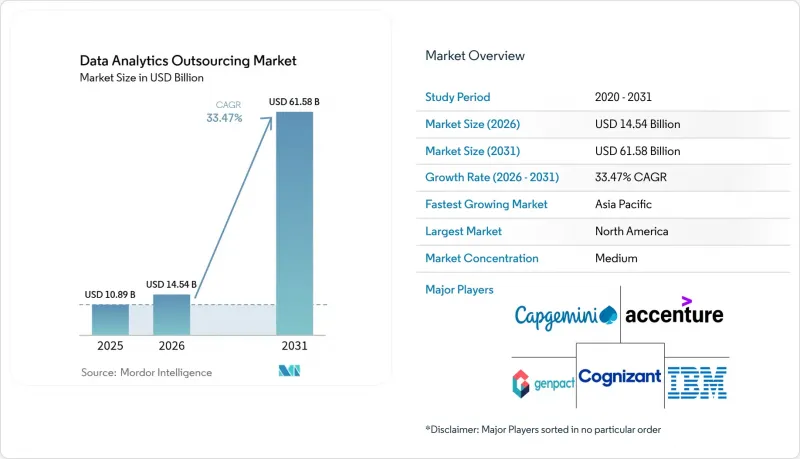
According to Mordor Intelligence, the data analytics outsourcing market size was valued at USD 10.89 billion in 2025 and estimated to grow from USD 14.54 billion in 2026 to reach USD 61.58 billion by 2031, at a CAGR of 33.47% during the forecast period (2026-2031).
This report is Segmented by Analytics Type (Descriptive, Diagnostic, and More), End-User Industry (Retail and E-Commerce, BFSI, and More), Service Model (Offshore, Nearshore, and On-shore/On-site), Organization Size (Large Enterprises and SMEs), Deployment Model (Cloud-Only and Hybrid Cloud), and Geography. The Market Forecasts are Provided in Terms of Value (USD).
Global Data Analytics Outsourcing Market Trends and Insights
Surging Enterprise Data Volumes and Complexity
Global organizations now generate petabytes of structured, semi-structured, and unstructured data from mobile apps, IoT devices, and omnichannel touchpoints, overwhelming in-house processing capacity. Limited internal skills in data engineering and machine learning further hamper timeliness. Outsourcing partners address these gaps with pre-built ingestion pipelines, scalable cloud infrastructure, and industry-specific data models that shorten time to insight while lowering total cost of ownership. Many clients adopt pay-as-you-go data-as-a-service contracts that unlock variable pricing advantages, enabling redeployment of scarce capital toward core innovation initiatives.
Need for Near-Real-Time Decision-Making in Omnichannel Commerce
Digital shoppers expect instant personalization and seamless inventory visibility whether they engage on web, mobile, or physical channels. This expectation drives demand for analytics engines capable of processing event streams, updating recommendation algorithms, and triggering interventions within milliseconds. Building such low-latency stacks in-house requires large capital outlays in stream-processing platforms, in-memory databases, and edge servers. Specialist outsourcing vendors offer turnkey real-time analytics platforms, complete with 24X7 operations support, that let retailers and consumer brands go live quickly while converting fixed investments into variable fees tied to usage.
Persistent Data-Residency and Cross-Border Transfer Regulations
GDPR enforcement and forthcoming AI-specific statutes tighten rules on where citizen data can be stored and processed. Multinationals reassess vendor portfolios to ensure compliance documentation, secure connectivity, and geo-fencing capabilities. Outsourcing agreements now include detailed sub-processor disclosures and audit clauses, adding legal complexity that can slow deal cycles and raise costs for providers that lack certified local facilities.
Other drivers and restraints analyzed in the detailed report include:
- Cost Pressure to Convert Capex Analytics Stacks into Variable Opex
- BFSI Shift to Outcome-Based Pricing for Fraud and Risk Analytics
- Talent Attrition and Wage Inflation in India-Centric Delivery Hubs
For complete list of drivers and restraints, kindly check the Table Of Contents.
Segment Analysis
Prescriptive tools translated 39.48% of total revenue into predictive models during 2025, yet their share continues to rise because enterprises increasingly demand recommendations rather than retrospective dashboards. The data analytics outsourcing market size for prescriptive solutions is projected to advance at a 34.32% CAGR over 2026-2031. Outsourcing partners differentiate by integrating scenario optimization engines with conversational AI, delivering decision automation that bypasses the need for specialized coding talent.
Generative AI further democratizes prescriptive analytics by allowing domain specialists to articulate business constraints in natural language, which engines then translate into optimization logic. Vendors embed frameworks that manage model governance, version control, and regulatory explainability, positioning themselves as partners in strategic decision making instead of report builders. As client expectations shift toward continuous improvement, providers bundle iterative model tuning and A/B testing into outcome-based contracts, ensuring value realization throughout the engagement lifecycle.
BFSI retained 27.05% of data analytics outsourcing market share in 2025 owing to longstanding investment in credit-risk scoring, fraud detection, and regulatory reporting. Nonetheless, healthcare is climbing fastest with a 34.15% CAGR to 2031, propelled by telehealth adoption, electronic health record integration, and personalized medicine protocols. Providers offering HIPAA-compliant data lakes and pre-certified clinical analytics libraries enjoy a first-mover advantage.
Life-science firms increasingly outsource real-world evidence gathering and genomic sequencing analytics, creating high-margin opportunities for vendors with specialist domain expertise. Meanwhile, insurers partner with analytics firms to combine claims data and wearable sensor inputs, driving early-warning models that reduce hospitalization costs. As payers and providers converge around value-based care, demand rises for longitudinal patient-journey analytics that span clinical, behavioral, and social determinants of health data.
Complete Report Scope:
- By Analytics Type
- Descriptive Analytics
- Diagnostic Analytics
- Predictive Analytics
- Prescriptive Analytics
- By End-user Industry
- Retail and e-Commerce
- Banking, Financial Services and Insurance (BFSI)
- Healthcare and Life Sciences
- Manufacturing
- IT and Telecom
- Automotive and Transport
- Energy, Utilities and Oil-and-Gas
- Others (Media, Public Sector, etc.)
- By Service Model
- Offshore
- Nearshore
- On-shore
- By Organization Size
- Large Enterprises
- Small and Medium Enterprises (SMEs)
- By Deployment Model
- Cloud-Only
- Hybrid Cloud
- By Geography
- North America
- United States
- Canada
- Europe
- Germany
- United Kingdom
- France
- Russia
- Rest of Europe
- Asia-Pacific
- China
- India
- Japan
- South-East Asia
- Rest of Asia-Pacific
- South America
- Brazil
- Argentina
- Rest of South America
- Middle East and Africa
- Middle East
- Saudi Arabia
- United Arab Emirates
- Rest of Middle East
- Africa
- South Africa
- Nigeria
- Rest of Africa
- Middle East
- North America
Geography Analysis
North America generated 38.35% of 2025 revenue, reflecting the region's deep enterprise technology budgets, mature regulatory frameworks, and early adoption of outcome-based vendor agreements. Fortune 500 multinationals rely on outsourced partners to manage data estates that underpin global operations while meeting Sarbanes-Oxley and HIPAA mandates. However, rising scrutiny of offshore labor practices and federal incentives for on-shore AI research push some workloads into Canadian and Mexican nearshore centers that offer both cultural proximity and bilingual talent.
Asia Pacific is the fastest-growing geography with a projected 34.62% CAGR between 2026 and 2031. Digital-government initiatives in India, smart-city rollouts in Southeast Asia, and large-scale manufacturing analytics programs in China all create fertile ground for data analytics outsourcing market expansion. Though India remains the primary delivery hub, emerging players in Vietnam and Indonesia secure specialized analytics work focused on AI annotation, edge computing, and domain-specific model testing. Digital-government initiatives in India, spearheaded by the national Digital India programme, are creating fertile ground for analytics-outsourcing growth across public-sector and commercial projects.
Europe's trajectory is heavily shaped by GDPR enforcement and impending AI-risk regulations that heighten emphasis on data provenance and algorithmic transparency. Clients increasingly favor providers that can supply in-region data centers certified to European Cybersecurity Certification Scheme standards. Nearshore centers in Poland and Portugal attract investment because they blend EU compliance with cost advantages compared to Western European capitals. South America and the Middle East and Africa together account for a modest slice of current spending but display accelerating demand tied to national digital-economy plans and growing private-sector awareness of data-driven decision making.
- Accenture plc
- Tata Consultancy Services Ltd.
- International Business Machines Corporation
- Cognizant Technology Solutions Corporation
- Wipro Limited
- Infosys Limited
- Genpact Limited
- Capgemini SE
- Deloitte Touche Tohmatsu Limited
- Ernst and Young Global Limited
- PricewaterhouseCoopers International Limited
- KPMG International Limited
- EXL Service Holdings, Inc.
- Mu Sigma Inc.
- Fractal Analytics Inc.
- LatentView Analytics Corporation
- Tiger Analytics, LLC
- ZS Associates, Inc.
- Opera Solutions, LLC
- LTI Mindtree Limited
- WNS (Holdings) Limited
- Happiest Minds Technologies Limited
Additional Benefits:
- The market estimate (ME) sheet in Excel format
- 3 months of analyst support
TABLE OF CONTENTS
1 INTRODUCTION
- 1.1 Study Assumptions and Market Definition
- 1.2 Scope of the Study
2 RESEARCH METHODOLOGY
3 EXECUTIVE SUMMARY
4 MARKET LANDSCAPE
- 4.1 Market Overview
- 4.2 Market Drivers
- 4.2.1 Surging enterprise data volumes and complexity
- 4.2.2 Need for near-real-time decision-making in omnichannel commerce
- 4.2.3 Cost-pressure to convert capex analytics stacks into variable opex
- 4.2.4 BFSI shift to outcome-based pricing for fraud and risk analytics
- 4.2.5 Emerging Gen-AI copilots that compress insight-delivery cycles
- 4.2.6 Sovereign-cloud mandates triggering offshore/nearshore re-balancing
- 4.3 Market Restraints
- 4.3.1 Persistent data-residency and cross-border transfer regulations
- 4.3.2 Talent attrition and wage inflation in India-centric delivery hubs
- 4.3.3 Buyer concerns over LLM "model leakage" when outsourcing Gen-AI analytics
- 4.3.4 Vendor lock-in risk due to proprietary accelerators and templates
- 4.4 Impact of Macroeconomic Factors
- 4.5 Regulatory Landscape
- 4.6 Technological Outlook
- 4.7 Porter's Five Forces Analysis
- 4.7.1 Bargaining Power of Suppliers
- 4.7.2 Bargaining Power of Buyers
- 4.7.3 Threat of New Entrants
- 4.7.4 Intensity of Competitive Rivalry
- 4.7.5 Threat of Substitutes
5 MARKET SIZE AND GROWTH FORECASTS (VALUE)
- 5.1 By Analytics Type
- 5.1.1 Descriptive Analytics
- 5.1.2 Diagnostic Analytics
- 5.1.3 Predictive Analytics
- 5.1.4 Prescriptive Analytics
- 5.2 By End-user Industry
- 5.2.1 Retail and e-Commerce
- 5.2.2 Banking, Financial Services and Insurance (BFSI)
- 5.2.3 Healthcare and Life Sciences
- 5.2.4 Manufacturing
- 5.2.5 IT and Telecom
- 5.2.6 Automotive and Transport
- 5.2.7 Energy, Utilities and Oil-and-Gas
- 5.2.8 Others (Media, Public Sector, etc.)
- 5.3 By Service Model
- 5.3.1 Offshore
- 5.3.2 Nearshore
- 5.3.3 On-shore
- 5.4 By Organization Size
- 5.4.1 Large Enterprises
- 5.4.2 Small and Medium Enterprises (SMEs)
- 5.5 By Deployment Model
- 5.5.1 Cloud-Only
- 5.5.2 Hybrid Cloud
- 5.6 By Geography
- 5.6.1 North America
- 5.6.1.1 United States
- 5.6.1.2 Canada
- 5.6.2 Europe
- 5.6.2.1 Germany
- 5.6.2.2 United Kingdom
- 5.6.2.3 France
- 5.6.2.4 Russia
- 5.6.2.5 Rest of Europe
- 5.6.3 Asia-Pacific
- 5.6.3.1 China
- 5.6.3.2 India
- 5.6.3.3 Japan
- 5.6.3.4 South-East Asia
- 5.6.3.5 Rest of Asia-Pacific
- 5.6.4 South America
- 5.6.4.1 Brazil
- 5.6.4.2 Argentina
- 5.6.4.3 Rest of South America
- 5.6.5 Middle East and Africa
- 5.6.5.1 Middle East
- 5.6.5.1.1 Saudi Arabia
- 5.6.5.1.2 United Arab Emirates
- 5.6.5.1.3 Rest of Middle East
- 5.6.5.2 Africa
- 5.6.5.2.1 South Africa
- 5.6.5.2.2 Nigeria
- 5.6.5.2.3 Rest of Africa
- 5.6.5.1 Middle East
- 5.6.1 North America
6 COMPETITIVE LANDSCAPE
- 6.1 Market Concentration
- 6.2 Strategic Moves
- 6.3 Market Share Analysis
- 6.4 Company Profiles (includes Global level Overview, Market level overview, Core Segments, Financials as available, Strategic Information, Market Rank/Share for key companies, Products and Services, and Recent Developments)
- 6.4.1 Accenture plc
- 6.4.2 Tata Consultancy Services Ltd.
- 6.4.3 International Business Machines Corporation
- 6.4.4 Cognizant Technology Solutions Corporation
- 6.4.5 Wipro Limited
- 6.4.6 Infosys Limited
- 6.4.7 Genpact Limited
- 6.4.8 Capgemini SE
- 6.4.9 Deloitte Touche Tohmatsu Limited
- 6.4.10 Ernst and Young Global Limited
- 6.4.11 PricewaterhouseCoopers International Limited
- 6.4.12 KPMG International Limited
- 6.4.13 EXL Service Holdings, Inc.
- 6.4.14 Mu Sigma Inc.
- 6.4.15 Fractal Analytics Inc.
- 6.4.16 LatentView Analytics Corporation
- 6.4.17 Tiger Analytics, LLC
- 6.4.18 ZS Associates, Inc.
- 6.4.19 Opera Solutions, LLC
- 6.4.20 LTI Mindtree Limited
- 6.4.21 WNS (Holdings) Limited
- 6.4.22 Happiest Minds Technologies Limited
7 MARKET OPPORTUNITIES AND FUTURE OUTLOOK
- 7.1 White-space and Unmet-Need Assessment

