PUBLISHER: Mordor Intelligence | PRODUCT CODE: 2122299

PUBLISHER: Mordor Intelligence | PRODUCT CODE: 2122299
Hardware OTP Token Authentication - Market Share Analysis, Industry Trends & Statistics, Growth Forecasts (2026 - 2031)
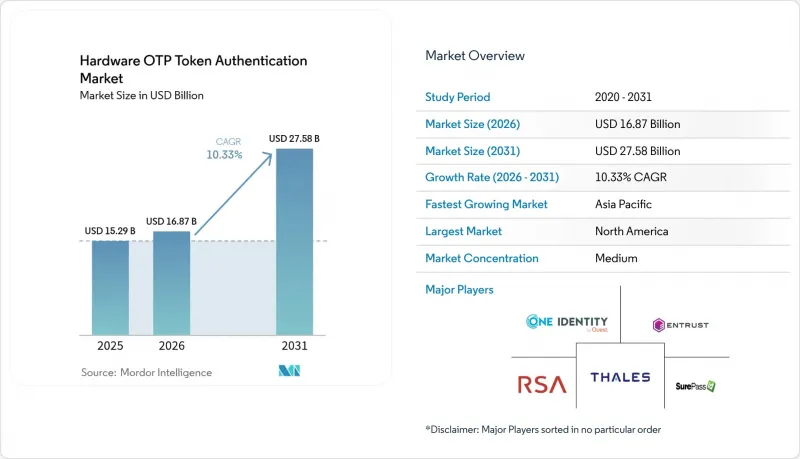
According to Mordor Intelligence, the hardware OTP token authentication market size is expected to grow from USD 15.29 billion in 2025 to USD 16.87 billion in 2026 and is forecast to reach USD 27.58 billion by 2031 at 10.33% CAGR over 2026-2031.
This report is Segmented by Type (Connected, Disconnected, Contactless), Authentication Method (Event-Based HOTP, Time-Based TOTP, and More), Form Factor (Display Card, USB Token, and More), End-User Industry (Banking, Financial Services and Insurance, and More), Deployment Mode (On-Premise, Private Cloud, and More), and Geography. The Market Forecasts are Provided in Terms of Value (USD).
Global Hardware OTP Token Authentication Market Trends and Insights
Growing Number of Internet-Based Transactions
E-commerce, instant payment rails, and mobile wallets are driving unprecedented credential exposure, forcing merchants and processors to add possession factors. PSD2 enforcement reduced unauthorized payment fraud by 23% in 2024; however, cross-border merchants continue to struggle with cart abandonment when a hardware step is introduced. Asia Pacific banks serving India's UPI ecosystem now issue NFC-enabled keys to high-value customers, harnessing tap-to-authenticate flows that avoid SMS latency. Real-time schemes such as FedNow or Brazil's PIX reward tokens that can confirm identity in milliseconds, leading issuers to favor capacitive-touch devices. OWASP notes that hardware tokens reduce account-recovery tickets by 40% compared with SMS OTP.
Increasing Investments From the Banking and Finance Industry
Banks weigh token costs against fraud losses and regulatory penalties, finding break-even at modest deployment scales. Large institutions adopt enterprise subscriptions to shift capital outlays to operating budgets and obtain replacement coverage. Multi-protocol tokens supporting smart-card, OTP, and FIDO allow banks to consolidate legacy PIV or EMV workflows into a single key, easing migration. Private-label recycled-plastic casings from Thales help align procurement with ESG targets.
Growing Use and Reliability of Biometric Authentication
National ID programs and smartphone sensors enable consumers to authenticate themselves with fingerprints or facial recognition, eliminating the need for separate devices. Middle Eastern platforms such as UAE Pass integrate biometrics for government and banking access, reducing token demand in consumer channels. Nigeria's new multipurpose biometric card combines payment and identity credentials, providing an all-in-one solution. Enterprises still require hardware for air-gapped sites and fail-safe scenarios, resulting in a fallback model where tokens complement biometrics rather than replace them.
Other drivers and restraints analyzed in the detailed report include:
- Regulatory Mandates for Strong Customer Authentication
- Rising Incidence of Data Breaches and Cyberattacks
- High Initial Procurement and Lifecycle Management Costs
For complete list of drivers and restraints, kindly check the Table Of Contents.
Segment Analysis
Connected tokens accounted for 47.35% of the hardware otp token authentication market size in 2025, reflecting desktop-centric workflows and tactile confirmation preferences. Contactless tokens, however, are projected to grow at a 12.12% CAGR as NFC-enabled smartphones dominate enterprise computing. Yubico's Security Key C NFC, priced at USD 29, broadened reach to cost-sensitive deployments and enabled tap-to-authenticate flows that shorten checkout and login times.
Enterprises, such as banks and healthcare providers, still rely on USB-attached devices, where physical insertion helps curb social-engineering risk. Dual-interface designs, such as the YubiKey 5C NFC, merge USB-C and NFC, supporting employees who frequently alternate between laptops and phones. Disconnected tokens remain important for classified defense networks lacking wireless allowances, even as their share declines. Overall, the adoption of contactless technology underscores the hardware OTP token authentication market's transition toward mobile-first operations.
Time-based TOTP held 59.62% of the hardware OTP token authentication market share in 2025, largely due to its entrenched use in banking and VPN applications. FIDO-compliant keys, recording an 10.94% CAGR, are eroding the lead by eliminating server-side shared secrets and stopping phishing through origin binding. Firmware 5.7 expanded on-device capacity to 100 passkeys, 64 OATH seeds, and 24 PIV certificates, letting one token replace multiple older devices.
Event-based HOTP lingers in plants and remote sites where time sync is unreliable, while hybrid OTP-PKI tokens help organizations bridge migrations. As identity platforms like Microsoft Entra ID allow direct passkey enrollment, FIDO usage is poised to accelerate, cementing asymmetric architectures as the default within the hardware otp token authentication market.
Complete Report Scope:
- By Type
- Connected
- Disconnected
- Contactless
- By Authentication Method
- Event-Based HOTP
- Time-Based TOTP
- FIDO-Compliant Hardware Key
- Hybrid OTP-PKI Token
- By Form Factor
- Display Card
- USB Token
- SIM Token
- Embedded Security Module
- By End-User Industry
- Banking, Financial Services AND Insurance
- Government
- Enterprise Security
- Healthcare
- Other End-User Industries
- By Deployment Mode
- On-Premise
- Private Cloud
- Public Cloud
- By Geography
- North America
- United States
- Canada
- Mexico
- South America
- Brazil
- Argentina
- Rest of South America
- Europe
- Germany
- United Kingdom
- France
- Russia
- Rest of Europe
- Asia Pacific
- China
- Japan
- India
- South Korea
- Australia
- Rest of Asia Pacific
- Middle East
- Saudi Arabia
- United Arab Emirates
- Turkey
- Rest of Middle East
- Africa
- South Africa
- Nigeria
- Egypt
- Rest of Africa
- North America
Geography Analysis
North America led the hardware otp token authentication market in 2024, reinforced by NIST SP 800-63B rules that steer federal entities toward FIPS-validated tokens. Fortune 500 security budgets sustain multi-protocol demand, and cloud hyperscalers bundle keys with identity and access management (IAM) subscriptions. Europe follows closely as PSD2 prohibitions on SMS OTP propel hardware into every payment worth more than EUR 30. The forthcoming Cyber Resilience Act extends these requirements to IoT gateways, broadening the regional addressable base.
The Asia Pacific region shows the highest growth, driven by Japan's My Number Card, India's Aadhaar linkages, and China's localization mandates. While biometrics enjoy mass adoption, enterprises and governments still purchase tokens for privileged roles and critical infrastructure. The Middle East and Africa present a greenfield opportunity: the UAE Pass surpassed 7.2 million users, and Saudi Arabia's ECC-1:2018 drives procurement across governmental and financial systems. However, only 12% of firms prioritized IAM in 2024, signaling latent upside. South America, led by Brazil and Argentina, deploys hardware to curb SIM-swap fraud in retail banking, though budget constraints confine issuance to high-value accounts.
In Africa, South African banks and Nigerian authorities spearhead issuance. Nigeria's biometric multipurpose card competes directly with standalone tokens, blending identity, payments and authentication, and underscores how regional markets may leapfrog to hybrid biometric-token frameworksAcross regions, macro drivers converge, including regulation, cyber risk, and zero-trust agendas, yet local payment habits, smartphone penetration, and supply-chain logistics shape adoption pace within the hardware OTP token authentication market.
List of Companies Covered in this Report:
- One Identity LLC
- Entrust Corp.
- RSA Security LLC
- Thales Group
- SurepassID Corp.
- Authenex Inc.
- Dell Technologies Inc.
- Microcosm Ltd.
- Broadcom Inc.
- OneSpan Inc.
- Yubico AB
- Deepnet Security Ltd.
- HID Global Corp.
- FEITIAN Technologies Co., Ltd.
- SecureMetric Technology Sdn Bhd
- Fortinet Inc.
- Nexus Group AB
- ID Control BV
- BIO-key International Inc.
- SafeNet Inc.
Additional Benefits:
- The market estimate (ME) sheet in Excel format
- 3 months of analyst support
TABLE OF CONTENTS
1 INTRODUCTION
- 1.1 Study Assumptions and Market Definition
- 1.2 Scope of the Study
2 RESEARCH METHODOLOGY
3 EXECUTIVE SUMMARY
4 MARKET LANDSCAPE
- 4.1 Market Overview
- 4.2 Market Drivers
- 4.2.1 Growing Number of Internet-Based Transactions
- 4.2.2 Increasing Investments From Banking and Finance Industry
- 4.2.3 Regulatory Mandates for Strong Customer Authentication
- 4.2.4 Rising Incidence of Data Breaches and Cyberattacks
- 4.2.5 Shift Toward Hardware-Based Phishing-Resistant FIDO Authenticators
- 4.2.6 Adoption of Eco-Friendly "Second Life" Plastic Tokens
- 4.3 Market Restraints
- 4.3.1 Growing Use and Reliability of Biometric Authentication
- 4.3.2 High Initial Procurement and Lifecycle Management Costs
- 4.3.3 Supply-Chain Security Concerns Over Hardware Tampering
- 4.3.4 Tariff-Induced Cost Inflation on Token Components
- 4.4 Value-Chain Analysis
- 4.5 Regulatory Landscape
- 4.6 Technological Outlook
- 4.7 Impact of Macroeconomic Factors on the Market
- 4.8 Porter's Five Forces Analysis
- 4.8.1 Bargaining Power of Suppliers
- 4.8.2 Bargaining Power of Consumers
- 4.8.3 Threat of New Entrants
- 4.8.4 Threat of Substitutes
- 4.8.5 Intensity of Competitive Rivalry
5 MARKET SIZE AND GROWTH FORECASTS (VALUE)
- 5.1 By Type
- 5.1.1 Connected
- 5.1.2 Disconnected
- 5.1.3 Contactless
- 5.2 By Authentication Method
- 5.2.1 Event-Based HOTP
- 5.2.2 Time-Based TOTP
- 5.2.3 FIDO-Compliant Hardware Key
- 5.2.4 Hybrid OTP-PKI Token
- 5.3 By Form Factor
- 5.3.1 Display Card
- 5.3.2 USB Token
- 5.3.3 SIM Token
- 5.3.4 Embedded Security Module
- 5.4 By End-User Industry
- 5.4.1 Banking, Financial Services AND Insurance
- 5.4.2 Government
- 5.4.3 Enterprise Security
- 5.4.4 Healthcare
- 5.4.5 Other End-User Industries
- 5.5 By Deployment Mode
- 5.5.1 On-Premise
- 5.5.2 Private Cloud
- 5.5.3 Public Cloud
- 5.6 By Geography
- 5.6.1 North America
- 5.6.1.1 United States
- 5.6.1.2 Canada
- 5.6.1.3 Mexico
- 5.6.2 South America
- 5.6.2.1 Brazil
- 5.6.2.2 Argentina
- 5.6.2.3 Rest of South America
- 5.6.3 Europe
- 5.6.3.1 Germany
- 5.6.3.2 United Kingdom
- 5.6.3.3 France
- 5.6.3.4 Russia
- 5.6.3.5 Rest of Europe
- 5.6.4 Asia Pacific
- 5.6.4.1 China
- 5.6.4.2 Japan
- 5.6.4.3 India
- 5.6.4.4 South Korea
- 5.6.4.5 Australia
- 5.6.4.6 Rest of Asia Pacific
- 5.6.5 Middle East
- 5.6.5.1 Saudi Arabia
- 5.6.5.2 United Arab Emirates
- 5.6.5.3 Turkey
- 5.6.5.4 Rest of Middle East
- 5.6.6 Africa
- 5.6.6.1 South Africa
- 5.6.6.2 Nigeria
- 5.6.6.3 Egypt
- 5.6.6.4 Rest of Africa
- 5.6.1 North America
6 COMPETITIVE LANDSCAPE
- 6.1 Market Concentration
- 6.2 Strategic Moves
- 6.3 Market Share Analysis
- 6.4 Company Profiles (includes Global level Overview, Market level overview, Core Segments, Financials as available, Strategic Information, Market Rank/Share for key companies, Products AND Services, and Recent Developments)
- 6.4.1 One Identity LLC
- 6.4.2 Entrust Corp.
- 6.4.3 RSA Security LLC
- 6.4.4 Thales Group
- 6.4.5 SurepassID Corp.
- 6.4.6 Authenex Inc.
- 6.4.7 Dell Technologies Inc.
- 6.4.8 Microcosm Ltd.
- 6.4.9 Broadcom Inc.
- 6.4.10 OneSpan Inc.
- 6.4.11 Yubico AB
- 6.4.12 Deepnet Security Ltd.
- 6.4.13 HID Global Corp.
- 6.4.14 FEITIAN Technologies Co., Ltd.
- 6.4.15 SecureMetric Technology Sdn Bhd
- 6.4.16 Fortinet Inc.
- 6.4.17 Nexus Group AB
- 6.4.18 ID Control BV
- 6.4.19 BIO-key International Inc.
- 6.4.20 SafeNet Inc.
7 MARKET OPPORTUNITIES AND FUTURE OUTLOOK
- 7.1 White-Space and Unmet-Need Assessment

