PUBLISHER: Mordor Intelligence | PRODUCT CODE: 2122301

PUBLISHER: Mordor Intelligence | PRODUCT CODE: 2122301
Network Bandwidth Management Software - Market Share Analysis, Industry Trends & Statistics, Growth Forecasts (2026 - 2031)
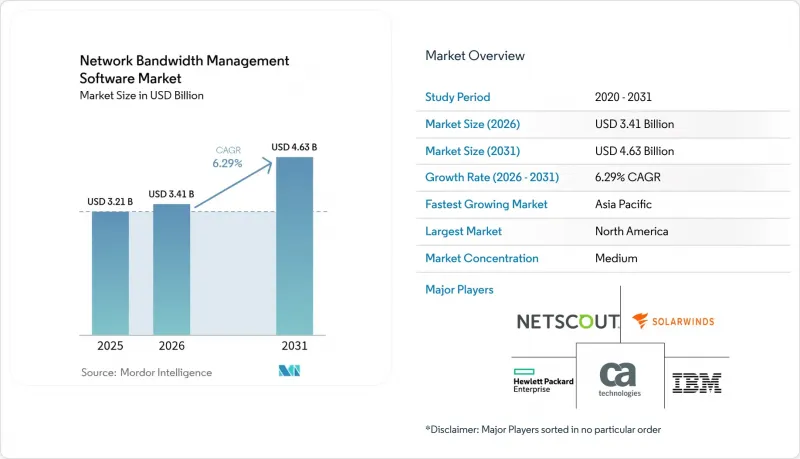
According to Mordor Intelligence, the network bandwidth management software market size is expected to grow from USD 3.21 billion in 2025 to USD 3.41 billion in 2026 and is forecast to reach USD 4.63 billion by 2031 at 6.29% CAGR over 2026-2031.
This report is Segmented by Deployment Model (On-Premise, Cloud), Enterprise Size (Small and Medium Enterprises, Large Enterprises), Solution Type (Bandwidth Monitoring and Reporting, and More), End-User Vertical (Telecommunication and IT, BFSI, and More), Network Type (Wired Networks, and More), and Geography. The Market Forecasts are Provided in Terms of Value (USD).
Global Network Bandwidth Management Software Market Trends and Insights
Explosion of IoT Endpoints and Private 5G Enterprise Networks
Enterprise IoT rollouts add thousands of sensors across factories, offices, and logistics hubs, generating unpredictable traffic that legacy best-effort routing cannot handle. Private 5G further intensifies the challenge because ultra-low-latency applications require strict bandwidth guarantees. A live deployment supporting 40,000 first responders for specialized services illustrates how mission-critical users depend on granular bandwidth control. Enterprises, therefore, select AI-driven tools that classify traffic, forecast consumption, and reallocate resources across heterogeneous links in real time.
Growing Need for High-Speed Internet and SD-WAN Adoption
SD-WAN introduces application-aware routing that spans MPLS, broadband, and 5G, turning bandwidth management from a reporting task into a business value lever. Organizations adopting SD-WAN have recorded 70% lower hardware spend and 74% higher operational efficiency by unifying transport links under a single policy engine. As a result, bandwidth software must optimize for user experience and business priority rather than raw throughput, embedding analytics to safeguard revenue-generating applications.
Freemium/Open-Source Traffic Tools Lower Entry Barriers
Robust free tools such as Zabbix and LibreQoS give firms basic visibility without license fees, delaying conversions to commercial platforms. Vendors counter by offering starter tiers that include core sensors at no cost, pushing differentiation toward AI insights, policy automation, and premium support. This commoditizes monitoring while raising the bar for orchestration features.
Other drivers and restraints analyzed in the detailed report include:
- Proliferation of Data-Rich Apps (4K/8K Video, AR/VR, AI Analytics)
- Edge AI Workloads Requiring Deterministic Bandwidth
- Integration Complexity with Legacy On-Premise Infrastructure
For complete list of drivers and restraints, kindly check the Table Of Contents.
Segment Analysis
Cloud options commanded 51.35% of total spending in 2025, illustrating how organizations favor scalable control planes accessed from anywhere. The segment is forecast to grow at 8.14% CAGR to 2031, far faster than on-premise deployments. Enterprises cite 40% lower total ownership through the elimination of hardware refreshes and simplified patching schedules. On-premise systems remain in place where sovereignty or ultra-low-latency processing dictates local control. Hybrid architectures combine edge gateways for sensitive data with cloud analytics hubs for broad visibility.
Lower management overhead sits at the heart of migration economics. Administrators can roll out policy changes across hundreds of sites without traveling, while multi-tenant instances enable MSPs to serve SMEs lacking in-house expertise. The Network Bandwidth Management Software market, therefore, tilts steadily toward SaaS models, although vendors still offer appliance images for air-gapped environments. This dual delivery strategy protects existing revenue while paving a path to subscription growth.
Large enterprises controlled 63.05% of 2025 revenue because complex topologies and compliance demands justified investment in advanced suites. Yet SMEs are on track for a 6.48% CAGR through 2031 as cloud-native pricing aligns with operating budgets. Managed services bundles allow smaller firms to outsource monitoring, reporting, and policy enforcement, accelerating adoption without adding headcount.
Volume growth among SMEs pushes vendors to streamline onboarding through auto-discovery, template-based policies, and guided remediation. At the same time, large enterprises continue to seek customizable modules that integrate with ITSM and SIEM stacks. This bifurcated roadmap anchors the Network Bandwidth Management Software market, giving suppliers multiple paths to expansion while maintaining clear account segmentation.
Complete Report Scope:
- By Deployment Model
- On-Premise
- Cloud
- By Enterprise Size
- Small and Medium Enterprises (SMEs)
- Large Enterprises
- By Solution Type
- Bandwidth Monitoring and Reporting
- Traffic Shaping / QoS Control
- WAN / Internet Link Optimization
- SD-WAN Bandwidth Management
- Others (Policy-based, DPI, etc.)
- By End-User Vertical
- Telecommunication and IT
- BFSI
- Healthcare
- Retail and E-commerce
- Education
- Government and Defense
- Manufacturing
- Others
- By Network Type
- Wired Networks
- Wireless and Wi-Fi Networks
- By Geography
- North America
- United States
- Canada
- Mexico
- South America
- Brazil
- Argentina
- Rest of South America
- Europe
- Germany
- United Kingdom
- France
- Netherlands
- Spain
- Rest of Europe
- Asia-Pacific
- China
- Japan
- India
- South Korea
- Australia and New Zealand
- Rest of Asia-Pacific
- Middle East and Africa
- Middle East
- Saudi Arabia
- United Arab Emirates
- Turkey
- Israel
- Rest of Middle East
- Africa
- South Africa
- Nigeria
- Kenya
- Rest of Africa
- Middle East
- North America
Geography Analysis
North America generated 34.05% of 2025 revenue, buoyed by mature IT budgets, tight compliance regimes, and ongoing investment in AI-enabled data centers. Hyperscalers' multibillion-dollar builds translate into sustained demand for traffic visibility, capacity planning, and SLA assurance. Regional healthcare and finance regulations add momentum because they mandate continuous monitoring and segmented architectures. Collectively, these forces cement North America as the largest slice of the Network Bandwidth Management Software market.
Asia-Pacific is poised for the fastest expansion with a 7.05% CAGR to 2031. Governments prioritize digital infrastructure, 5G rollouts advance quickly, and enterprises leapfrog legacy circuit models by adopting cloud and SD-WAN concurrently. Wide variance in network maturity encourages flexible licensing ranging from pay-as-you-grow SKUs for emerging economies to full-stack suites for advanced markets such as Japan and South Korea. Vendors that localize language support and compliance templates stand to capture outsized share.
- Cisco Systems Inc.
- IBM Corporation
- NetScout Systems Inc.
- SolarWinds Corporation
- Broadcom Inc. (CA Technologies)
- Hewlett Packard Enterprise Company
- Juniper Networks Inc.
- InfoVista SA
- BMC Software Inc.
- Alcatel-Lucent Enterprise Holding
- GFI Software SA
- Axence Software Inc.
- Zoho Corporation Pvt. Ltd.
- Riverbed Technology LLC
- Paessler AG
- ManageEngine (Zoho Corp.)
- Auvik Networks Inc.
- Fortinet Inc.
- Huawei Technologies Co., Ltd.
- Extreme Networks Inc.
Additional Benefits:
- The market estimate (ME) sheet in Excel format
- 3 months of analyst support
TABLE OF CONTENTS
1 INTRODUCTION
- 1.1 Study Assumptions and Market Definition
- 1.2 Scope of the Study
2 RESEARCH METHODOLOGY
3 EXECUTIVE SUMMARY
4 MARKET LANDSCAPE
- 4.1 Market Overview
- 4.2 Market Drivers
- 4.2.1 Explosion of IoT endpoints and private 5G enterprise networks
- 4.2.2 Growing need for high-speed internet and SD-WAN adoption
- 4.2.3 Proliferation of data-rich apps (4K/8K video, AR/VR, AI analytics)
- 4.2.4 Edge AI workloads requiring deterministic bandwidth (under-the-radar)
- 4.2.5 5G network-slicing unlocking per-slice bandwidth orchestration (under-the-radar)
- 4.2.6 Shift toward AIOps demanding embedded bandwidth analytics (under-the-radar)
- 4.3 Market Restraints
- 4.3.1 Freemium/open-source traffic tools lower entry barriers
- 4.3.2 Integration complexity with legacy on-prem infrastructure
- 4.3.3 Privacy regulations curb deep-packet inspection capability (under-the-radar)
- 4.3.4 Zero-trust focus diverts budgets from bandwidth tools (under-the-radar)
- 4.4 Supply-Chain Analysis
- 4.5 Regulatory Landscape
- 4.6 Technological Outlook
- 4.7 Porter's Five Forces Analysis
- 4.7.1 Threat of New Entrants
- 4.7.2 Bargaining Power of Buyers
- 4.7.3 Bargaining Power of Suppliers
- 4.7.4 Threat of Substitutes
- 4.7.5 Intensity of Competitive Rivalry
5 MARKET SIZE AND GROWTH FORECASTS (VALUE)
- 5.1 By Deployment Model
- 5.1.1 On-Premise
- 5.1.2 Cloud
- 5.2 By Enterprise Size
- 5.2.1 Small and Medium Enterprises (SMEs)
- 5.2.2 Large Enterprises
- 5.3 By Solution Type
- 5.3.1 Bandwidth Monitoring and Reporting
- 5.3.2 Traffic Shaping / QoS Control
- 5.3.3 WAN / Internet Link Optimization
- 5.3.4 SD-WAN Bandwidth Management
- 5.3.5 Others (Policy-based, DPI, etc.)
- 5.4 By End-User Vertical
- 5.4.1 Telecommunication and IT
- 5.4.2 BFSI
- 5.4.3 Healthcare
- 5.4.4 Retail and E-commerce
- 5.4.5 Education
- 5.4.6 Government and Defense
- 5.4.7 Manufacturing
- 5.4.8 Others
- 5.5 By Network Type
- 5.5.1 Wired Networks
- 5.5.2 Wireless and Wi-Fi Networks
- 5.6 By Geography
- 5.6.1 North America
- 5.6.1.1 United States
- 5.6.1.2 Canada
- 5.6.1.3 Mexico
- 5.6.2 South America
- 5.6.2.1 Brazil
- 5.6.2.2 Argentina
- 5.6.2.3 Rest of South America
- 5.6.3 Europe
- 5.6.3.1 Germany
- 5.6.3.2 United Kingdom
- 5.6.3.3 France
- 5.6.3.4 Netherlands
- 5.6.3.5 Spain
- 5.6.3.6 Rest of Europe
- 5.6.4 Asia-Pacific
- 5.6.4.1 China
- 5.6.4.2 Japan
- 5.6.4.3 India
- 5.6.4.4 South Korea
- 5.6.4.5 Australia and New Zealand
- 5.6.4.6 Rest of Asia-Pacific
- 5.6.5 Middle East and Africa
- 5.6.5.1 Middle East
- 5.6.5.1.1 Saudi Arabia
- 5.6.5.1.2 United Arab Emirates
- 5.6.5.1.3 Turkey
- 5.6.5.1.4 Israel
- 5.6.5.1.5 Rest of Middle East
- 5.6.5.2 Africa
- 5.6.5.2.1 South Africa
- 5.6.5.2.2 Nigeria
- 5.6.5.2.3 Kenya
- 5.6.5.2.4 Rest of Africa
- 5.6.5.1 Middle East
- 5.6.1 North America
6 COMPETITIVE LANDSCAPE
- 6.1 Market Concentration
- 6.2 Strategic Moves
- 6.3 Market Share Analysis
- 6.4 Company Profiles (includes Global level Overview, Market level overview, Core Segments, Financials as available, Strategic Information, Market Rank/Share, Products and Services, Recent Developments)
- 6.4.1 Cisco Systems Inc.
- 6.4.2 IBM Corporation
- 6.4.3 NetScout Systems Inc.
- 6.4.4 SolarWinds Corporation
- 6.4.5 Broadcom Inc. (CA Technologies)
- 6.4.6 Hewlett Packard Enterprise Company
- 6.4.7 Juniper Networks Inc.
- 6.4.8 InfoVista SA
- 6.4.9 BMC Software Inc.
- 6.4.10 Alcatel-Lucent Enterprise Holding
- 6.4.11 GFI Software SA
- 6.4.12 Axence Software Inc.
- 6.4.13 Zoho Corporation Pvt. Ltd.
- 6.4.14 Riverbed Technology LLC
- 6.4.15 Paessler AG
- 6.4.16 ManageEngine (Zoho Corp.)
- 6.4.17 Auvik Networks Inc.
- 6.4.18 Fortinet Inc.
- 6.4.19 Huawei Technologies Co., Ltd.
- 6.4.20 Extreme Networks Inc.
7 MARKET OPPORTUNITIES AND FUTURE OUTLOOK
- 7.1 White-space and Unmet-Need Assessment

