PUBLISHER: Mordor Intelligence | PRODUCT CODE: 2122303

PUBLISHER: Mordor Intelligence | PRODUCT CODE: 2122303
Privacy Filters - Market Share Analysis, Industry Trends & Statistics, Growth Forecasts (2026 - 2031)
According to Mordor Intelligence, the privacy filters market size is expected to grow from USD 1.38 billion in 2025 to USD 1.55 billion in 2026 and is forecast to reach USD 2.83 billion by 2031 at 12.68% CAGR over 2026-2031.
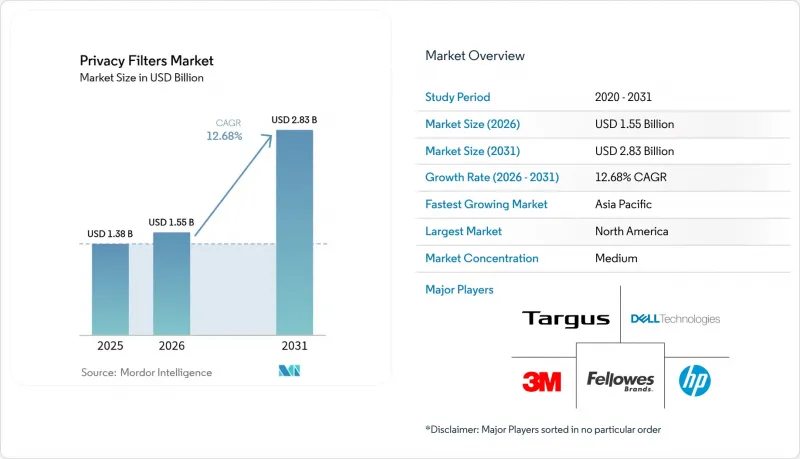
This report is Segmented by Product Type (2-Way Privacy Filters, and More), Material Technology (Microlouver Film Filters, and More), Device Size (15-24 Inch Screens, Above 24 Inch Screens, and More), End-User (Corporate Offices, Financial Services, and More), Distribution Channel (Online Retail, Offline Retail, Direct OEM Integration), and Geography. The Market Forecasts are Provided in Terms of Value (USD).
Global Privacy Filters Market Trends and Insights
Growing Data Privacy Regulations in Corporate Environments
European Union regulators imposed fines of EUR 4.1 billion (USD 4.4 billion) in 2024 for GDPR violations, with 18% of cases involving visual data exposure. The U.S. Federal Trade Commission revised the Gramm-Leach-Bliley Safeguards Rule to require documented controls against screen eavesdropping. Canada, Mexico, and UAE authorities enacted parallel mandates, prompting multinational firms to adopt privacy filters across global offices for audit uniformity. Procurement teams now list optical screens alongside encryption and multifactor authentication in security budgets. This regulatory alignment keeps the privacy filters market on a steep adoption curve as fines escalate and audit cycles shorten.
Rising Remote and Hybrid Working Trends
Hybrid work blurs the perimeter; employees handle sensitive data in cafes, on trains, and in shared spaces. Screen exposure in public venues heightens the risk, yet only one-third of employers supply visual privacy accessories, creating a secondary demand wave from staff who self-purchase. Online retail fulfills these fragmented orders, sustaining 45.63% channel share in 2024. Airlines, rail operators, and hospitality chains have begun adding embedded privacy panels to seat-backs and lobby kiosks, demonstrating how mobility expands the privacy filters market beyond the traditional desk environment.
Declining Desktop Monitor Refresh Cycles in Developed Markets
Extended monitor lifespans cut replacement-trigger events that historically drove privacy-filter sales, especially for screens larger than 24 inches. Organizations prioritizing laptops for mobile teams defer desktop rollouts, shrinking the immediate addressable base. Vendors respond with retrofit kits and magnetic frames aimed at aging fleets; however, the structural tilt toward mobile devices tempers growth in the legacy segment of the privacy filter market.
Other drivers and restraints analyzed in the detailed report include:
- Increasing Laptop and Tablet Shipments Globally
- Expanding Healthcare IT Investments
- Price Sensitivity Among Consumer Buyers
For complete list of drivers and restraints, kindly check the Table Of Contents.
Segment Analysis
4-way designs enable omnidirectional shielding, meeting the demands of open-plan offices, trading floors, and public kiosks. The privacy filters market size for 4-way products is poised to expand rapidly because viewing angles from all sides require protection. In 2025, two-way models still accounted for 49.10% of revenue, yet their dominance is waning as hot desking grows. Vendors differentiate through touch-screen compatibility and blue-light reduction coatings that preserve image brightness while meeting ergonomic norms.
Electrochromic implementations, though currently niche, reduce attachment friction and support instant toggling between collaboration and privacy modes. The defense and finance sectors are early adopters, validating premium price points that reach three times the cost of conventional units. As OEMs embed microlouver or electrochromic layers at panel assembly, aftermarket clip-on demand is expected to shift toward specialized use cases rather than broad fleet coverage, reshaping future channel mix in the privacy filters market.
Microlouver film, underpinned by 3M's proprietary light-control technology, captured 60.73% revenue in 2025. It remains the benchmark for clarity versus the trade-off of dimming. However, nanostructure metasurfaces demonstrated 30% thickness reduction while sustaining contrast, an advantage for ultrathin laptops and foldables. Nanotech adoption, with a forecast near 13.35% CAGR, promises lighter devices and simplified recycling pathways, addressing polycarbonate waste concerns highlighted in the EU Circular Economy Action Plan.
Electrochromic polymers introduce dynamic opacity control but also pose disposal issues related to circuitry. Material selection now intertwines with environmental policy; bio-based polycarbonates are attracting European buyers seeking to comply with extended producer responsibility directives. Such shifts create opportunities for upstream partnerships between optical-film makers and display fabs, anchoring long-term supply agreements that stabilize component pricing across the privacy filter market.
Complete Report Scope:
- By Product Type
- 2-Way Privacy Filters
- 4-Way Privacy Filters
- Touch-Screen Optimized Filters
- Integrated OEM Privacy Displays
- By Material Technology
- Microlouver Film Filters
- Nanotechnology-Based Filters
- Electrochromic Switchable Filters
- By Device Size
- Less than or equal to 15 Inch Screens
- 15-24 Inch Screens
- Above 24 Inch Screens
- By End-User Industry
- Corporate Offices
- Healthcare Facilities
- Financial Services
- Government Agencies
- Educational Institutions
- By Distribution Channel
- Online Retail
- Offline Retail
- Direct OEM Integration
- By Geography
- North America
- United States
- Canada
- Mexico
- Europe
- Germany
- United Kingdom
- France
- Russia
- Rest of Europe
- Asia-Pacific
- China
- Japan
- India
- South Korea
- Australia
- Rest of Asia-Pacific
- Middle East and Africa
- Middle East
- Saudi Arabia
- United Arab Emirates
- Rest of Middle East
- Africa
- South Africa
- Egypt
- Rest of Africa
- Middle East
- South America
- Brazil
- Argentina
- Rest of South America
- North America
Geography Analysis
North America commanded 33.20% of 2025 revenue, propelled by HIPAA mandates and updated Gramm-Leach-Bliley rules that classify visual privacy as a required safeguard. High device ownership and the adoption of zero-trust cybersecurity amplify baseline demand. Federal agencies standardize privacy screens across their field offices, and state privacy statutes, such as the California Privacy Rights Act, spur private-sector purchases to avoid enforcement penalties.
The Asia-Pacific region is expected to register the fastest growth at 13.62% through 2031, as the implementation of China's Personal Information Protection Law and India's Digital Personal Data Protection Act raises compliance thresholds. Rapid IT infrastructure rollouts, increasing laptop penetration, and government digitization projects expand the install base. OEMs with fabs in Taiwan and South Korea integrate privacy layers during assembly, reducing import costs for regional buyers.
Europe enforces stringent GDPR penalties, positioning privacy filters as a form of insurance against multi-million-euro fines. ISO standards on display ergonomics converge with green policy pushes for recyclable materials, influencing procurement criteria toward nanostructured films. Middle East nations, such as the UAE and Saudi Arabia, mirror GDPR frameworks, fueling adoption in banking and public-sector digital services. Africa and South America exhibit emerging demand; South Africa's POPIA and Brazil's LGPD establish legal baselines that multinational firms must adhere to, facilitating early-stage deployments.
List of Companies Covered in this Report:
- 3M Company
- Targus International LLC
- Kensington Computer Products Group, a division of ACCO Brands Corporation
- Fellowes Inc.
- HP Inc.
- Dell Technologies Inc.
- V7 - Ingram Micro Inc.
- ViewSonic Corporation
- Lenovo Group Limited
- ZAGG Inc.
- PanzerGlass A/S
- Tech Armor LLC
- Amazon Basics (Amazon.com Inc.)
- Belkin International Inc.
- DMC Co. Ltd.
- Dicota GmbH
- Klear Screen LLC
- GlareGuard Screen Protectors LLC
- MOSISO (Mosiso LAB, Inc.)
- JCPal Technology Ltd.
Additional Benefits:
- The market estimate (ME) sheet in Excel format
- 3 months of analyst support
TABLE OF CONTENTS
1 INTRODUCTION
- 1.1 Study Assumptions and Market Definition
- 1.2 Scope of the Study
2 RESEARCH METHODOLOGY
3 EXECUTIVE SUMMARY
4 MARKET LANDSCAPE
- 4.1 Market Overview
- 4.2 Market Drivers
- 4.2.1 Growing Data Privacy Regulations in Corporate Environments
- 4.2.2 Rising Remote and Hybrid Working Trends
- 4.2.3 Increasing Laptop and Tablet Shipments Globally
- 4.2.4 Expanding Healthcare IT Investments
- 4.2.5 Integration of Privacy Filters into OEM Display Manufacturing Lines
- 4.2.6 Adoption of Smart Electrochromic Privacy Technologies for Defense Applications
- 4.3 Market Restraints
- 4.3.1 Declining Desktop Monitor Refresh Cycles in Developed Markets
- 4.3.2 Price Sensitivity Among Consumer Buyers
- 4.3.3 Compatibility Challenges with Curved and Foldable Displays
- 4.3.4 Environmental Concerns Over Disposal of Polycarbonate-Based Filters
- 4.4 Industry Value Chain Analysis
- 4.5 Regulatory Landscape
- 4.6 Technological Outlook
- 4.7 Impact of Macroeconomic Factors
- 4.8 Porter's Five Forces Analysis
- 4.8.1 Threat of New Entrants
- 4.8.2 Bargaining Power of Buyers
- 4.8.3 Bargaining Power of Suppliers
- 4.8.4 Threat of Substitute Products
- 4.8.5 Competitive Rivalry
5 MARKET SIZE AND GROWTH FORECASTS (VALUE)
- 5.1 By Product Type
- 5.1.1 2-Way Privacy Filters
- 5.1.2 4-Way Privacy Filters
- 5.1.3 Touch-Screen Optimized Filters
- 5.1.4 Integrated OEM Privacy Displays
- 5.2 By Material Technology
- 5.2.1 Microlouver Film Filters
- 5.2.2 Nanotechnology-Based Filters
- 5.2.3 Electrochromic Switchable Filters
- 5.3 By Device Size
- 5.3.1 Less than or equal to 15 Inch Screens
- 5.3.2 15-24 Inch Screens
- 5.3.3 Above 24 Inch Screens
- 5.4 By End-User Industry
- 5.4.1 Corporate Offices
- 5.4.2 Healthcare Facilities
- 5.4.3 Financial Services
- 5.4.4 Government Agencies
- 5.4.5 Educational Institutions
- 5.5 By Distribution Channel
- 5.5.1 Online Retail
- 5.5.2 Offline Retail
- 5.5.3 Direct OEM Integration
- 5.6 By Geography
- 5.6.1 North America
- 5.6.1.1 United States
- 5.6.1.2 Canada
- 5.6.1.3 Mexico
- 5.6.2 Europe
- 5.6.2.1 Germany
- 5.6.2.2 United Kingdom
- 5.6.2.3 France
- 5.6.2.4 Russia
- 5.6.2.5 Rest of Europe
- 5.6.3 Asia-Pacific
- 5.6.3.1 China
- 5.6.3.2 Japan
- 5.6.3.3 India
- 5.6.3.4 South Korea
- 5.6.3.5 Australia
- 5.6.3.6 Rest of Asia-Pacific
- 5.6.4 Middle East and Africa
- 5.6.4.1 Middle East
- 5.6.4.1.1 Saudi Arabia
- 5.6.4.1.2 United Arab Emirates
- 5.6.4.1.3 Rest of Middle East
- 5.6.4.2 Africa
- 5.6.4.2.1 South Africa
- 5.6.4.2.2 Egypt
- 5.6.4.2.3 Rest of Africa
- 5.6.4.1 Middle East
- 5.6.5 South America
- 5.6.5.1 Brazil
- 5.6.5.2 Argentina
- 5.6.5.3 Rest of South America
- 5.6.1 North America
6 COMPETITIVE LANDSCAPE
- 6.1 Market Concentration
- 6.2 Strategic Moves
- 6.3 Market Share Analysis
- 6.4 Company Profiles (includes Global Level Overview, Market Level Overview, Core Segments, Financials as available, Strategic Information, Market Rank/Share for key companies, Products and Services, and Recent Developments)
- 6.4.1 3M Company
- 6.4.2 Targus International LLC
- 6.4.3 Kensington Computer Products Group, a division of ACCO Brands Corporation
- 6.4.4 Fellowes Inc.
- 6.4.5 HP Inc.
- 6.4.6 Dell Technologies Inc.
- 6.4.7 V7 - Ingram Micro Inc.
- 6.4.8 ViewSonic Corporation
- 6.4.9 Lenovo Group Limited
- 6.4.10 ZAGG Inc.
- 6.4.11 PanzerGlass A/S
- 6.4.12 Tech Armor LLC
- 6.4.13 Amazon Basics (Amazon.com Inc.)
- 6.4.14 Belkin International Inc.
- 6.4.15 DMC Co. Ltd.
- 6.4.16 Dicota GmbH
- 6.4.17 Klear Screen LLC
- 6.4.18 GlareGuard Screen Protectors LLC
- 6.4.19 MOSISO (Mosiso LAB, Inc.)
- 6.4.20 JCPal Technology Ltd.
7 MARKET OPPORTUNITIES AND FUTURE OUTLOOK
- 7.1 White-space and Unmet-Need Assessment

