PUBLISHER: Mordor Intelligence | PRODUCT CODE: 2122308

PUBLISHER: Mordor Intelligence | PRODUCT CODE: 2122308
Flexible Hybrid Electronics (FHE) - Market Share Analysis, Industry Trends & Statistics, Growth Forecasts (2026 - 2031)
According to Mordor Intelligence, flexible hybrid electronics market size in 2026 is estimated at USD 254.39 million, growing from 2025 value of USD 214.76 million with 2031 projections showing USD 593.42 million, growing at 18.46% CAGR over 2026-2031.
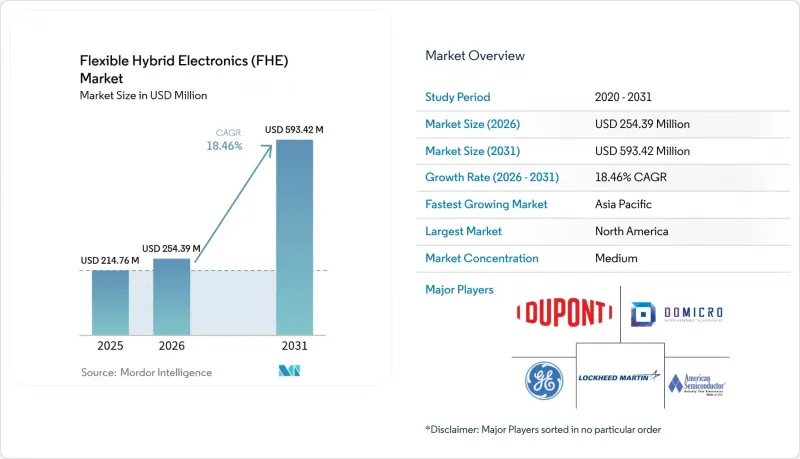
This report is Segmented by Component (Flexible Sensors, Flexible Displays, and More), Substrate Material (Polyimide, PET, PEN, and More), End-Use Industry (Healthcare and Medical, Consumer Electronics, Industrial Manufacturing, and More), Manufacturing Process (Sheet-To-Sheet, Roll-To-Roll, Transfer Printing, and More), and Geography. The Market Forecasts are Provided in Terms of Value (USD).
Global Flexible Hybrid Electronics (FHE) Market Trends and Insights
Lightweight, mechanically-flexible and cost-effective product demand
Consumer-facing brands now compete on form-factor freedom rather than incremental performance gains. Samsung Display's 18.1-inch foldable OLED panel with more than 500,000 fold cycles demonstrated that reliability thresholds for premium devices are achievable. Simultaneously, cost-sensitive markets are embracing paper and cellulose substrates that support disposable electronics for logistics, smart labels, and one-time medical tests. VARTA AG's multilayer printed battery based on recycled inputs shows how sustainable design goals can coexist with the need for flexible power sources. Collectively, these advances widen the accessible customer base for the flexible hybrid electronics market and stimulate fresh design activity across multiple tiers of the value chain.
Government-funded commercialization programs
NextFlex has deployed USD 165 million since 2015 to move pilot concepts toward volume production, allocating USD 5.3 million in 2024 and USD 5.0 million in 2025 to R2R scale-up and in-mold electronics. Grant recipients coordinate through technical working groups that standardize materials sets, metrology, and workforce training, shortening learning curves for smaller firms. In Europe, IMEC's EUR 14 million PI-SCALE line delivered a foundry model that produced flexible thin-film microprocessors across several independent fabs. Such initiatives address costly equipment barriers and accelerate time-to-market, adding 2.8 percentage points to forecast CAGR for the flexible hybrid electronics market.
High R&D and capex requirements
Tooling for R2R photonic sintering, ultra-thin die handling, and precision printing incurs multimillion-dollar outlays that smaller enterprises struggle to finance. Although public grants offset some cost, multiple process steps still require bespoke fixtures. Venture financing for capital-heavy hardware remains limited compared with software, curbing entry of new players into the flexible hybrid electronics market and prolonging payback periods for existing investors.
Other drivers and restraints analyzed in the detailed report include:
- Wearable health monitoring proliferation
- Shift to low-cost PET/paper substrates for high-volume packaging
- Fragmented standards and supply-chain complexity
For complete list of drivers and restraints, kindly check the Table Of Contents.
Segment Analysis
Flexible displays contributed 41.02% of the flexible hybrid electronics market share in 2025, validating early investments in foldable and rollable form factors. The segment benefits from established mass-production fabs and premium consumer willingness to pay for novel user experiences. Sensors are advancing at a 18.96% CAGR as healthcare, industrial IoT, and smart packaging adopt thin, conformal sensing layers. Energy storage elements such as stretchable lithium-ion batteries are witnessing double-digit growth, ensuring autonomous operation for mobile or disposable devices. Flexible IC dies remain technically challenging yet strategically critical for on-board processing, while flexible antennas close the performance loop by enabling robust wireless links.
Product diversification has intensified competition yet accelerated ecosystem maturation. Display vendors extend existing OLED platforms toward transparent and multi-fold designs, creating technology spill-overs that sensor and battery suppliers exploit for their own roll-to-roll upgrades. Breakthroughs in thin-film transistor stability are narrowing performance gaps with rigid driver ICs, improving overall system reliability in the flexible hybrid electronics market.
Polyimide held 45.78% share of the flexible hybrid electronics market size in 2025 due to its high-temperature resilience during solder reflow and chemical robustness in aerospace settings. Yet cellulose substrates are rising quickly (19.02% CAGR) on the back of eco-design regulations and brand sustainability pledges. PET films have reclaimed attention as photonic sintering unlocked low-temperature metallization, positioning PET as a cost-efficient alternative for large-area circuits.
Material choice now hinges on an application's thermal, mechanical, and environmental profile. High-reliability markets such as defense continue to favor polyimide, whereas packaging lines in APAC gravitate toward paper webs that match existing printing infrastructure. Elastomeric substrates enable stretchable wearables, though washing durability poses engineering hurdles. Each substrate advances process innovation, expanding the addressable customer base for the flexible hybrid electronics market.
Complete Report Scope:
- By Component
- Flexible Sensors
- Flexible Displays
- Flexible Batteries and Energy Storage
- Flexible IC Dies
- Flexible Antennas and RF Components
- Flexible Memory
- Flexible Photovoltaics
- By Substrate Material
- Polyimide (PI)
- PET
- PEN
- TPU/Elastomeric
- Paper and Cellulose
- Fabric/Textile
- By End-use Industry
- Healthcare and Medical
- Consumer Electronics
- Industrial Manufacturing
- Packaging and Logistics
- Automotive
- Aerospace and Defense
- Energy and Utilities
- Agriculture
- By Manufacturing Process
- Sheet-to-Sheet (S2S)
- Roll-to-Roll (R2R)
- Transfer Printing
- In-Mold Electronics (IME)
- Pick-and-Place Hybrid Assembly
- 3D / Additive Printing
- By Geography
- North America
- United States
- Canada
- South America
- Brazil
- Argentina
- Rest of South America
- Europe
- Germany
- United Kingdom
- France
- Italy
- Spain
- Russia
- Rest of Europe
- Asia Pacific
- China
- Japan
- South Korea
- India
- Australia and New Zealand
- Rest of Asia Pacific
- Middle East
- GCC
- Turkey
- Rest of Middle East
- Africa
- South Africa
- Nigeria
- Rest of Africa
- North America
Geography Analysis
North America commanded 38.10% of total revenue in 2025, supported by NextFlex's funding pipeline and strong defense, aerospace, and medical device ecosystems. Federal grants de-risk R&D, while a network of contract manufacturers accelerates pilot-to-production transitions. Canada contributes niche strengths in advanced materials and space-qualified circuitry, complementing the region's broader competitive edge.
Asia-Pacific records the highest regional CAGR at 18.97% through 2031, reflecting China's dominance in display and smartphone manufacturing coupled with Japan's materials expertise and South Korea's leadership in OLED technology. Local governments offer subsidies for high-volume R2R lines, and electric vehicle adoption stimulates demand for in-mold electronics dashboards. The flexible hybrid electronics market size in Asia-Pacific is therefore poised for rapid scaling, with multinational suppliers forming joint ventures to tap regional growth.
Europe maintains momentum through automotive and industrial opportunities. IMEC's PI-SCALE pilot line validates a foundry model that reduces entry barriers for startups, while regulatory emphasis on sustainability encourages cellulose substrate adoption, particularly in Germany and France. The Middle East and Africa explore flexible photovoltaics for off-grid power in remote areas, whereas South America, led by Brazil, integrates flexible circuits into consumer appliances and packaging. Overall, geography dictates adoption speed but global collaboration continues to spread best practices across borders.
- DuPont de Nemours, Inc.
- DuPont Teijin Films U.S. Limited Partnership
- DoMicro BV
- General Electric Company
- Lockheed Martin Corporation
- American Semiconductor, Inc.
- Flex Ltd.
- Brewer Science, Inc.
- Integrity Industrial Inkjet Integration, Inc.
- Antenna Research Associates, Inc.
- Epicore Biosystems, Inc.
- TactoTek Oy
- PragmatIC Semiconductor Ltd.
- Samsung Electronics Co., Ltd.
- LG Display Co., Ltd.
- Molex, LLC
- 3M Company
- TE Connectivity Ltd.
- FlexEnable Limited
- Interlink Electronics, Inc.
- Blue Spark Technologies, Inc.
- Enfucell Oy
Additional Benefits:
- The market estimate (ME) sheet in Excel format
- 3 months of analyst support
TABLE OF CONTENTS
1 INTRODUCTION
- 1.1 Study Assumptions and Market Definition
- 1.2 Scope of the Study
2 RESEARCH METHODOLOGY
3 EXECUTIVE SUMMARY
4 MARKET LANDSCAPE
- 4.1 Market Overview
- 4.2 Flexible Hybrid Electronics Ecosystem Analysis
- 4.3 Market Drivers
- 4.3.1 Lightweight, mechanically-flexible and cost-effective product demand
- 4.3.2 Government-funded commercialization programs
- 4.3.3 Wearable-health monitoring proliferation
- 4.3.4 Shift to low-cost PET/paper substrates for high-volume packaging
- 4.3.5 Photonic sintering and low-temp solders enabling PET adoption
- 4.3.6 In-mold structural electronics in vehicle interiors
- 4.4 Market Restraints
- 4.4.1 High R&D and capex requirements
- 4.4.2 Fragmented standards and supply-chain complexity
- 4.4.3 Reliability of thinned dies under cyclic bending
- 4.4.4 Absence of fast, low-cost inline test/inspection
- 4.5 Industry Value Chain Analysis
- 4.6 Regulatory Landscape
- 4.7 Technological Outlook and FHE Roadmap
- 4.8 Impact of Macroeconomic Factors
- 4.9 Porter's Five Forces Analysis
- 4.9.1 Threat of New Entrants
- 4.9.2 Bargaining Power of Buyers
- 4.9.3 Bargaining Power of Suppliers
- 4.9.4 Threat of Substitutes
- 4.9.5 Intensity of Competitive Rivalry
- 4.10 Impact of Macroeconomic Factors
- 4.11 Patent Analysis
- 4.12 Government-Supported Research Centres
- 4.12.1 NextFlex
- 4.12.2 Holst Centre
- 4.12.3 IMEC
- 4.12.4 VTT Technical Research Centre of Finland Ltd.
- 4.12.5 CPI
- 4.12.6 CEA-Liten
- 4.12.7 Korea Institute of Machinery and Materials
5 MARKET SIZE AND GROWTH FORECASTS (VALUE)
- 5.1 By Component
- 5.1.1 Flexible Sensors
- 5.1.2 Flexible Displays
- 5.1.3 Flexible Batteries and Energy Storage
- 5.1.4 Flexible IC Dies
- 5.1.5 Flexible Antennas and RF Components
- 5.1.6 Flexible Memory
- 5.1.7 Flexible Photovoltaics
- 5.2 By Substrate Material
- 5.2.1 Polyimide (PI)
- 5.2.2 PET
- 5.2.3 PEN
- 5.2.4 TPU/Elastomeric
- 5.2.5 Paper and Cellulose
- 5.2.6 Fabric/Textile
- 5.3 By End-use Industry
- 5.3.1 Healthcare and Medical
- 5.3.2 Consumer Electronics
- 5.3.3 Industrial Manufacturing
- 5.3.4 Packaging and Logistics
- 5.3.5 Automotive
- 5.3.6 Aerospace and Defense
- 5.3.7 Energy and Utilities
- 5.3.8 Agriculture
- 5.4 By Manufacturing Process
- 5.4.1 Sheet-to-Sheet (S2S)
- 5.4.2 Roll-to-Roll (R2R)
- 5.4.3 Transfer Printing
- 5.4.4 In-Mold Electronics (IME)
- 5.4.5 Pick-and-Place Hybrid Assembly
- 5.4.6 3D / Additive Printing
- 5.5 By Geography
- 5.5.1 North America
- 5.5.1.1 United States
- 5.5.1.2 Canada
- 5.5.2 South America
- 5.5.2.1 Brazil
- 5.5.2.2 Argentina
- 5.5.2.3 Rest of South America
- 5.5.3 Europe
- 5.5.3.1 Germany
- 5.5.3.2 United Kingdom
- 5.5.3.3 France
- 5.5.3.4 Italy
- 5.5.3.5 Spain
- 5.5.3.6 Russia
- 5.5.3.7 Rest of Europe
- 5.5.4 Asia Pacific
- 5.5.4.1 China
- 5.5.4.2 Japan
- 5.5.4.3 South Korea
- 5.5.4.4 India
- 5.5.4.5 Australia and New Zealand
- 5.5.4.6 Rest of Asia Pacific
- 5.5.5 Middle East
- 5.5.5.1 GCC
- 5.5.5.2 Turkey
- 5.5.5.3 Rest of Middle East
- 5.5.6 Africa
- 5.5.6.1 South Africa
- 5.5.6.2 Nigeria
- 5.5.6.3 Rest of Africa
- 5.5.1 North America
6 COMPETITIVE LANDSCAPE
- 6.1 Market Concentration
- 6.2 Strategic Moves
- 6.3 Market Share Analysis
- 6.4 Company Profiles {(includes Global-level Overview ... Recent Developments)}
- 6.4.1 DuPont de Nemours, Inc.
- 6.4.2 DuPont Teijin Films U.S. Limited Partnership
- 6.4.3 DoMicro BV
- 6.4.4 General Electric Company
- 6.4.5 Lockheed Martin Corporation
- 6.4.6 American Semiconductor, Inc.
- 6.4.7 Flex Ltd.
- 6.4.8 Brewer Science, Inc.
- 6.4.9 Integrity Industrial Inkjet Integration, Inc.
- 6.4.10 Antenna Research Associates, Inc.
- 6.4.11 Epicore Biosystems, Inc.
- 6.4.12 TactoTek Oy
- 6.4.13 PragmatIC Semiconductor Ltd.
- 6.4.14 Samsung Electronics Co., Ltd.
- 6.4.15 LG Display Co., Ltd.
- 6.4.16 Molex, LLC
- 6.4.17 3M Company
- 6.4.18 TE Connectivity Ltd.
- 6.4.19 FlexEnable Limited
- 6.4.20 Interlink Electronics, Inc.
- 6.4.21 Blue Spark Technologies, Inc.
- 6.4.22 Enfucell Oy
7 MARKET OPPORTUNITIES AND FUTURE OUTLOOK
- 7.1 White-space and Unmet-Need Assessment

