PUBLISHER: Mordor Intelligence | PRODUCT CODE: 2122315

PUBLISHER: Mordor Intelligence | PRODUCT CODE: 2122315
Thermoplastic Vulcanizate (TPV) - Market Share Analysis, Industry Trends & Statistics, Growth Forecasts (2026 - 2031)
According to Mordor Intelligence, the thermoplastic vulcanizate market size is projected to expand from 478.22 kilotons in 2025 and 503.66 kilotons in 2026 to 652.67 kilotons by 2031, registering a CAGR of 5.32% between 2026 to 2031.
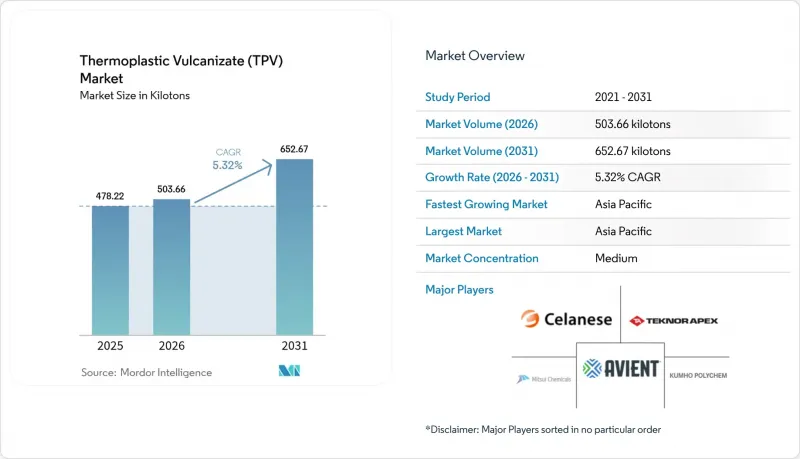
This report is Segmented by Product Type (Standard EPDM/PP, High-Performance/Heat-Resistant, and More), Application (Sealing Systems, Interior/Exterior Trim, Under-The-Hood, and More), End-User (Automotive, Building and Construction, and More), and Geography (Asia-Pacific, North America, Europe, South America, Middle East and Africa). Market Forecasts are Provided in Terms of Volume (Tons).
Global Thermoplastic Vulcanizate (TPV) Market Trends and Insights
Rising Lightweighting Demand From Global Automotive OEMs
Automotive light-weighting goals have cascaded from primary metal structures to elastomeric parts, giving TPV a 20%-24% mass-saving edge over thermoset rubber in door seals and glass-run channels without part redesign. Every 10% curb-weight reduction improves battery-electric range by roughly 6%-8%, an efficiency lever OEMs need to satisfy the European Union's 2027 fleet CO2 cap of 93.6 g/km. Chinese automakers such as BYD and NIO already integrate multi-material TPV seals on high-volume EV models, while tier-one suppliers Cooper Standard and Toyoda Gosei expanded Wuhan and Tianjin TPV extrusion lines in 2025 to chase 15%-plus compound growth targets. Adoption remains slower in North America, yet Ford retrofitted TPV belt-line seals on the 2025 F-150 Lightning to offset battery-pack mass penalties.
Surge in TPV-Based Soft-Touch Parts for Consumer Electronics
Smartphone, tablet, and wearable OEMs specify Shore A 60-80 TPV overmolds on polycarbonate and ABS housings to eliminate secondary painting and capture a 12%-15% scrap-reduction benefit relative to silicone elastomers. Vietnam and Korea molders that serve Samsung and Xiaomi posted 18% year-on-year TPV volume gains in 2025, buoyed by foldable-phone hinge covers and smartwatch bands requiring high flex fatigue resistance. Premium electronics lines are migrating to renewable-content TPV, whereas cost-sensitive contracts still prefer fossil-derived grades, leaving a 25%-plus price delta. Regulatory pressure is minimal, but voluntary ISO 14001 adoption across the supply chain reinforces a recyclable-thermoplastic preference.
Volatility in Propylene and EPDM Feedstock Prices
Unplanned cracker outages and fluctuating naphtha costs lifted spot propylene to USD 1,120 per ton in April 2025 before easing later in the year, while European EPDM contracts jumped 12% quarter-over-quarter after capacity curtailments at major producers. TPV compounders normally lock downstream prices for 12-24 months, so rapid feedstock inflation compressed gross margins by up to 300 basis points. The pressure is heaviest in Asia-Pacific, where propylene derivatives account for almost 60% of TPV manufacturing cost.
Other drivers and restraints analyzed in the detailed report include:
- OEM Shift Toward Recyclable Elastomeric Materials
- Expansion of EV Battery-Pack Sealing Applications
- Inferior Long-Term Chemical/Wear Resistance vs. Thermoset Rubber
For complete list of drivers and restraints, kindly check the Table Of Contents.
Segment Analysis
Bio-based grades are projected to grow with the highest CAGR of 6.82% CAGR through 2031. Kuraray commercialized SEPTON BIO in 2024 with 80% renewable content and secured Toyota interior-trim contracts for the 2026 model year. Standard EPDM/PP compounds still dominate with 45.15% of 2025 volume because their unit costs of USD 2.80-3.20 per kg undercut renewable alternatives by as much as 30%. High-performance heat-resistant TPV wins critical under-hood hose and turbocharger duct slots, sustaining premium pricing despite more complex peroxide cross-linking. Recycled-content grades depend on feedstock access; fewer than 5% of post-consumer elastomers in North America reenter mechanical recycling streams, forcing compounders to rely on pricier post-industrial scrap.
Standard EPDM/PP grades carry a fossil-derived carbon footprint near 3 kg CO2-equivalent per kg, exposing OEMs to tightening scope-3 emission audits under the European Corporate Sustainability Reporting Directive. Bio-based alternatives gain share in visible interior trim despite 20%-35% cost premiums because renewable-carbon disclosure provides branding value that offsets higher material expenses. High-performance peroxide-cured grades open battery-pack and turbocharged-engine doors, but reduced re-processability limits recyclability and truncates circular-economy claims. Recycled-content TPV remains capacity-constrained until shredder-residue sorting improves.
Complete Report Scope:
- By Product Type
- Standard EPDM/PP TPV
- High-Performance / Heat-Resistant TPV
- Bio-based TPV
- Recycled-content TPV
- By Application
- Sealing Systems and Weather-strips
- Interior and Exterior Trim
- Under-the-Hood Components
- Hose and Tubing
- Wire and Cable
- Medical Devices
- Consumer and Sporting Goods Parts
- By End-User Industry
- Automotive
- Building and Construction
- Consumer Goods
- Healthcare
- Other End-user Industries
- By Geography
- Asia-Pacific
- China
- India
- Japan
- South Korea
- Indonesia
- Malaysia
- Thailand
- Vietnam
- Rest of Asia-Pacific
- North America
- United States
- Canada
- Mexico
- Europe
- Germany
- United Kingdom
- France
- Italy
- Spain
- Nordic Countries
- Russia
- Rest of Europe
- South America
- Brazil
- Argentina
- Colombia
- Rest of South America
- Middle-East and Africa
- Saudi Arabia
- Qatar
- United Arab Emirates
- Nigeria
- Egypt
- South Africa
- Rest of Middle-East and Africa
- Asia-Pacific
Geography Analysis
Asia-Pacific anchored 45.78% of 2025 TPV volume and is projected to grow at 6.18% through 2031. China shipped 5.5 million vehicles abroad in 2024, a 30% rise that has spurred domestic compounders such as Zhejiang Xiantong Rubber to boost TPV nameplate capacity by roughly 20% per year. India, now the world's third-largest vehicle producer, is adopting TPV on two-wheelers and compact cars to meet rising fuel-economy targets, while Japanese and Korean suppliers Mitsui Chemicals and Kumho Polychem continue to push heat-resistant grades for Toyota, Hyundai, and Kia EV platforms.
North America accounted for significant market demand in 2025. U.S. pickup platforms remain durability-oriented, yet TPV adoption is creeping upward as Ford and General Motors integrate seals on electrified trucks to offset battery weight. Mexico's 4.1-million-unit assembly base sources local TPV from Teknor Apex's Matamoros site, giving regional converters supply-chain resilience. Europe's market growth is driven by bio-based and recycled-content adoption due to EU sustainability directives. Germany, France, and Italy represent 60% of regional TPV needs as Volkswagen, Stellantis, and BMW intensify scope-3 emission audits.
South America market is centered on Brazil, where Fiat and Volkswagen apply TPV weatherstrips on compact models. The Middle East and Africa collectively register nascent growth as Saudi and UAE assembly plants import TPV parts alongside imported kits. Lack of mandatory recycled-content or EPR schemes slows the adoption of renewable or recycled grades in these regions.
- Avient Corporation
- Celanese Corporation
- DuPont
- Elastron TPE
- FM Plastics
- HEXPOL AB
- Kumho Polychem
- LCY
- LOTTE Chemical CORPORATION
- Mitsubishi Chemical Group Corporation
- Mitsui Chemicals Inc.
- Orbia (Alphagary)
- Ravago
- RTP Company
- Shandong Dawn Polymer Materials Co. Ltd
- Teknor Apex
- Trinseo
- Zylog ElastoComp LLP
Additional Benefits:
- The market estimate (ME) sheet in Excel format
- 3 months of analyst support
TABLE OF CONTENTS
1 Introduction
- 1.1 Study Assumptions and Market Definition
- 1.2 Scope of the Study
2 Research Methodology
3 Executive Summary
4 Market Landscape
- 4.1 Market Overview
- 4.2 Market Drivers
- 4.2.1 Rising Lightweighting Demand from Global Automotive OEMs
- 4.2.2 Surge in TPV-Based Soft-Touch Parts for Consumer Electronics
- 4.2.3 OEM Shift Toward Recyclable Elastomeric Materials
- 4.2.4 Expansion of EV Battery-Pack Sealing Applications
- 4.2.5 Emergence of Bio-Based TPV Grades
- 4.3 Market Restraints
- 4.3.1 Volatility in Propylene and EPDM Feedstock Prices
- 4.3.2 Inferior Long-Term Chemical/Wear Resistance Vs. Thermoset Rubber
- 4.3.3 Lack of Closed-Loop Recycling Infrastructure for TPV Scrap
- 4.4 Value Chain Analysis
- 4.5 Porter's Five Forces
- 4.5.1 Bargaining Power of Suppliers
- 4.5.2 Bargaining Power of Buyers
- 4.5.3 Threat of New Entrants
- 4.5.4 Threat of Substitute Products
- 4.5.5 Degree of Competition
5 Market Size and Growth Forecasts (Volume)
- 5.1 By Product Type
- 5.1.1 Standard EPDM/PP TPV
- 5.1.2 High-Performance / Heat-Resistant TPV
- 5.1.3 Bio-based TPV
- 5.1.4 Recycled-content TPV
- 5.2 By Application
- 5.2.1 Sealing Systems and Weather-strips
- 5.2.2 Interior and Exterior Trim
- 5.2.3 Under-the-Hood Components
- 5.2.4 Hose and Tubing
- 5.2.5 Wire and Cable
- 5.2.6 Medical Devices
- 5.2.7 Consumer and Sporting Goods Parts
- 5.3 By End-User Industry
- 5.3.1 Automotive
- 5.3.2 Building and Construction
- 5.3.3 Consumer Goods
- 5.3.4 Healthcare
- 5.3.5 Other End-user Industries
- 5.4 By Geography
- 5.4.1 Asia-Pacific
- 5.4.1.1 China
- 5.4.1.2 India
- 5.4.1.3 Japan
- 5.4.1.4 South Korea
- 5.4.1.5 Indonesia
- 5.4.1.6 Malaysia
- 5.4.1.7 Thailand
- 5.4.1.8 Vietnam
- 5.4.1.9 Rest of Asia-Pacific
- 5.4.2 North America
- 5.4.2.1 United States
- 5.4.2.2 Canada
- 5.4.2.3 Mexico
- 5.4.3 Europe
- 5.4.3.1 Germany
- 5.4.3.2 United Kingdom
- 5.4.3.3 France
- 5.4.3.4 Italy
- 5.4.3.5 Spain
- 5.4.3.6 Nordic Countries
- 5.4.3.7 Russia
- 5.4.3.8 Rest of Europe
- 5.4.4 South America
- 5.4.4.1 Brazil
- 5.4.4.2 Argentina
- 5.4.4.3 Colombia
- 5.4.4.4 Rest of South America
- 5.4.5 Middle-East and Africa
- 5.4.5.1 Saudi Arabia
- 5.4.5.2 Qatar
- 5.4.5.3 United Arab Emirates
- 5.4.5.4 Nigeria
- 5.4.5.5 Egypt
- 5.4.5.6 South Africa
- 5.4.5.7 Rest of Middle-East and Africa
- 5.4.1 Asia-Pacific
6 Competitive Landscape
- 6.1 Market Concentration
- 6.2 Strategic Moves
- 6.3 Market Share(%)/Ranking Analysis
- 6.4 Company Profiles (includes Global Overview, Market Overview, Core Segments, Financials, Strategic Information, Products and Services, Recent Developments)
- 6.4.1 Avient Corporation
- 6.4.2 Celanese Corporation
- 6.4.3 DuPont
- 6.4.4 Elastron TPE
- 6.4.5 FM Plastics
- 6.4.6 HEXPOL AB
- 6.4.7 Kumho Polychem
- 6.4.8 LCY
- 6.4.9 LOTTE Chemical CORPORATION
- 6.4.10 Mitsubishi Chemical Group Corporation
- 6.4.11 Mitsui Chemicals Inc.
- 6.4.12 Orbia (Alphagary)
- 6.4.13 Ravago
- 6.4.14 RTP Company
- 6.4.15 Shandong Dawn Polymer Materials Co. Ltd
- 6.4.16 Teknor Apex
- 6.4.17 Trinseo
- 6.4.18 Zylog ElastoComp LLP
7 Market Opportunities and Future Outlook
- 7.1 White-space and Unmet-Need Assessment

