PUBLISHER: Mordor Intelligence | PRODUCT CODE: 2122320

PUBLISHER: Mordor Intelligence | PRODUCT CODE: 2122320
Biocides - Market Share Analysis, Industry Trends & Statistics, Growth Forecasts (2026 - 2031)
According to Mordor Intelligence, the biocides market size is estimated at 19.78 million tons in 2026 and is expected to reach 24.86 million tons by 2031, at a CAGR of 4.68% during the forecast period (2026-2031).
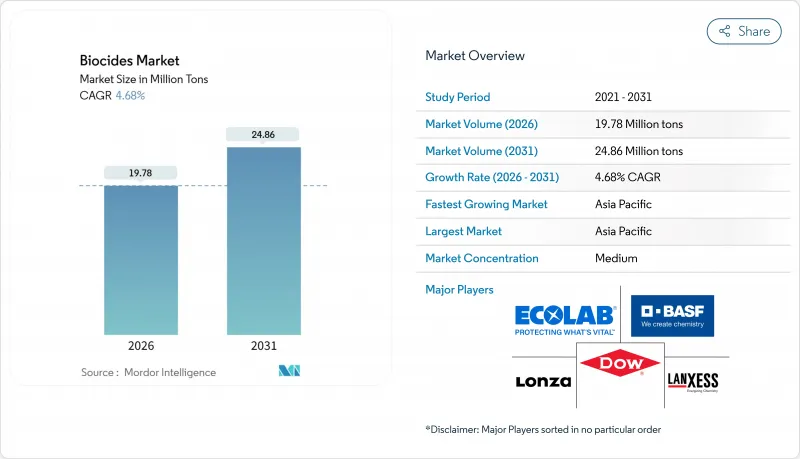
This report is Segmented by Type (Halogen Compounds, Metallic Compounds, and More), Application (Water Treatment, Pharmaceutical and Personal-Care, Wood Preservation, and More), Mode of Action (Oxidizing Biocides and Non-Oxidizing Biocides), and Geography (Asia-Pacific, North America, Europe, South America, and Middle East and Africa). Market Forecasts are Provided in Terms of Volume (Tons).
Global Biocides Market Trends and Insights
Increasing Demand for Water Treatment Globally
Municipal and industrial treatment plants remain the single largest outlet for oxidizing chemistries such as chlorine dioxide and sodium hypochlorite, because these agents deliver reliable microbial control at the lowest cost per treated liter. The updated U.S. Stage 3 Disinfectants rule in 2024 lowered allowable trihalomethanes, prompting utilities to blend peracetic acid or ultraviolet oxidation with traditional chlorination. China's zero-discharge mandate for coastal industrial cooling water is pushing operators toward non-oxidizing isothiazolinone programs that limit salinity and chemical oxygen demand. Across the Middle East, rapid desalination expansion has favored monochloramine systems because they minimize membrane biofouling and lower residual chlorine in brine. India's National Mission for Clean Ganga funds ultraviolet-peracetic acid hybrids for new wastewater plants, which embed biocides as a secondary barrier rather than the lone treatment step. Together, these moves extend the serviceable universe for high-efficacy, low-dose oxidizers, sustaining the biocides market trajectory through 2031.
Growing Demand from the Food and Beverage Industry
Sanitation managers face a patchwork of residue limits that differ sharply between the United States and the European Union, accelerating the shift from commodity chlorine rinses to premium peracetic-acid or quaternary-ammonium blends. FDA guidance issued in 2025 allows 80 ppm peracetic acid on fresh-cut produce without a potable rinse, saving an estimated 15% water per line and encouraging processors to standardize around single-step protocols. Dutch dairy cooperatives reported 25% shorter clean-in-place cycles after switching to quaternary foams, a gain that lifts throughput and lowers steam use. Meanwhile, beverage plants fight yeast and mold in aseptic fillers with broad-spectrum biocides that remain efficacious across acidic product lines, evident in BASF Preventol's success at pH 3-7. Retail pressure for clean labels has prompted formulators to experiment with sorbic acid and natamycin; however, higher dosing rates and tighter application windows offset part of the consumer appeal. The net effect is a higher average selling price per active kilogram, bolstering revenue even when volumes shift toward costlier niches in the biocides market.
Environmental Issues and Health Hazards Related to Biocides
Regulators are elevating environmental and toxicological scrutiny, leading to longer approval pipelines and outright bans on specific actives. The European Chemicals Agency added bronopol and glutaraldehyde to its Candidate List in 2024, compelling users to run substitution assessments wherever safer options exist. The U.S. EPA's endocrine-disruption screen flagged triclosan and triclocarban in 2025, prompting consumer-goods makers to phase out both and cut usage in personal-care products by 62% within 18 months. Aquatic-toxicity caps on isothiazolinones in EU industrial discharges now stand at 0.1 µg L-1, forcing plants to upgrade to closed-loop treatments or pay wastewater surcharges. Encapsulation technologies help curb environmental release but raise production costs by 15-20%, squeezing margins on commodity lines. Collectively, tightening standards subtract 0.8 percentage points from the forecast CAGR and heighten compliance risk for suppliers that lag in portfolio renewal.
Other drivers and restraints analyzed in the detailed report include:
- Heightened Awareness of Health and Hygiene
- Rising Demand in Paints and Coatings Industry
- Fluctuating Raw Material Prices
For complete list of drivers and restraints, kindly check the Table Of Contents.
Segment Analysis
Halogen compounds accounted for 28.23% of global volume in 2025, underscoring their status as the most widely used chemistry in the biocides market share. This subsegment is forecast to grow at a 5.86% CAGR through 2031, outpacing the broader biocides market as utilities and industrial users rely on chlorine- and bromine-based systems they already understand and can purchase at scale. Chlorine remains central to potable-water programs because operators can meet stricter disinfection-by-product limits through pH control and improved contact-time protocols rather than wholesale chemistry swaps. Bromine's higher efficacy at elevated pH makes it the preferred choice for zero-liquid-discharge cooling towers where blowdown must be minimized. Metallic compounds, led by copper preservatives and silver-ion antimicrobials, satisfy niche yet high-value needs. Meanwhile, phenolics continue to lose share to quaternary ammonium and peroxide systems that avoid characteristic odor and surface staining. Regulatory reviews of isothiazolinones in the European Union pressure organosulfurs, but alternative pockets, such as organic acids, benefit from food-industry demand for clean-label antimicrobials exempt from full biocidal registration.
Halogens also derive strength from integrated supply chains; suppliers such as Dow operate captive chlor-alkali assets that hedge margin against feedstock swings. Growing installation of on-site chlorine dioxide generators further reduces lifecycle cost and transport risk, anchoring customer retention for established vendors. However, halogen volumes face a long-term ceiling as municipal utilities invest in multi-barrier treatment that incorporates ultraviolet or advanced oxidation to reduce chemical dosage. Suppliers that complement halogen products with bio-based or encapsulated alternatives will protect revenue as the biocides market absorbs both cost-driven and regulatory shifts in the 2030s.
Complete Report Scope:
- By Type
- Halogen Compounds
- Metallic Compounds
- Organosulfurs
- Organic Acids
- Phenolics
- Other Types (Quaternary Ammonium Compounds)
- By Application
- Water Treatment
- Pharmaceutical and Personal-care
- Wood Preservation
- Food and Beverage
- Paints and Coatings
- Other Applications (Oil and Gas, Agriculture, Disinfectants and Sanitization)
- By Mode of Action
- Oxidizing Biocides
- Non-oxidizing Biocides
- By Geography
- Asia-Pacific
- China
- India
- Japan
- South Korea
- Thailand
- Malaysia
- Indonesia
- Vietnam
- Rest of Asia-Pacific
- North America
- United States
- Canada
- Mexico
- Europe
- Germany
- United Kingdom
- Italy
- France
- Spain
- Russia
- Nordics
- Rest of Europe
- South America
- Brazil
- Argentina
- Rest of South America
- Middle East and Africa
- Saudi Arabia
- United Arab Emirates
- Qatar
- South Africa
- Nigeria
- Egypt
- Rest of Middle East and Africa
- Asia-Pacific
Geography Analysis
Asia-Pacific made up 35.32% of the 2025 volume and posts the fastest 5.22% CAGR through 2031, reflecting vigorous infrastructure spending and stricter water-quality laws. China's zero-discharge cooling-water mandate forces petrochemical and metals plants onto closed-loop systems that require constant biocide dosing to control microbial-induced corrosion. India's Jal Jeevan Mission, targeting universal rural water connections, rolls out millions of small dosing stations that rely on sodium hypochlorite powder for simplified logistics. Japan tightened Legionella monitoring in tower loops, lifting domestic demand for non-oxidizing solutions that can be deployed without draining systems in densely occupied buildings. Southeast Asian manufacturing hubs insist on EPA- or EU-compliant biocides to secure export certifications, prompting BASF to add 40,000 ton/year capacity at Nanjing for regional supply.
North America and Europe together account for half of global consumption, yet expand slowly because markets are mature and regulatory constraints drive reformulation rather than volume expansion. The United States advanced its Safer Choice standards in 2024, banning or limiting eighteen actives, thereby nudging suppliers toward bio-based alternatives that command higher prices but lower dose rates. Canada's re-evaluation program for pollinator safety delays renewal for several commonly used actives, adding supply uncertainty. Europe's centralized Union Authorization process now stretches approvals to three years, a burden that favors multinationals with robust regulatory teams. Demand inside the bloc concentrates in Germany, the United Kingdom, and France, driven by automotive coatings, pharmaceuticals, and municipal water.
South America and the Middle East and Africa are witnessing a significant rise in demand as governments expand water and energy infrastructure. Brazil now permits chlorine dioxide and peracetic acid as alternatives to chlorine in potable water, opening the door for on-site generation equipment. Argentina's industry upgrades cooling systems to comply with stricter discharge rules, supporting sales of non-oxidizing packages. Saudi Arabia's Vision 2030 desalination build-out calls for monochloramine to curb membrane biofouling, representing a significant new outlet for oxidizer producers. Nigeria and Egypt secure African Development Bank grants for WHO-compliant chlorination installations, signalling future upside in sub-Saharan volumes.
- Albemarle Corporation
- Arxada
- Baker Hughes Company
- BASF SE
- Dow
- Ecolab
- IRO Group Inc.
- Italmatch AWS
- Kemipex
- Kemira
- LANXESS
- Lonza
- Merck KGaA
- Nouryon
- Solvay
- Stepan Company
- The Lubrizol Corporation
- Thor Group Ltd.
- Valtris Specialty Chemicals
- Veolia
- Vink Chemicals GmbH & Co. KG
Additional Benefits:
- The market estimate (ME) sheet in Excel format
- 3 months of analyst support
TABLE OF CONTENTS
1 Introduction
- 1.1 Study Assumptions and Market Definition
- 1.2 Scope of the Study
2 Research Methodology
3 Executive Summary
4 Market Landscape
- 4.1 Market Overview
- 4.2 Market Drivers
- 4.2.1 Increasing Demand for Water Treatment Globally
- 4.2.2 Growing Demand from the Food and Beverage Industry
- 4.2.3 Heightened Awareness of Health and Hygiene
- 4.2.4 Rising Demand in Paints and Coatings Industry
- 4.2.5 Regulatory Support for Safer Alternatives
- 4.3 Market Restraints
- 4.3.1 Environmental Issues and Health Hazards Related to Biocides
- 4.3.2 Fluctuating Raw Material Prices
- 4.3.3 High Research and Development Costs
- 4.4 Value Chain Analysis
- 4.5 Porter's Five Forces
- 4.5.1 Bargaining Power of Suppliers
- 4.5.2 Bargaining Power of Buyers
- 4.5.3 Threat of New Entrants
- 4.5.4 Threat of Substitutes
- 4.5.5 Degree of Competition
5 Market Size and Growth Forecasts (Volume)
- 5.1 By Type
- 5.1.1 Halogen Compounds
- 5.1.2 Metallic Compounds
- 5.1.3 Organosulfurs
- 5.1.4 Organic Acids
- 5.1.5 Phenolics
- 5.1.6 Other Types (Quaternary Ammonium Compounds)
- 5.2 By Application
- 5.2.1 Water Treatment
- 5.2.2 Pharmaceutical and Personal-care
- 5.2.3 Wood Preservation
- 5.2.4 Food and Beverage
- 5.2.5 Paints and Coatings
- 5.2.6 Other Applications (Oil and Gas, Agriculture, Disinfectants and Sanitization)
- 5.3 By Mode of Action
- 5.3.1 Oxidizing Biocides
- 5.3.2 Non-oxidizing Biocides
- 5.4 By Geography
- 5.4.1 Asia-Pacific
- 5.4.1.1 China
- 5.4.1.2 India
- 5.4.1.3 Japan
- 5.4.1.4 South Korea
- 5.4.1.5 Thailand
- 5.4.1.6 Malaysia
- 5.4.1.7 Indonesia
- 5.4.1.8 Vietnam
- 5.4.1.9 Rest of Asia-Pacific
- 5.4.2 North America
- 5.4.2.1 United States
- 5.4.2.2 Canada
- 5.4.2.3 Mexico
- 5.4.3 Europe
- 5.4.3.1 Germany
- 5.4.3.2 United Kingdom
- 5.4.3.3 Italy
- 5.4.3.4 France
- 5.4.3.5 Spain
- 5.4.3.6 Russia
- 5.4.3.7 Nordics
- 5.4.3.8 Rest of Europe
- 5.4.4 South America
- 5.4.4.1 Brazil
- 5.4.4.2 Argentina
- 5.4.4.3 Rest of South America
- 5.4.5 Middle East and Africa
- 5.4.5.1 Saudi Arabia
- 5.4.5.2 United Arab Emirates
- 5.4.5.3 Qatar
- 5.4.5.4 South Africa
- 5.4.5.5 Nigeria
- 5.4.5.6 Egypt
- 5.4.5.7 Rest of Middle East and Africa
- 5.4.1 Asia-Pacific
6 Competitive Landscape
- 6.1 Market Concentration
- 6.2 Strategic Moves
- 6.3 Market Share/Ranking Analysis
- 6.4 Company Profiles (includes Global Overview, Market Level Overview, Core Segments, Financials, Strategic Information, Products and Services, Recent Developments)
- 6.4.1 Albemarle Corporation
- 6.4.2 Arxada
- 6.4.3 Baker Hughes Company
- 6.4.4 BASF SE
- 6.4.5 Dow
- 6.4.6 Ecolab
- 6.4.7 IRO Group Inc.
- 6.4.8 Italmatch AWS
- 6.4.9 Kemipex
- 6.4.10 Kemira
- 6.4.11 LANXESS
- 6.4.12 Lonza
- 6.4.13 Merck KGaA
- 6.4.14 Nouryon
- 6.4.15 Solvay
- 6.4.16 Stepan Company
- 6.4.17 The Lubrizol Corporation
- 6.4.18 Thor Group Ltd.
- 6.4.19 Valtris Specialty Chemicals
- 6.4.20 Veolia
- 6.4.21 Vink Chemicals GmbH & Co. KG
7 Market Opportunities and Future Outlook
- 7.1 White-space and Unmet-need Assessment

