PUBLISHER: Mordor Intelligence | PRODUCT CODE: 2122333

PUBLISHER: Mordor Intelligence | PRODUCT CODE: 2122333
Managed IT Infrastructure Services - Market Share Analysis, Industry Trends & Statistics, Growth Forecasts (2026 - 2031)
According to Mordor Intelligence, the managed IT infrastructure services market size was valued at USD 128.53 billion in 2025 and estimated to grow from USD 140.36 billion in 2026 to reach USD 217.68 billion by 2031, at a CAGR of 9.20% during the forecast period (2026-2031).
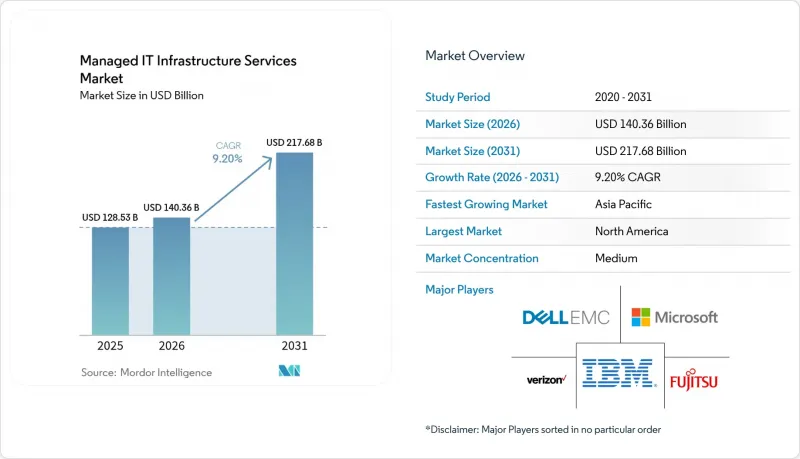
This report is Segmented by Service Category (Virtualization, Networking, Storage, Servers, and More), Enterprise Size (Small and Medium Enterprises, Large Enterprises), Deployment Model (On-Premises, Cloud, Hybrid), End-User Industry (IT and Telecommunication, BFSI, and More), and Geography. The Market Forecasts are Provided in Terms of Value (USD).
Global Managed IT Infrastructure Services Market Trends and Insights
Cost Optimisation Through Outsourcing
Enterprises are replacing labour-arbitrage contracts with outcome-based partnerships that funnel savings into innovation programs. Managed vendors provide predictable operating expenses, freeing CIO budgets for AI pilots and product digitization. CFO stewardship now benchmarks partners on uptime, resiliency, and experience scores rather than invoice line items. These dynamics reaffirm the managed IT infrastructure services market as a lever for value creation rather than a cost-cutting commodity.
Cloud and Hybrid-First Transformation Wave
Cloud migration has matured into workload placement optimisation across multicloud estates. Enterprises mix hyperscaler, colocation, and edge footprints to satisfy latency, sovereignty, and TCO goals. The expanded Oracle Database@Azure program-now in 24 additional regions-underscores how joint service catalogs mitigate lock-in and achieve policy compliance. Providers able to engineer and operate these interwoven fabrics win larger, longer contracts that elevate the managed IT infrastructure services market.
Security and Privacy Concerns
Financial services and healthcare boards scrutinise managed deals for threat exposure and compliance posture. HIPAA requires robust Business Associate Agreements, layered encryption, and audit trails before workloads leave hospital campuses. Extended due diligence lengthens sales cycles and can delay revenue realisation, tempering near-term growth for the managed IT infrastructure services market.
Other drivers and restraints analyzed in the detailed report include:
- IT-Skills Shortage in Advanced Infrastructure Ops
- AI-Driven Hyper-Automation Lowers MTTR
- Vendor Lock-in and Integration Complexity
For complete list of drivers and restraints, kindly check the Table Of Contents.
Segment Analysis
In 2025, managed network services accounted for 33.72% of total revenue, making connectivity optimisation the biggest contributor to overall demand. Enterprises continue to modernise SD-WAN and zero-trust architectures to support hybrid work and latency-sensitive SaaS. Parallel growth in edge orchestration at an 11.33% CAGR mirrors rising sensor density and real-time analytics across factories. The managed IT infrastructure services market rewards vendors that merge campus, branch, cloud, and edge monitoring into single observability stacks.
Network modernisation also anchors higher-value cross-selling. Once circuits and routers fall under an MSP's remote management, adjacent services such as SASE gateways, firewall-as-a-service, and AI-based traffic optimisation follow. Virtualisation, storage, and server management maintain steady demand as legacy hardware is rationalised, but margins trend lower due to commoditisation. By contrast, cloud infrastructure management is ascending on the back of multicloud finops, security posture management, and AI workload tuning. Providers that package these layers in integrated blueprints will capture outsized wallet share as the managed IT infrastructure services market matures.
Large enterprises delivered 60.55% of 2025 billings, reflecting complex multiregional estates needing 24X7 oversight. However, SMEs now post a 9.28% CAGR to 2031, benefitting from subscription pricing that obviates data-center buildouts. Cloud marketplaces and self-service portals let a 500-employee retailer spin up managed firewalls, backups, and observability within hours.
The resulting democratization fuels net-new logo growth inside the managed IT infrastructure services market. For MSPs, SME onboarding drives volume efficiency, though ARPU remains lower than with global accounts. Economies of scale thus hinge on automation and AI chatbots that minimise manual ticket handling while preserving SLA adherence. As consumption models evolve, flexible term lengths and modular bundles will remain decisive in winning SME contracts.
Complete Report Scope:
- By Service Category
- Virtualization
- Networking
- Storage
- Servers
- Cloud Infrastructure Management
- Edge Infrastructure Management
- By Enterprise Size
- Small and Medium Enterprises
- Large Enterprises
- By Deployment Model
- On-premises
- Cloud
- Hybrid
- By End-User Industry
- IT and Telecommunication
- BFSI
- Manufacturing
- Retail and E-commerce
- Transportation and Logistics
- Healthcare
- Energy and Utilities
- Geographic Analysis
- North America
- United States
- Canada
- Mexico
- South America
- Brazil
- Argentina
- Rest of South America
- Europe
- Germany
- United Kingdom
- France
- Italy
- Spain
- Russia
- Rest of Europe
- Asia-Pacific
- China
- Japan
- India
- South Korea
- Australia
- Rest of Asia-Pacific
- Middle East
- Saudi Arabia
- United Arab Emirates
- Turkey
- Rest of Middle East
- Africa
- South Africa
- Nigeria
- Kenya
- Rest of Africa
- North America
Geography Analysis
North America sustained 34.12% revenue share in 2025, reflecting early-mover maturity in workload outsourcing and stringent SLAs that favour outcome-based contracts. United States multinationals execute multi-year renewals covering cloud migration, AI co-development, and zero-trust enablement. Canadian firms prioritise hybrid platforms to ensure data residency, and Mexican manufacturers deploy managed campus networks aligned with Automotive-4.0 production lines. Vendor competition here is intense, driving consolidation among midsized MSPs and telecom-carrier captives.
Asia Pacific is projected to grow at 10.12% CAGR through 2031, the fastest regional pace inside the managed IT infrastructure services market. China's state-incentivised digitisation funnels managed spend into smart-factory platforms. Japan's enterprises experiment with private-cloud AI clusters to accelerate product innovation cycles, while India's domestic startups adopt consumption-based managed Kubernetes clusters straight from the cloud. Australia, South Korea, and ASEAN-5 economies witness leapfrog uptake as businesses bypass legacy data centers and go straight to SaaS and managed edge nodes.
- Accenture plc
- Amazon Web Services, Inc.
- ATandT Inc.
- Capgemini SE
- Cisco Systems, Inc.
- Cognizant Technology Solutions Corp.
- Dell Technologies Inc.
- DXC Technology Company
- Fujitsu Limited
- Google LLC
- HCL Technologies Ltd.
- Hewlett Packard Enterprise Co.
- IBM Corporation
- Kyndryl Holdings, Inc.
- Microsoft Corporation
- NTT DATA Corporation
- Rackspace Technology, Inc.
- Tata Consultancy Services Ltd.
- Verizon Communications Inc.
- Wipro Limited
Additional Benefits:
- The market estimate (ME) sheet in Excel format
- 3 months of analyst support
TABLE OF CONTENTS
1 INTRODUCTION
- 1.1 Study Assumptions and Market Definition
- 1.2 Scope of the Study
2 RESEARCH METHODOLOGY
3 EXECUTIVE SUMMARY
4 MARKET LANDSCAPE
- 4.1 Market Overview
- 4.2 Market Drivers
- 4.2.1 Cost optimisation through outsourcing
- 4.2.2 Cloud and hybrid-first transformation wave
- 4.2.3 IT-skills shortage in advanced infrastructure ops
- 4.2.4 AI-driven hyper-automation lowers MTTR (under-radar)
- 4.2.5 Edge infrastructure surge in Industry 4.0 (under-radar)
- 4.2.6 Green-datacentre mandates and ESG scorecards (under-radar)
- 4.3 Market Restraints
- 4.3.1 Security and privacy concerns
- 4.3.2 Vendor lock-in and integration complexity
- 4.3.3 Escalating power-/cooling OPEX for MSPs (under-radar)
- 4.3.4 Data-sovereignty/geopolitical fragmentation (under-radar)
- 4.4 Supply-Chain Analysis
- 4.5 Regulatory Landscape
- 4.6 Technological Outlook
- 4.7 Porter's Five Forces Analysis
- 4.7.1 Threat of New Entrants
- 4.7.2 Bargaining Power of Buyers
- 4.7.3 Bargaining Power of Suppliers
- 4.7.4 Threat of Substitutes
- 4.7.5 Competitive Rivalry
- 4.8 Impact of Macroeconomic Factors on the Market
5 MARKET SIZE AND GROWTH FORECASTS (VALUE)
- 5.1 By Service Category
- 5.1.1 Virtualization
- 5.1.2 Networking
- 5.1.3 Storage
- 5.1.4 Servers
- 5.1.5 Cloud Infrastructure Management
- 5.1.6 Edge Infrastructure Management
- 5.2 By Enterprise Size
- 5.2.1 Small and Medium Enterprises
- 5.2.2 Large Enterprises
- 5.3 By Deployment Model
- 5.3.1 On-premises
- 5.3.2 Cloud
- 5.3.3 Hybrid
- 5.4 By End-User Industry
- 5.4.1 IT and Telecommunication
- 5.4.2 BFSI
- 5.4.3 Manufacturing
- 5.4.4 Retail and E-commerce
- 5.4.5 Transportation and Logistics
- 5.4.6 Healthcare
- 5.4.7 Energy and Utilities
- 5.5 Geographic Analysis
- 5.5.1 North America
- 5.5.1.1 United States
- 5.5.1.2 Canada
- 5.5.1.3 Mexico
- 5.5.2 South America
- 5.5.2.1 Brazil
- 5.5.2.2 Argentina
- 5.5.2.3 Rest of South America
- 5.5.3 Europe
- 5.5.3.1 Germany
- 5.5.3.2 United Kingdom
- 5.5.3.3 France
- 5.5.3.4 Italy
- 5.5.3.5 Spain
- 5.5.3.6 Russia
- 5.5.3.7 Rest of Europe
- 5.5.4 Asia-Pacific
- 5.5.4.1 China
- 5.5.4.2 Japan
- 5.5.4.3 India
- 5.5.4.4 South Korea
- 5.5.4.5 Australia
- 5.5.4.6 Rest of Asia-Pacific
- 5.5.5 Middle East
- 5.5.5.1 Saudi Arabia
- 5.5.5.2 United Arab Emirates
- 5.5.5.3 Turkey
- 5.5.5.4 Rest of Middle East
- 5.5.6 Africa
- 5.5.6.1 South Africa
- 5.5.6.2 Nigeria
- 5.5.6.3 Kenya
- 5.5.6.4 Rest of Africa
- 5.5.1 North America
6 COMPETITIVE LANDSCAPE
- 6.1 Market Concentration
- 6.2 Strategic Moves
- 6.3 Market Share Analysis
- 6.4 Company Profiles (includes Global level Overview, Market level overview, Core Segments, Financials as available, Strategic Information, Market Rank/Share for key companies, Products and Services, and Recent Developments)
- 6.4.1 Accenture plc
- 6.4.2 Amazon Web Services, Inc.
- 6.4.3 ATandT Inc.
- 6.4.4 Capgemini SE
- 6.4.5 Cisco Systems, Inc.
- 6.4.6 Cognizant Technology Solutions Corp.
- 6.4.7 Dell Technologies Inc.
- 6.4.8 DXC Technology Company
- 6.4.9 Fujitsu Limited
- 6.4.10 Google LLC
- 6.4.11 HCL Technologies Ltd.
- 6.4.12 Hewlett Packard Enterprise Co.
- 6.4.13 IBM Corporation
- 6.4.14 Kyndryl Holdings, Inc.
- 6.4.15 Microsoft Corporation
- 6.4.16 NTT DATA Corporation
- 6.4.17 Rackspace Technology, Inc.
- 6.4.18 Tata Consultancy Services Ltd.
- 6.4.19 Verizon Communications Inc.
- 6.4.20 Wipro Limited
7 MARKET OPPORTUNITIES AND FUTURE OUTLOOK
- 7.1 White-space and Unmet-Need Assessment

