PUBLISHER: Mordor Intelligence | PRODUCT CODE: 2122334

PUBLISHER: Mordor Intelligence | PRODUCT CODE: 2122334
Cold Plasma In Healthcare - Market Share Analysis, Industry Trends & Statistics, Growth Forecasts (2026 - 2031)
According to Mordor Intelligence, the cold plasma in healthcare market size is expected to increase from USD 2.81 billion in 2025 to USD 3.19 billion in 2026 and reach USD 6.31 billion by 2031, growing at a CAGR of 14.62% over 2026-2031.
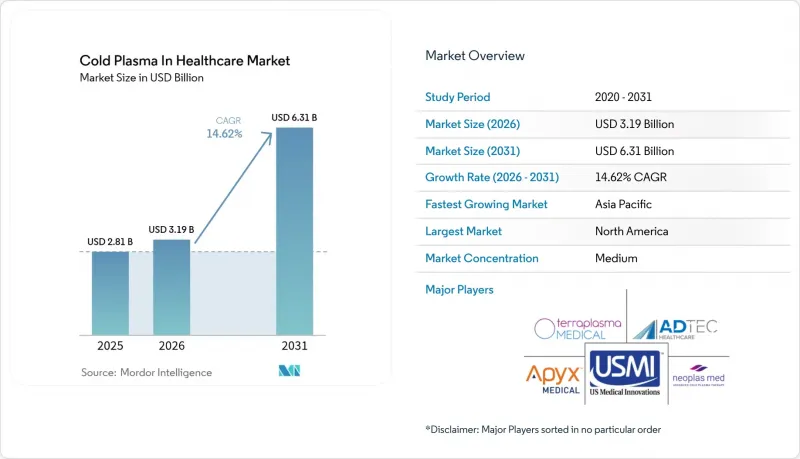
This report is Segmented by Product Type (Devices, Consumables, Services & Software), Device Technology (Radio-Frequency CAP, Microwave CAP, Piezoelectric Handheld Jet, and More), Pressure Type (Atmospheric, and More), Application (Chronic Wound Healing, and More), End User (Hospitals, and More), and Geography (North America, and More). Market Forecasts are Provided in Terms of Value (USD).
Global Cold Plasma In Healthcare Market Trends and Insights
Rising Prevalence of Chronic Wounds & Diabetic Ulcers
Diabetic foot ulcers affect 4%-25% of people with diabetes and recur in 65% of cases within five years, creating a weekly caseload of 60,000-75,000 treatments in England alone. These hard-to-heal wounds precede 80% of non-traumatic amputations and cost USD 8,600-13,500 per patient each year. Cold plasma generates reactive oxygen and nitrogen species at skin-safe temperatures, accelerating granulation while lowering antibiotic use from 23% to 4% in the POWER trial. Academic groups in Sheffield and Adelaide confirmed in 2024 that plasma-activated hydrogels eradicate biofilms within 24 hours while maintaining moisture balance. As diabetes prevalence rises, hospitals are embedding plasma protocols into multidisciplinary foot clinics.
Increasing Antibiotic-Resistant Infections Spur Demand for Non-Thermal Sterilization
The World Health Organization attributes 1.27 million deaths to bacterial resistance each year, with 42% of Escherichia coli isolates now defying third-generation cephalosporins. Cold plasma offers a drug-free pathway by rupturing bacterial membranes and DNA in under a minute. A 2024 study showed 3- to 5-log reductions in multidrug-resistant Pseudomonas and Acinetobacter on hospital surfaces, outperforming chemical disinfectants that need 10 minutes. Japan's health ministry approved Plasma Care for room decontamination the same year, validating the technology as an adjunct to chemical wipes. Infection-control committees now bundle plasma units with UV-C and HEPA measures in intensive-care settings.
High Capital Cost of Cold-Plasma Systems & Noble-Gas Consumables
Entry-level atmospheric units cost USD 12,000-25,000, and low-pressure chambers exceed USD 150,000, out-pricing many public hospitals. Helium now runs USD 80-120 per cylinder after the U.S. reserve sale, lifting per-procedure consumables to USD 15-25. Argon mixes are cheaper but require higher voltage and yield narrower antimicrobial spectra. Leasing and pay-per-use contracts in Germany and the UK are emerging to convert capex into opex, yet uptake in price-sensitive markets still lags.
Other drivers and restraints analyzed in the detailed report include:
- Growing Adoption of Atmospheric CAP in Hospital Infection-Control Protocols
- Favorable Regulatory Approvals & Reimbursement Pilots
- Lack of Standardized Clinical Protocols & Limited Large-Scale RCTs
For complete list of drivers and restraints, kindly check the Table Of Contents.
Segment Analysis
Devices captured 73.11% of the cold plasma in healthcare market in 2025 as hospitals expanded installed bases for wound-care and sterilization. Consumables such as disposable electrodes and gas cartridges drove 18% of revenue, locking customers into proprietary supply chains. Services and software owned just 9% but are scaling at an 18.57% CAGR because predictive-analytics modules sell for USD 500-1,200 per month. This shift lifts recurring revenue and cushions hardware price erosion.
The cold plasma in healthcare market size linked to services will expand further once plasma-activated dressings reach commercial volumes after 2027. Electrode replacement every 200-500 cycles and gas canisters per 30-40 procedures add stable aftermarket streams. Cloud dashboards that document RONS exposure, tissue impedance, and healing curves satisfy MDR traceability rules and underpin outcome-based reimbursement contracts.
Plasma jets commanded 41.57% revenue in 2025 thanks to handheld ergonomics, yet helium shortages are pushing operators toward radio-frequency units that need only ambient air. RF systems are forecast to grow at 17.35% CAGR, helped by RKI guidelines that cite 99.9% sporicidal kill in 90 seconds. Microwave CAP occupies a 12% niche for bulk instrument loads but requires electromagnetic shielding.
Piezoelectric jets usher battery-driven portability, fast-tracked by Japan's regulator in 2024. DBD roll-to-roll arrays remain pre-commercial but could transform manufacturing of plasma-activated dressings. As gas-free top-line gains offset higher capex, RF vendors are closing the performance-price gap and taking share from jet incumbents.
Complete Report Scope:
- By Product Type
- Devices
- Plasma Jet Generators
- Dielectric Barrier Discharge Units
- Microwave CAP Systems
- Low-Pressure RF Chambers
- Consumables
- Disposable Gas Cartridges
- Plasma-Activated Dressings / Patches
- Replacement Electrodes & Nozzles
- Services & Software
- AI-Driven Dose-Control Platforms
- Installation & Maintenance Contracts
- Devices
- By Device Technology
- Radio-Frequency CAP
- Microwave CAP
- Piezoelectric Handheld Jet
- DBD Roll-to-Roll Arrays
- By Pressure Type
- Atmospheric Pressure Cold Plasma
- Low-Pressure / Vacuum Cold Plasma
- By Application
- Chronic Wound Healing
- Surgical Oncology Ablation
- Hemostasis & Blood Coagulation
- Dentistry & Oral Care
- Dermatology & Aesthetics
- Sterilization & Disinfection of Instruments & Surfaces
- Plasma-Activated Liquids & Hydrogels
- Implant Surface Functionalization
- By End User
- Hospitals (Inpatient)
- Ambulatory Surgical Centers
- Dedicated Wound-Care Centers
- Specialty Clinics (Dermatology / Oncology)
- Research & Academic Institutes
- Home-Care Settings
- By Geography
- North America
- United States
- Canada
- Mexico
- Europe
- Germany
- France
- United Kingdom
- Italy
- Spain
- Rest of Europe
- Asia-Pacific
- China
- Japan
- India
- South Korea
- Australia
- Rest of Asia-Pacific
- Middle East & Africa
- GCC
- South Africa
- Rest of Middle East & Africa
- South America
- Brazil
- Argentina
- Rest of South America
- North America
Geography Analysis
North America controlled 39.62% revenue in 2025, anchored by FDA clearances. Yet absent Medicare-wide coverage tempers hospital rollouts, shifting emphasis toward private-payer pilots and software subscriptions. Helium rationing is nudging buyers to ambient-air RF models, and margins for jet suppliers are thinning.
Europe generated 32% share, underpinned by Germany's new codes and RKI guidelines. Funding from Niterra Ventures is scaling device capacity, while at-home pilots test recurrence reduction in diabetic ulcers. The UK's NICE is drafting guidance for 2026, and Spain and Italy run research protocols until payer positions mature.
Asia-Pacific is the growth engine at a 16.83% CAGR to 2031. Japan's PMDA fast-tracked handheld jets and sanctioned Plasma Care for room disinfection, while China finalizes Class III oncology rules. India's public sector struggles with capex, but private-chain hospitals in tier-1 cities are adopting atmospheric units. South Korea approved two sterilization models, and Australia is trialing reimbursement in New South Wales wound clinics.
- AcXys Plasma Technologies
- Adtec Plasma Technology Co. Ltd.
- Advanced Plasma Solutions
- Apyx Medical
- CINOGY System
- Coldplasmatech GmbH
- Europlasma NV
- Henniker Plasma
- Mirari Doctor Inc.
- Molecular Plasma Group
- Neoplas Med GmbH
- Nordson Corporation (Healthcare Segment)
- Plasmacure BV
- PlasmaLeap Technologies
- Plasmapp GmbH
- PlasmaTreat GmbH
- Relyon Plasma GmbH
- SOFTAL Corona & Plasma GmbH
- Surfx Technologies LLC
- Tantec A/S (Plasma MEDICAL)
- terraplasma medical
- US Medical Innovations LLC
Additional Benefits:
- The market estimate (ME) sheet in Excel format
- 3 months of analyst support
TABLE OF CONTENTS
1 Introduction
- 1.1 Study Assumptions & Market Definition
- 1.2 Scope of the Study
2 Research Methodology
3 Executive Summary
4 Market Landscape
- 4.1 Market Overview
- 4.2 Market Drivers
- 4.2.1 Rising Prevalence of Chronic Wounds & Diabetic Ulcers
- 4.2.2 Increasing Antibiotic-Resistant Infections Spur Demand for Non-Thermal Sterilization
- 4.2.3 Growing Adoption of Atmospheric CAP In Hospital Infection-Control Protocols
- 4.2.4 Favorable Regulatory Approvals & Reimbursement Pilots (E.G., German G-BA)
- 4.2.5 Emergence of Plasma-Activated Hydrogel Dressings for Sustained ROS Delivery
- 4.2.6 AI-Driven Dose-Control Modules Improve Clinical Outcomes & Data Logging
- 4.3 Market Restraints
- 4.3.1 High Capital Cost of Cold-Plasma Systems & Noble-Gas Consumables
- 4.3.2 Lack Of Standardized Clinical Protocols & Limited Large-Scale RCTs
- 4.3.3 Multi-Disciplinary, Lengthy Regulatory Pathways Across Regions
- 4.3.4 Helium Supply-Chain Volatility Inflates Operating Expenses for Jet Devices
- 4.4 Value / Supply-Chain Analysis
- 4.5 Regulatory Landscape
- 4.6 Technological Outlook
- 4.7 Porter's Five Forces Analysis
- 4.7.1 Threat of New Entrants
- 4.7.2 Bargaining Power of Suppliers
- 4.7.3 Bargaining Power of Buyers
- 4.7.4 Threat of Substitutes
- 4.7.5 Intensity of Competitive Rivalry
5 Market Size & Growth Forecasts (Value in USD)
- 5.1 By Product Type
- 5.1.1 Devices
- 5.1.1.1 Plasma Jet Generators
- 5.1.1.2 Dielectric Barrier Discharge Units
- 5.1.1.3 Microwave CAP Systems
- 5.1.1.4 Low-Pressure RF Chambers
- 5.1.2 Consumables
- 5.1.2.1 Disposable Gas Cartridges
- 5.1.2.2 Plasma-Activated Dressings / Patches
- 5.1.2.3 Replacement Electrodes & Nozzles
- 5.1.3 Services & Software
- 5.1.3.1 AI-Driven Dose-Control Platforms
- 5.1.3.2 Installation & Maintenance Contracts
- 5.1.1 Devices
- 5.2 By Device Technology
- 5.2.1 Radio-Frequency CAP
- 5.2.2 Microwave CAP
- 5.2.3 Piezoelectric Handheld Jet
- 5.2.4 DBD Roll-to-Roll Arrays
- 5.3 By Pressure Type
- 5.3.1 Atmospheric Pressure Cold Plasma
- 5.3.2 Low-Pressure / Vacuum Cold Plasma
- 5.4 By Application
- 5.4.1 Chronic Wound Healing
- 5.4.2 Surgical Oncology Ablation
- 5.4.3 Hemostasis & Blood Coagulation
- 5.4.4 Dentistry & Oral Care
- 5.4.5 Dermatology & Aesthetics
- 5.4.6 Sterilization & Disinfection of Instruments & Surfaces
- 5.4.7 Plasma-Activated Liquids & Hydrogels
- 5.4.8 Implant Surface Functionalization
- 5.5 By End User
- 5.5.1 Hospitals (Inpatient)
- 5.5.2 Ambulatory Surgical Centers
- 5.5.3 Dedicated Wound-Care Centers
- 5.5.4 Specialty Clinics (Dermatology / Oncology)
- 5.5.5 Research & Academic Institutes
- 5.5.6 Home-Care Settings
- 5.6 By Geography
- 5.6.1 North America
- 5.6.1.1 United States
- 5.6.1.2 Canada
- 5.6.1.3 Mexico
- 5.6.2 Europe
- 5.6.2.1 Germany
- 5.6.2.2 France
- 5.6.2.3 United Kingdom
- 5.6.2.4 Italy
- 5.6.2.5 Spain
- 5.6.2.6 Rest of Europe
- 5.6.3 Asia-Pacific
- 5.6.3.1 China
- 5.6.3.2 Japan
- 5.6.3.3 India
- 5.6.3.4 South Korea
- 5.6.3.5 Australia
- 5.6.3.6 Rest of Asia-Pacific
- 5.6.4 Middle East & Africa
- 5.6.4.1 GCC
- 5.6.4.2 South Africa
- 5.6.4.3 Rest of Middle East & Africa
- 5.6.5 South America
- 5.6.5.1 Brazil
- 5.6.5.2 Argentina
- 5.6.5.3 Rest of South America
- 5.6.1 North America
6 Competitive Landscape
- 6.1 Market Concentration
- 6.2 Market Share Analysis
- 6.3 Company Profiles (includes Global level Overview, Market level overview, Core Segments, Financials as available, Strategic Information, Market Rank/Share for key companies, Products and Services, and Recent Developments)
- 6.3.1 AcXys Plasma Technologies
- 6.3.2 Adtec Plasma Technology Co. Ltd.
- 6.3.3 Advanced Plasma Solutions
- 6.3.4 Apyx Medical Corporation
- 6.3.5 CINOGY System GmbH
- 6.3.6 Coldplasmatech GmbH
- 6.3.7 Europlasma NV
- 6.3.8 Henniker Plasma
- 6.3.9 Mirari Doctor Inc.
- 6.3.10 Molecular Plasma Group
- 6.3.11 Neoplas Med GmbH
- 6.3.12 Nordson Corporation (Healthcare Segment)
- 6.3.13 Plasmacure BV
- 6.3.14 PlasmaLeap Technologies
- 6.3.15 Plasmapp GmbH
- 6.3.16 PlasmaTreat GmbH
- 6.3.17 Relyon Plasma GmbH
- 6.3.18 SOFTAL Corona & Plasma GmbH
- 6.3.19 Surfx Technologies LLC
- 6.3.20 Tantec A/S (Plasma MEDICAL)
- 6.3.21 terraplasma medical GmbH
- 6.3.22 US Medical Innovations LLC
7 Market Opportunities & Future Outlook
- 7.1 White-Space & Unmet-Need Assessment

