PUBLISHER: Mordor Intelligence | PRODUCT CODE: 2122360

PUBLISHER: Mordor Intelligence | PRODUCT CODE: 2122360
Fresh Apples - Market Share Analysis, Industry Trends & Statistics, Growth Forecasts (2026 - 2031)
According to Mordor Intelligence, the fresh apples market size is projected to expand from USD 107.51 billion in 2025 and USD 108.42 billion in 2026 to USD 130.95 billion by 2031, registering a CAGR of 3.85% between 2026 to 2031.
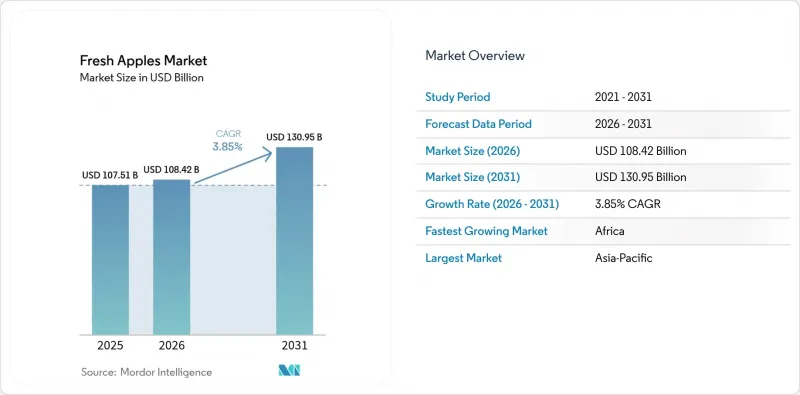
This report is Segmented by Geography (North America, Europe, Asia-Pacific, South America, and More). The Report Includes Production Analysis (Volume), Consumption Analysis (Value and Volume), Export Analysis (Value and Volume), Import Analysis (Value and Volume), Wholesale Price Trend Analysis and Forecast, and More. The Market Forecasts are Provided in Terms of Value (USD) and Volume (Metric Tons).
Global Fresh Apples Market Trends and Insights
High-Density Orchard Expansion in China and India
China converted about 1.2 million hectares to high-density systems between 2020 and 2025, boosting yields to 35-40 metric tons per hectare, up from 15-20 metric tons in legacy apple orchards. In India, state incentives covering half the cost of rootstock and trellis infrastructure drove an 18% increase in high-density acreage in 2024. Shorter time to commercial production, together with drip-based fertigation that trims water use by up to 40%, improves payback periods and aligns with tightening environmental standards. Capital intensity remains a hurdle because smaller growers lack access to long-term credit. Consolidation among well-financed producers therefore advances quickly in Himachal Pradesh and Shaanxi, concentrating value capture and raising quality benchmarks within the fresh apples market.
Organic Acreage Incentives in the European Union
The European Union's incentives for organic apple production align with the Farm to Fork strategy, which aims to convert 25% of agricultural land to organic farming by 2030. These payments aim to support farmers during the transition to organic farming, covering costs associated with certification and sustainable practices. Retailers in Germany, France, and Italy offer premiums of 40-60% for certified organic fruit, incentivizing growers to complete the mandatory three-year transition period. Poland leverages lower land costs to export organic apples to Western Europe, demonstrating how policy incentives influence intra-European trade patterns. Challenges such as reduced yields during the conversion period and limited biocontrol options for fire blight and codling moth slow adoption. These issues highlight the need for continued research and innovation in organic farming methods. Despite these obstacles, growing consumer demand for residue-free produce supports the continued growth of the organic fresh apples market, with retailers and policymakers playing a crucial role in driving this trend.
Intensifying Pest and Disease Pressure
Fire blight infection reached 10-15% of trees in parts of North America and Europe during 2024-2025, triggering costly tree removal at USD 3,000-5,000 per hectare. Codling moth expanded northward into Sweden and Scotland as winters warmed, while apple scab resistance to key fungicides forced growers to rotate to older chemistries with lower efficacy. Organic producers, restricted from synthetic treatments, lost up to 30% of yield in wet years, narrowing economic margins. Adoption of pheromone traps and parallel scouting cuts pesticide use by one-third, yet upfront monitoring costs hold back widespread rollout. Rising biological pressure elevates input uncertainty in the fresh apples market.
Other drivers and restraints analyzed in the detailed report include:
- Monetization of Orchard-Based Carbon Credits
- Commercialization of Gene-Edited Non-Browning Varieties
- Shipping Container Rate Spikes on Key Export Lanes
For complete list of drivers and restraints, kindly check the Table Of Contents.
Geography Analysis
Asia-Pacific accounted for 52.4% of the fresh apples market share in 2025 and continues to define volume, price, and variety preferences. Yield gains of 35-50% from high-density orchards in Shaanxi, Shandong, and Himachal Pradesh offset land constraints, while premium cultivars such as Fuji and Envy retail at USD 3.00-5.00 per kilogram in Chinese tier-one supermarkets. Japan focuses on ultra-premium gifting apples that command over USD 10.00 per kilogram, though the grower is 67 years old, highlighting looming succession challenges. Southeast Asian imports are delivering double-digit growth, intensifying competition among New Zealand, the United States, and Chinese exporters for tariff-advantaged slots.
Africa records the fastest regional growth, with a projected 4.8% CAGR, anticipated to elevate its share of the fresh apples market by 2031. South Africa exported 1.1 million metric tons in 2025, using GlobalGAP certification to unlock shelf space in the European Union and Asia at attractive margins. Egypt harvested 850,000 metric tons and consumed 70% domestically, while shipping the remainder to Gulf states. Morocco's drip-irrigated, high-density projects illustrate North Africa's role as an emergent supplier, though cold-chain gaps still cap large-scale exports. These dynamics confirm that Africa is the fastest-growing geography in the fresh apples market.
Europe produced 12.5 million metric tons in 2025, with Poland supplying one-third and exporting 1.2 million metric tons mainly into neighboring European Union markets and the Middle East. Farm-to-Fork pesticide-reduction targets raise production costs by 20-30%, nudging growers toward integrated pest management or organic certification. Italy's cooperative models pool resources for controlled-atmosphere storage and safeguard quality differentiation. Spain and France faced yield dips due to frost and water shortages, tightening intra-European spot availability during 2025-2026. Russia's import-substitution drive lifted national output to 1.9 million metric tons, but quality gaps persist, maintaining demand for Polish and Turkish fruit in premium supermarket tiers.
- The market estimate (ME) sheet in Excel format
- 3 months of analyst support
TABLE OF CONTENTS
1 Introduction
- 1.1 Study Assumptions and Market Definition
- 1.2 Scope of the Study
2 Research Methodology
3 Executive Summary
4 Market Landscape
- 4.1 Market Overview
- 4.2 Market Drivers
- 4.2.1 High-density orchard expansion in China and India
- 4.2.2 Organic acreage incentives in the European Union
- 4.2.3 Cultivar innovation for climate resilience
- 4.2.4 Monetization of orchard-based carbon credits
- 4.2.5 Adoption of precision orcharding robotics
- 4.2.6 Commercialization of gene-edited non-browning varieties
- 4.3 Market Restraints
- 4.3.1 Climate-driven yield volatility
- 4.3.2 Intensifying pest and disease pressure
- 4.3.3 Orchard water use regulations tightening
- 4.3.4 Shipping container rate spikes on key export lanes
- 4.4 Opportunities
- 4.5 Challenges
- 4.6 Value Chain Analysis
- 4.7 Technologies and usage of AI in the Industry
- 4.8 Input Market Analysis
- 4.8.1 Seeds
- 4.8.2 Fertilizers
- 4.8.3 Crop Protection Chemicals
- 4.9 Distribution Channel Analysis
- 4.10 Market Sentiment Analysis
- 4.11 PESTLE Analysis
5 Market Size and Growth Forecasts (Value and Volume)
- 5.1 By Geography
- 5.1.1 North America
- 5.1.1.1 United States
- 5.1.1.1.1 Production Analysis (Area Harvested, Yield, and Production Volume)
- 5.1.1.1.2 Consumption Analysis (Consumption Value and Volume)
- 5.1.1.1.3 Import Market Analysis (Import Value, Volume, and Key Supplying Markets)
- 5.1.1.1.4 Export Market Analysis (Export Value, Volume, and Key Destination Markets)
- 5.1.1.1.5 Wholesale Price Trend Analysis and Forecast
- 5.1.1.1.6 Regulatory Framework
- 5.1.1.1.7 List of Key Players
- 5.1.1.1.8 Logistics and Infrastructure
- 5.1.1.1.9 Seasonality Analysis
- 5.1.1.2 Mexico
- 5.1.1.2.1 Production Analysis (Area Harvested, Yield, and Production Volume)
- 5.1.1.2.2 Consumption Analysis (Consumption Value and Volume)
- 5.1.1.2.3 Import Market Analysis (Import Value, Volume, and Key Supplying Markets)
- 5.1.1.2.4 Export Market Analysis (Export Value, Volume, and Key Destination Markets)
- 5.1.1.2.5 Wholesale Price Trend Analysis and Forecast
- 5.1.1.2.6 Regulatory Framework
- 5.1.1.2.7 List of Key Players
- 5.1.1.2.8 Logistics and Infrastructure
- 5.1.1.2.9 Seasonality Analysis
- 5.1.1.3 Canada
- 5.1.1.3.1 Production Analysis (Area Harvested, Yield, and Production Volume)
- 5.1.1.3.2 Consumption Analysis (Consumption Value and Volume)
- 5.1.1.3.3 Import Market Analysis (Import Value, Volume, and Key Supplying Markets)
- 5.1.1.3.4 Export Market Analysis (Export Value, Volume, and Key Destination Markets)
- 5.1.1.3.5 Wholesale Price Trend Analysis and Forecast
- 5.1.1.3.6 Regulatory Framework
- 5.1.1.3.7 List of Key Players
- 5.1.1.3.8 Logistics and Infrastructure
- 5.1.1.3.9 Seasonality Analysis
- 5.1.1.1 United States
- 5.1.2 Europe
- 5.1.2.1 Germany
- 5.1.2.1.1 Production Analysis (Area Harvested, Yield, and Production Volume)
- 5.1.2.1.2 Consumption Analysis (Consumption Value and Volume)
- 5.1.2.1.3 Import Market Analysis (Import Value, Volume, and Key Supplying Markets)
- 5.1.2.1.4 Export Market Analysis (Export Value, Volume, and Key Destination Markets)
- 5.1.2.1.5 Wholesale Price Trend Analysis and Forecast
- 5.1.2.1.6 Regulatory Framework
- 5.1.2.1.7 List of Key Players
- 5.1.2.1.8 Logistics and Infrastructure
- 5.1.2.1.9 Seasonality Analysis
- 5.1.2.2 United Kingdom
- 5.1.2.2.1 Production Analysis (Area Harvested, Yield, and Production Volume)
- 5.1.2.2.2 Consumption Analysis (Consumption Value and Volume)
- 5.1.2.2.3 Import Market Analysis (Import Value, Volume, and Key Supplying Markets)
- 5.1.2.2.4 Export Market Analysis (Export Value, Volume, and Key Destination Markets)
- 5.1.2.2.5 Wholesale Price Trend Analysis and Forecast
- 5.1.2.2.6 Regulatory Framework
- 5.1.2.2.7 List of Key Players
- 5.1.2.2.8 Logistics and Infrastructure
- 5.1.2.2.9 Seasonality Analysis
- 5.1.2.3 France
- 5.1.2.3.1 Production Analysis (Area Harvested, Yield, and Production Volume)
- 5.1.2.3.2 Consumption Analysis (Consumption Value and Volume)
- 5.1.2.3.3 Import Market Analysis (Import Value, Volume, and Key Supplying Markets)
- 5.1.2.3.4 Export Market Analysis (Export Value, Volume, and Key Destination Markets)
- 5.1.2.3.5 Wholesale Price Trend Analysis and Forecast
- 5.1.2.3.6 Regulatory Framework
- 5.1.2.3.7 List of Key Players
- 5.1.2.3.8 Logistics and Infrastructure
- 5.1.2.3.9 Seasonality Analysis
- 5.1.2.4 Poland
- 5.1.2.4.1 Production Analysis (Area Harvested, Yield, and Production Volume)
- 5.1.2.4.2 Consumption Analysis (Consumption Value and Volume)
- 5.1.2.4.3 Import Market Analysis (Import Value, Volume, and Key Supplying Markets)
- 5.1.2.4.4 Export Market Analysis (Export Value, Volume, and Key Destination Markets)
- 5.1.2.4.5 Wholesale Price Trend Analysis and Forecast
- 5.1.2.4.6 Regulatory Framework
- 5.1.2.4.7 List of Key Players
- 5.1.2.4.8 Logistics and Infrastructure
- 5.1.2.4.9 Seasonality Analysis
- 5.1.2.5 Italy
- 5.1.2.5.1 Production Analysis (Area Harvested, Yield, and Production Volume)
- 5.1.2.5.2 Consumption Analysis (Consumption Value and Volume)
- 5.1.2.5.3 Import Market Analysis (Import Value, Volume, and Key Supplying Markets)
- 5.1.2.5.4 Export Market Analysis (Export Value, Volume, and Key Destination Markets)
- 5.1.2.5.5 Wholesale Price Trend Analysis and Forecast
- 5.1.2.5.6 Regulatory Framework
- 5.1.2.5.7 List of Key Players
- 5.1.2.5.8 Logistics and Infrastructure
- 5.1.2.5.9 Seasonality Analysis
- 5.1.2.6 Spain
- 5.1.2.6.1 Production Analysis (Area Harvested, Yield, and Production Volume)
- 5.1.2.6.2 Consumption Analysis (Consumption Value and Volume)
- 5.1.2.6.3 Import Market Analysis (Import Value, Volume, and Key Supplying Markets)
- 5.1.2.6.4 Export Market Analysis (Export Value, Volume, and Key Destination Markets)
- 5.1.2.6.5 Wholesale Price Trend Analysis and Forecast
- 5.1.2.6.6 Regulatory Framework
- 5.1.2.6.7 List of Key Players
- 5.1.2.6.8 Logistics and Infrastructure
- 5.1.2.6.9 Seasonality Analysis
- 5.1.2.7 Russia
- 5.1.2.7.1 Production Analysis (Area Harvested, Yield, and Production Volume)
- 5.1.2.7.2 Consumption Analysis (Consumption Value and Volume)
- 5.1.2.7.3 Import Market Analysis (Import Value, Volume, and Key Supplying Markets)
- 5.1.2.7.4 Export Market Analysis (Export Value, Volume, and Key Destination Markets)
- 5.1.2.7.5 Wholesale Price Trend Analysis and Forecast
- 5.1.2.7.6 Regulatory Framework
- 5.1.2.7.7 List of Key Players
- 5.1.2.7.8 Logistics and Infrastructure
- 5.1.2.7.9 Seasonality Analysis
- 5.1.2.1 Germany
- 5.1.3 Asia-Pacific
- 5.1.3.1 China
- 5.1.3.1.1 Production Analysis (Area Harvested, Yield, and Production Volume)
- 5.1.3.1.2 Consumption Analysis (Consumption Value and Volume)
- 5.1.3.1.3 Import Market Analysis (Import Value, Volume, and Key Supplying Markets)
- 5.1.3.1.4 Export Market Analysis (Export Value, Volume, and Key Destination Markets)
- 5.1.3.1.5 Wholesale Price Trend Analysis and Forecast
- 5.1.3.1.6 Regulatory Framework
- 5.1.3.1.7 List of Key Players
- 5.1.3.1.8 Logistics and Infrastructure
- 5.1.3.1.9 Seasonality Analysis
- 5.1.3.2 India
- 5.1.3.2.1 Production Analysis (Area Harvested, Yield, and Production Volume)
- 5.1.3.2.2 Consumption Analysis (Consumption Value and Volume)
- 5.1.3.2.3 Import Market Analysis (Import Value, Volume, and Key Supplying Markets)
- 5.1.3.2.4 Export Market Analysis (Export Value, Volume, and Key Destination Markets)
- 5.1.3.2.5 Wholesale Price Trend Analysis and Forecast
- 5.1.3.2.6 Regulatory Framework
- 5.1.3.2.7 List of Key Players
- 5.1.3.2.8 Logistics and Infrastructure
- 5.1.3.2.9 Seasonality Analysis
- 5.1.3.3 Japan
- 5.1.3.3.1 Production Analysis (Area Harvested, Yield, and Production Volume)
- 5.1.3.3.2 Consumption Analysis (Consumption Value and Volume)
- 5.1.3.3.3 Import Market Analysis (Import Value, Volume, and Key Supplying Markets)
- 5.1.3.3.4 Export Market Analysis (Export Value, Volume, and Key Destination Markets)
- 5.1.3.3.5 Wholesale Price Trend Analysis and Forecast
- 5.1.3.3.6 Regulatory Framework
- 5.1.3.3.7 List of Key Players
- 5.1.3.3.8 Logistics and Infrastructure
- 5.1.3.3.9 Seasonality Analysis
- 5.1.3.4 New Zealand
- 5.1.3.4.1 Production Analysis (Area Harvested, Yield, and Production Volume)
- 5.1.3.4.2 Consumption Analysis (Consumption Value and Volume)
- 5.1.3.4.3 Import Market Analysis (Import Value, Volume, and Key Supplying Markets)
- 5.1.3.4.4 Export Market Analysis (Export Value, Volume, and Key Destination Markets)
- 5.1.3.4.5 Wholesale Price Trend Analysis and Forecast
- 5.1.3.4.6 Regulatory Framework
- 5.1.3.4.7 List of Key Players
- 5.1.3.4.8 Logistics and Infrastructure
- 5.1.3.4.9 Seasonality Analysis
- 5.1.3.5 Vietnam
- 5.1.3.5.1 Production Analysis (Area Harvested, Yield, and Production Volume)
- 5.1.3.5.2 Consumption Analysis (Consumption Value and Volume)
- 5.1.3.5.3 Import Market Analysis (Import Value, Volume, and Key Supplying Markets)
- 5.1.3.5.4 Export Market Analysis (Export Value, Volume, and Key Destination Markets)
- 5.1.3.5.5 Wholesale Price Trend Analysis and Forecast
- 5.1.3.5.6 Regulatory Framework
- 5.1.3.5.7 List of Key Players
- 5.1.3.5.8 Logistics and Infrastructure
- 5.1.3.5.9 Seasonality Analysis
- 5.1.3.6 Thailand
- 5.1.3.6.1 Production Analysis (Area Harvested, Yield, and Production Volume)
- 5.1.3.6.2 Consumption Analysis (Consumption Value and Volume)
- 5.1.3.6.3 Import Market Analysis (Import Value, Volume, and Key Supplying Markets)
- 5.1.3.6.4 Export Market Analysis (Export Value, Volume, and Key Destination Markets)
- 5.1.3.6.5 Wholesale Price Trend Analysis and Forecast
- 5.1.3.6.6 Regulatory Framework
- 5.1.3.6.7 List of Key Players
- 5.1.3.6.8 Logistics and Infrastructure
- 5.1.3.6.9 Seasonality Analysis
- 5.1.3.7 Taiwan
- 5.1.3.7.1 Production Analysis (Area Harvested, Yield, and Production Volume)
- 5.1.3.7.2 Consumption Analysis (Consumption Value and Volume)
- 5.1.3.7.3 Import Market Analysis (Import Value, Volume, and Key Supplying Markets)
- 5.1.3.7.4 Export Market Analysis (Export Value, Volume, and Key Destination Markets)
- 5.1.3.7.5 Wholesale Price Trend Analysis and Forecast
- 5.1.3.7.6 Regulatory Framework
- 5.1.3.7.7 List of Key Players
- 5.1.3.7.8 Logistics and Infrastructure
- 5.1.3.7.9 Seasonality Analysis
- 5.1.3.1 China
- 5.1.4 South America
- 5.1.4.1 Brazil
- 5.1.4.1.1 Production Analysis (Area Harvested, Yield, and Production Volume)
- 5.1.4.1.2 Consumption Analysis (Consumption Value and Volume)
- 5.1.4.1.3 Import Market Analysis (Import Value, Volume, and Key Supplying Markets)
- 5.1.4.1.4 Export Market Analysis (Export Value, Volume, and Key Destination Markets)
- 5.1.4.1.5 Wholesale Price Trend Analysis and Forecast
- 5.1.4.1.6 Regulatory Framework
- 5.1.4.1.7 List of Key Players
- 5.1.4.1.8 Logistics and Infrastructure
- 5.1.4.1.9 Seasonality Analysis
- 5.1.4.2 Argentina
- 5.1.4.2.1 Production Analysis (Area Harvested, Yield, and Production Volume)
- 5.1.4.2.2 Consumption Analysis (Consumption Value and Volume)
- 5.1.4.2.3 Import Market Analysis (Import Value, Volume, and Key Supplying Markets)
- 5.1.4.2.4 Export Market Analysis (Export Value, Volume, and Key Destination Markets)
- 5.1.4.2.5 Wholesale Price Trend Analysis and Forecast
- 5.1.4.2.6 Regulatory Framework
- 5.1.4.2.7 List of Key Players
- 5.1.4.2.8 Logistics and Infrastructure
- 5.1.4.2.9 Seasonality Analysis
- 5.1.4.3 Chile
- 5.1.4.3.1 Production Analysis (Area Harvested, Yield, and Production Volume)
- 5.1.4.3.2 Consumption Analysis (Consumption Value and Volume)
- 5.1.4.3.3 Import Market Analysis (Import Value, Volume, and Key Supplying Markets)
- 5.1.4.3.4 Export Market Analysis (Export Value, Volume, and Key Destination Markets)
- 5.1.4.3.5 Wholesale Price Trend Analysis and Forecast
- 5.1.4.3.6 Regulatory Framework
- 5.1.4.3.7 List of Key Players
- 5.1.4.3.8 Logistics and Infrastructure
- 5.1.4.3.9 Seasonality Analysis
- 5.1.4.1 Brazil
- 5.1.5 Middle East
- 5.1.5.1 United Arab Emirates
- 5.1.5.1.1 Production Analysis (Area Harvested, Yield, and Production Volume)
- 5.1.5.1.2 Consumption Analysis (Consumption Value and Volume)
- 5.1.5.1.3 Import Market Analysis (Import Value, Volume, and Key Supplying Markets)
- 5.1.5.1.4 Export Market Analysis (Export Value, Volume, and Key Destination Markets)
- 5.1.5.1.5 Wholesale Price Trend Analysis and Forecast
- 5.1.5.1.6 Regulatory Framework
- 5.1.5.1.7 List of Key Players
- 5.1.5.1.8 Logistics and Infrastructure
- 5.1.5.1.9 Seasonality Analysis
- 5.1.5.2 Iran
- 5.1.5.2.1 Production Analysis (Area Harvested, Yield, and Production Volume)
- 5.1.5.2.2 Consumption Analysis (Consumption Value and Volume)
- 5.1.5.2.3 Import Market Analysis (Import Value, Volume, and Key Supplying Markets)
- 5.1.5.2.4 Export Market Analysis (Export Value, Volume, and Key Destination Markets)
- 5.1.5.2.5 Wholesale Price Trend Analysis and Forecast
- 5.1.5.2.6 Regulatory Framework
- 5.1.5.2.7 List of Key Players
- 5.1.5.2.8 Logistics and Infrastructure
- 5.1.5.2.9 Seasonality Analysis
- 5.1.5.3 Morocco
- 5.1.5.3.1 Production Analysis (Area Harvested, Yield, and Production Volume)
- 5.1.5.3.2 Consumption Analysis (Consumption Value and Volume)
- 5.1.5.3.3 Import Market Analysis (Import Value, Volume, and Key Supplying Markets)
- 5.1.5.3.4 Export Market Analysis (Export Value, Volume, and Key Destination Markets)
- 5.1.5.3.5 Wholesale Price Trend Analysis and Forecast
- 5.1.5.3.6 Regulatory Framework
- 5.1.5.3.7 List of Key Players
- 5.1.5.3.8 Logistics and Infrastructure
- 5.1.5.3.9 Seasonality Analysis
- 5.1.5.1 United Arab Emirates
- 5.1.6 Africa
- 5.1.6.1 Egypt
- 5.1.6.1.1 Production Analysis (Area Harvested, Yield, and Production Volume)
- 5.1.6.1.2 Consumption Analysis (Consumption Value and Volume)
- 5.1.6.1.3 Import Market Analysis (Import Value, Volume, and Key Supplying Markets)
- 5.1.6.1.4 Export Market Analysis (Export Value, Volume, and Key Destination Markets)
- 5.1.6.1.5 Wholesale Price Trend Analysis and Forecast
- 5.1.6.1.6 Regulatory Framework
- 5.1.6.1.7 List of Key Players
- 5.1.6.1.8 Logistics and Infrastructure
- 5.1.6.1.9 Seasonality Analysis
- 5.1.6.2 South Africa
- 5.1.6.2.1 Production Analysis (Area Harvested, Yield, and Production Volume)
- 5.1.6.2.2 Consumption Analysis (Consumption Value and Volume)
- 5.1.6.2.3 Import Market Analysis (Import Value, Volume, and Key Supplying Markets)
- 5.1.6.2.4 Export Market Analysis (Export Value, Volume, and Key Destination Markets)
- 5.1.6.2.5 Wholesale Price Trend Analysis and Forecast
- 5.1.6.2.6 Regulatory Framework
- 5.1.6.2.7 List of Key Players
- 5.1.6.2.8 Logistics and Infrastructure
- 5.1.6.2.9 Seasonality Analysis
- 5.1.6.1 Egypt
- 5.1.1 North America
6 End Use Applications and Industries
- 6.1 Primary Applications and Emerging Applications
- 6.2 Consumption Breakdown by Industries
7 Competitive Landscape
- 7.1 Overview of the Competition
- 7.2 Recent Developments
- 7.3 Market Concentration Analysis
8 Market Opportunities and Future Outlook

