PUBLISHER: Mordor Intelligence | PRODUCT CODE: 2122365

PUBLISHER: Mordor Intelligence | PRODUCT CODE: 2122365
Resins In Paints And Coatings - Market Share Analysis, Industry Trends & Statistics, Growth Forecasts (2026 - 2031)
According to Mordor Intelligence, the resins in paints and coatings market size is expected to grow from USD 38.89 billion in 2025 to USD 40.76 billion in 2026 and is forecast to reach USD 51.65 billion by 2031 at 4.85% CAGR over 2026-2031.
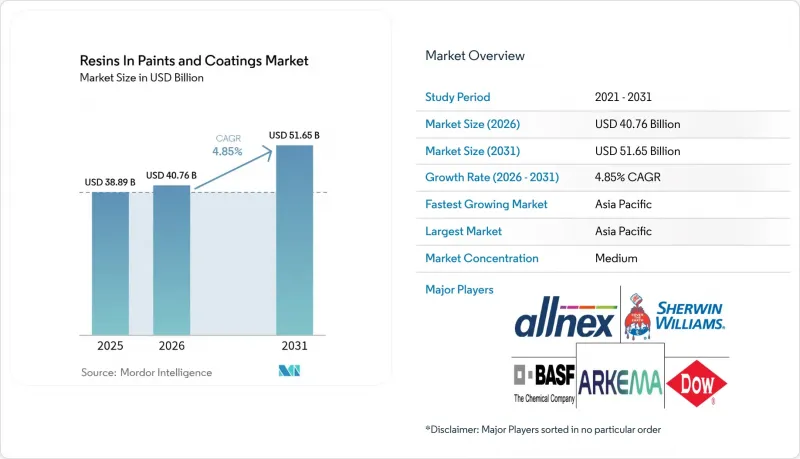
This report is Segmented by Resin Type (Acrylic, Epoxy, Polyurethane, Polyester, Polypropylene, Alkyd, and Other Resin Types), End-User Industry (Architectural, Industrial, Automotive, Packaging, and Other End-User Industries), and Geography (Asia-Pacific, North America, Europe, South America, and Middle-East and Africa). The Market Forecasts are Provided in Terms of Value (USD).
Global Resins In Paints And Coatings Market Trends and Insights
Construction Boom Across Asia-Pacific
Infrastructure programs in China, India, and ASEAN nations convert raw resin demand into multi-year contracts for waterborne acrylic and hybrid polyurethane systems. China's 2025 mandate requiring low-VOC interior coatings in public buildings above 10,000 m2 eliminated solvent-based alkyd primers from the commercial segment. India's plan to build 1,000 km of new metro track by 2027 specifies high-solids epoxy linings that resist monsoon moisture. Logistics-warehouse construction tied to e-commerce fulfillment in Vietnam and Indonesia embeds acrylic or methyl methacrylate polymers in polymer-concrete flooring, compressing cure times and downtime. Demand volatility remains high; a 10% dip in Chinese residential starts could strip roughly 150,000 t of annual acrylic volume, reinforcing the need for agile emulsion capacity.
Growing Demand from Automotive Industry
Battery-electric vehicle lines cap oven bake temperatures at 120 °C, replacing traditional 140-160 °C alkyd systems with 2-component polyurethane or acrylic-melamine clearcoats that rely on new catalyst packages. Hyundai's USD 45 million e-coat upgrade in Ulsan finished in late 2025, adopting low-cure cathodic epoxies that perform at 110 °C. UV-curable acrylic resins increasingly coat plastic exterior parts, removing oven energy entirely. Dual-track demand forces suppliers to maintain alkyd assets for internal-combustion platforms while investing in acrylic and polyurethane emulsions for EVs, complicating capital allocation.
Feedstock Price Volatility
Benzene averaged USD 820 t-1 in Q1 2025, spiked 25% after cracker outages, and fell back to USD 840 t-1 by Q4, eroding margins for styrene-acrylic and unsaturated polyester producers. Propylene's decoupling from crude oil following new PDH units adds forecasting uncertainty. Resin makers without naphtha hedges delay expansions when price-band risk exceeds 15%, tightening supply and amplifying cyclical swings. Bio-feedstocks provide partial insulation but remain volume-constrained.
Other drivers and restraints analyzed in the detailed report include:
- Refurbishment Wave in Middle-East and Africa Housing
- Growing Demand for On-Site 3D Printing Repair Resins
- Free Monomer Exposure Limits Tightening
For complete list of drivers and restraints, kindly check the Table Of Contents.
Segment Analysis
Acrylic resins held 30.05% of resins in paints and coatings market share in 2025 and are projected to advance at a 5.30% CAGR through 2031, outperforming epoxy and polyurethane segments. Demand originates from interior wall paints that now dominate residential repaint cycles and from EV basecoats requiring low-bake performance. Epoxy maintains a premium niche in chemical-resistant marine applications, yet powder-coating substitution trims its liquid volume. Polyurethane bifurcates into 2-component systems for aerospace composites and single-component waterborne dispersions for cabinetry, preserving price premiums.
Polyester's role in powder lines secures metal-finishing growth, while alkyd demand retrenches in high-VOC markets. Specialty silicone-modified acrylics and fluoropolymers command margins that attract R&D funding. Continuous emulsion polymerization coupled with machine-learning process control underscores why acrylic R&D filings at the 2025 European Coatings Show outnumbered rival chemistries four-to-one.
Complete Report Scope:
- By Resin Type
- Acrylic
- Epoxy
- Polyurethane
- Polyester
- Polypropylene
- Alkyd
- Other Resin Types
- By End-user Industry
- Architectural
- Industrial
- Automotive
- Packaging
- Other End-user Industries
- By Geography
- Asia-Pacific
- China
- India
- Japan
- South Korea
- ASEAN Countries
- Rest of Asia-Pacific
- North America
- United States
- Canada
- Mexico
- Europe
- Germany
- United Kingdom
- France
- Italy
- Spain
- Russia
- Rest of Europe
- South America
- Brazil
- Argentina
- Rest of South America
- Middle-East and Africa
- Saudi Arabia
- United Arab Emirates
- South Africa
- Egypt
- Rest of Middle-East and Africa
- Asia-Pacific
Geography Analysis
Asia-Pacific generated 44.15% of 2025 revenue and is projected to post the fastest 5.36% CAGR through 2031. China's urban-migration target of 70% by 2030 sustains interior repaint cycles, while India's highway and metro projects elevate epoxy and polyurethane demand for steel and concrete protection. Japanese and South Korean OEMs realign to EV coating requirements, sourcing low-bake resins that cut electricity use 20%. ASEAN's electronics expansion necessitates durable coatings for device enclosures, drawing imports of acrylic and polyester intermediates. Currency swings and import reliance for benzene challenge profitability across the region.
North America is buoyed by the U.S. Infrastructure Investment and Jobs Act, which funds USD 110 billion of road and bridge work through 2026. Traffic-marking and bridge-deck overlays lean on fast-cure acrylic and epoxy chemistries. Canada tightens building codes to enforce low-VOC interiors, further shifting away from solvent alkyds. Mexican automotive clusters apply high-solids polyurethanes but trim paint usage per vehicle as manufacturers adopt thinner coat architectures.
Europe is shaped by renovation grants and stringent chemical policy. Germany's EUR 5 billion retrofit fund in 2025 underwrote facade coatings with silicone-modified acrylics that limit algae growth. France and Italy stipulate renewable-content thresholds, accelerating lignin-based epoxy trials in public projects. The European Chemicals Agency's 2027 microplastics ban will necessitate reformulation of certain acrylic copolymers, signaling capex needs. South America and Middle-East and Africa demand is also accelerating because Brazil, Saudi Arabia, and Egypt bankroll housing upgrades emphasizing durable, low-cost emulsions.
- Allnex GMBH
- Arkema
- BASF
- Covestro AG
- Dow
- Evonik Industries AG
- Hexion
- Huntsman International LLC
- Kangnam Chemical
- KANSAI HELIOS
- Mitsubishi Shoji Chemical Corporation
- Mitsui Chemicals, Inc.
- Olin Corporation
- Reichhold LLC 2
- Solvay
- Synthomer plc
- The Sherwin-Williams Company
- Uniform Synthetics
- Vil Resins
- Wanhua
- Westlake Epoxy
Additional Benefits:
- The market estimate (ME) sheet in Excel format
- 3 months of analyst support
TABLE OF CONTENTS
1 Introduction
- 1.1 Study Assumptions and Market Definition
- 1.2 Scope of the Study
2 Research Methodology
3 Executive Summary
4 Market Landscape
- 4.1 Market Overview
- 4.2 Market Drivers
- 4.2.1 Construction boom across Asia-Pacific
- 4.2.2 Growing demand form automotive industry
- 4.2.3 Refurbishment wave in Middle-East and Africa housing
- 4.2.4 Grwoing demand for on-site 3-D printing repair resins
- 4.2.5 Increasing Bio-based epoxy scale-up incentives
- 4.3 Market Restraints
- 4.3.1 Feed-stock price volatility
- 4.3.2 Shift toward powder-only systems
- 4.3.3 Free monomer exposure limits tightening
- 4.4 Value Chain Analysis
- 4.5 Porter's Five Forces
- 4.5.1 Bargaining Power of Suppliers
- 4.5.2 Bargaining Power of Buyers
- 4.5.3 Threat of New Entrants
- 4.5.4 Threat of Substitutes
- 4.5.5 Degree of Competition
5 Market Size and Growth Forecasts (Value)
- 5.1 By Resin Type
- 5.1.1 Acrylic
- 5.1.2 Epoxy
- 5.1.3 Polyurethane
- 5.1.4 Polyester
- 5.1.5 Polypropylene
- 5.1.6 Alkyd
- 5.1.7 Other Resin Types
- 5.2 By End-user Industry
- 5.2.1 Architectural
- 5.2.2 Industrial
- 5.2.3 Automotive
- 5.2.4 Packaging
- 5.2.5 Other End-user Industries
- 5.3 By Geography
- 5.3.1 Asia-Pacific
- 5.3.1.1 China
- 5.3.1.2 India
- 5.3.1.3 Japan
- 5.3.1.4 South Korea
- 5.3.1.5 ASEAN Countries
- 5.3.1.6 Rest of Asia-Pacific
- 5.3.2 North America
- 5.3.2.1 United States
- 5.3.2.2 Canada
- 5.3.2.3 Mexico
- 5.3.3 Europe
- 5.3.3.1 Germany
- 5.3.3.2 United Kingdom
- 5.3.3.3 France
- 5.3.3.4 Italy
- 5.3.3.5 Spain
- 5.3.3.6 Russia
- 5.3.3.7 Rest of Europe
- 5.3.4 South America
- 5.3.4.1 Brazil
- 5.3.4.2 Argentina
- 5.3.4.3 Rest of South America
- 5.3.5 Middle-East and Africa
- 5.3.5.1 Saudi Arabia
- 5.3.5.2 United Arab Emirates
- 5.3.5.3 South Africa
- 5.3.5.4 Egypt
- 5.3.5.5 Rest of Middle-East and Africa
- 5.3.1 Asia-Pacific
6 Competitive Landscape
- 6.1 Market Concentration
- 6.2 Strategic Moves
- 6.3 Market Share(%)/Ranking Analysis
- 6.4 Company Profiles (includes Global level Overview, Market level overview, Core Segments, Financials as available, Strategic Information, Products and Services, and Recent Developments)
- 6.4.1 Allnex GMBH
- 6.4.2 Arkema
- 6.4.3 BASF
- 6.4.4 Covestro AG
- 6.4.5 Dow
- 6.4.6 Evonik Industries AG
- 6.4.7 Hexion
- 6.4.8 Huntsman International LLC
- 6.4.9 Kangnam Chemical
- 6.4.10 KANSAI HELIOS
- 6.4.11 Mitsubishi Shoji Chemical Corporation
- 6.4.12 Mitsui Chemicals, Inc.
- 6.4.13 Olin Corporation
- 6.4.14 Reichhold LLC 2
- 6.4.15 Solvay
- 6.4.16 Synthomer plc
- 6.4.17 The Sherwin-Williams Company
- 6.4.18 Uniform Synthetics
- 6.4.19 Vil Resins
- 6.4.20 Wanhua
- 6.4.21 Westlake Epoxy
7 Market Opportunities and Future Outlook
- 7.1 White-space and Unmet-Need Assessment

