PUBLISHER: Mordor Intelligence | PRODUCT CODE: 2122373

PUBLISHER: Mordor Intelligence | PRODUCT CODE: 2122373
Advanced Functional Materials - Market Share Analysis, Industry Trends & Statistics, Growth Forecasts (2026 - 2031)
According to Mordor Intelligence, advanced functional materials market size in 2026 is estimated at USD 147.06 billion, growing from 2025 value of USD 138.65 billion with 2031 projections showing USD 197.45 billion, growing at 6.07% CAGR over 2026-2031.
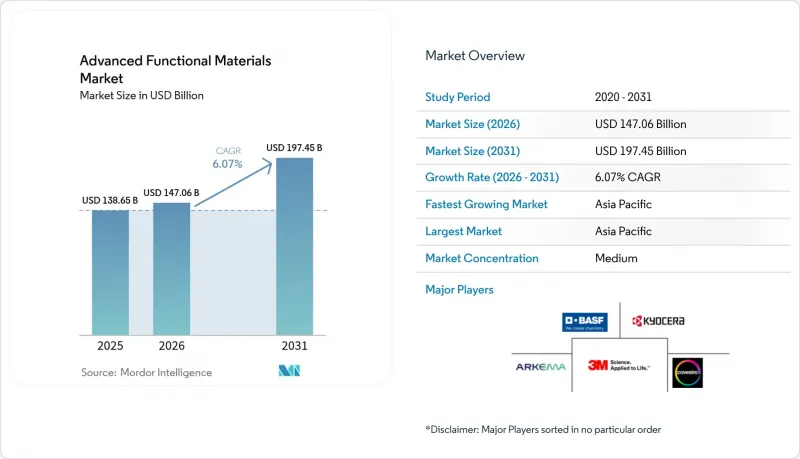
This report Segments the Industry by Material Type (Ceramics, Composites, Conductive Polymers, Nanomaterials, and More), End-User Industry (Electrical and Electronics, Automotive, Healthcare, Aerospace and Defense, and More), and Geography (Asia-Pacific, North America, Europe, South America, and Middle-East and Africa). The Market Forecasts are Provided in Terms of Value (USD).
Global Advanced Functional Materials Market Trends and Insights
Rising Demand for Miniaturisation in Consumer Electronics
Smartphones, laptops, wearables, and AI edge devices all need thinner interconnects, lower-loss substrates, and conductive pastes that tolerate higher power densities without heat damage. Transparent conducting oxides under development at the University of Minnesota boost electron mobility while letting 90% of visible light pass, pivotal for next-generation OLED and micro-LED displays. Organic electrochemical transistors engineered by the University of Hong Kong integrate machine-learning capability into textile-grade sensors and cut power draw by 80%, which lengthens battery life in medical wearables. MXene sheets now register 35,000 S/cm conductivity and block 99.9% of high-frequency electromagnetic noise, resolving signal-integrity problems inside 5 G handsets and electric vehicles. Collectively, these breakthroughs enlarge design windows for OEMs and reinforce procurement spending on the advanced functional materials market.
Increasing Usage in Automotive and Aerospace for Lightweighting
Automakers and aircraft OEMs target weight cuts that translate directly into range extension and lower lifecycle emissions. Oak Ridge National Laboratory's nanofiber infusion process lifts carbon-fiber tensile strength by 50% while doubling toughness so that components withstand crash loads and lightning strikes. Hyundai Motor Group and Toray Industries co-develop carbon-fiber-reinforced polymer housings that shed 40 kg from an electric SUV's battery pack, helping meet a 500 km real-world range goal. Korea Institute of Science and Technology's high-crystallinity carbon nanotubes replace copper coil windings to raise motor power density by 20%. Shape-memory alloys and piezoelectric actuators improve aerodynamic control surfaces, lowering fuel burn in narrow-body aircraft. United States Department of Energy roadmaps call for 25% lightweighting of light-duty vehicles by 2030, signaling a durable pull for advanced functional materials market suppliers.
High Production Costs and Critical Raw Material Scarcity
International Energy Agency models show demand for rare-earth oxides rising to 169 kt by 2040 while 77% of refining capacity remains in one country, prompting price jumps that hurt margin targets for magnets, phosphors, and battery additives. The United States Department of Homeland Security flags regulatory overlap that delays new mines by up to eight years, creating a mismatch between offtake agreements and feedstock availability. Europe's Critical Raw Materials Act covers 34 elements and imposes recycling quotas many smelters cannot yet meet, compelling producers to redesign formulations or pay penalties. Spot energy prices above USD 80/MWh in several OECD economies also squeeze ceramic-kiln operators whose firing steps need 1,600 °C, adding cost pressures.
Other drivers and restraints analyzed in the detailed report include:
- Growth of Renewable-Energy Storage and Conversion Solutions
- Expanding Healthcare and Biomedical Applications
- Complex, Evolving Regulatory Compliance
For complete list of drivers and restraints, kindly check the Table Of Contents.
Segment Analysis
Ceramics commanded 31.78% of 2025 revenue within the advanced functional materials market on the back of aerospace engine linings, 5 G filters, and implantable bioceramics. Nanomaterials, however, headline growth at 7.18%, supported by ongoing capital expansion at MXene, graphene, and carbon-nanotube fabs. Ultra-high-temperature ceramics such as hafnium carbide tolerate 4,000 °C re-entry heat, enabling hypersonic gliders that were previously infeasible. Ceramic-matrix composites from GE Aerospace run 300 °C hotter than nickel alloys, raising jet-engine fuel efficiency by 2% and saving airlines USD 1 million per twin-aisle unit over the life cycle.
Composites and conductive polymers maintain respectable pipelines. Golden polyaniline films from the University of Tsukuba reach metal-like luster yet keep polymer flexibility, a boon for foldable screens. Two-dimensional polymer sheets with 10 S/cm in-plane conductivity supply electromagnetic shielding inside data-center racks. These expansions diversify the portfolio and strengthen supplier bargaining power in the advanced functional materials market size for high-frequency applications.
Complete Report Scope:
- By Material Type
- Ceramics
- Composites
- Conductive Polymers
- Nanomaterials
- Energy Materials
- Other Types
- By End-user Industry
- Electrical and Electronics
- Automotive
- Healthcare
- Aerospace and Defence
- Energy and Power (incl. Chemical)
- Other End-user Industries
- By Geography
- Asia-Pacific
- China
- India
- Japan
- South Korea
- Rest of Asia-Pacific
- North America
- United States
- Canada
- Mexico
- Europe
- Germany
- United Kingdom
- France
- Italy
- Rest of Europe
- South America
- Brazil
- Argentina
- Rest of South America
- Middle-East and Africa
- Saudi Arabia
- South Africa
- Rest of Middle-East and Africa
- Asia-Pacific
Geography Analysis
Asia-Pacific generated 47.62% of 2025 turnover and is expanding at 7.03% CAGR thanks to policy incentives, deep manufacturing clusters, and raw-material access. China's 14th Five-Year Plan funnels USD 28 billion into specialty materials, while Japan issues GX Economy Transition Bonds to subsidize net-zero process upgrades. These programs shorten scale-up cycles and place local firms at the center of the advanced functional materials market.
North America leverages the CHIPS and Science Act, a USD 52.7 billion package that mandates domestic content thresholds for critical substrates and encapsulants. Canada advances cathode-grade nickel and cobalt refining, while Mexico attracts EV assembly nearshoring, anchoring regional supply chains.
Europe couples the Net-Zero Industry Act with PFAS curbs, motivating incumbents to substitute fluoro-elastomers with silicone and thermoplastic olefin blends.
- 3M
- Arkema
- BASF
- CeramTec GmbH
- Covestro AG
- Dow
- Evonik Industries AG
- Hexcel Corporation
- Huntsman International LLC
- JCBL Group
- Kyocera Corporation
- LG Chem
- Morgan Advanced Materials
- Resonac Holdings Corporation
- SGL Carbon
- Sumitomo Chemical Co., Ltd.
- Mitsubishi Chemical Group Corporation
- TORAY INDUSTRIES, INC.
Additional Benefits:
- The market estimate (ME) sheet in Excel format
- 3 months of analyst support
TABLE OF CONTENTS
1 Introduction
- 1.1 Study Assumptions and Market Definition
- 1.2 Scope of the Study
2 Research Methodology
3 Executive Summary
4 Market Landscape
- 4.1 Market Overview
- 4.2 Market Drivers
- 4.2.1 Rising Demand for Miniaturisation in Consumer Electronics
- 4.2.2 Increasing Usage in Automotive and Aerospace for Lightweighting
- 4.2.3 Growth of Renewable-Energy Storage and Conversion Solutions
- 4.2.4 Expanding Healthcare and Biomedical Applications
- 4.2.5 Green Public Procurement Mandates for Low-Carbon Materials
- 4.3 Market Restraints
- 4.3.1 High Production Costs and Critical Raw Material Scarcity
- 4.3.2 Complex, Evolving Regulatory Compliance
- 4.3.3 Skilled-Labour Bottlenecks in Advanced-Materials Processing
- 4.4 Value Chain Analysis
- 4.5 Porter's Five Forces
- 4.5.1 Bargaining Power of Suppliers
- 4.5.2 Bargaining Power of Buyers
- 4.5.3 Threat of New Entrants
- 4.5.4 Threat of Substitutes
- 4.5.5 Degree of Competition
5 Market Size and Growth Forecasts (Value)
- 5.1 By Material Type
- 5.1.1 Ceramics
- 5.1.2 Composites
- 5.1.3 Conductive Polymers
- 5.1.4 Nanomaterials
- 5.1.5 Energy Materials
- 5.1.6 Other Types
- 5.2 By End-user Industry
- 5.2.1 Electrical and Electronics
- 5.2.2 Automotive
- 5.2.3 Healthcare
- 5.2.4 Aerospace and Defence
- 5.2.5 Energy and Power (incl. Chemical)
- 5.2.6 Other End-user Industries
- 5.3 By Geography
- 5.3.1 Asia-Pacific
- 5.3.1.1 China
- 5.3.1.2 India
- 5.3.1.3 Japan
- 5.3.1.4 South Korea
- 5.3.1.5 Rest of Asia-Pacific
- 5.3.2 North America
- 5.3.2.1 United States
- 5.3.2.2 Canada
- 5.3.2.3 Mexico
- 5.3.3 Europe
- 5.3.3.1 Germany
- 5.3.3.2 United Kingdom
- 5.3.3.3 France
- 5.3.3.4 Italy
- 5.3.3.5 Rest of Europe
- 5.3.4 South America
- 5.3.4.1 Brazil
- 5.3.4.2 Argentina
- 5.3.4.3 Rest of South America
- 5.3.5 Middle-East and Africa
- 5.3.5.1 Saudi Arabia
- 5.3.5.2 South Africa
- 5.3.5.3 Rest of Middle-East and Africa
- 5.3.1 Asia-Pacific
6 Competitive Landscape
- 6.1 Market Concentration
- 6.2 Strategic Moves
- 6.3 Market Share(%)/Ranking Analysis
- 6.4 Company Profiles (includes Global-level Overview, Market-level Overview, Core Segments, Financials, Strategic Information, Market Rank/Share, Products and Services, Recent Developments)
- 6.4.1 3M
- 6.4.2 Arkema
- 6.4.3 BASF
- 6.4.4 CeramTec GmbH
- 6.4.5 Covestro AG
- 6.4.6 Dow
- 6.4.7 Evonik Industries AG
- 6.4.8 Hexcel Corporation
- 6.4.9 Huntsman International LLC
- 6.4.10 JCBL Group
- 6.4.11 Kyocera Corporation
- 6.4.12 LG Chem
- 6.4.13 Morgan Advanced Materials
- 6.4.14 Resonac Holdings Corporation
- 6.4.15 SGL Carbon
- 6.4.16 Sumitomo Chemical Co., Ltd.
- 6.4.17 Mitsubishi Chemical Group Corporation
- 6.4.18 TORAY INDUSTRIES, INC.
7 Market Opportunities and Future Outlook
- 7.1 White-space and Unmet-need Assessment

