PUBLISHER: Mordor Intelligence | PRODUCT CODE: 2122374

PUBLISHER: Mordor Intelligence | PRODUCT CODE: 2122374
Polyvinyl Alcohol - Market Share Analysis, Industry Trends & Statistics, Growth Forecasts (2026 - 2031)
According to Mordor Intelligence, the polyvinyl alcohol market size is projected to expand from 1.42 million tons in 2025 and 1.46 million tons in 2026 to 1.67 million tons by 2031, registering a CAGR of 2.72% between 2026 to 2031.
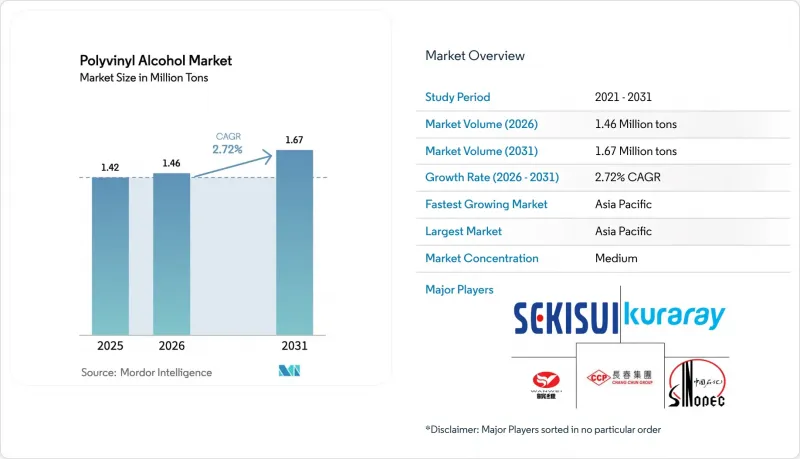
This report is Segmented by Grade (Partially Hydrolyzed, Fully Hydrolyzed, and More), Form (Powder, Granules, and More), Application (Polymerization Additives, Polyvinyl Butyral, and More), End-Use Industry (Food Packaging, Paper Manufacturing, and More), and Geography (Asia-Pacific, North America, and More). The Market Forecasts are Provided in Terms of Volume (Tons).
Global Polyvinyl Alcohol Market Trends and Insights
Growing Demand from Food-Packaging Industry
Single-serve convenience formats reshaped purchasing choices. Dishwasher-tablet wraps, coffee pods, and sauce sachets jointly held 33.67% of end-use volume in 2025. Updated U.S. FDA food-contact protocols in 2024 fast-tracked approvals for PVA films with antimicrobial nanoparticles, lifting agency submissions by 22% in 2025. Japan's health ministry halved approval lead times, spurring domestic uptake in bento-box liners and noodle-packet films . German and Dutch grocers reported a 12-15% consumer premium for dissolve-in-sink packaging, validating price-elastic demand.
Increasing Usage in Construction Sealants and Mortar
Partially hydrolyzed PVA improves rheology and crack resistance in tile adhesives and self-leveling compounds. China's 2024 low-VOC mandate for public infrastructure lifted construction-grade PVA offtake 9% in 2025. India's affordable-housing drive adopted PVA fibers to cut rebar costs, while Middle Eastern mega-projects specified PVA-modified sealants able to absorb daily thermal swings from 50 °C to 15 °C.
Volatile Vinyl-Acetate-Monomer Prices Squeezing Margins
Spot VAM swung 18% in 2025, narrowing non-integrated producers' gross margins by 12-15% and prompting temporary shutdowns. Integrated Chinese firms enjoyed a USD 180 per-ton cost edge, boosting exports 23%.
Other drivers and restraints analyzed in the detailed report include:
- Surging Adoption in Detergent Pods and Water-Soluble Films
- Expansion of PVA-Based Emulsion Polymers for Water-Borne Coatings
- Availability of Bio-Based and Petro-Based Substitutes (PLA, EVOH)
For complete list of drivers and restraints, kindly check the Table Of Contents.
Segment Analysis
Partially hydrolyzed captured 37.51% of 2025 volume, expanding at 3.01% through 2031 as textile mills favored its dual cold- and hot-water solubility. Fully hydrolyzed variants underpin detergent-pod films; Kuraray's POVAL 205 with 98.5% hydrolysis became the reference grade in 2025. Specialty innovations include super-low-foaming types for high-speed inkjet coating and thermally reversible gels for reusable cold packs. Collectively, advanced grades increase average selling prices and stabilize margins.
Manufacturers tailor viscosity, molecular weight, and functional groups. Mitsubishi Chemical launched a PVA with surface tension of 28 dynes/cm in 2025 for defect-free optical-film coating. Sekisui's thermally reversible gels liquefy above 60 °C then resolidify, finding new use in data-center thermal buffers. These developments maintain customer lock-in and underpin the polyvinyl alcohol market's shift toward value-added niches.
Powder retained 54.36% share in 2025, driven by on-site dissolution needs in adhesives and textiles. Water-soluble films, however, will post a 3.41% CAGR to 2031 as pod and agrochemical-sachet demand widens. Japan VAM & Poval's 2025 tri-layer film dissolved 30% faster in cold water, cutting cycle times for detergent plants. Granules serve dust-free construction job sites, while fibers reinforce concrete and asphalt; Kuraray's Kuralon fiber replaced steel in Japan's maglev tunnel shotcrete, lowering weight 40%.
Film producers manage plasticizer ratios for balance between tensile strength and dissolution. Flake forms, produced via drum drying, cater to automated dosing in paper mills. Physical format choice therefore dictates reachable applications and pricing power within the polyvinyl alcohol market.
Complete Report Scope:
- By Grade
- Partially Hydrolyzed
- Fully Hydrolyzed
- Sub-Partially Hydrolyzed
- Low-Foaming Grades
- Other Grades (Tactified Grades, Fine Particle Grades)
- By Form
- Powder
- Granules
- Flakes
- Water-Soluble Films
- Fibers
- By Application
- Polymerization Additives
- Polyvinyl Butyral
- Adhesives
- Textile
- Paper Pulp and Coating
- Developing Application
- Other Applications
- By End-use Industry
- Food Packaging
- Paper Manufacturing
- Construction
- Electronics
- Textile
- Other End-use Industries (Detergent, Agrochemicals, etc.)
- By Geography
- Asia-Pacific
- China
- India
- Japan
- South Korea
- Malaysia
- Thailand
- Indonesia
- Vietnam
- Rest of Asia-Pacific
- North America
- United States
- Canada
- Mexico
- Europe
- Germany
- United Kingdom
- Italy
- France
- Spain
- NORDIC Countries
- Rest of Europe
- South America
- Brazil
- Argentina
- Colombia
- Rest of South America
- Middle-East and Africa
- Saudi Arabia
- Qatar
- United Arab Emirates
- Egypt
- South Africa
- Rest of Middle-East and Africa
- Asia-Pacific
Geography Analysis
Asia-Pacific dominated with 47.72% volume in 2025 and is forecast to expand at 2.92% CAGR. China's 850,000-ton integrated capacity enjoys USD 180/t cost advantages vs. ethylene routes, allowing aggressive commodity pricing. India's 2025 offtake jumped due to housing construction and textile sizing. Japan exported high-viscosity grades for optical films. Southeast Asia posted detergent-pod demand growth as multinationals localized production.
In North America, streamlined FDA clearances accelerated film approvals, and Procter & Gamble's pod shift added demand. Canada piloted PVA seed coatings with 10% germination uplift in saline soils. Mexico enjoyed moderate growth in PVA-modified mortars tied to near-shoring construction.
Europe is prioritizing biodegradable films under its 2025 waste regulation, driving import growth from Japan. South America and the Middle East and Africa commanded demand as infrastructure and agricultural trials multiply. Petrobras tested PVA drilling-fluid additives, while Saudi Arabia's NEOM project specified PVA sealants for glass facades, underscoring emerging regional niches.
- Anhui Wanwei Updated High Tech Material Industry Co Ltd
- Astrra Chemicals
- Chang Chun Group
- JAPAN VAM & POVAL CO.,LTD.
- KURARAY CO., LTD.
- Mitsubishi Chemical Group Corporation
- Nippon Chemical Industrial CO., LTD.
- OCI COMPANY Ltd
- Polysciences
- SEKISUI CHEMICAL CO., LTD.
- Shandong Tiancheng Chemical Co., Ltd.
- Shuangxin PVA Tech Co., Ltd.
- Sinopec Sichuan Vinylon Works
Additional Benefits:
- The market estimate (ME) sheet in Excel format
- 3 months of analyst support
TABLE OF CONTENTS
1 Introduction
- 1.1 Study Assumptions and Market Definition
- 1.2 Scope of the Study
2 Research Methodology
3 Executive Summary
4 Market Landscape
- 4.1 Market Overview
- 4.2 Market Drivers
- 4.2.1 Growing Demand from Food-Packaging Industry
- 4.2.2 Increasing Usage in Construction Sealants and Mortar
- 4.2.3 Surging Adoption in Detergent Pods and Water-Soluble Films
- 4.2.4 Expansion of PVA-Based Emulsion Polymers for Water-Borne Coatings
- 4.2.5 Emergence of PVA-Based Biodegradable Agricultural Films
- 4.3 Market Restraints
- 4.3.1 Volatile Vinyl-Acetate-Monomer (VAM) Prices Squeezing Margins
- 4.3.2 Availability of Bio-Based and Petro-Based Substitutes (PLA, EVOH)
- 4.3.3 Limited Recycling Infrastructure for PVA Films in Emerging Economies
- 4.4 Value Chain Analysis
- 4.5 Porter's Five Forces
- 4.5.1 Bargaining Power of Suppliers
- 4.5.2 Bargaining Power of Buyers
- 4.5.3 Threat of New Entrants
- 4.5.4 Threat of Substitutes
- 4.5.5 Degree of Competition
5 Market Size and Growth Forecasts (Volume)
- 5.1 By Grade
- 5.1.1 Partially Hydrolyzed
- 5.1.2 Fully Hydrolyzed
- 5.1.3 Sub-Partially Hydrolyzed
- 5.1.4 Low-Foaming Grades
- 5.1.5 Other Grades (Tactified Grades, Fine Particle Grades)
- 5.2 By Form
- 5.2.1 Powder
- 5.2.2 Granules
- 5.2.3 Flakes
- 5.2.4 Water-Soluble Films
- 5.2.5 Fibers
- 5.3 By Application
- 5.3.1 Polymerization Additives
- 5.3.2 Polyvinyl Butyral
- 5.3.3 Adhesives
- 5.3.4 Textile
- 5.3.5 Paper Pulp and Coating
- 5.3.6 Developing Application
- 5.3.7 Other Applications
- 5.4 By End-use Industry
- 5.4.1 Food Packaging
- 5.4.2 Paper Manufacturing
- 5.4.3 Construction
- 5.4.4 Electronics
- 5.4.5 Textile
- 5.4.6 Other End-use Industries (Detergent, Agrochemicals, etc.)
- 5.5 By Geography
- 5.5.1 Asia-Pacific
- 5.5.1.1 China
- 5.5.1.2 India
- 5.5.1.3 Japan
- 5.5.1.4 South Korea
- 5.5.1.5 Malaysia
- 5.5.1.6 Thailand
- 5.5.1.7 Indonesia
- 5.5.1.8 Vietnam
- 5.5.1.9 Rest of Asia-Pacific
- 5.5.2 North America
- 5.5.2.1 United States
- 5.5.2.2 Canada
- 5.5.2.3 Mexico
- 5.5.3 Europe
- 5.5.3.1 Germany
- 5.5.3.2 United Kingdom
- 5.5.3.3 Italy
- 5.5.3.4 France
- 5.5.3.5 Spain
- 5.5.3.6 NORDIC Countries
- 5.5.3.7 Rest of Europe
- 5.5.4 South America
- 5.5.4.1 Brazil
- 5.5.4.2 Argentina
- 5.5.4.3 Colombia
- 5.5.4.4 Rest of South America
- 5.5.5 Middle-East and Africa
- 5.5.5.1 Saudi Arabia
- 5.5.5.2 Qatar
- 5.5.5.3 United Arab Emirates
- 5.5.5.4 Egypt
- 5.5.5.5 South Africa
- 5.5.5.6 Rest of Middle-East and Africa
- 5.5.1 Asia-Pacific
6 Competitive Landscape
- 6.1 Market Concentration
- 6.2 Strategic Moves
- 6.3 Market Share(%)/Ranking Analysis
- 6.4 Company Profiles (includes Global level Overview, Market level overview, Core Segments, Financials as available, Strategic Information, Products and Services, and Recent Developments)
- 6.4.1 Anhui Wanwei Updated High Tech Material Industry Co Ltd
- 6.4.2 Astrra Chemicals
- 6.4.3 Chang Chun Group
- 6.4.4 JAPAN VAM & POVAL CO.,LTD.
- 6.4.5 KURARAY CO., LTD.
- 6.4.6 Mitsubishi Chemical Group Corporation
- 6.4.7 Nippon Chemical Industrial CO., LTD.
- 6.4.8 OCI COMPANY Ltd
- 6.4.9 Polysciences
- 6.4.10 SEKISUI CHEMICAL CO., LTD.
- 6.4.11 Shandong Tiancheng Chemical Co., Ltd.
- 6.4.12 Shuangxin PVA Tech Co., Ltd.
- 6.4.13 Sinopec Sichuan Vinylon Works
7 Market Opportunities and Future Outlook
- 7.1 White-Space and Unmet-Need Assessment
- 7.2 Innovations in Polyvinyl Alcohol for Packaging and Medical

