PUBLISHER: Mordor Intelligence | PRODUCT CODE: 2122389

PUBLISHER: Mordor Intelligence | PRODUCT CODE: 2122389
Air Purifier - Market Share Analysis, Industry Trends & Statistics, Growth Forecasts (2026 - 2031)
According to Mordor Intelligence, the air purifier market is expected to grow from USD 18.5 billion in 2025 to USD 20.04 billion in 2026 and is forecasted to reach USD 29.05 billion by 2031 at 7.71% CAGR over 2026-2031.
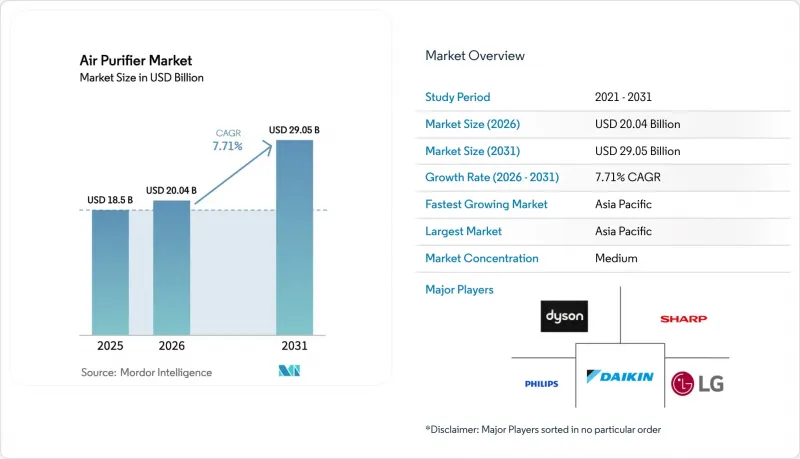
This report is Segmented by Filtration Technology (HEPA, Activated Carbon, Ionic/Electrostatic Precipitators, UV-C and Photocatalytic Oxidation, and Hybrid and Multi-Stage Systems), Type (Stand-Alone and In-Duct), Connectivity (Non-Smart and Smart/IoT-Enabled ), End User (Residential, Commercial, and Industrial), and Geography (North America, Europe, Asia-Pacific, South America, and Middle East and Africa).
Global Air Purifier Market Trends and Insights
Post-COVID Health-Centric Device Adoption in East Asian Metros
Persistent PM2.5 readings above national targets in Beijing, Seoul, and Tokyo have normalized year-round purifier ownership, extending the air purifier market beyond the pandemic spike. China's Ministry of Ecology and Environment confirmed that 38 of 168 monitored cities missed PM2.5 goals in 2024. Japan's health ministry updated indoor-air guidelines in 2024 to recommend HEPA filtration in childcare and eldercare facilities, institutionalizing a replacement cycle. Semiconductor engineers in South Korea, exposed to ultra-clean fabs, increasingly mirror workplace standards at home, creating a premium residential cohort. Xiaomi's RMB 2.5 billion smart-appliance factory opened in Wuhan in 2025, adding 7 million units of annual capacity that can flex between domestic and export orders. This combination of regulatory push and consumer pull solidifies a stable East-Asian demand base.
Stricter PM2.5 Commercial Real-Estate Standards in North America (LEED v4.1)
LEED v4.1's Indoor Environmental Quality credit mandates MERV 13 or higher filtration and continuous PM2.5 monitoring, compelling U.S. and Canadian building owners to retrofit or specify advanced purification from the design stage. Compliance budgets ranging from USD 50,000 to USD 150,000 for a 100,000-square-foot office are increasingly justified as tenants demand healthy-building certification for talent attraction and ESG reporting. ASHRAE 62.1-2022 further tightens outdoor-air ventilation rates, encouraging hybrid solutions that pair in-duct HEPA modules with portable units in meeting spaces. The Canada Green Building Council noted that 68% of new commercial projects sought LEED certification in 2025, signaling mainstream adoption. These standards are likely to cascade into Europe as revisions to the Energy Performance of Buildings Directive embed indoor-air metrics by 2027.
Ozone-Emission Restrictions on Ionizers in California & Japan
California's Air Resources Board capped ozone output from indoor cleaners at 0.050 ppm in 2024, effectively sidelining ionizer-centric designs. Japan's health ministry imposed parallel labeling rules in 2025 that limit ionizer sales in childcare facilities. Brands dependent on ionization, including Sharp and Panasonic, face USD 15-USD 25 per-unit redesign costs to meet thresholds, crimping margins in entry segments. The rule change funnels demand toward HEPA-pure or hybrid devices, benefiting competitors without ion emitters.
Other drivers and restraints analyzed in the detailed report include:
- Semiconductor Cleanroom Capacity Build-out in the US & South Korea
- Smart-Home Integration Pull for Connected Purifiers in EU & US
- High Filter Replacement Cost Sensitivity in ASEAN Mass Market
For complete list of drivers and restraints, kindly check the Table Of Contents.
Segment Analysis
HEPA media captured 68.1% of the air purifier market share in 2025, favored for its 99.97% efficiency at 0.3 µm and endorsements from the U.S. EPA and WHO. Hybrid configurations that pair HEPA with activated carbon, UV-C, or photocatalytic oxidation are slated for a 9.3% CAGR because households and businesses now target VOCs, pathogens, and odors in a single chassis. Daikin's Streamer plasma module showed 99.9% SARS-CoV-2 inactivation in 2024 lab tests. Panasonic's nanoe X hydroxyl-radical generator is popular in Japan's eldercare market, where pathogen control ranks with particulate capture. Ionic precipitators retreat to niche industrial uses as ozone-cap rules in California and Japan tighten. Lack of harmonized efficacy standards for hybrid units, however, tempers adoption in risk-averse hospitals and pharmaceutical plants.
Hybrid systems also dovetail with smart-sensor arrays that trigger stage-specific filtration to curb energy draw and extend filter life. LG's Clean Booster vortex airflow increases CADR 47% over conventional centrifugal fans, enabling similar room coverage with smaller form factors. UV-C and photocatalytic modules remain premium add-ons costing USD 80-USD 120 per unit, limiting penetration below the USD 500 price tier. Prospective regulation around UV-C exposure could further shape the competitive field, but no global consensus exists yet.
Stand-alone devices accounted for 79.5% of the air purifier market volume in 2025 as renters and homeowners favored plug-and-play solutions priced between USD 150 and USD 800. Nevertheless, in-duct installations are scaling at an 8.8% CAGR through 2031, especially within commercial campuses that prefer centralized maintenance. A single in-duct HEPA retrofit costing USD 20,000-USD 40,000 can meet LEED air-change requirements for a 50,000-square-foot office, whereas equivalent coverage with portables would need 50 units and recurring labor for filter swaps. Samsung's 2025 acquisition of FlaktGroup extends its HVAC reach into purification modules that target hospitals and airports. Data-center operators adopt in-duct systems to keep airborne particulates below 10 µg/m3, protecting high-density servers from overheating or shorts. Portable units remain dominant in hospitality and multifamily housing, where room-specific control and aesthetics outweigh operational consolidations.
Regional HVAC penetration shapes these trends: North America and Europe, with about 85% central-HVAC adoption in commercial buildings, naturally migrate to in-duct solutions. By contrast, Asia-Pacific's heterogeneous building stock sustains portable demand, although new Grade-A offices in Beijing, Seoul, and Singapore are increasingly designed with built-in filtration plenum space. Suppliers that can package both portable and in-duct offerings stand to address the full project life cycle, from break-fix replacements to green-field architectural specs.
Complete Report Scope:
- By Filtration Technology
- HEPA
- Activated Carbon
- Ionic/Electrostatic Precipitators
- UV-Cand Photocatalytic Oxidation
- Hybrid and Multi-stage Systems
- By Type
- Stand-alone/Portable
- In-duct/Central HVAC
- By Connectivity
- Non-Smart (Manual/Analog)
- Smart/IoT-Enabled (App and Voice Controlled)
- By End User
- Residential
- Commercial (Hospitality and Leisure, Healthcare Facilities and Clinics, Educational Institutions and Corporate Offices and Retail)
- Industrial (Manufacturing and Warehousing, Food and Beverage Processing, Pharmaceuticals and Clean-rooms and Data Centers and Server Rooms)
- By Geography
- North America
- United States
- Canada
- Mexico
- Europe
- United Kingdom
- Germany
- France
- Spain
- Nordic Countries
- Russia
- Rest of Europe
- Asia-Pacific
- China
- India
- Japan
- South Korea
- ASEAN Countries
- Australia
- Rest of Asia-Pacific
- South America
- Brazil
- Argentina
- Colombia
- Rest of South America
- Middle East and Africa
- United Arab Emirates
- Saudi Arabia
- South Africa
- Egypt
- Rest of Middle East and Africa
- North America
Geography Analysis
Asia-Pacific generated 42.9% of 2025 revenue for the air purifier market and will climb at an 8.5% CAGR through 2031 on sustained urban PM2.5 levels, aggressive semiconductor investments, and government clean-air programs. China's environment ministry reported 38 non-attainment cities in 2024, underpinning stable household demand. Xiaomi's Wuhan factory adds 7 million units of annual output, reinforcing local cost advantages. Japan's updated childcare IAQ guidelines promote HEPA installations, creating steady replacement cycles.
North America, though smaller in unit volume, exhibits the fastest policy-driven acceleration as LEED v4.1, ASHRAE 62.1, and CHIPS Act funds converge. Semiconductor fabs under construction across Arizona, Texas, and Ohio mandate HEPA/ULPA infrastructure, pulling through significant B2B orders. Canada's 68% LEED adoption rate for new builds underscores continental alignment with IAQ standards.
Europe's forthcoming Energy Performance of Buildings Directive revision will formalize indoor-air metrics by 2027, driving uptake in Germany, France, and the Nordics. The Middle East leverages hospitality retrofits under Saudi and Emirati climate pledges, producing double-digit growth, albeit from a small base. South America trails as economic volatility and limited regulatory frameworks hamper widespread adoption, although pollution in Sao Paulo and Buenos Aires nudges incremental residential sales.
- Daikin Industries Ltd
- Sharp Corporation
- Dyson Ltd
- Koninklijke Philips N.V.
- LG Electronics Inc.
- Panasonic Corporation
- Whirlpool Corporation
- Resideo Technologies Inc.
- Samsung Electronics Co. Ltd
- Xiaomi Corp.
- Honeywell International Inc.
- IQAir AG
- Coway Co. Ltd
- Winix Inc.
- Blueair AB
- AllerAir Industries Inc.
- Airdog (IAQ Tech)
- Austin Air Systems Ltd
- Kent RO Systems Ltd
- TruSens (ACCO Brands)
- Medify Air LLC
Additional Benefits:
- The market estimate (ME) sheet in Excel format
- 3 months of analyst support
TABLE OF CONTENTS
1 Introduction
- 1.1 Study Assumptions & Market Definition
- 1.2 Scope of the Study
2 Research Methodology
3 Executive Summary
4 Market Landscape
- 4.1 Market Overview
- 4.2 Market Drivers
- 4.2.1 Post-COVID Health-Centric Device Adoption in East Asian Metros
- 4.2.2 Stricter PM2.5 Commercial Real-Estate Standards in North America (LEED v4.1)
- 4.2.3 Semiconductor Clean-room Capacity Build-out in the US & South Korea
- 4.2.4 Smart-Home Integration Pull for Connected Purifiers in EU & US
- 4.2.5 ESG-Driven Hospitality Upgrades across GCC Countries
- 4.2.6 Indian NCAP Subsidies for HEPA Purifiers in Public Schools
- 4.3 Market Restraints
- 4.3.1 Ozone-Emission Restrictions on Ionizers in California & Japan
- 4.3.2 High Filter Replacement Cost Sensitivity in ASEAN Mass Market
- 4.3.3 Consumer Skepticism on CADR Claims-Lack of Unified Test Protocol
- 4.3.4 HVAC In-duct Filtration Diluting Stand-alone Unit Demand in Large Offices
- 4.4 Supply-Chain Analysis
- 4.5 Regulatory Outlook
- 4.6 Technological Outlook
- 4.7 Porter's Five Forces Analysis
- 4.7.1 Bargaining Power of Suppliers
- 4.7.2 Bargaining Power of Buyers
- 4.7.3 Threat of New Entrants
- 4.7.4 Threat of Substitutes
- 4.7.5 Intensity of Competitive Rivalry
5 Market Size & Growth Forecasts
- 5.1 By Filtration Technology
- 5.1.1 HEPA
- 5.1.2 Activated Carbon
- 5.1.3 Ionic/Electrostatic Precipitators
- 5.1.4 UV-Cand Photocatalytic Oxidation
- 5.1.5 Hybrid and Multi-stage Systems
- 5.2 By Type
- 5.2.1 Stand-alone/Portable
- 5.2.2 In-duct/Central HVAC
- 5.3 By Connectivity
- 5.3.1 Non-Smart (Manual/Analog)
- 5.3.2 Smart/IoT-Enabled (App and Voice Controlled)
- 5.4 By End User
- 5.4.1 Residential
- 5.4.2 Commercial (Hospitality and Leisure, Healthcare Facilities and Clinics, Educational Institutions and Corporate Offices and Retail)
- 5.4.3 Industrial (Manufacturing and Warehousing, Food and Beverage Processing, Pharmaceuticals and Clean-rooms and Data Centers and Server Rooms)
- 5.5 By Geography
- 5.5.1 North America
- 5.5.1.1 United States
- 5.5.1.2 Canada
- 5.5.1.3 Mexico
- 5.5.2 Europe
- 5.5.2.1 United Kingdom
- 5.5.2.2 Germany
- 5.5.2.3 France
- 5.5.2.4 Spain
- 5.5.2.5 Nordic Countries
- 5.5.2.6 Russia
- 5.5.2.7 Rest of Europe
- 5.5.3 Asia-Pacific
- 5.5.3.1 China
- 5.5.3.2 India
- 5.5.3.3 Japan
- 5.5.3.4 South Korea
- 5.5.3.5 ASEAN Countries
- 5.5.3.6 Australia
- 5.5.3.7 Rest of Asia-Pacific
- 5.5.4 South America
- 5.5.4.1 Brazil
- 5.5.4.2 Argentina
- 5.5.4.3 Colombia
- 5.5.4.4 Rest of South America
- 5.5.5 Middle East and Africa
- 5.5.5.1 United Arab Emirates
- 5.5.5.2 Saudi Arabia
- 5.5.5.3 South Africa
- 5.5.5.4 Egypt
- 5.5.5.5 Rest of Middle East and Africa
- 5.5.1 North America
6 Competitive Landscape
- 6.1 Market Concentration
- 6.2 Strategic Moves (M&A, Partnerships, PPAs)
- 6.3 Market Share Analysis (Market Rank/Share for key companies)
- 6.4 Company Profiles (includes Global level Overview, Market level overview, Core Segments, Financials as available, Strategic Information, Products & Services, and Recent Developments)
- 6.4.1 Daikin Industries Ltd
- 6.4.2 Sharp Corporation
- 6.4.3 Dyson Ltd
- 6.4.4 Koninklijke Philips N.V.
- 6.4.5 LG Electronics Inc.
- 6.4.6 Panasonic Corporation
- 6.4.7 Whirlpool Corporation
- 6.4.8 Resideo Technologies Inc.
- 6.4.9 Samsung Electronics Co. Ltd
- 6.4.10 Xiaomi Corp.
- 6.4.11 Honeywell International Inc.
- 6.4.12 IQAir AG
- 6.4.13 Coway Co. Ltd
- 6.4.14 Winix Inc.
- 6.4.15 Blueair AB
- 6.4.16 AllerAir Industries Inc.
- 6.4.17 Airdog (IAQ Tech)
- 6.4.18 Austin Air Systems Ltd
- 6.4.19 Kent RO Systems Ltd
- 6.4.20 TruSens (ACCO Brands)
- 6.4.21 Medify Air LLC
7 Market Opportunities & Future Outlook
- 7.1 White-space & Unmet-Need Assessment

