PUBLISHER: Mordor Intelligence | PRODUCT CODE: 2122411

PUBLISHER: Mordor Intelligence | PRODUCT CODE: 2122411
Farm Management Software - Market Share Analysis, Industry Trends & Statistics, Growth Forecasts (2026 - 2031)
According to Mordor Intelligence, the farm management software market size is projected to grow from USD 2.91 billion in 2025 to USD 3.25 billion in 2026 and is forecast to reach USD 5.64 billion by 2031 at 11.66% CAGR over 2026-2031.
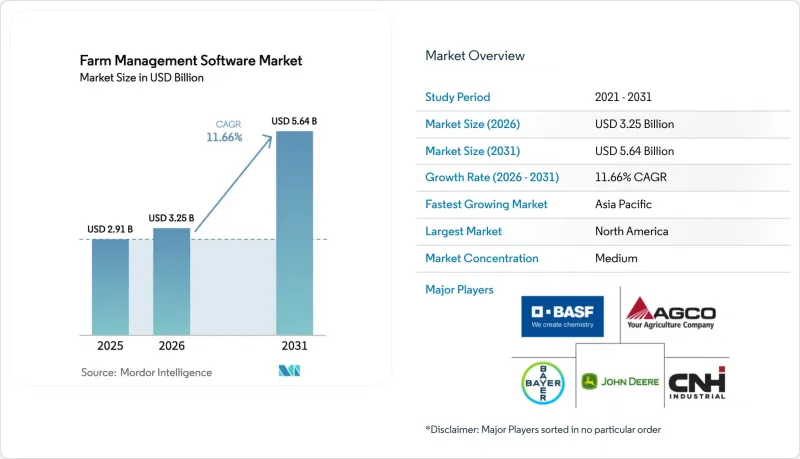
This report is Segmented by Type (Local/Web-based and Cloud-Based), by Application (Precision Farming, Livestock Monitoring, and More), by Farm Size (Smallholder Farms, and More), by Function (Planning and Resource Management, and More), by Delivery Platform (Desktop, and More), and by Geography (North America, Europe, and More). The Market Forecasts are Provided in Terms of Value (USD).
Global Farm Management Software Market Trends and Insights
Farm Labor Shortages and Aging Farmer Population
The average age of principal operators surpassed 58 years in the United States and 68 years in Japan in 2024, creating a knowledge gap that is driving digital adoption among new entrants who favor mobile-first tools. Seasonal labor availability in California's Central Valley declined by 22% between 2024 and 2025, prompting vegetable growers to adopt task-management modules that enable real-time crew allocation. In Europe, digital field journals have become mandatory for subsidy eligibility, requiring over one million farms to implement compliance-ready software by 2027. This transition has made software an operational necessity for farms exceeding 500 hectares, where manual oversight is no longer feasible. Labor shortages are increasing the demand for platforms capable of processing guidance data from autonomous tractors, ensuring traceability for operator-free tasks.
Decreasing Arable Land Driving Yield Optimization
Global arable land per capita is projected to decline to 0.19 hectares by 2025, increasing the need to enhance agricultural yields. In 2024, China lost 1.1 million hectares of farmland due to urban expansion, leading to the enforcement of mandatory precision nutrient management for subsidized grain producers. India's soil health card program now integrates laboratory results with geo-tagged recommendations, resulting in an 18% reduction in fertilizer costs and a 12% increase in yields in pilot districts. In the water-scarce Middle East, farms utilize scheduling algorithms that activate drip irrigation only when sensors detect a need, resulting in a 30% reduction in water usage in Saudi Arabia. In response, software vendors are incorporating crop models that simulate the effects of nutrient timing, seed density, and fungicide application intervals, transforming raw data into actionable insights.
Other drivers and restraints analyzed in the detailed report include:
- Rapid Integration of Precision Agriculture IoT Sensors
- Surge in Venture Capital Funding for Agricultural Software Scale-Ups
- Fragmented Smallholder Farm Ownership
- Interoperability Issues with Legacy On-Farm Hardware
For complete list of drivers and restraints, kindly check the Table Of Contents.
Segment Analysis
Cloud solutions accounted for 48.2% of the farm management software market share in 2025, establishing themselves as the leading deployment model in the market. The segment's compound annual growth rate (CAGR) of 12.8% reflects the appeal of improved connectivity and subscription-based pricing among both large and mid-sized operators. Local and web-based installations remain relevant, particularly in the United States and Europe, where large farms continue to express concerns about data sovereignty and latency. Hybrid edge architectures address these challenges by caching data on-site and synchronizing it when bandwidth permits, thereby enhancing vendor retention.
The flexibility of cloud solutions also supports geographic expansion, as Software-as-a-Service (SaaS) platforms reduce server maintenance costs for users such as Brazilian soy producers and Indian rice cooperatives. Bayer's FieldView expanded to 14 additional countries in 2025, demonstrating how multi-tenant architectures enable rapid scaling of features. With regulators increasingly requiring digital records, cloud solutions offer a straightforward path to automated compliance.
Large farms exceeding 500 hectares accounted for 40.2% of the farm management software market size in 2025, driven by economies of scale and the presence of in-house agronomic teams. These farms benefit from the adoption of advanced technologies, enabling efficient resource management and higher productivity. Their ability to invest in premium software solutions further strengthens their market position. Subsidized smartphone distribution in countries such as India and Kenya, combined with tailored freemium models, has helped lower financial barriers and foster digital adoption. This initiative has been instrumental in introducing technology to previously underserved regions, laying the groundwork for broader market penetration.
The fastest growth is projected from smallholder farms under 10 hectares, with a forecasted CAGR of 15.6%. Cooperative aggregation models, such as Safaricom's DigiFarm, have shown that bundled services, including weather alerts, advisory support, and microcredit, can increase yields by 15% within two growing seasons. Medium-sized farms present a moderate growth opportunity, often starting with modular point solutions before transitioning to comprehensive software suites. Vendors are increasingly adopting land-agnostic pricing models that decouple features from acreage, encouraging upgrades without disadvantaging smaller plots. The market share of farm management software for smallholders is projected to increase as governments direct subsidies toward this group to address food security and emission reduction objectives.
Complete Report Scope:
- By Type
- Local / Web-based
- Cloud-based
- Software as a Service (SaaS)
- Platform as a Service (PaaS)
- By Farm Size
- Smallholder Farms
- Medium Farms
- Large Farms
- By Application
- Precision Farming
- Livestock Monitoring
- Smart Greenhouse
- Aquaculture
- Other Applications
- By Function
- Planning and Resource Management
- Record Keeping
- Financial Management
- Inventory and Supply Chain Management
- Analytics and Reporting
- By Delivery Platform
- Desktop
- Mobile Applications
- By Geography
- North America
- United States
- Canada
- Mexico
- Rest of North America
- Europe
- Germany
- United Kingdom
- France
- Spain
- Italy
- Russia
- Rest of Europe
- Asia-Pacific
- China
- India
- Japan
- Australia
- South Korea
- Rest of Asia-Pacific
- South America
- Brazil
- Argentina
- Rest of South America
- Middle East
- Saudi Arabia
- United Arab Emirates
- Turkey
- Rest of Middle East
- Africa
- South Africa
- Kenya
- Nigeria
- Rest of Africa
- North America
Geography Analysis
North America accounted for 37.2% of the farm management software market share in 2025. In the United States, 68% of farms larger than 400 hectares deployed software, incorporating carbon-credit measurement tools as an additional income source. In Canada, the prairie provinces achieved a 16% reduction in nitrogen use across 14 million hectares by using variable-rate prescriptions. Mexico's protected agriculture sector enhanced water efficiency by 31% by integrating greenhouse controls with farm management dashboards. The region benefits from 82% rural broadband penetration, proximity to dealers, and widespread use of precision agriculture hardware. The market focus is shifting toward specialty crops, mid-sized growers, and livestock operators.
The Asia-Pacific region is projected to lead future market growth with a compound annual growth rate (CAGR) of 11.4%. In China, digital traceability is mandated for 80% of fruit and vegetable production. Japan's aging rice farming population has adopted drone scouting and autonomous tractors, resulting in a 35% reduction in labor requirements. In Australia, 22 million hectares of cotton and grain fields utilize satellite-driven irrigation systems, achieving a 28% reduction in water usage. South Korea's smart farm initiative is investing USD 450 million in subsidies for greenhouse and livestock monitoring, aiming to accelerate adoption among 12,000 producers by 2027.
Europe has captured significant revenue due to Common Agricultural Policy reforms, which require environmental metrics to be logged through compliant software. German arable farms have integrated nitrogen models to comply with fertilizer caps, resulting in an 18% reduction in surplus. In the United Kingdom, the Environmental Land Management Scheme has driven 78% software penetration among English farms. French vineyards have reduced their use of fungicides by 32% through the use of drone-guided spraying. South America has contributed to the market, driven by Brazilian soybean production and Argentine cattle farming. In contrast, the Middle East and Africa face challenges such as fragmented land tenure and limited connectivity. The region is poised for growth as satellite broadband prices decline, enabling broader adoption of farm management software.
- AGCO Corporation (Trimble Inc.)
- Deere & Company
- Bayer AG (Climate LLC)
- Farmers Edge Inc. (Fairfax Financial Holdings Limited)
- CNH Industrial N.V. (Raven Industries LLC)
- Topcon Corporation
- BASF SE (BASF Digital Farming GmbH)
- Corteva Agriscience (Granular Inc.)
- Conservis Corporation (TELUS Agriculture and Consumer Goods Inc.)
- AGRIVI Ltd.
- CropIn Technology Solutions Pvt. Ltd.
- Taranis Inc.
- Ag Leader Technology Inc.
- Eagle IoT (Bentley Systems)
- CropZilla Software, Inc.
Additional Benefits:
- The market estimate (ME) sheet in Excel format
- 3 months of analyst support
TABLE OF CONTENTS
1 Introduction
- 1.1 Study Assumptions and Market Definition
- 1.2 Scope of the Study
2 Research Methodology
3 Executive Summary
4 Market Landscape
- 4.1 Market Overview
- 4.2 Market Drivers
- 4.2.1 Farm labor shortages and aging farmer population
- 4.2.2 Decreasing arable land driving yield optimization
- 4.2.3 Rapid integration of precision agriculture IoT sensors
- 4.2.4 Government digital-agriculture incentives and mandates
- 4.2.5 Ultra-high-resolution satellite imagery proliferation
- 4.2.6 Surge in venture capital funding for agriculture software scale-ups
- 4.3 Market Restraints
- 4.3.1 Fragmented smallholder farm ownership
- 4.3.2 High upfront software, hardware and training costs
- 4.3.3 Interoperability issues with legacy on-farm hardware
- 4.3.4 Limited rural broadband connectivity
- 4.4 Regulatory Landscape
- 4.5 Technological Outlook
- 4.6 Porter's Five Forces Analysis
- 4.6.1 Bargaining Power of Suppliers
- 4.6.2 Bargaining Power of Buyers
- 4.6.3 Threat of New Entrants
- 4.6.4 Threat of Substitutes
- 4.6.5 Intensity of Competitive Rivalry
5 Market Size and Growth Forecasts (Value)
- 5.1 By Type
- 5.1.1 Local / Web-based
- 5.1.2 Cloud-based
- 5.1.2.1 Software as a Service (SaaS)
- 5.1.2.2 Platform as a Service (PaaS)
- 5.2 By Farm Size
- 5.2.1 Smallholder Farms
- 5.2.2 Medium Farms
- 5.2.3 Large Farms
- 5.3 By Application
- 5.3.1 Precision Farming
- 5.3.2 Livestock Monitoring
- 5.3.3 Smart Greenhouse
- 5.3.4 Aquaculture
- 5.3.5 Other Applications
- 5.4 By Function
- 5.4.1 Planning and Resource Management
- 5.4.2 Record Keeping
- 5.4.3 Financial Management
- 5.4.4 Inventory and Supply Chain Management
- 5.4.5 Analytics and Reporting
- 5.5 By Delivery Platform
- 5.5.1 Desktop
- 5.5.2 Mobile Applications
- 5.6 By Geography
- 5.6.1 North America
- 5.6.1.1 United States
- 5.6.1.2 Canada
- 5.6.1.3 Mexico
- 5.6.1.4 Rest of North America
- 5.6.2 Europe
- 5.6.2.1 Germany
- 5.6.2.2 United Kingdom
- 5.6.2.3 France
- 5.6.2.4 Spain
- 5.6.2.5 Italy
- 5.6.2.6 Russia
- 5.6.2.7 Rest of Europe
- 5.6.3 Asia-Pacific
- 5.6.3.1 China
- 5.6.3.2 India
- 5.6.3.3 Japan
- 5.6.3.4 Australia
- 5.6.3.5 South Korea
- 5.6.3.6 Rest of Asia-Pacific
- 5.6.4 South America
- 5.6.4.1 Brazil
- 5.6.4.2 Argentina
- 5.6.4.3 Rest of South America
- 5.6.5 Middle East
- 5.6.5.1 Saudi Arabia
- 5.6.5.2 United Arab Emirates
- 5.6.5.3 Turkey
- 5.6.5.4 Rest of Middle East
- 5.6.6 Africa
- 5.6.6.1 South Africa
- 5.6.6.2 Kenya
- 5.6.6.3 Nigeria
- 5.6.6.4 Rest of Africa
- 5.6.1 North America
6 Competitive Landscape
- 6.1 Market Concentration
- 6.2 Strategic Moves
- 6.3 Market Share Analysis
- 6.4 Company Profiles (includes Global Overview, Market-level Overview, Core Segments, Financials as Available, Strategic Information, Market Rank/Share, Products and Services, and Recent Developments)
- 6.4.1 AGCO Corporation (Trimble Inc.)
- 6.4.2 Deere & Company
- 6.4.3 Bayer AG (Climate LLC)
- 6.4.4 Farmers Edge Inc. (Fairfax Financial Holdings Limited)
- 6.4.5 CNH Industrial N.V. (Raven Industries LLC)
- 6.4.6 Topcon Corporation
- 6.4.7 BASF SE (BASF Digital Farming GmbH)
- 6.4.8 Corteva Agriscience (Granular Inc.)
- 6.4.9 Conservis Corporation (TELUS Agriculture and Consumer Goods Inc.)
- 6.4.10 AGRIVI Ltd.
- 6.4.11 CropIn Technology Solutions Pvt. Ltd.
- 6.4.12 Taranis Inc.
- 6.4.13 Ag Leader Technology Inc.
- 6.4.14 Eagle IoT (Bentley Systems)
- 6.4.15 CropZilla Software, Inc.
7 Market Opportunities and Future Outlook

